BlackRock Quantum Whitepaper: The Threat & The Hard Truth
Key takeaways:
Quantum computers could break current encryption within years, not decades. BlackRock confirms the timeline has accelerated.
The quantum threat
Shor's Algorithm can break Elliptic Curve Cryptography (ECC), the exact math securing Bitcoin and Ethereum digital signatures. A sufficiently powerful quantum computer could derive private keys from public keys visible on-chain.
Bitcoin's vulnerability
Approximately 35% of the Bitcoin supply (~7M BTC) is currently exposed:
• 1.9M BTC in P2PK/P2TR/P2MS addresses
• 5M BTC in addresses with reused keys
This creates two distinct attack vectors:
At-Rest: CRQC (Cryptographically Relevant Quantum Computers) can steal coins from the 35% of supply even if never spent.
On-Spend: All Bitcoin addresses become vulnerable during the 10-minute mempool window of a transaction.
Quantum is advancing fast
• Google has moved its encryption migration deadline to 2029.
• IBM targets large-scale, fault-tolerant quantum systems by 2029–2033.
• Recent breakthroughs in error correction have pulled timelines forward significantly.
The migration crisis
Governments plan full migration by 2035, BlackRock notes that while technically feasible, coordination is the bottleneck. It requires multi-year timelines that legacy chains simply may not have.
Legacy chain problems
• Bitcoin: Development is relatively decentralized and there is no current consensus on PQ encryption/signature schemes, migration timelines, and the optimal specific implementation mechanisms.
• Ethereum: Requires seven upcoming network updates/hard forks (2026–2029) with massive complexity due to Proof-of-Stake and smart contracts.
• Ecosystem: Exchanges, custodians, and validators must simultaneously upgrade hardware, software, and policies.
Why QANplatform, the post-quantum blockchain wins
We built quantum-resistant cryptography as our foundation, not as a retrofit. No consensus chaos. No 35% of supply at risk. Already defended from day one.
The bottom line
BlackRock states that upgrading cryptographic systems is easier than building a quantum computer. However, they also admit migration is coordination-heavy and slow, while quantum timelines have accelerated to within years.
We don't face this dilemma. We are already secured.
Q-Day favors the future-proof.
"QAN is not competing with Ethereum. QAN is extending Ethereum"
A community member created this visual from recent updates.
Innovation for Quantum migration solutions 💥
$QANX $QRL $ABEL $CELL $MCM $XX $NXS $ALGO $HBAR $TRX $USDC $BTC $ETH $ADA $SOL $XRP $IONQ $RGTI
Two tech giants. One timeline: 2029.
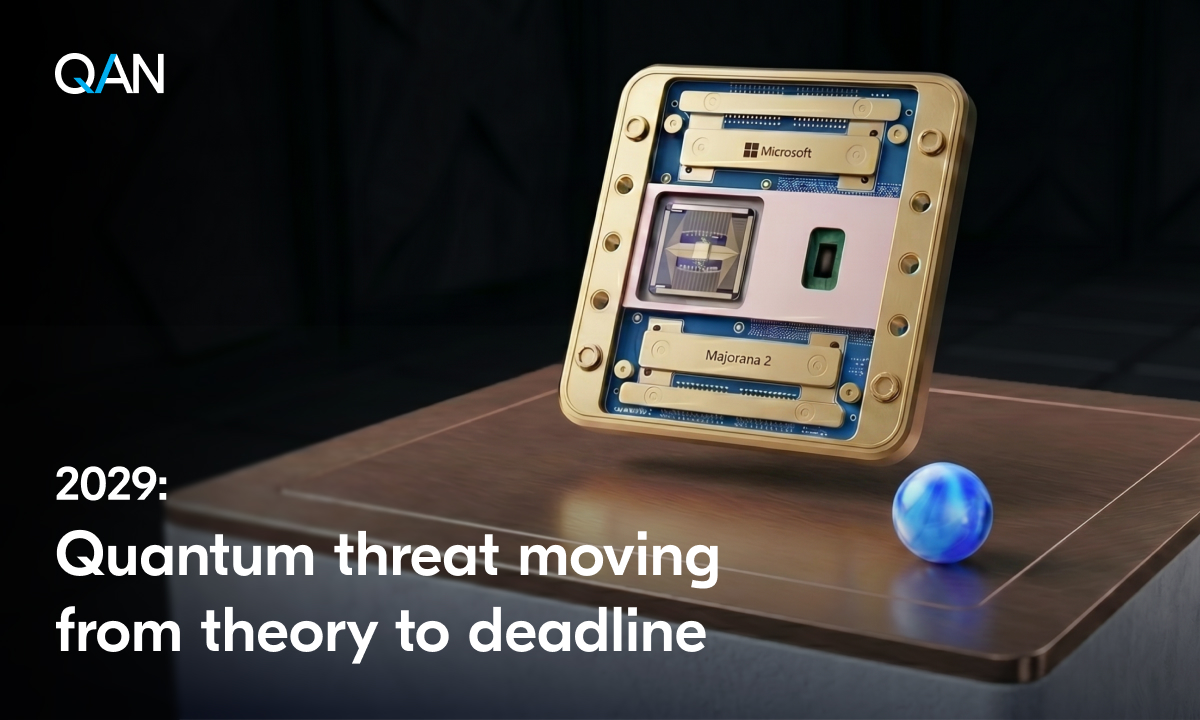
Microsoft just unveiled Majorana 2: topological qubits that last 20 seconds (vs. 1-12 milliseconds in Majorana 1).
That improvement is roughly comparable to inventing a phone battery that instead of dying in a day could last for nearly three years on a single charge.
That's a 1,000x reliability leap, built with agentic AI.
Their practical quantum computer target? 2029, the original timeline cut in half.
Google independently set the same year as its internal deadline to complete PQC migration across all systems, warning that quantum computers could break current encryption before the decade ends.
When Microsoft AND Google converge on 2029, that's not a prediction. That's a countdown.
Every blockchain still running on legacy cryptography needs to ask: are you quantum-safe?
The migration window is closing.
Most #CryptoEcosystem fail because they wait for activity BEFORE building infrastructure
Real growth happens in reverse:
✅ Infrastructure→ Devs
✅ DApps→ Users
Qanforge is a launch layer for qanplatform:native
🔹 Tokens + Liquidity
🔹 Distribution + Onboarding
🔹 All in ONE flow
Lower friction → More buidlers → More liquidity → Flywheel spins
BUIDL infrastructure BEFORE scale, not after.
$BTC $ETH
March Milestones: New QAN XLINK Release, TestNet Fixes, and Status Page
This month's update highlights the release of a refined QAN XLINK Beta version with a smoother user experience, alongside essential TestNet fixes. We've also taken steps to increase transparency with our new public Status Page and addressed documentation gaps to make integration easier for developers.
Read the full recap on our blog, link in the comments 🔗👇
We've shipped a new version of the QAN XLINK desktop app.
Download it from our website! 💻
Here's what we updated based on your feedback:
- refined the UX with targeted improvements for a smoother, more intuitive experience
- resolved a bug affecting account visibility within the app
- expanded the user guide with greater detail and clearer step-by-step guidance
Test it and let us know what you think.
Link to the download page in the comments 👇