Hey everyone!
I am on X to bring awareness to "The Fix for Capitalism" plan that I have proposed to help us address the root cause of the biggest problem that we face as a society.
Greed.
Greed is the underlying problem that destroys societies.
Why has communism historically failed? "Rules for thee and not for me" which comes back to greed.
The people who are in charge, or are in the favor of those in charge, are the only ones who manage to do well in communist societies.
Socialism fails into this same trap.
Our current version of crony capitalism is just as guilty. The saving grace for capitalism is the meritocratic nature that allows people to potentially get ahead. However, there is significant exploitation that is rewarded in our current capitalist society.
We need to save the meritocratic nature while applying limitations on the damage that is done by the greedy nature. Or as I like to say, we need to capitalize on capitalism.
I have proposed a solution that includes 8 steps to correct this problem, "The Fix for Capitalism".
I invite you to continue this thread to learn more and I also invite you to join our peaceful protest to bring awareness to the plan. Just simply "Pause for the Cause" and don't spend money at any corporate owned businesses on the 8th, 18th or 28th of each month. Instead choose to shop local and support small business on those days.
What we need is The Fix for Capitalism, which is a comprehensive set of reforms designed to restore balance to the economic system.
It targets unchecked disparity as the root cause of exploitation, instability, and issues like the AI driven layoff trap. The plan eliminates the existing complex tax code and minimum wage, then introduces targeted, self adjusting mechanisms that preserve market incentives while adding natural checks.
Core Components of the Plan
Maximum Disparity Income Tax:
Personal income tax rates tie directly to the ratio of your income to the lowest paid worker in the full business chain. The lowest paid pays 1 percent. Higher earners pay a multiple of that (your income divided by the lowest wage, times 1 percent). This automatically scales with disparity and rewards companies that raise the floor.
Corporate Tax:
A flat rate applied to all wages paid by the company. This encourages efficient labor use while aligning business costs with workforce investment.
Corporate Real Estate Ban and Exponential Property Taxes:
Corporations cannot own real estate and must lease from individuals. Real estate taxes start at a base rate (for example, 1 percent on the first property) and double for each additional property or equivalent acreage. This makes large scale hoarding extremely expensive without banning ownership outright.
Additional elements include new capital gains and import tax rates, plus transparency rules for political ads and laws. The overall framework removes loopholes and focuses on equality of opportunity rather than forced outcomes.
How It Addresses Key Concerns, Including the AI Layoff TrapThe theoretical model in "The AI Layoff Trap" shows competitive firms over automating because they capture full cost savings from replacing workers but share only a fraction of the resulting demand drop. This creates a self reinforcing cycle of layoffs and falling consumer spending. The plan counters this through multiple layered incentives.
First, the disparity income tax makes extreme wage gaps costly for owners and executives. By tying top tax rates to the ratio between highest and lowest compensation in the full business chain, companies face strong pressure to raise the wage floor. While replacing the absolute lowest earners with AI may compress the ratio (and temporarily lower top tax rates), the overall structure still penalizes maintaining a large spread between top and bottom. This gives companies meaningful incentive to retain workers, raise base wages, invest in human-AI hybrid roles, or share productivity gains more broadly — all of which help preserve employment, income, and consumer spending power.
Second, the corporate wage tax and real estate rules raise the effective cost of hyper scaling automated operations. Firms cannot own vast facilities cheaply for pure automation plays. They lease from individuals who face exponential taxes on multiple holdings. This limits winner take all growth, reduces extreme competitive pressure, and distributes property income more broadly to sustain demand.
Together, these elements blunt the Prisoner's Dilemma dynamic. Firms still pursue efficiency, but the system favors balanced automation over race to zero human employment. Consumer demand holds up better because more people stay employed and gain access to asset derived income. Short term adjustment pains, such as initial restructuring, may occur, but long term adaptation leads to greater stability.
Broader Benefits and Philosophical Fit
The plan keeps capitalism intact by rewarding effort and innovation while preventing extreme concentration. It avoids heavy bureaucracy like per task automation taxes, relying instead on simple, verifiable metrics (payroll ratios and property counts) that self enforce. It promotes local business, reduces monopolistic tendencies, and addresses related issues such as housing affordability through the exponential curve. In essence, The Fix for Capitalism provides a market friendly way to internalize externalities around disparity and asset hoarding. It directly mitigates risks like the AI demand collapse by aligning private incentives with societal resilience, fostering a more sustainable and hopeful economic future.
#PauseForTheCause
@elonmusk They hate what they cannot control...
A totalitarian regime's sole focus is absolute control. Anything that prevents or goes against that control must be destroyed for them to obtain the object of their desire.
I for one, do not intend to give up my freedom.
#IStandWithElon
@benjaminbranham Check out https://t.co/t8BMXnr8zh and join our peaceful protest to bring awareness to "The Fix for Capitalism" plan that addresses this issue.
💰 I watched someone spend $3,500 on a 9"x12" pan of fried pies this weekend.
That's absurd, right? 🤷
It was for charity... But still absurd.
The reason it's absurd is because we have people at the top of the wealth brackets who are able to drop this much money on some fried pies, while others struggle just to make ends meet.
This is symptomatic of a broken system.
One hurdle we face is a disagreement on how to fix the problem.
👈 The left commonly advocates for a living wage.
What is a living wage?
This term is thrown around today to describe the minimum wage needed to truly participate in society.
This amount varies based on where you live.
The state and federal minimum wage amounts are, quite often, not sufficient enough to meet these needs. So why do we even have them?
They're used as a benchmark for the lowest amount you can legally get away with paying your employees. 👇
This is important when a society bases everything on profits. The employees who make minimum wage don't ever see these profits. They are often even viewed as a barrier to generating more profits.
"How can we squeeze out more profits from the business to enrich the lives of the shareholders?"
This usually comes in the form of placing significant workloads on low paid employees. While paying other low paid employees a slightly higher amount to keep the others on task. The primary focus is making sure that the profits continue to enrich the lives of the people at the top. 👑
When the federal/state minimum wage is raised, it causes profits to drop, due to the increased cost of labor. The response by the businesses is to raise prices of goods and services to reflect the new cost of labor. This is why raising the minimum wage is ineffective at addressing this problem.
This is treating a symptom of the problem versus the root cause.
👉 The right commonly wants to address the issue with less regulations. While this seems, on paper, to help reduce some of the associated costs with business operations. The most likely result is less favorable conditions for workers and any increase in profits continuing to enrich the people at the top.
The current system is designed for all profits to flow up to the top, so most changes will not have any meaningful impact. 🚫
This is why you have people advocating for things like Marxism. Yet, they can't seem to even agree on what that would look like in practice. I think capitalism is a better system, but it's currently just broken.
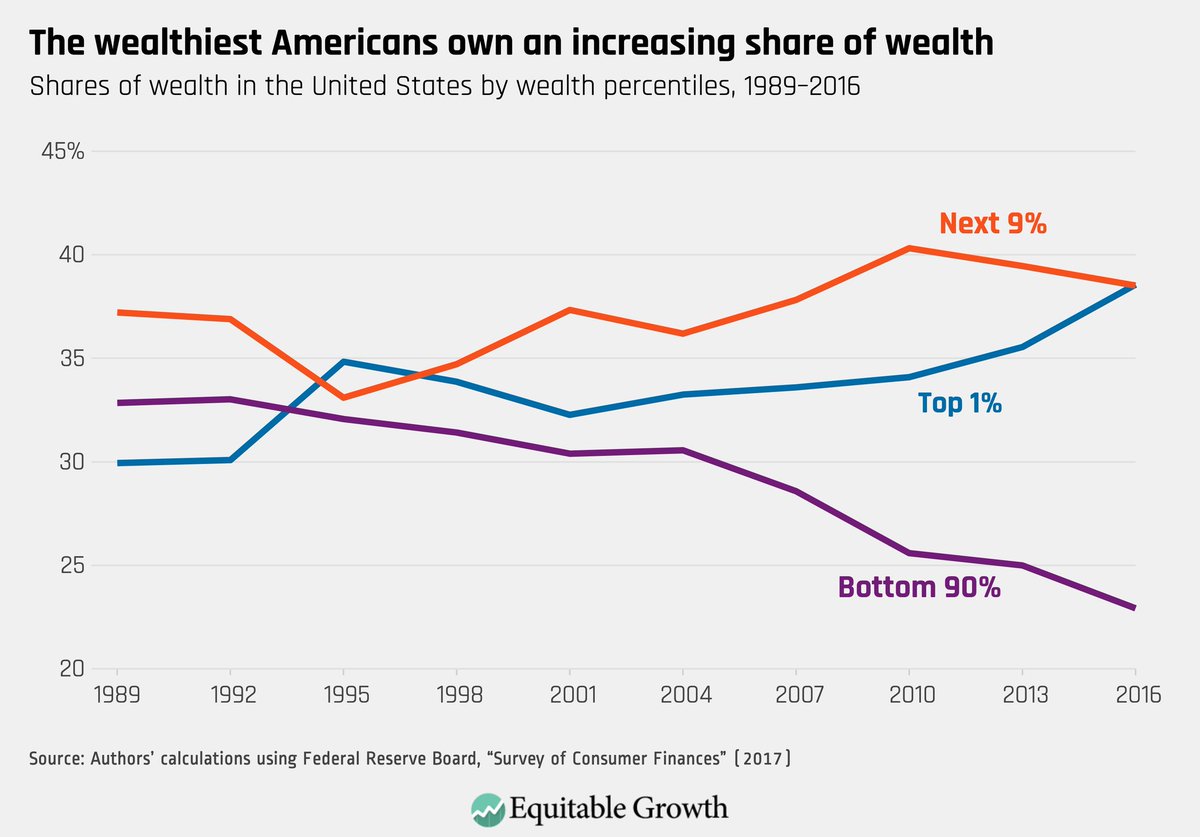
The economic disparity is exponentially growing. The CEO to typical employee pay in 1965 averaged around 20:1. In 2022 that number had grown to 399:1. 📈
The bottom half of earners in the US only get about 2% of the total earnings, this is a pretty good indicator of how skewed the system really is.
I know how I would fix the problem and where I stand on the issue, but I want to hear from you on your thoughts.
🤔 Where do you stand?
How would you address this issue?
What type of discussions would you like to see surrounding it?
@WallStreetSilv It always come to greed... Power is the typical object of their greed.
They want to collapse the dollar to force the change.
Check out my post about MMT if you are unaware...
https://t.co/9U1HJ6NY7e
Dr. Carson, I hate that the vote comes down to the lesser of two evils.
I do not care for Trump. I think he is arrogant, narcissistic and very immature.
However, I really worry that our country cannot survive another 4 years on our current path.
I believe that Kamala will continue to lead us astray and will finish bankrupting our country and then proceed to give control over to the IMF in the form of a global currency. Then we will no longer have sovereignty as a country and be subject to rules and regulations of a foreign entity.
I do not see this ending favorably for us...
We need a true systemic change for society.
It's the 8th! Pause for the Cause!
Join our peaceful protest to bring awareness to "The Fix for Capitalism" and avoid spending any money at corporate owned businesses on the 8th, 18th and 28th of each month.
Let's make a better tomorrow for all of us!
What is your favorite local small business that you visit?
Show them some love today.
Avoid spending money at any corporate owned businesses on the 8th, 18th and 28th of each month.
#pauseforthecause
So many people don't understand how controlled this world really is...
Free speech is imperative and necessary for what is to come.
𝕏 and Rumble are on the right side of this fight, but we have to fix the foundation of the system before any true change can happen.
It's all about power. Greed is the underlying cause of the majority of the issues that we currently face as a society.
Join our peaceful protest to bring awareness to "The Fix for Capitalism" and help us make a better tomorrow for everyone.
Wake up!
This is a major issue.
How bad does it have to get?
We must make a change for the sake of our future generations.
There is a solution.
Join our peaceful protest to bring awareness to "The Fix for Capitalism" plan and shop local on the 8th, 18th & 28th each month.🧵
@benjaminbranham@POTUS Check out https://t.co/t8BMXnr8zh to see The Fix for Capitalism proposal and join our peaceful protest!
Help us make a better tomorrow for all of society!
Supporting small accounts is something that a lot of people can understand. They can see how it benefits the masses and not just the already established large and corporate accounts. 🤔
This is a good parallel to society and businesses. When we support each other, we can all win. However, if we only support the large accounts/businesses then they will continue to dominate and have full control.
For a moment, think about the influence and reach that large accounts have, now apply that same logic to businesses. If a very large account continuously promotes and engages with a specific account, then that account is likely to grow... Even if their content is subpar engagement farming and mostly overly used memes. 💩
This happens in the business world too. Take a look at the picture I posted, you can see all of the different brands that are really just subsidiaries to these much larger companies. These larger companies have control over most things. They even use lobbyists to help control our government... They prop up candidates who will look out for their best interest.
This type of behavior is not a net add for society. The concentration of wealth and power allows this to continue to happen. Big corporations regularly buy out small businesses that they see as a threat to the status quo.
Free speech is something that they find threatening to the status quo, this is why there has been such a large push for censorship and against Elon's advocacy of free speech. 📢
I'm not big on just complaining, I am the kind of person who identifies a problem and then comes up with a solution to the problem. The root cause of this issue is greed. The people who are in control want more control and do not want to lose it. Money is the way they exert their power.
I have released a proposal called "The Fix for Capitalism" and it centers around eliminating the entire current tax code and getting rid of all the loopholes and deductions that have been added over the years. Then implementing a new income tax that uses the lowest paid employee's salary, within each business chain, to determine the tax rates for everyone else in the chain. 🔗
This change will help keep the economic disparity from continuing to widen as fast as it has been through the years. For example, in 1965 the CEO to typical employee pay in averaged 20:1. That number had grown to 399:1 by 2022... This gets corrected with my proposal, however it still allows for the meritocratic nature of capitalism to thrive.
If you would like to check out the rest of the proposed plan, I'll post a link in the replies or you can go to pauseforthecause . com.
Speaking of "Pause for the Cause", if you have read this post and want to help bring awareness to this issue and proposed solution, then join our peaceful protest. Pause your spending at corporate owned businesses on the 8th, 18th and 28th of each month.
Shop local on those days, support small businesses. Let's all win together. We can make a difference, we can help make a better tomorrow for all of us. 🎉
Share this message with your friends and family. RP or QP and help spread the word.
Today is probably my favorite day of the year.
8/8
The number 8 means a lot of things to a lot of different people.
• In Chinese 🇨🇳 culture, the number 8 is considered very lucky because it sounds similar to the word for "prosper" or "wealth."
• In the Bible , the number 8 is associated with new beginnings and resurrection ✝️ (e.g., Jesus rose from the dead on the 8th day).
• In Hinduism 🕉️, the god Shiva has 8 forms, and there are 8 types of wealth in the Vedas.
• In Buddhism ☸️, the Noble Eightfold Path consists of 8 steps to enlightenment .
• In the Jewish tradition, the number 8 represents superabundance and is associated with the festival of Hanukkah 🕎, which lasts for 8 days.
• The symbol for infinity - ♾️ , resembles a sideways 8 and represents endlessness or the infinite.
It's no coincidence that there are 8 steps in "The Fix for Capitalism" plan that I have proposed.
If you are unfamiliar with the proposal, there is a link in my bio and I'll link to it in a reply below.
I invite you today, to join our peaceful protest and to Pause for the Cause! On the 8th, 18th and 28th of each month just avoid spending any 💰 at corporate owned businesses. Instead, shop local and support small businesses.
Share this message with your friends and family. Follow me and @PFTCOfficial.
Help us bring awareness to "The Fix for Capitalism" so we can build a better tomorrow for all of society.
Pause for the Cause! Join our peaceful protest to bring awareness to "The Fix for Capitalism" plan!
Help us usher in a new era.
Let's make a better tomorrow for all of society!
The problem is that the state of society gives people a reason to even consider Marxism....
We have two "extreme" positions.
On the left we have a society completely under control by the government with forced equity for the masses, while the people in charge live extravagantly...
Then on the right we have a society that is under rule of corporations and the masses have a chance at a "better" life if they fall in line and submit to the will and rule of corporations, while the people in charge live extravagantly...
Why do we allow the uniparty to do this?
It's all about control, it's our greedy human nature.
The answer is not to the extreme in either direction. However, as long as they can keep the masses divided, they will keep everyone fighting amongst each other.
When will people wake up?
When will we learn?
There is a better option...
💯 Capitalism has the ability to help raise the standard of living while providing a meritocratic way of improving your living standards...
So why have we allowed corporations to establish monopolies and siphon the majority of wealth to the hands of a few? 🤔 In the name of capitalism? That's 💩.
Greed is the underlying cause of the majority of problems with our society. Power is the ultimate target of that greed. Money is just the 🔨 used to obtain power.
The meritocratic nature of capitalism is the best part of the system. This is the positive driving force that is missing from a system like communism.
The problem is the more consolidated that wealth becomes, the less impact the meritocratic nature has for an individual.
With corporations growing in size and devouring the competition, they are able to strong arm small businesses and governments into a less favorable outcome for "We the People".
Consolidation of wealth and power is never a good thing for the masses...
A lot of people celebrate diversity, while trying to eliminate diversity of influence. If your idea of diversity is limited to the color of someone's skin or sexual preference, then you are likely a part of the problem.
Equity is not diversity. Equal outcomes is not diversity.
Currently, the only equal outcome that we are heading towards is the consolidation of wealth by the 0.01% and the inability for anyone to ever break through the classes again.
This is a major problem. This is the biggest threat that we currently face as a society. The people who are in charge will do anything and everything they can to avoid losing that power.
We the people deserve better than this...
We the people are the only ones who can do something about it...