I am a pro-constitution, bill of rights, founding father's principles, limited government, free-market capitalist, conservative libertarian populist supporter
https://t.co/ebndxjEGep.
“For nearly two centuries the United States has been an expansionist power. Though it was the War of 1812 when the U.S. solidified its dominion over the Americas, it was at the twilight of the Spanish-American War when the American Empire finally came of age. The first two decades of the 20th century marked America’s transition — for better or worse — into a global superpower.
By the end of the First World War, the United States had solidified itself as an emerging global power until finally asserting itself as the world’s dominant ascendancy in the aftermath of World War II. From 1945 and over the course of the next fifty years, the U.S.’s sphere of influence would continue to expand its global network of military installations in order to curtail Soviet influence. Now, nearly three decades following the USSR’s collapse, there are still 800 formal U.S. bases across eighty countries worldwide. Not only is this unacceptable, but it is also needlessly wasteful. Since 2001, close to $6 trillion has been spent on wars in Syria, Iraq, Afghanistan and Pakistan alone. The utility of the empire’s foreign military infrastructure is simply not worth the cost required to sustain it; therefore, the number of bases worldwide should be strategically reduced to only those installations that are essential to defending the homeland and protecting international commerce.
Though the USSR no longer threatens liberal hegemony, U.S. foreign policy is still rooted in a Cold War mindset. While an official plan for base realignment and closure was presented in the 1990s under President Bill Clinton, only a select few installations were shut down; most were simply repurposed and assigned to deter other perceived threats to U.S. primacy. However, very few of these installations actually do much to help secure the homeland. In fact, this was not even their original intended purpose! They were designed to defend liberal hegemony, which is no longer the centralized bloc it once was. While American primacy may have made logical sense in the post-war era, in order to halt the spread of communism (although that too has been subject to debate), there is no longer any practical need for the extent of its power to be so expansive.
Today, the single largest concentration of U.S. foreign bases is located within the eurozone, where there exist roughly 300 military installations. Since 1942 the U.S. has maintained a permanent presence in Europe and, after the Second World War, played a significant role in stabilizing the continent, which would go on to serve as the key focal point for NATO. Since then, the EU has become incredibly self-sufficient; the combined European armed forces and nuclear arsenals are more than capable of deterring potential threats without the need for U.S. assistance. Every major European nation is wealthy enough to afford its own defense. It is therefore strategically useless for the U.S. to maintain such a gargantuan military presence in the EU, whose members are already among America’s closest allies.”………….
-link to full article:
https://t.co/E0AZL9n2ee.
“Why is the price of gold rising if the global economy is not in recession and inflation is allegedly under control? This is a question often heard in investment circles, and I will try to answer it.
We must begin by clarifying the question. It is true that inflation is slowly decreasing, but we cannot say that it is under control. Let us remember that the latest CPI data in the United States was 3% annualized and that in the eurozone it is 2.6%, with eight countries publishing data above 3%, including Spain.
This is why central banks need to give the impression of hawkishness and maintain rates or lower them very cautiously. However, monetary policy is far from being restrictive. Money supply growth is picking up, the ECB maintains its “anti-fragmentation mechanism,” and the Federal Reserve continues to inject money through the liquidity window. We can say, without a doubt, that monetary policy is beyond accommodative.
At the end of this article, the price of gold is above $2,400 an ounce, up 16.5% between January and July 19, 2024. In the same period, gold has performed better than the S&P 500, the Stoxx 600 in Europe, and the MSCI Global. In fact, over the past five years, gold has outperformed not only the European and global stock markets, but also the S&P 500, with only the Nasdaq surpassing the precious metal. This is a period of alleged recovery and strong expansion of the stock markets. On the one hand, the market is discounting the central banks’ continued accommodative and expansionary policies, even possible high debt monetization, given the unsustainable deficits in the United States and developed countries. That is, the market assumes that the Federal Reserve and the ECB will not be able to maintain the reduction of their balance sheets in the face of rising debt and public spending in many economies. As a result, gold protects many investors against the erosion of the currency’s purchasing power, i.e., inflation, without the extreme volatility of Bitcoin. If the market discounts further monetary expansion to cover the accumulated deficits, it is normal for the investor to seek protection with gold, which has centuries of history as an alternative to fiduciary money and offers a low-volatility hedge against currency debasement.
Another important factor is the central bank’s purchase of gold. JP Morgan is credited with the phrase “gold is money and everything else is credit.” All the world’s central banks include treasury bonds from countries that serve as global reserve currencies in their asset base. This allows central banks around the world to try to stabilize their currencies. When we read that a central bank buys or sells dollars or euros, it is not making transactions with physical currency but with government bonds. Hence, as the market price of government bonds has fallen 7% between 2019 and 2024, many of these central banks are facing latent losses from a slump in the value of their assets. What is the best way to strengthen a central bank’s balance sheet, thereby diversifying and reducing exposure to fiat currencies? Purchase gold.”
The rising purchases of gold by central banks are an essential factor justifying the recent increase in demand for the precious metal. Central banks, especially in China and India, are trying to reduce their dependence on the dollar or the euro to diversify their reserves. However, this does not mean full de-dollarization. Far from it.”…..
-link to full article!:
https://t.co/9Acc6azKBH.
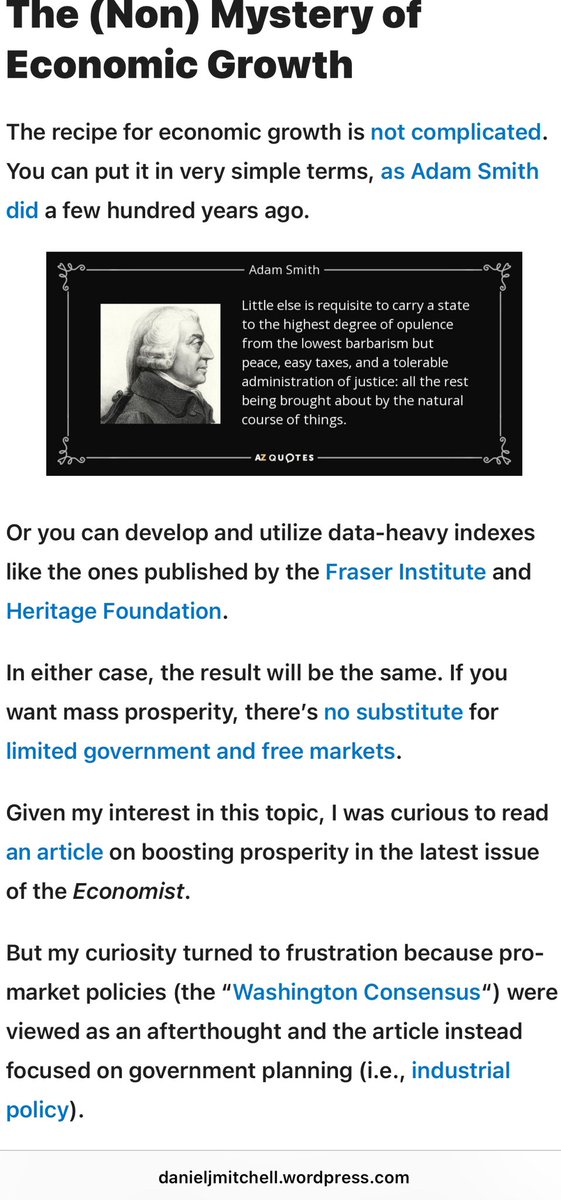
“The recipe for economic growth is not complicated. You can put it in very simple terms, as Adam Smith did a few hundred years ago.

Or you can develop and utilize data-heavy indexes like the ones published by the Fraser Institute and Heritage Foundation.
In either case, the result will be the same. If you want mass prosperity, there’s no substitute for limited government and free markets.
Given my interest in this topic, I was curious to read an article on boosting prosperity in the latest issue of the Economist.
But my curiosity turned to frustration because pro-market policies (the “Washington Consensus“) were viewed as an afterthought and the article instead focused on government planning (i.e., industrial policy).
By 2050 there will be a new crop of economic powers—if things go to plan. Narendra Modi, India’s prime minister, wants his country’s GDP per person to surpass the World Bank’s high-income threshold three years before then. Indonesia’s leaders reckon that they have until the mid-century mark…to catch up with rich countries. …These…all have something in common: breathtaking ambition.

…Very few countries have maintained such growth for five years, let alone for 30. Nor is there an obvious recipe for runaway growth. To boost prosperity, economists typically prescribe liberalising reforms of the sort that have been advanced…under the label of the “Washington consensus”. …the three strategies employed by countries looking to get rich—leaping to high-tech manufacturing, exploiting the green transition and reinventing the entrepot—all represent gambles, and expensive ones at that. …a certain amount of state involvement in the process is inevitable, and that policymakers will have to pick some winners. Even so, governments are now intervening much more frequently. Many have lost patience with the Washington consensus.
At the risk of understatement, the countries discussed in the article (India, Indonesia, Saudi Arabia, etc) will never become rich for the simple reason that they generally have bad economic policy.
And to the extent they waste taxpayer money trying to pick “winners,” their bad policies will become worse policies.
The article included a chart about rare growth miracles, but there were two big problems with the chart. First, there was no explanation of why South Korea grew faster than China, Nigeria, and Ghana. So I added the economic freedom rankings to show that South Korea has pro-market policies compared to the other nations.

My second concern is that I don’t view South Korea as a “growth miracle.”
Yes, it has done well compared to the other nations. And you could say it is a miracle compared to the disaster of North Korea.
But the Economist should have used Singapore as their example of “how to get rich.” As you can from this chart, South Korea has enjoyed decent growth, but there’s very little chance it will ever catch the United States.
Singapore, by contrast, already has eclipsed the United States.

Singapore is the real “growth miracle.” And it is no coincidence that it also ranks #1 for economic freedom.
In other words, it is possible to avoid the “middle-income trap,” but it only happens rarely because politicians are not will willing to stand aside and let markets work.”
“I have conventionally libertarian views on immigration, but with a couple of caveats.
▪The immigration system should be especially welcoming
▪to people who are likely to increase the country’s per-capita economic output.
▪On the flip side, the immigration system should be very unwelcoming for people who want to get government handouts.
▪Refugee laws should be immediately reformed to minimize the likelihood of trapping people in long-run government dependency.
In short, I want people with high levels of societal capital (work ethic, spirit of self-reliance, western values, etc).
Which is why a story about Germany caught my attention. James Jackson reported for the U.K.-based Telegraph that a German district is cutting handouts for migrants who refuse to help their community.
Germany has cut the benefits of asylum seekers who refused to pick rubbish in the aftermath of heavy flooding in east Germany… Local authorities in the state of Saxony-Anhalt wrote to a group of 64 asylum seekers, demanding they help clear debris and erect dykes for a fee of 80 cents (68p) an hour. …Only 39 went to help… Now the district council has ruled that the 15 who had no excuse not to take part will have their asylum benefits cut in half to €232 (£195) a month for three months. Mamad Mohamad, from the migrant network Lamsa, criticised the court’s decision, suggesting the work order was exploitative. …Opposition politicians said those who refuse work should be sent back home.
At the risk of sounding Trumpian, I agree with the opposition politicians. Migrants who come to a country should not be getting any handouts in the first place.
And if they refuse to do something in exchange for handouts, their freebies should be taken away and they should be put on the first-available plane to their home nations.
P.S. There’s compelling evidence from Sweden that government handouts for migrants are a recipe for government dependency.
P.P.S. It’s probably a very safe idea to allow free immigration from nations with very generous welfare states.”
https://t.co/PkhfDlTilJ
https://t.co/IaziLMVRxg.
“In what George Washington University law professor and constitutional expert Jonathan Turley calls "the most dangerous movement in our history," Americans more and more are starting to believe in radical censorship of speech.
At this point, polling shows that more than half say the First Amendment goes too far in protecting free speech and there's even a movement afoot to change that constitutional protection so that people have the right to speak, but also have the right "to be shut up."
In an online column he notes he addresses the "global anti-free speech movement" in his book, "The Indispensable Right: Free Speech in an Age of Rage."
"It is in my view the most dangerous movement in our history due to an unprecedented alliance of government, corporate, academic, and media forces. That fear was amplified this week with polling showing that years of attacking free speech as harmful has begun to change the views of citizens," he explained.
It's all the rage in academia, he said, so it now is "not surprising to see the new Knight Foundation-Ipsos study revealing a further a decline in students' views concerning the state of free speech on college campuses. The study shows that 70 percent of students 'believe that speech can be as damaging as physical violence.' It also shows the impact of speech codes and regulations with two out of three students reporting that they 'self-censor' during classroom discussions."
Nearly two out of three on campus say, "[t]he climate at my school or on my campus prevents some people from saying things they believe, because others might find it offensive."
And worse, where it used to be 78% a few years ago, now only 54% of students say colleges should allow students to be exposed to speech even if its "offensive."
And, he noted, the Foundation for Individual Rights and Expression found 53% of Americans believe that the First Amendment goes too far in protecting rights."
Forebodingly, 40% now "trust" the government to censor speech.
"We have created a generation of speech phobics who are willing to turn their backs on centuries of struggle against censorship and speech codes," he noted.
Leaders of the movement include University of Michigan law professor Barbara McQuade who has called free speech the "Achilles Heel" of the nation, and Joe Biden, who has claimed corporations that don't censor are "killing people."
It is Mary Anne Franks, of George Washington University, who is pushing for a rewrite of the First Amendment, so that would demand speech conflicts "be resolved in accordance with the principle of equality and dignity of all persons."
But he explained Antifa has been one of the "most dangerous" censorship groups around.
"Antifa continues to attack those with opposing views and anti-free speech allies continue to 'deplatform' speakers on campuses and public forums. 'Your speech is violence' is now a common mantra heard around the country. Faculty continue to lead students in attacking pro-life and other demonstrators."
In fact, he cited one Antifa activist whose ideology is: "You have the right to speak but you also have the right to be shut up."
“Political language is designed to make lies sound truthful and murder respectable, and to give an appearance of solidity to pure wind.” — George Orwell
Keep the above quote near you at all times and it will serve as a reminder decipher political speech whenever you see or hear it.
Political speech contains magical properties. It mesmerizes the masses because it is more illusory than a David Copperfield grand finale. It has even ensorcelled the Supreme Corrupt, which validated the law giving incumbent politicians’ the power to regulate political speech.
You haven’t heard of this, you say? It goes by another name, as all political speech does. It’s called “campaign finance reform” which banned like-minded voters from pooling resources to buy TV or radio ads which dare to criticize incumbents within 60 days of an election.
Conservative columnist George Will rightly lamented at the time, “The First Amendment [right of free speech] is now permanently in play, its protections to be truncated whenever congressional majorities envision short-term partisan advantages.” Unleashed by the Supreme Court to regulate political speech, bureaucrats beholden to incumbent politicians and the congressweasels themselves will surely propose new reforms that further empower political speech at the expense of free speech.
This is why political speech is dangerous. While it sounds innocuous, it is as deadly as a bear trap hidden beneath the leaves or a siren singing her song. It can grab you suddenly, or it can ensnare you subtly. Either way, you learn too late that you have been conned and there is no escape.
The magic of political speech is not happenstance. There are change agents at work in the inner sanctums of power whose job it is to create special words and phrases that are used in political speech. Those words and phrases are repeated over and over by the elites in order to dumb us down and create a conditioned response.
Beware of ‘Talking Points’!
The process of dumbing down and the conditioning of the mind to create a nation of good, obedient subjects loyal and subservient to political authority and to the legitimacy of the political order begins early on.
We are now several generations into the plan by the elites to create a Nation of state-worshiping ignoramuses taught pseudo-history and inculcated with a loyalty to and dependence upon big government. For many — if not most — of the nation’s young people below the age of 30, government provided them with most of their meals while the majority of their days were spent submitting to government authority figures (teachers/principals/school officers) in rigid, structured environments that dissuade original thought.
Also aiding the elites and politicians in this effort is an army of “journalists” who never stray far from the official line of the state apparatus. They are eager to spread their lies and half-truths because that ensures them their seats near the halls of power. On that rare occasion one of them strays too far from the party line, retribution is swift and harsh (see Helen Thomas and Sharyl Attkisson). This discourages dissent.
Politicians have learned that the more lies they tell, the more lies we believe. And the more lies we believe, the more dependent we become. Conversely, the fewer myths, lies and deceptions we succumb to, the less dependent we are and, therefore, the more liberty we enjoy.
I long ago learned the power of propaganda. I have watched as otherwise intelligent and thoughtful people have had their minds so manipulated by political speech that they acted contrary to their own best interests without a second thought.
It seems that organized and sophisticated propaganda is able to operate outside the threshold of intelligence. In other words, without some imperative to trigger inquiry, very intelligent people buy into lies and myths the same as the general population. The lies and myths then become conventional wisdom.”
Link to full article:
https://t.co/ul87XsJO3H
“Many claim the problem with fractional reserve banking is that it loans money into existence. It does, but under normal circumstances the money created by commercial banks disappears when loans are repaid or defaulted on, which therefore doesn’t create a permanent inflation of the money supply. Government intervention, however, converts temporary money into permanent money through bailouts like the Troubled Asset Relief Program. They purchase loans that would have been defaulted on, preventing the evaporation of credit. When banks hold loans that are at risk of default, they face having to write them off, which would remove this part of the money supply. Bailouts turn such disappearing credit into permanent money, in effect giving banks free money.
Without government bailouts, banks would be unwilling to make loans that are unlikely to be repaid, thus limiting their willingness to loan large amounts of money into existence. This would keep the money supply more stable. At any time, some part of the money in existence would still be destined for removal through repayment. This proportion would somewhat fluctuate with economic conditions, and the temporary money would be indistinguishable from other money until a loan is repaid, but new money would not continually get loaned into existence.
When high-risk loans inevitably fail, the state steps in to purchase them to prevent banks from having to write off so many loans that they have net negative assets on their books. However, seeing the creation of toxic loans as just excessive risk-taking in reaction to having a safety net misses the larger dynamic. Praxeologically, the production of toxic loans is the rational supply of a good in high demand. These financial assets can be sold for a higher value than it costs to make them, thus their production is economically rational.
Banks essentially perform the function of government contractors, producing the product “toxic financial asset.” Similar to how defense contractors produce fighter jets or fish farms produce caviar for state banquets, banks create failing loans knowing the government will purchase them. This demand ensures that banks continue to produce high-risk financial instruments. The financial sector profits from creating these products despite knowing they may become worthless. Ironically, it is their worthlessness that causes them to be valuable since that rationalizes the bailout.
Companies receiving bailout funds have not incurred typical costs, like having to maintain machinery or invest in future production, meaning they operate on much higher margins. Thus, they have much more money to offload before it loses value. They are looking for quick gains, not stable dividends, which can typically be found in assets like tech stocks and real estate, causing an unnatural inflow of funds into these sectors. This explains why tech giants grow disproportionately large; they happen to attract the interest of people with fresh money. Productivity and value creation become relatively less valuable as the economy becomes optimized toward capturing inflation investments. This process distorts market signals, misallocates resources, and perpetuates an economic environment where success ties more to financial maneuvering than genuine productive output.
Many businesses today, especially in the tech sector, function more as inflation-capturing devices than traditional profit-generating enterprises. They prioritize attracting investment from the recipients of fresh money. A second layer of these inflation-capturing suppliers grew to capture the trickle of funds from the first layer. This means the economy has geared itself to supply the businesses that get new money, instead of allocating resources to what actual people want to buy.”
-link to full article!:
https://t.co/X4aF7QposW
https://t.co/4V9DBntniA.
“According to the most recent report from the federal government’s Bureau of Labor Statistics, the US economy added 114,000 jobs (according to the establishment survey) during July. This was a lackluster number that came in below expectations, and it wasn’t enough to prevent a surge in the unemployment rate up to 4.3 percent. Moreover, the “underemployment” rate, the “U-6” unemployment rate, jumped substantially from 7.4 percent to 7.8 percent. Excluding the Covid Panic, that’s the largest year-over-year increase in U-6 since the Great Recession.
At the same time, the BEA’s other employment survey, the household survey, showed that the year-long stagnation in employment continued into July. According to the household survey, total employed persons in the United States increased by only 57,000 from July 2023 to July 2024—an increase of a mere 0.03 percent. Since September of last year, the number of employed persons has fallen by 284,000.
Moreover, the establishment survey continues to be suspect in light of the so-called “birth-death” model as well. This model is used to estimate how many new jobs were created by new businesses—i..e, “births”—that are missed by the actual survey results. The BLS says it must use “non-sampling methods” to add in these newly created jobs. “Non-sampling methods” means the numbers are made upby number crunchers. They don’t show up in any survey. In July, the establishment survey simply assumed the creation of 246,000 jobs.
Other indicators have long pointed to a disappointing employment situation. The nation has been in a recession in full-time jobs for months. That is, part-time jobs have accounted for the vast majority of employment growth over the past year, while growth in full-time jobs has largely disappeared. Full-time employment has fallen, year over year, for the past six months. Meanwhile, temporary employment has been down, year over year, for the past 21 months. Both of these trends are strong recession indicators.
In spite of all these other indicators, the media over the past year has steadfastly doubled down on the establishment survey—the one indicator that continued to show significant job growth. Following the release of today’s report, however, it seems serious cracks are now appearing in the narrative. In the financial media, claims that the US is in the midst of a Bidenomics-fueled boom now appear all but dead. This may be due to the fact that the unemployment rate’s surge has triggered the so-called “Sahm rule” which is influential among finance media pundits.
According to the Sahm rule, a recession is expected “when the three-month moving average of the national unemployment rate (U3) rises by 0.50 percentage points or more relative to the minimum of the three-month averages from the previous 12 months.” In July, that three-month moving average hit 0.53 percent. That’s the highest since the Covid Panic, and it’s now following a pattern similar to Spring 2008 as the US entered the Great Recession.”
-link to full article!
https://t.co/2HWmZefQGb.
““We gave them a great country with essentially no inflation. And after two years, they drove this country and they drove inflation through the roof. Two years, cost of living went up in some cases by over 50 percent. They say 22 percent. They like to say 22 but it could be much higher and it is much higher depending on what they include. They don’t include things like interest rates…”
That was former President Donald Trump speaking at the Bitcoin Conference on July 27, stating that once interest rates and other increases are included, the cost of living has skyrocketed for American households.
Trump is right. There is no question.
In fact, monthly mortgage payments with higher interest rates and greater home values have more than doubled since Jan. 2021, according to an analysis of Federal Reserve and Freddie Mac data. Let’s break it down.
According to the Freddie Mac home price index, home values in the U.S. have increased by 35 percent since Jan. 2021. Meaning a house that cost $250,000 then would go for $337,000 today.
Additionally, 30-year mortgage interest rateshave increased from about 2.65 percent on Jan. 7, 2021 to a current 6.78 percent, according to Federal Reserve data.

Using an amortization calculator, that shows if you purchased a home for $250,000 before former President Donald Trump left office, with the low interest rate of 2.65 percent, the monthly payment with principal and interest would be $1007.
Now, say you had to refinance for whatever reason, or get a new mortgage for a home priced at $250,000, at 6.78 percent, the monthly payment rises to $1,626. That’s a 61.4 percent increase.
But home values did not remain the same. With inflation drive up average home values by 35 percent, the home that cost $250,000 in 2021 now costs $337,000. That’s great if you’re selling your home, not so great if you’re buying one.
Then, with the higher interest rate of 6.78 percent, the monthly payment on the $337,000 mortgage rises to $2,192. That is an 117 percent increase in monthly mortgage payments — for the same house!”









![PHENTZ3's tweet photo. https://t.co/IaziLMVRxg.
“In what George Washington University law professor and constitutional expert Jonathan Turley calls "the most dangerous movement in our history," Americans more and more are starting to believe in radical censorship of speech.
At this point, polling shows that more than half say the First Amendment goes too far in protecting free speech and there's even a movement afoot to change that constitutional protection so that people have the right to speak, but also have the right "to be shut up."
In an online column he notes he addresses the "global anti-free speech movement" in his book, "The Indispensable Right: Free Speech in an Age of Rage."
"It is in my view the most dangerous movement in our history due to an unprecedented alliance of government, corporate, academic, and media forces. That fear was amplified this week with polling showing that years of attacking free speech as harmful has begun to change the views of citizens," he explained.
It's all the rage in academia, he said, so it now is "not surprising to see the new Knight Foundation-Ipsos study revealing a further a decline in students' views concerning the state of free speech on college campuses. The study shows that 70 percent of students 'believe that speech can be as damaging as physical violence.' It also shows the impact of speech codes and regulations with two out of three students reporting that they 'self-censor' during classroom discussions."
Nearly two out of three on campus say, "[t]he climate at my school or on my campus prevents some people from saying things they believe, because others might find it offensive."
And worse, where it used to be 78% a few years ago, now only 54% of students say colleges should allow students to be exposed to speech even if its "offensive."
And, he noted, the Foundation for Individual Rights and Expression found 53% of Americans believe that the First Amendment goes too far in protecting rights."
Forebodingly, 40% now "trust" the government to censor speech.
"We have created a generation of speech phobics who are willing to turn their backs on centuries of struggle against censorship and speech codes," he noted.
Leaders of the movement include University of Michigan law professor Barbara McQuade who has called free speech the "Achilles Heel" of the nation, and Joe Biden, who has claimed corporations that don't censor are "killing people."
It is Mary Anne Franks, of George Washington University, who is pushing for a rewrite of the First Amendment, so that would demand speech conflicts "be resolved in accordance with the principle of equality and dignity of all persons."
But he explained Antifa has been one of the "most dangerous" censorship groups around.
"Antifa continues to attack those with opposing views and anti-free speech allies continue to 'deplatform' speakers on campuses and public forums. 'Your speech is violence' is now a common mantra heard around the country.
Faculty continue to lead students in attacking pro-life and other demonstrators."
In fact, he cited one Antifa activist whose ideology is: "You have the right to speak but you also have the right to be shut up."](https://pbs.twimg.com/media/GUFG0zQW8AAbC4I.jpg)


