The People's #Health Movement Scotland is part of the @PHMglobal #socialmovement working towards the progressive realisation of a fairer & healthier world
The International Association of Health Policy in Europe (IAHPE) announces 20th IAHPE Conference on “Public Health and Healthcare Under War Economy and Imperialist Warfare” due to be held in Bologna, 23-26 Sept, '27. The call for abstracts is open too.
https://t.co/PSjPlcUK9q
We attended the march against hyperscale data centres today because they are a massive threat to human health and wellbeing. Noisy, polluting, water and energy guzzling war machines
Scotland’s energy debate is shifting from abstract constitutionals to a concrete crisis of resource extraction.
At the heart of it? Westminster’s reserved strategic energy powers, green land grab and a corporate-driven AI data centre gold rush.
Under the current setup, strategic energy regulation remains strictly reserved to Westminster.
This means Scotland despite producing a massive surplus of clean, renewable energy has zero control over its own national grid pricing, transmission charges, or capacity allocation.
The result? A classic model of colonial-style economic extraction. Scotland's energy is piped south or ring-fenced for multinational corporations, while local communities are left with sky-high grid connection charges, transmission penalities, and rampant fuel poverty.
Now, a new front has opened: Hyperscale AI Data Centres. Seizing on Scotland’s cool climate and abundant wind power, tech conglomerates are rushing to build massive, energy-hungry computer hubs across rural communities. Over 23 sites are already in the pipeline.
The numbers are staggering. Just 24 of these proposed hubs would consume more than 1.5 times Scotland’s entire peak electricity demand.
A single proposed 1-gigawatt site at Chapelcross would draw enough annual power to run over 2 million homes.
Rural communities are fighting back against this "data centre bubble". From Dumfries & Galloway to Fife, massive local resistance has erupted over fears of localised power cuts, immense water drawdown for cooling, and destruction of greenfield land.
The pushback is historic. Public opposition to the Chapelcross development recently overwhelmed local council IT systems.
Meanwhile, a coalition of 75+ organisations, trade unions, and housing groups is marching in Edinburgh to demand an immediate moratorium.
The economic trade-off is a raw deal. These giant hubs swallow massive swathes of land and strain public utilities, yet create negligible long-term employment often as few as 120 to 450 permanent roles once operational. High impact, low return.
‼️🏴This isn't just a corporate issue; it's a profound democratic deficit.
Because Westminster controls the energy strategy and grid priorities, and local planning authorities and because Holyrood has had no updated Energy Plan since 2017 communities have effectively been bypassed, stripped of a meaningful voice.
This structural extraction is set to collide directly with the upcoming May local council elections.
Rural voters are demanding to know why local authorities have been forced to rubber-stamp hyper-extractive projects that drain Scottish resources for external corporate profit.
Expect the council elections to become a referendum on resource sovereignty.
Candidates will need to answer a fundamental question: Should Scotland’s resources serve the public good, or remain an un-decolonised asset for Westminster and Silicon Valley?
Yesterday we teamed up with other grassroots campaigns across the UK to co-host a special online event marking 40 years since the disastrous policy of bus deregulation was implemented 🚍🚏
You can now watch the recording here 👇
https://t.co/ogixI78YzW
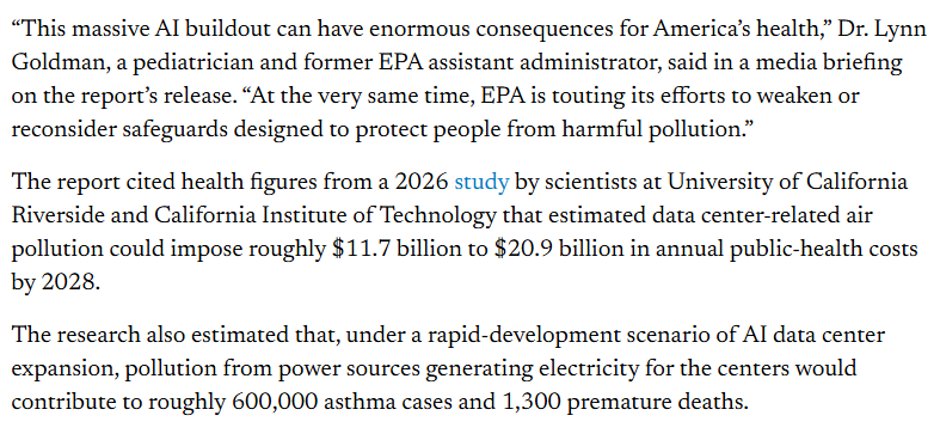
11/9/26. US. Former EPA officials warn of health risks from data centre pollution. As AI expansion drives demand for electricity to power the data centres, an increasingly weakening EPA is unprepared to manage the increase in pollution that comes with it
https://t.co/zboi3WnocW
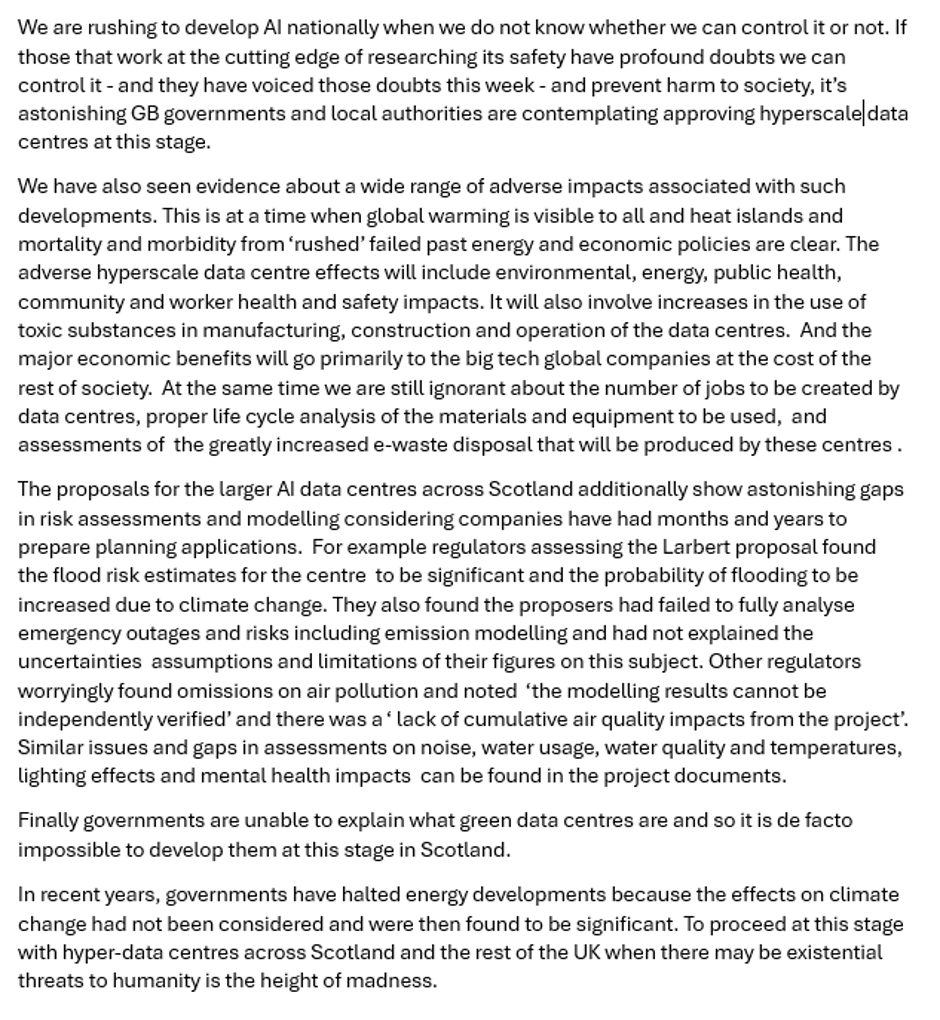
11/9/26. Scotland. Public health expert issues major AI data centre warning. Upstream negative societal implications are disturbing. Downstream building hyperscale data centres is non-sensical when there are major concerns (1)
https://t.co/qjHzC87ZnL
Today, @PHMScotland is highlighting the health risks from hyperscale data centres and calls on the Scottish Government to apply the Precautionary Principle and enforce Health Impact Assessments for all new data centres.
https://t.co/b605eL112e
Think Scottish Government should do more to improve ordinary people's lives *and* tackle the #climate crisis?
Like & share our🧵if you want action on this.
Read our blog on what should be in the 5-year plan (Programme for Government) 👉 https://t.co/7RtxRMek2B
We urge @scotgovhealth to intervene on AI data centres to protect health. Emerging evidence suggests risks to heart and respiratory health, hearing and mental health problems
Data centres for AI could more than double Scotland's electricity use.
If it’s really Scotland’s Energy, why let big tech use so much of the renewables we need for our homes, our transport, our industry?
We still need a moratorium on hyperscale #datacentres.
@APRScotland
🧵
The likely exponential growth of hyperscale AI centres has profound health risks as well as environmental ones inc respiratory and cardiovascular from air pollution, mental health and hearing difficulties from noise pollution + impact from contaminated water. HIA essential
SCOTLAND: The Summary
The Scottish Parliament reopens The summer break did not make this go away!
Scotland faces an unprecedented wave of "hyperscale" data center proposals. As of mid-2026, ~24 projects are in the pipeline with a combined power demand of up to 6,000 MW.
For context: Scotland’s winter peak electricity demand is ~4,000 MW.
We are effectively building an entire second country’s worth of energy consumption.
The "Green" Paradox
Developers pitch these sites as "green" due to Scotland’s >90% renewable grid & its Governments lack of an updated Energy Plan provides the planning gaps.
However, critics (APRS, local groups) argue that diverting massive renewable capacity to low-employment server farms risks slowing national decarbonisation and potentially keeping fossil-fuel plants online longer to meet baseload spikes.
The Backup Nightmare
It’s not just about power; it’s about pollution. Large sites require 100–200+ diesel generators for emergency resilience.
At the proposed 300 MW Larbert campus, monthly testing alone would emit ~288 tonnes of NOx annually placing it among Scotland’s top 10 industrial polluters, situated dangerously close to homes, a kindergarten, and a hospital.
Land Use & "Greengrab"
These aren't just server rooms; they are industrial fortresses.
Each site occupies 30–60+ hectares of greenbelt or farmland dozens of football pitches per facility.
From Wester Hermiston to the Borders, communities are fighting the permanent loss of biodiversity and the industrialisation of rural landscapes that define Scotland’s tourism brand.
The Employment Myth
Developers promise "thousands of jobs."
Reality check: Independent analysis shows high automation limits permanent on-site staff to just 20–50 people per facility.
Construction creates a temporary spike, but the long-term economic trade-off for rural communities is often minimal compared to the permanent loss of amenity and land.
Water Scarcity
Cooling these massive banks of servers requires millions of liters of water.
While developers promise "closed-loop" systems, Scottish Water has flagged rising demand and future scarcity risks.
In an era of climate-driven droughts, prioritising industrial cooling over community supply is becoming a major point of contention.
Where are they clustering?
Projects are heavily concentrated in the Central Belt, often ignoring brownfield sites in favor of cheaper, easier-to-build greenfield land.
Falkirk/Larbert: High-density campus proposals.
Fife (Auchtertool): Conflicts with rural tourism.
Edinburgh Edges: Greenbelt encroachment.
Lanarkshire: Targeted as an "AI Growth Zone."
The Regulatory Shift
The Scottish Government is promising to finally hit the brakes.
Environmental Impact Assessments (EIAs) and requiring notification for schemes >50 MW.
Campaigners are now pushing for a formal national definition of "green data centers" and a potential moratorium on greenfield sites.
The Bottom Line
Not every project will be built, but the cumulative impact is what matters.
Without a strategic national framework, Scotland risks sleepwalking into a future where precious renewable energy and land are locked into low-employment, high-pollution digital infrastructure.
Sources & Further Reading
Data compiled from APRS reports, planning EIAs (Larbert/Auchtertool), and Scottish Water statements.
The good news: YOU CAN INTRODUCE A NATIONAL CARE SERVICE NOW
1 Publish plan
2 Undertake productive resource audit of available trained staff, technology, materials
3 @bankofengland creates required funding
4 Implement within available resources
https://t.co/pl4pWsWNEI