My Nobel lecture and the video of the Stockholm lecture are online.
It covers what creative destruction tells us about secular stagnation, firm dynamics, the middle-income trap, and AI as the next GPT revolution.
Paper: https://t.co/Viem3OXkiC
Video: https://t.co/9rfqTvWXMy
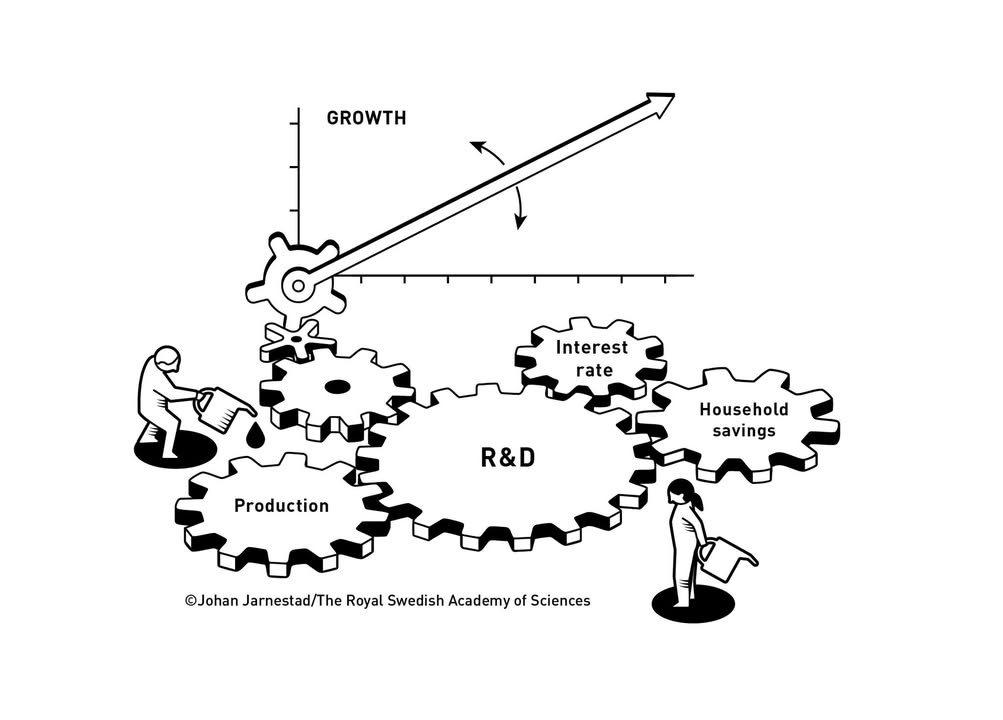
Inspired by modern data, Philippe Aghion and Peter Howitt constructed a mathematical economic model that shows how technological advancement leads to sustained growth.
Economic growth in industrialised nations such as Britain and Sweden has been remarkably stable. However, below the surface, the reality is anything but stable. In the US, for example, over ten per cent of all companies go out of business every year, and just as many are started. Among the remaining businesses, a large number of jobs are created or disappear every year; even if these figures are not as high in other countries, the pattern is the same.
Aghion and Howitt realised that this transformative process of creative destruction, in which companies and jobs continually disappear and are replaced, is at the heart of the process that leads to sustained growth. A company that has an idea for a better product or a more efficient means of production can outcompete others to become the market leader. However, as soon as this happens, it creates an incentive for other companies to further improve the product or production method and so climb to the top of the ladder.
A simplified description of some of the model’s important mechanisms would be that an economy includes companies with the best and most advanced technology; when these take out patents on their products they can be paid more than their production costs and thus profit from a monopoly. These are the companies that have moved to the top of the ladder. A patent offers protection from competition, but not from another company making a new patentable innovation. If the new product or production process is good enough, it can outcompete the old one and further climb the ladder.
The model that Aghion and Howitt presented in their 1992 paper was the first macroeconomic model for creative destruction to have general equilibrium.
Learn more about the 2025 prize in economic sciences, awarded to Joel Mokyr “for having identified the prerequisites for sustained growth through technological progress” and to Philippe Aghion and Peter Howitt “for the theory of sustained growth through creative destruction.” https://t.co/muoJMEoAdE
ENTRETIEN 1/2 - Paris Match a réuni le prix Nobel d’économie et l’ancien ministre de François Bayrou pour leur demander comment redresser les finances publiques et redonner à la France les moyens de redevenir une grande puissance. https://t.co/Ik3MZYqbfd
Read the latest #POIDWorkingPaper: A theory of endogenous degrowth and environmental sustainability
By @Ph_Aghion, Timo Boppart, Michael Peters, @SchwartzmanEcon and Fabrizio Zilibotti
https://t.co/WheNXQGhBO
DÉCRYPTAGE - Un vaste rapport, corédigé notamment par le prix Nobel d’économie Philippe Aghion, le prix Turing Yoshua Bengio et l’ancienne commissaire européenne Margrethe Vestager, appelle l’Union…
➡️ https://t.co/pdXJsfSG0s https://t.co/pdXJsfSG0s
How can Europe turn innovation into growth?
At the #FTConnectEurope Forum on 1/10, 2025 Nobel laureate Philippe Aghion (@Ph_Aghion) will explore how creative destruction can drive renewal and what it means for Europe’s #connectivity future. Join him: https://t.co/u2T71THQ8C
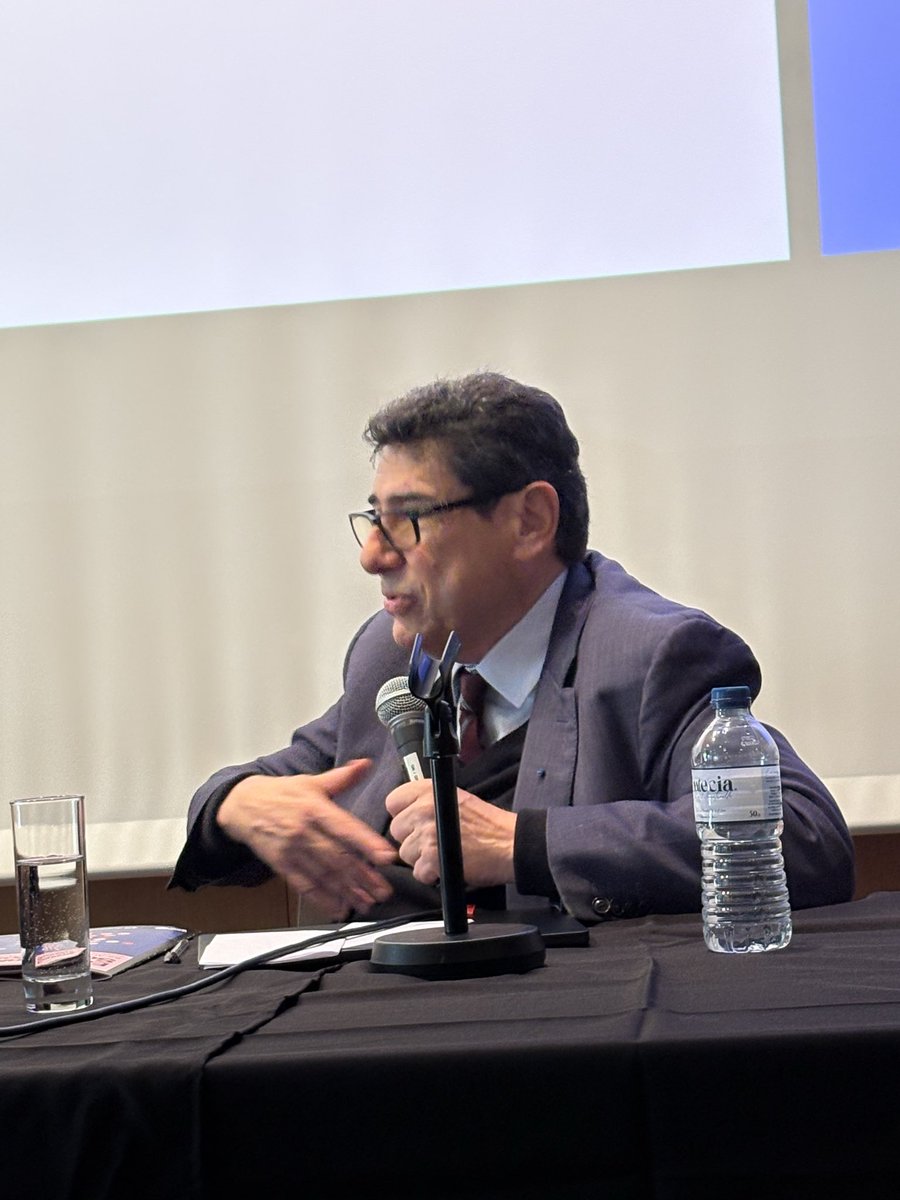
Wonderful to hear @Ph_Aghion on Ai here @cdf1530 Fahri Innovation Centre (Lots of lovely very French expressive hand movements). "New ideas are often a recombination of old ideas and you can do it much faster with AI".
Hearing @a_bergeaud’s introduction at #HECTalks yesterday was a proud moment for me. Seeing my students thrive and achieve great things is my ultimate reward.
Thank you @HECParis !
« Pour distribuer de la richesse, il faut la produire ! », estime le Nobel d'économie Philippe Aghion
Merci @publicsenat pour cet entretien
https://t.co/cGihnKYM7l
Today, we publish a Transformative AI Strategy for Europe.
Over the last few months, we’ve rallied researchers and engaged with governments to develop a plan for protecting the prosperity, sovereignty, and security of Europeans in a time of rapid AI progress.
https://t.co/Jc34ptCRMc
@MonikaSchnitzer and I are honored to have convened an all-star team of thinkers and researchers contributing ambitious near-term objectives to make Europe relevant again, including:
— Creating a Member State Alliance for Supply Chain Security (@anton_d_leicht et al)
— Making European institutions ready to act in a transformative AI world (Conor McGlynn et al)
— Securing Europe's share of global AI compute, in a ‘European Way’ that benefits local communities (@philip_fox_ et al)
— Ensuring resilience to AI crises (@ben_s_bucknall et al)
— Making Europe the global leader in assurance technology
— And more objectives around security of supply and leverage (@milorignell et al), economic strength (@FraukeStehr et al), and safety/security (@NoemiDreksler et al)
Our all-star senior expert council of Europe’s best and brightest (and non-European friends) reviewed drafts, provided strategic advice, and made suggestions for how to make the strategy more useful: @Ph_Aghion@Christophkw@bakkermichiel@ischinger@vestager@aleks_madry@FuestClemens Marta Kwiatkowska @LeoVaradkar@antonosika@DAcemogluMIT@Yoshua_Bengio
It’s never been more clear: AI is real, and Europe needs to act. We’ve had all the warning shots and wake-up calls we need. Now the question is ‘what must be done?’ This strategy is our answer.
https://t.co/Jc34ptCRMc
« Si l’on regarde le PIB mondial, il est constant de Jésus Christ jusqu’à 1820. Le décollage est la révolution industrielle grâce à la machine à vapeur. Puis, il y a eu l’électricité, les technologies d’information et maintenant l’IA », rappelle Philippe Aghion #UMUR@fitouss
"Tout enfant, quelque que soit son milieu social, a droit à un système éducatif de qualité"
Philippe Aghion, économiste, défend avec ferveur l'école et l'égalité dans et par l'éducation. Il est l'invité de Rebecca Fitoussi cette semaine dans Un monde, un regard.
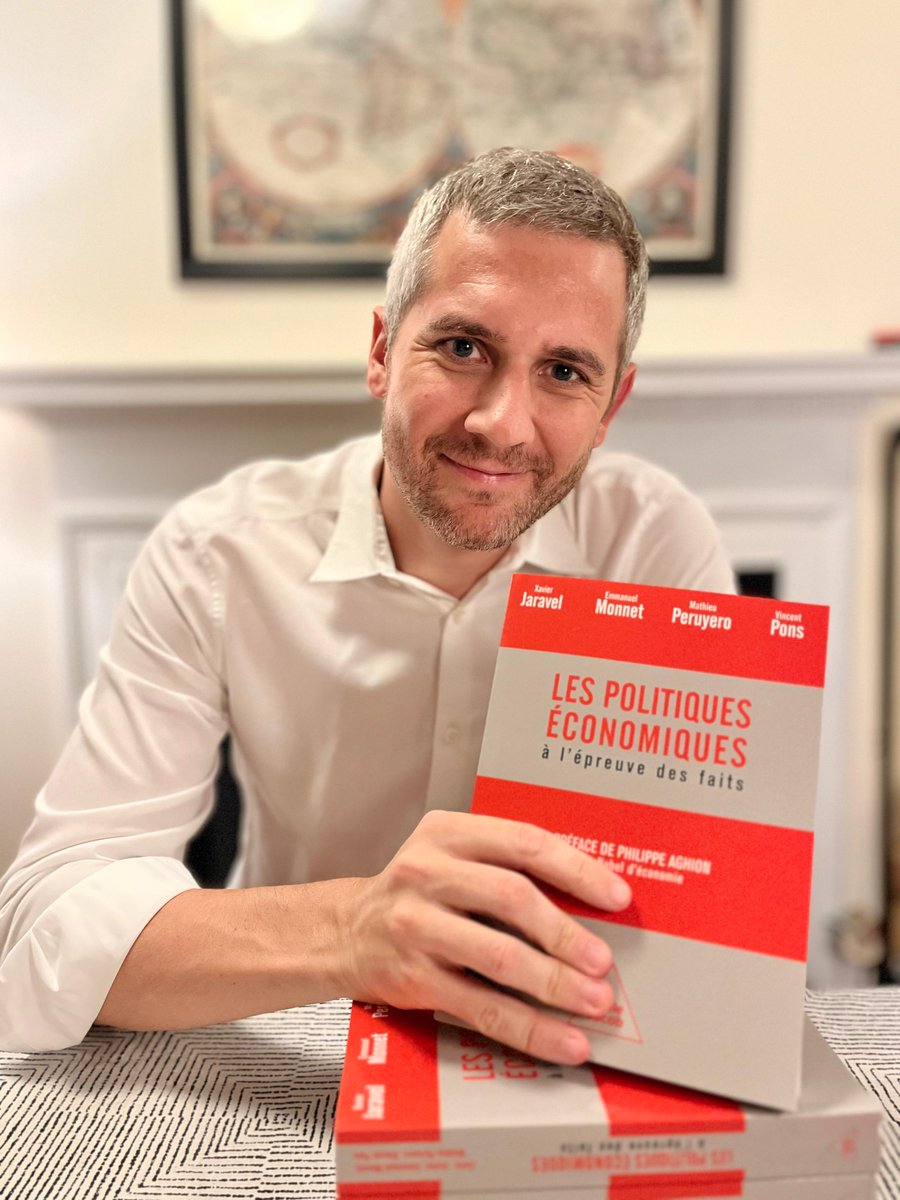
📘 Très heureux d’annoncer la parution aujourd’hui de notre livre, Les Politiques économiques à l’épreuve des faits !
Fruit de notre collaboration avec @XJaravel, @emm_monnet et Mathieu Peruyero, aux @OdileJacob, avec une préface de @Ph_Aghion.
Sophisme de l’argument d’autorité inversé. Aghion ne fait pas étalage de ses médailles : il explique ce qui ne va pas dans les propositions de LFI. Le fait qu’il se trouve avoir un prix Nobel ne discrédite en rien son propos.
LFI, qui, par ailleurs, fait preuve de stakhanovisme lorsqu’il s’agit de miner du crédentialisme pour elle-même. Tous les deux mois, on nous rabâche une nouvelle liste d’une centaine d’économistes soutenant telle ou telle proposition de LFI, généralement composée en grande partie de gens sans rapport avec la profession.
On n’a pas entendu Mélenchon s’attaquer à la Banque de Suède lorsque ses minions racontaient que le programme du NFP avait été validé par une prix Nobel… ce qui était d’ailleurs un mensonge éhonté.
🔵 🇫🇷 ENTRETIEN EXCLUSIF – « Marine Le Pen fait semblant d’être raisonnable » : L'avertissement de @Ph_Aghion, Prix Nobel d’économie
Le chercheur alerte sur la situation du pays, dénonce les programmes des extrêmes et explique comment éviter la �� catastrophe ».
▶️ https://t.co/bTO198dMcF
✍️ Par @mpgrondahl et @JeudyBruno #Économie
Bonsoir à toutes et à tous,
⚡🚨 Découvrez en exclusivité notre « Une » de La Tribune Dimanche n°153, disponible dès demain matin dans tous vos kiosques à journaux et sur notre app.
Philippe Aghion remarque que «cela reste techniquement possible», mais qu'une telle annulation ferait fuir les acheteurs de dette française. ���https://t.co/QoIADFaOPs