Use the below referral code for @JungleRockRes discount! No other place you'll get top notch research with a top tier meme team who are so accessible. I stand by them and their product.
https://t.co/o2QSZ8N8Fj
CHEETAH is the Jungle Rock Capital SMA Index.
It is a mix of Trend Following, Directional Trading, Strategic Asset Allocation and Tactical Asset Allocation. The Index rebalances daily, and has 1.75x maximum leverage.
It makes use of proprietary algorithms to allocate weights to different parts of the Treasury bond curve depending on market conditions, further implementing algorithms of volatility, leverage control, and concentration / overexposure caps.
We are still running the -25% OFF Hot Summer Deal this week. 4 days left to claim the discount across both Yearly and Monthly options for Jungle Rock's Retail, Trader and PM tier 👇
In September of 1814, America was once again in trouble.
The young republic was only thirty-eight years old. The War of 1812 had gone badly. British troops had marched into Washington, burned the Capitol, set the White House ablaze, and now turned their sights toward Baltimore. If Fort McHenry fell, the harbor would be open, the city would likely follow, and another devastating blow would be dealt to the fragile nation.
Amid this uncertainty, a young American lawyer named Francis Scott Key sailed under a flag of truce to the British fleet. He had come to negotiate the release of a friend, a physician the British had captured.
He succeeded.
The British agreed to free the doctor.
But there was a catch.
Because Key and his companions had seen too much of the British fleet and learned too much about its plans, they were not allowed to return to shore. Instead, they were detained aboard a ship in the harbor and forced to watch the coming battle from behind enemy lines.
On the morning of September 13, the bombardment began.
For the next twenty-five hours, British warships unleashed somewhere between 1,500 and 1,800 bombs and rockets upon Fort McHenry. These were the “bombs bursting in air” and the “rockets’ red glare” of the song—not poetic embellishments, but terrible realities.
Key stood on the deck through the endless day and the long, terrifying night. Every explosion lit the darkness for a fleeting instant before the smoke swallowed everything again. Somewhere beyond that wall of fire stood the fort. Somewhere beyond it flew an American flag if it still flew at all.
He could not see.
He could only listen.
As long as the guns continued firing, there was reason to hope. The British would not waste ammunition on a fort that had already surrendered.
Then, just before dawn…
The guns fell silent.
For the first time all night, there was only stillness.
It was the most frightening sound of all.
Had the fort finally fallen? Had the defenders surrendered? Had the flag been torn down in the darkness while no one could see?
There was nothing to do but wait.
As the first light of September 14 slowly pushed back the smoke, Francis Scott Key strained his eyes toward the distant fort.
Then he saw it. Not a British flag.
The American flag. Still there. Still flying.
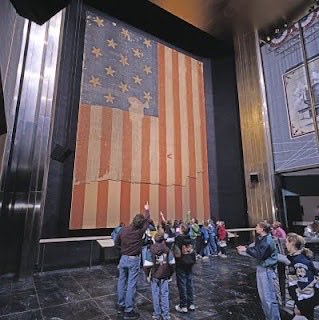
That flag was no ordinary banner. Months earlier, the fort’s commander had commissioned a Baltimore flagmaker, Mary Pickersgill, to sew a flag so enormous “that the British would have no difficulty seeing it from a distance.” It measured roughly thirty by forty-two feet, carried fifteen stars and fifteen stripes, and was so large it had to be assembled on the floor of a brewery because no ordinary room could contain it.
That was the Star-Spangled Banner.
The very flag Key saw through the morning mist.
The very flag that still survives today in the Smithsonian.
Overcome by what he had witnessed, Key reached into his pocket, pulled out an envelope, and began writing. The words came from a heart that had spent an entire night fearing his country might disappear with the dawn.
He first titled the poem Defence of Fort M’Henry.
Within days it was printed and circulating throughout the country. Before long, people began singing it to a melody they already knew—an old British tune called “To Anacreon in Heaven,” originally written for a London social club. There is something beautifully ironic in that: America’s most beloved patriotic song borrowed the melody of the very nation it had just survived. It also explains why the anthem is so notoriously difficult to sing. It was never written for ordinary voices gathered in stadiums or school assemblies.
The song spread quickly and became one of America’s favorite patriotic hymns, but it would wait more than a century before receiving official recognition. Not until 1931 did Congress declare “The Star-Spangled Banner” the national anthem of the United States.
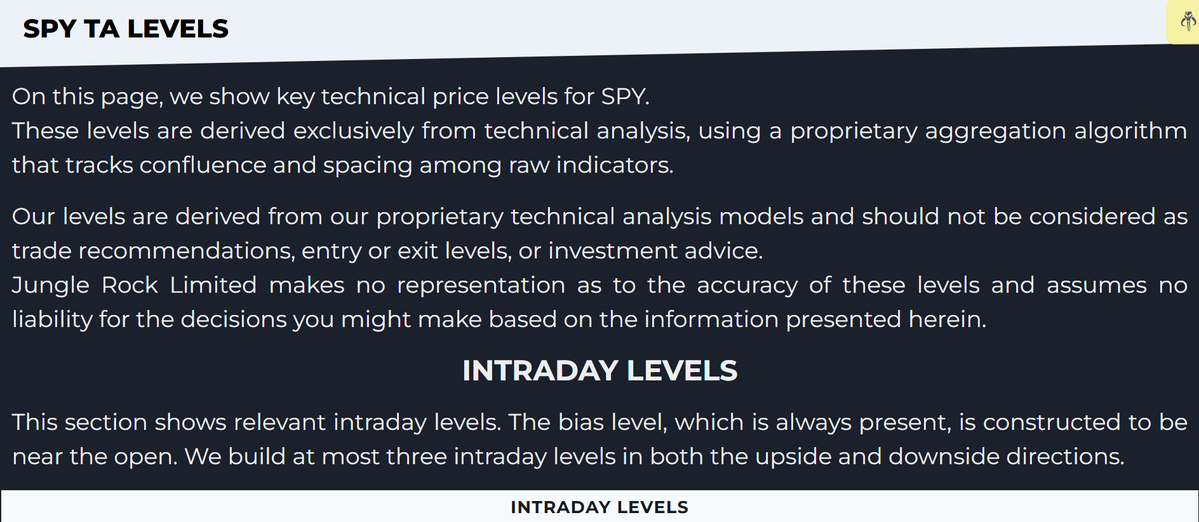
Our $SPY TA LEVELS Page is now LIVE 🚀
Register a free account with us and check the homepage for the link to start your trial. It's a one-click process.
Gm
Massive service update !!
Today we will be releasing our systematic TA levels for clients of Jungle Rock
These are intraday levels, tail levels and historical data points for $SPY
We are now regulated in the U.S. ‼️
“JUNGLE ROCK CAPITAL LTD, hereinafter referred to as the Applicant, doing business as JUNGLE ROCK CAPITAL, filed an application for registration as an investment adviser under Section 203(c) of the Investment Advisers Act of 1940 ("Act"). Applicant states that it is eligible to register with the Commission as an investment adviser.”
Stallion is a 60 / 40 made of 60% Directional Trading and 40% Trend.
The Directional Trading component is equally weighted between Mako Shark (with TMF instead of TLT) and Great White Shark (with SPXL instead of SPY). The trend component is equally weighted between Giant Turtle and Sea Turtle, but with TLT instead of IEF.
Finally, Stallion uses inverse and leveraged ETFs to get the desired exposure, so that the result is a long-only, unleveraged daily program.