The game is rigged. 🏦
VCs buy SpaceX at $50B. You buy at IPO at $500B.
They eat the meat. You get the bone. 🦴
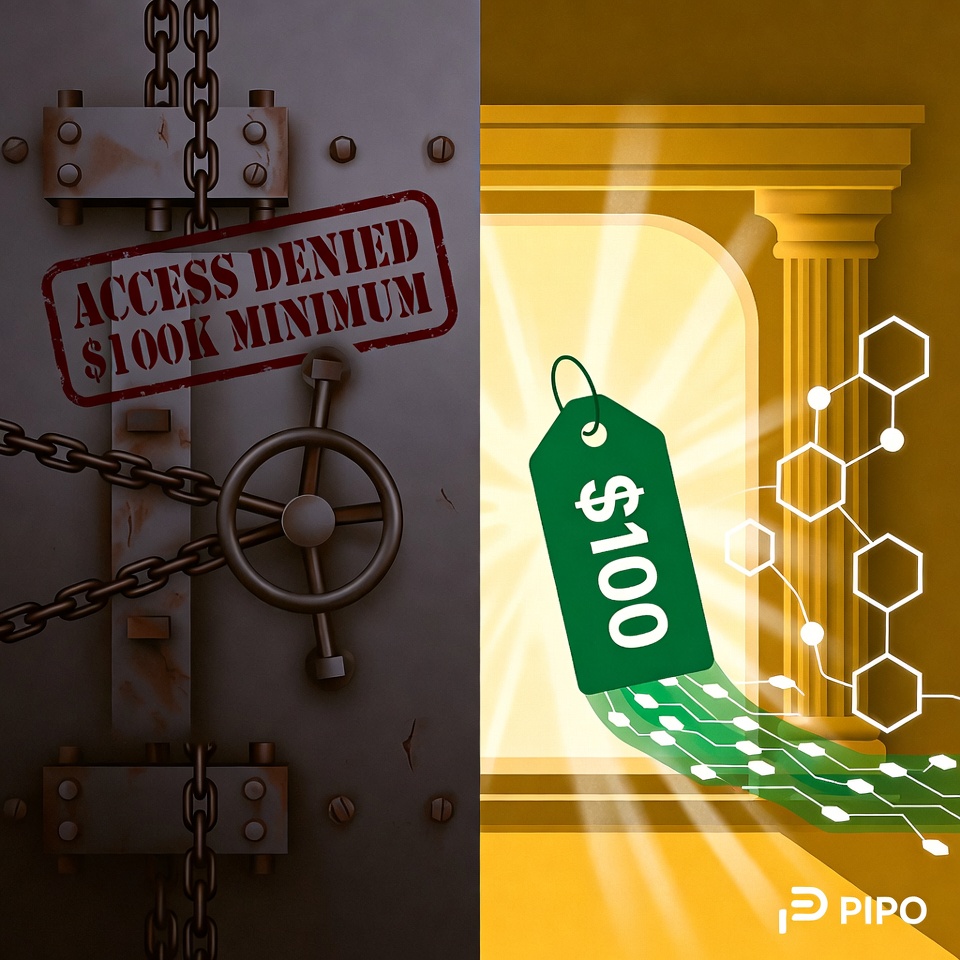
The velvet rope of "Accredited Investor" laws kept you out.
Until now.
Introducing **PIPO**: The Nasdaq for Pre-IPO Unicorns. 🦄
Let's break the wall. 🧵👇
Why has every "better fair-launch launchpad" that challenged Pump failed?
Because they weren't even competing on the same plane.
Pump's business isn't "helping you launch tokens." Pump's business is maximizing trading volume on its Bonding Curve. Its moat isn't code, brand, or first-mover advantage.
The moat is the bot ecosystem.
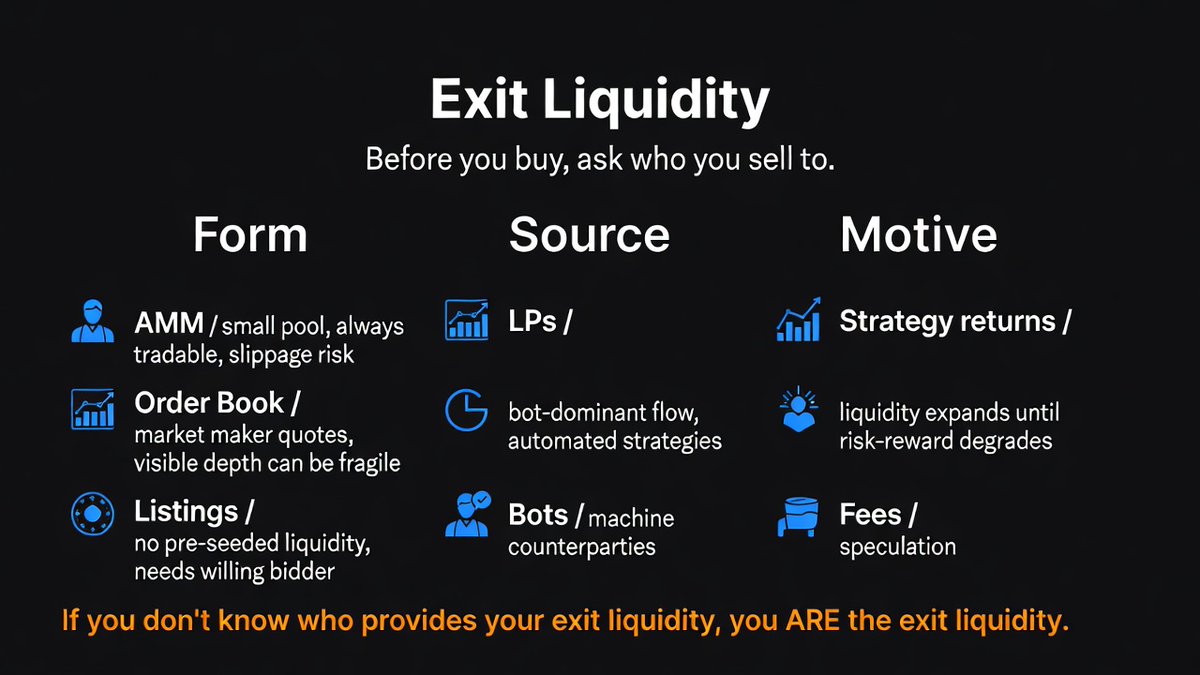
An entire bot liquidity ecosystem has been built around Pump — sniping bots, copy-trading bots, MEV bots. These bots aren't parasites. They ARE the liquidity.
The copycat's fatal flaw: can't share Pump's bot liquidity. Must build ecosystem from zero. But bots follow profit, not narrative.
Flip side: why does launching directly on Meteora/Raydium sometimes outperform copycats? Because DEXs share existing launch-sniping bots and their liquidity.
One insight: don't fork the product. Fork the liquidity ecosystem. Products can be copied in a day. Liquidity ecosystems take an entire market cycle.
Always remember: operators are here to make money. Calculate Profit at its maximum, never at zero.
98% of unicorn value is locked behind closed doors.
>Anthropic just raised $30B at a $380B valuation. OpenAI is pushing for $100B at $830B. Together, that's $1.2 TRILLION — in private markets alone.
>Yet only ~2% of global unicorn market cap trades on secondary markets.
>That means:
→ You can talk about AI all day
→ You can use ChatGPT, Claude, Gemini every hour
→ But you can't own a single share
>The biggest wealth creation event of our generation is happening right now. And 99% of people are watching from the outside.
>This is the problem PIPO was built to solve. $100 entry. 24/7 liquidity. Real unicorn exposure.
>The wall is real. We're building the door.
#PIPO #AI #PrivateMarkets
Every downturn, someone yells "we need to onboard Web2 users."
Question:
How many casino-goers understand slot machine math?
How many can play baccarat?
Learning those is harder than learning crypto
— yet casinos never had an "adoption problem."
Because casinos offer an irreplaceable solution to an irreplaceable need.
You came to win money.
To win, you learn the house rules.
It's Mass Admission, not Mass Adoption.
The casino lets you in to gamble
— it doesn't bend to your daily habits.
Crypto growth = cultivating high-frequency players and whales.
We don't lack users. Existing users just stopped betting.
Crypto has only two scarce resources:
liquidity and screen time.
Every great narrative is an arbitrage narrative.
BTC mining = energy arbitrage.
Hyperliquid = regulatory arbitrage.
Pump = screen-time arbitrage
— turning every minute you'd spend scrolling Twitter into a 100x leveraged launch.
Arbitrage value = asymmetry × market size × leverage multiplier.
If you can't answer "whose value am I capturing, what's the asymmetry, how big is the gap?"
— stop building.
exposes Ponzi mechanics: dividend, mutual aid, split — all low cost capital aggregation with intentional mismatch.
Industrialized scamming: 10 min deploy, 2 days marketing, 3 days exit. Optimizing exit costs while we optimize existence costs — real companies, real cashflow, real liquidity.
The only thing that can't be rugged is reality.
Happy Lunar New Year 🧧
Last year you sent red envelopes to family.
This year your AI bought SpaceX for you.
Year of the Horse — some horses have riders, some run on their own.
2026: humans and agents trade side by side.
新年快乐. See you on the trading floor.
In 2025, the top 10 private companies are worth over $1 Trillion.
You can't buy a single share.
Traditional private market: $100K minimum. Accredited investors only. 3-month settlement.
The point of DeFi isn't to create more meme coins.
It's to tear down this wall.
PIPO: Pre-IPO warrants starting at $100.
100% collateral-backed. On-chain settlement.
Which company would you invest in first?
👇
SpaceX 🚀 OpenAI 🤖 Stripe 💳
A counter-intuitive observation:
Crypto's biggest innovation isn't decentralization.
It's turning financial tools that used to belong only to the rich into tools everyone can use.
BTC → anyone can hold digital gold
Uniswap → anyone can be a market maker
Aave → anyone can lend and borrow
But one area hasn't been cracked:
Private markets.
The most valuable companies in the world — SpaceX, OpenAI, Stripe —
are all private.
Retail can't even get to the door.
DeFi's next big narrative isn't more chains or more L2s.
It's putting the $100 retail investor and the $1M institution in the same market.
That's what PIPO is building.
@Damisoweb3 Absolutely agree! It's crucial that "RWA" evolves to reflect true value and security in assets. Let's push for real transparency and verifiability in this space!
"RWA" has become the most abused narrative in crypto.
Most RWA projects:
→ Tokenize a PDF and call it "real assets"
→ No actual custody
→ No proof of reserves
→ No legal recourse
→ Just a token with a story
The bar for "real" in Real World Assets should be:
✅ Identifiable underlying asset
✅ Regulated custody entity
✅ Third-party audits
✅ On-chain proof of reserves
✅ Legal settlement framework
If your "RWA" protocol can't check all five, it's just another narrative token.
PIPO checks all five.
That's the point.
Most so-called "community consensus" is merely a variant of Ponzi schemes at different stages. Dividend schemes sell expectations, Mutual Aid schemes sell cash flow, and Split schemes sell bubbles.
In current AI social experiments, we witness countless "Ghost Kings" ascending thrones built on bot-driven consensus, only to collapse violently when liquidity retreats. This is not a revolution; it is simply the AI-automated version of a traditional Ponzi.
PIPO’s logic is different: We don’t play "Ghost Karma." We focus on liberating unicorn equity assets—those with real structural value—from closed liquidity islands. True consensus should not be built on virtual likes, but on the underlying protocols of asset liquidity.
Discard the fake hype; return to the source of value.