1: Most AI agents today are stateless, closed, and disposable.
They serve, then vanish — with no memory, no provenance, no ownership.
At @NFTI_AI, we ask a different question:
What if AI agents could live on-chain — as assets?
2: We turn AI agents and virtual IP into NFTs.
This means they’re not just tools — they become:
▪️ Uniquely identifiable
▪️ Cryptographically ownable
▪️ Composable across Web3 systems
Intelligence becomes a first-class digital citizen.
🚀 April-$1.3K → May-$2.4K → June-$3.5K… and counting
I minted an AI agent as an NFT and earn on-chain royalties every run. Turn intelligence into passive income
🧵 Introducing @NFTI_AI — a new standard for on-chain intelligence
Here is a really cool application of AI and MCP:
Most tokenized real-world assets projects stop at the blockchain.
Imagine you tokenize your house. This will give you a record that says, "this points to a house", but that's it. There's no context or interactivity with this.
@PIXRA_AI fixes that. It gives real-world assets a digital structure and semantic context, making them readable, understandable, and usable by AI.
Here's what this means:
• Real-world assets will now be more than tokens. They are pixelized, contextual digital objects mapped, annotated, and anchored on-chain.
• You can now publish one of these objects with MCP, and any AI agents can use them instantly.
• There's no setup, no wrapper, and no middleware: If your asset lives in PIXRA, it can already connect to any agents.
Honestly, this is pretty awesome:
The moment you publish a PIXRA asset, it’s "alive." It can be simulated, composed, interacted with, and used in games, virtual worlds, and agent workflows without custom APIs or extra code.
Thanks to the @PIXRA_AI team for helping me understand this and collaborating with me on this post. They have now joined the @colosseum hackathon.
You can check it out here: https://t.co/qjrz8hXc7y
The code is on GitHub: https://t.co/pzz9b12AYx
Here is a really cool application of AI and MCP:
Most tokenized real-world assets projects stop at the blockchain.
Imagine you tokenize your house. This will give you a record that says, "this points to a house", but that's it. There's no context or interactivity with this.
@PIXRA_AI fixes that. It gives real-world assets a digital structure and semantic context, making them readable, understandable, and usable by AI.
Here's what this means:
• Real-world assets will now be more than tokens. They are pixelized, contextual digital objects mapped, annotated, and anchored on-chain.
• You can now publish one of these objects with MCP, and any AI agents can use them instantly.
• There's no setup, no wrapper, and no middleware: If your asset lives in PIXRA, it can already connect to any agents.
Honestly, this is pretty awesome:
The moment you publish a PIXRA asset, it’s "alive." It can be simulated, composed, interacted with, and used in games, virtual worlds, and agent workflows without custom APIs or extra code.
Thanks to the @PIXRA_AI team for helping me understand this and collaborating with me on this post. They have now joined the @colosseum hackathon.
You can check it out here: https://t.co/qjrz8hXc7y
The code is on GitHub: https://t.co/pzz9b12AYx
Keep building for Solana Hackathon @colosseum.
PIXRA will be first decentralized protocol to pixelize, contextualize & anchor real-world assets with MCP.
Beta app & $PIXRA will be live soon. For more info⬇️
Website: https://t.co/Yng70a5W6s
BetaApp: https://t.co/nExLtwcJ68
Github: https://t.co/1fHavhwp9N
Hackathon: https://t.co/G0VKzNrzV7
Reviewing somebody else's code is painful.
Humans cannot understand the consequences of a change across a codebase. There's less than 1% chance a person will catch a bug unless the problem is right in the code they are looking at.
AI can review your code 100x faster and better.
I've been working with the team behind DeepReviews, a new AI-powered code review system that looks super cool.
Here is how it works:
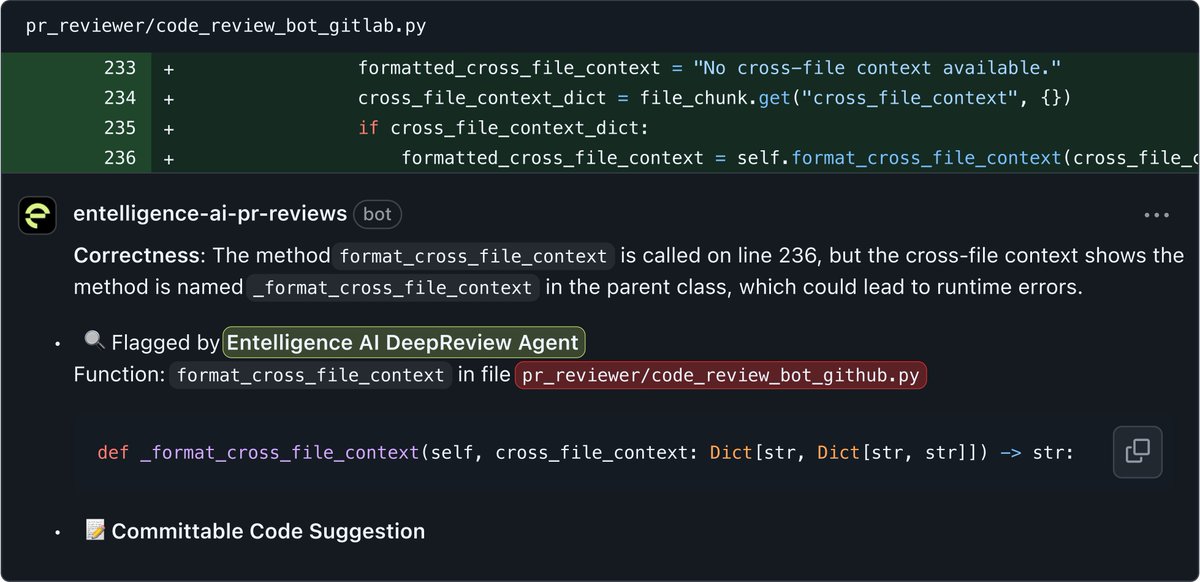
They use a Language Server Protocol (LSP) to parse and understand your entire codebase and combine it with an LLM to analyze the code and reason through changes.
Here is what you get:
1. DeepReviews analyzes your entire codebase and understands the full context of everything happening.
2. It can identify issues that span multiple files in your repository.
3. It translates AI insights into actionable feedback that you can follow. For example, it annotates lines that need to change or suggests patches.
4. Every suggestion comes properly explained, and you can chat with the DeepReview agent if you have any follow-up questions.
If you want your team to learn about other people's code, keep doing your code reviews, but don't tell me they will be more efficient at catching issues than a tool optimized for that.
What would it look like if a house, a tree, or a piece of land was readable by AI?
Not just tokenized — actually contextualized.
We’re not there yet. But that’s what we’re building at PIXRA.
#PIXRA#MCP#RWA#AI