#excitingtimes 😉 - I am running for the coordinating commiittee of the #ESIL interest group on international courts and tribunals. If you are a member, I would be really happy to receive your support! #intlaw
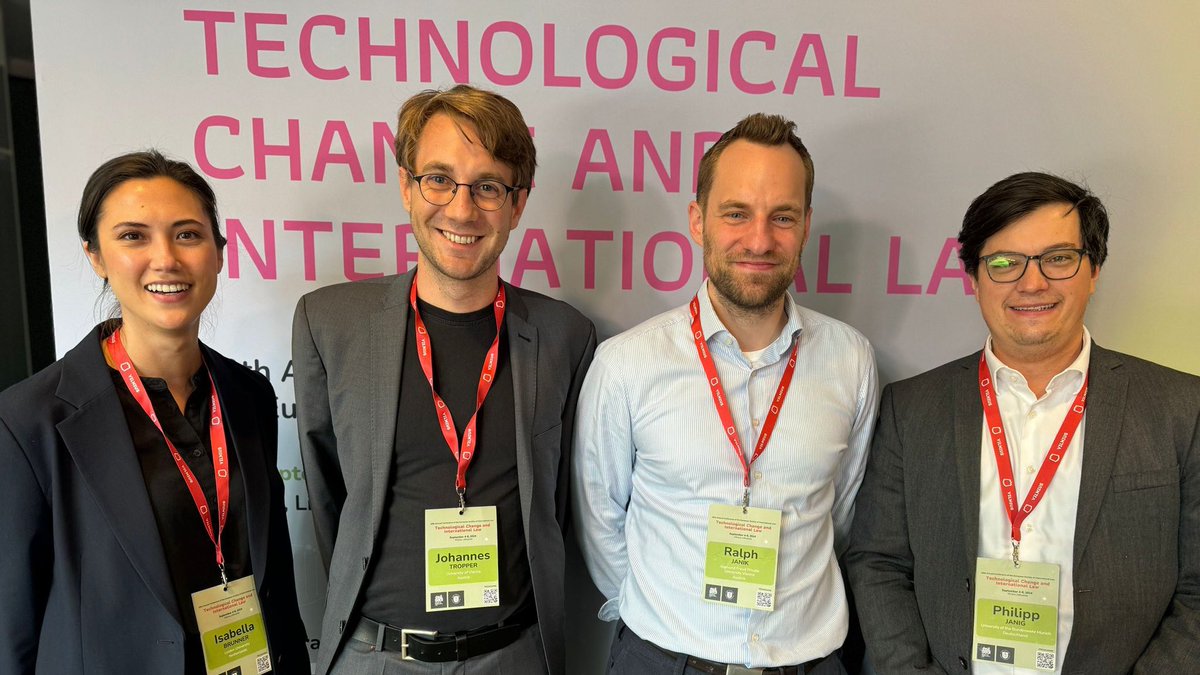
Temporarily deactivated my Twitter account to enjoy the 2024 European Society of International Law Conference on technological change in Vilnius, happy to have seen @brunnerisi, @PJanig, @TropperJohannes and countless others again (damn this tweet reads like a LinkedIn post)
‘The European Union’s Participation in the Creation of Customary International Law and Its Impact on Member State Sovereignty’
by Christina Binder (@unibw_m) and Philipp Janig (@PJanig)
https://t.co/64tFAwcSiI
Looking forward to share some thoughts on how climate change may impact peacekeeping operations - and what to do about it from a human rights perspective!
Pleased to partner with the International Law Group @uocommonlaw & @DrCiviluOttawa & the Neuberger-Jesin Professor @JP_Peacemaking to present this lecture with @PJanig next March 27 at 11:30 am.
Register here: https://t.co/1WS8IyuZVK
this one has been on our mind for some time! https://t.co/p2zmsrXOtd: With the majority of peacekeeping missions operating in areas most impacted by climate change risks, IOs have increasingly embraced the idea that climate change needs to become part of the mandate of PKOs...
On a completely different note, the Austrian Supreme Court recently re-opened the question of succession into state property, suggesting that Ukraine might be entitled to around 16% of all former foreign assets of the UDSSR - often held by Russia.
https://t.co/A4iuCMg5s4
Recently had the opportunity to share some thoughts on what international law has to say on sanctions against the Central Bank of Russia - and the problems with proposals to confiscate its assets.
#EUsanctions#restrictivemeasures#esil2023
We are pleased to share episode 2 of the @ESIL_IGPS Peace and Security Podcast:
Dr. Philipp Janig discusses the law and politics of state efforts to freeze and seize the Russian Central Bank's assets
Tune in 👇🎙️🎶
https://t.co/OVhKLV3kLi
@cfsmoran @pilabuda
However, we first have know what state immunity prohibts here specifically to get our legal analysis on countermeasures right - which at any rate probably won't allow for confiscation, as recently thoughfully argued by @oonahathaway and others
https://t.co/rfGm3mLIzg
We are pleased to share episode 2 of the @ESIL_IGPS Peace and Security Podcast:
Dr. Philipp Janig discusses the law and politics of state efforts to freeze and seize the Russian Central Bank's assets
Tune in 👇🎙️🎶
https://t.co/OVhKLV3kLi
@cfsmoran @pilabuda
I am running for one of the convener spots of the coordinating committee of the #ESIL Interest Group on International Courts and Tribunals. If you are part of the Group, I would very much appreciate your support. Deadline is 7 October.
@sophie_duroy True, seems underexplored to me. Would love to read what you come up with! I'd probably start with the general Q of immunities/HR (so Waite and Kennedy) and see how far the reasoning applies, but you certainly thought of that already
@sophie_duroy I'd wager yes, given that (for HR) a state in principle has jurisdiction over everything happening in its territory (see Mozer v Moldovia and Russia). The content of the specific obligations might well be affected by the SOFA though. However, not aware of a pertinent case.
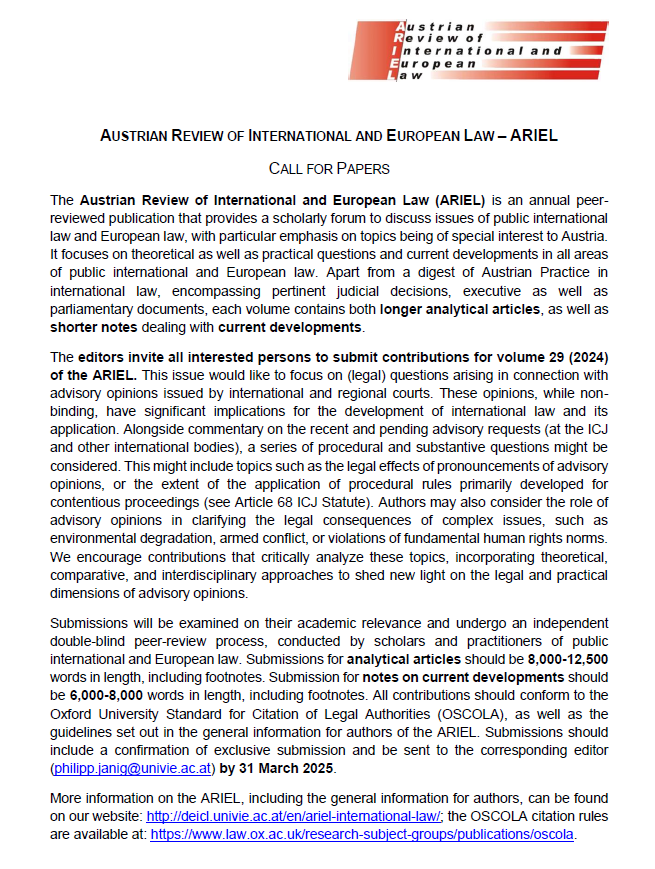
New cfp out! Volume 26 of ARIEL encourages submissions focusing on the changing structures of international investment and trade law - ISDS, ECT modernization, WTO reforms, SDG alignments... 1 March 2022! See https://t.co/3imDW0P5rO @Brill_Law