We're launching Bridge today 🌉
An AI engine that builds virtual homes. Blueprint in, walkable home out. Every plan, every option, structural changes included.
What took 3D artists months now takes days. Homebuilders can finally show buyers every home they sell.
https://t.co/QrwlM5FUjP
RT-Splatting: Joint Reflection-Transmission Modeling with Gaussian Splatting
Contributions:
• We introduce a unified surface-volume Gaussian scene representation for jointly modeling sharp specular reflections and clear transmission in real-world scenes containing thin semi-transparent surfaces.
• We propose Specular-Aware Gradient Gating to suppress misleading gradients from complex specular regions, substantially reducing floaters in the transmission branch.
• Extensive experiments demonstrate that RT-Splatting significantly outperforms prior methods while maintaining real-time rendering and enabling flexible scene editing.
We’re on the verge of interactive, real-time, photorealistic video generation with what are called World Models. These require a fair amount of expensive compute, but costs will come down over time. Today, these interactions are essentially real-time dreams. They lack the persistence and shared logic that turns a video into a multiplayer game. Or concert. Or classroom. Or the holodeck.
We believe the ultimate architecture for gaming (and the holodeck) is Roblox Reality. It’s a hybrid architecture that marries the structured data and logic of the Roblox Engine and Roblox Cloud with the generative power of Video World Models. The Roblox Engine provides the underlying synchronized ground truth—the score, physics, multiplayer sync, etc.—while our video model acts as a Super Upsampler to layer on photorealistic detail.
We believe this will ultimately remove barriers to high-fidelity creation, allowing a team of three people to build a narrative-driven, photorealistic masterpiece in a single week. This is an early look at turning solitary AI dreams into a social, playable reality.
https://t.co/9SYizn5TV6
This is a wickedly good color map for metric depth proposed in Vision Banana.
See more examples, also other modalities! https://t.co/QhndJsm8Kt
Congrats @songyoupeng and @GoogleDeepMind team!
TokenLight by Adobe!.
Precise lighting control for images via attribute tokens.
it's like Qwen Light Migration LoRA on a steroid.
- virtual 3D light placement
- shadow softness adjustment
- multi-light control
- high spatial accuracy
- handles glass, fur, and complex occlusions
this is gonna be Photoshop-only for years
https://t.co/SXRjwECw0e
NVIDIA just dropped UniRelight, a handy video-relighting model
- estimates albedo, relit video in a single pass
- based on Cosmos-Predict1-7B
- supports complex materials
- temporal consistency
- beats DiLightNet, NeuralGaffer
https://t.co/nQU1fKem9R
🎉 After one year of teamwork, we are excited to release our 3D foundation model — LingBot-Map!
Unlike DA3/VGGT, LingBot-Map is a purely autoregressive model for streaming 3D reconstruction ⚡
It achieves ~20 FPS on 518×378 resolution over sequences exceeding 10,000 frames — and beyond 🚀
Two key insights behind LingBot-Map:
🔑 Keep SLAM's structural wisdom: build Geometric Context Attention with long-context modeling while maintaining a compact streaming state
🔑 Make everything end-to-end learnable — no optimization, no post-processing
Let's check out our demos 👇
Today, we released Lyra 2.0, a framework for generating persistent, explorable 3D worlds at scale, from NVIDIA Research.
Generating large-scale, complex environments is difficult for AI models. Current models often “forget” what spaces look like and lose track of movement over time, causing objects to shift, blur, or appear inconsistent. This prevents them from creating the reliable 3D environments required for downstream simulations. Lyra 2.0 solves these issues by:
✅ Maintaining per-frame 3D geometry to retrieve past frames and establish spatial correspondences
✅ Using self-augmented training to correct its own temporal drifting.
Lyra 2.0 turns an image into a 3D world you can walk through, look back, and drop a robot into for real-time rendering, simulation, and immersive applications.
➡️ Learn more: https://t.co/ROR7miJeCU
📄 Read the paper: https://t.co/1osU9EGjGD
📢GaussianGPT: autoregressive 3D Gaussian scene generation.
We introduce a GPT-style model that directly generates 3D Gaussian scenes, token by token, in a series of small, discrete decision steps. Generation, completion, and large-scale outpainting in a single pipeline.
Unlike diffusion-based approaches, GaussianGPT explicitly models the scene distribution at every step, allowing for quite flexible scene synthesis.
🌐 https://t.co/Ewv4CyLD2O
▶️ https://t.co/zKOugfD9gl
Great work by @nicolasvluetzow, @barbara_roessle, @katha_schmid
There's a fruit fly walking around right now that was never born.
@eonsys just released a video where they took a real fly's connectome — the wiring diagram of its brain — and simulated it. Dropped it into a virtual body. It started walking. Grooming. Feeding. Doing what flies do.
Nobody taught it to walk. No training data, no gradient descent toward fly-like behavior. This is the opposite of how AI works. They rebuilt the mind from the inside, neuron by neuron, and behavior just... emerged. It's the first time a biological organism has been recreated not by modeling what it does, but by modeling what it is.
A human brain is 6 OOM more neurons. That's a scaling problem, something we've gotten very good at solving. So what happens when we have a working copy of the human mind?
Had early access to Genie 3 world modelling. Huge leap forward in modelling/physics but some issues remain
Here is a bit of an otter airline pilot with a duck on its head walking through a Rothko inspired airport and an otter in a wingsuit flying through a city of gothic towers.
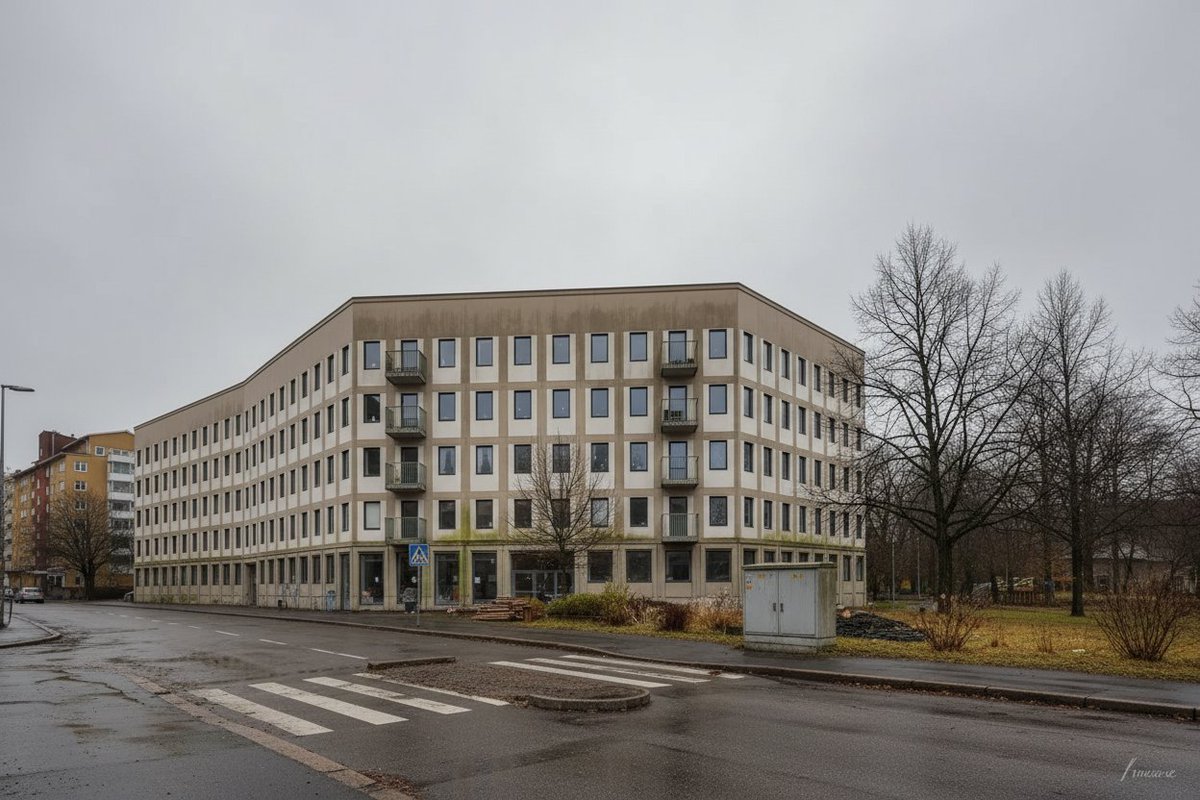
Made a little @Lovable website to allow you to see through architecture renders, to see what the buildings will look like on a grey november day without any people