Service Owner Updates: 🧵
PSM4Win v0.1.14 is out now. This is a priority upgrade adding support for the new HA Relay Miner setup, and additional server configuration options for multi-port services.
https://t.co/eFCMmgwT6e
For developers who build AI agents but have never used Web3 infrastructure.
Pocket Network is a marketplace for API data that runs without a central company. Instead of one vendor deciding prices and uptime, independent operators stake POKT to serve requests, and the protocol matches each request to a server and settles it on-chain.
Nothing about the developer experience changes: calls are plain HTTP and answers come back as JSON. What changes is who runs the infrastructure and who verifies it.
Practical use case: your agent needs to search the web and turn a page into clean text for an LLM. On Pocket's Agentic Portal those calls are two services, AgentSearch and Web Extract, at $0.005 each, paid in USDC with no account and no API key.
Start here: https://t.co/Urkck0qVYL
Sources: https://t.co/Urkck0qVYL
Pocket API Pro is live 🚀
Pay-as-you-go RPC on Pocket Network. No sign-up, just a wallet.
Higher limits, WebSocket, gRPC & SSE streaming, and per-app API tokens. The free endpoints stay free.
Start here ⤵️
https://t.co/PbbzWh9SkH
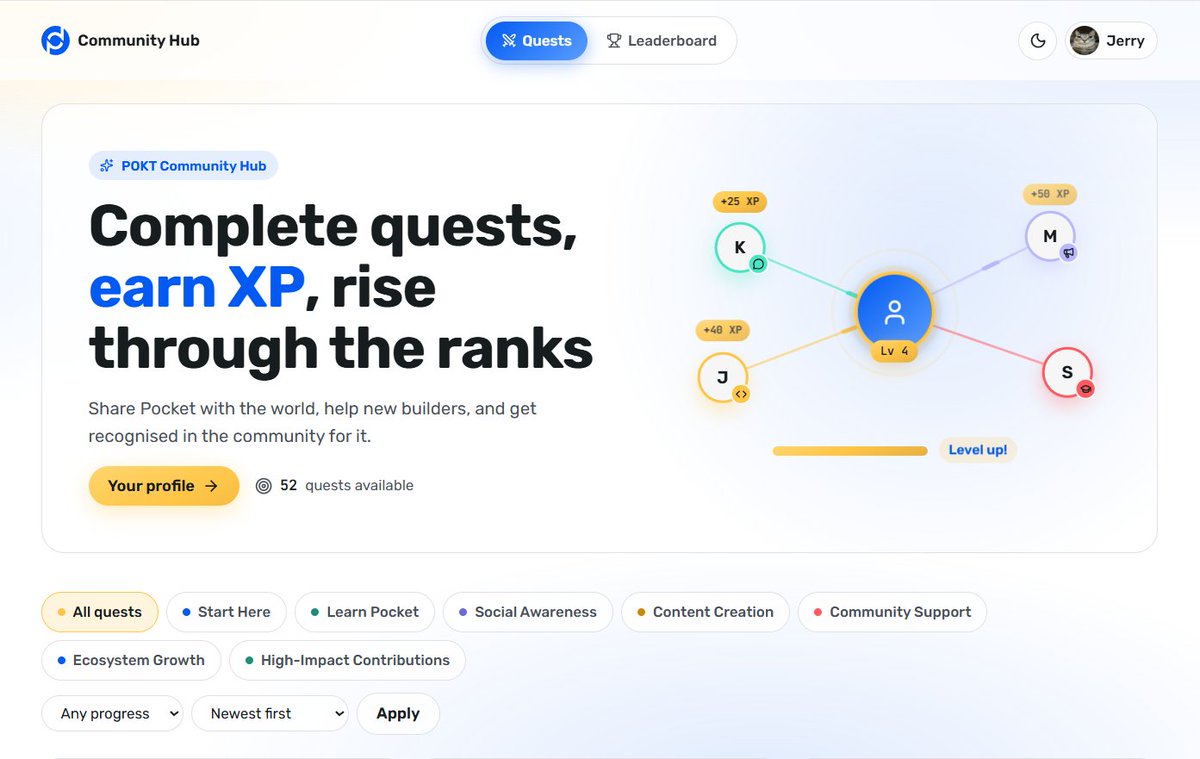
🚀 The Pocket Ambassador Program is officially back!
Our new Community Hub is live, with 52 quests across 7 categories and 30,000 base:0x764a726d9ced0433a8d7643335919deb03a9a935 in relaunch rewards up for grabs.
Complete quests, contribute to the ecosystem, earn XP, and climb the leaderboard.
📅 November 9–29
🏆 Winners announced November 30
Get started: https://t.co/hA6pabB2pj
🚀 The Pocket Ambassador Program is making a comeback!
A brand-new Community Hub is almost here.
✅ Complete quests
🌐 Contribute to the ecosystem
🏆 Earn XP & climb the leaderboard
🎁 30,000 POKT in relaunch rewards!
📅 Targeting Monday, November 9.
Stay tuned! 👀
✅ Pocket Network Mainnet Upgrade: v0.1.36 — COMPLETE
Mainnet is running v0.1.36. The chain halted at 982867 (13:14 UTC) and resumed on the new binary about 3 minutes later. Blocks and settlement are normal.
Release notes: https://t.co/zk3eKryAas
Suppliers: make sure you run a v0.1.36-compatible RelayMiner. Older versions get their proofs rejected and are slashed. Thanks to everyone who made this upgrade super smooth! 🙏
Yep, we saw an expected dip in traffic as teams scrambled to mitigate security issues this week, but it's starting to go back up now. Big shout out to our heroes @ottoevc and @OverlordYorch for their work this week handling the fires.
p.s. even during major hacks this week like the Initia Network exploit and PHP2Shell which impacted up to 80% of all users, most markets are down generally all across as everyone is attending to these matters and their impacted equipment/etc.
still...
@POKTnetwork
https://t.co/9YLENVsJYP still strong.
just barely dipped under 4k requests for 1 day.
Contest winners from the most recent Hackathon announced today. More STELLAR services coming onboard very soon!
base:0x764a726d9ced0433a8d7643335919deb03a9a935
Grateful beyond words for the support from the @POKTNetwork community.
Thanks for the win!
I hadn’t really built much before this. I’ve always been more of a thinker, someone who approaches problems from outside the box by nature, but turning those ideas into actual working ideas felt out of reach.
The people here gave me the space and patience to slowly step out of that shell, understand what I was talking about, and then apply that same outside the box thinking to something concrete.
The jump from “non-technical person trying to code” to actually shipping something was humbling.
Traditional coding meant constantly fighting syntax, not knowing why something broke, and feeling like every step required knowledge I didn’t have.
With @claudeai it was different — closer to vibe coding. I could describe the idea, the constraints, and the weird angles I was seeing, and get something back I could actually work with.
Even then it wasn’t automatic. Verifying the output, understanding what the code was really doing, fixing the gaps the model missed, forget about, skipped, or just purposely wrote errors into, and making it hold up in a real environment still took real effort.
The difference was that my strength in thinking through problems and questioning assumptions became useful instead of just abstract.
Huge thanks to @frenzo, @MzyngaTech , and @ethoggy especially. The constant encouragement, the genuine questions, and the shared drive to just keep building made a bigger difference than I can properly say.
Still feels a bit unreal that I got recognized with a spot in the hackathon. Forever grateful to everyone who’s been part of this — you’ve made the process of learning and shipping feel a lot less lonely. 🙏
I found my peeps for sure.
Still building......
on base:0x764a726d9ced0433a8d7643335919deb03a9a935
P.S. I went from 7th place, to 3rd place, and you know what I am gunning for next.
Always TLDR.
Building something from scratch is harder when you cannot yet see the final product clearly. You may have a goal in mind. But.
That has been one of the biggest lessons while working in general beyond my skill set.
Testing prior to further building exposed the problem: some checks confirm economic information, while others only confirm that our systems are working correctly.
Price comparisons show that our value is within tolerance of another source. They do not prove full independence, especially when providers may rely on overlapping market data, which in many cases due to crypto adoption, is still overlapping.
Testing early saved us from building more work on top of a weak foundation.
We are redesigning the core responses of the oracle so every check clearly states:
What it proves
What it does not prove
Which block and timestamp were used
Which sources were consulted
How independent those sources really are
What threshold defines agreement
Whether the result is reproducible and signed
Evidence-backed — every claim is supported by recorded evidence.
Independently verifiable — another party can check the result without trusting your system alone.
Reproducible — the same inputs and method can recreate the result.
Auditable — the process, sources, conflicts, and changes are preserved for review.
The goal is to make uncertainty visible, preserve disagreements for review, and ensure that the scoring layer never hides conflicting evidence.
This is the kind of infrastructure we are building on base:0x764a726d9ced0433a8d7643335919deb03a9a935 for the agent economy: data that can be retrieved, checked, reproduced, and trusted by both people and machines.
Test the foundation before scaling the building.
It may feel slower at the beginning, but it prevents much larger rebuilds later.
And always stick to your core values.
Evidence-backed — every claim is supported by recorded evidence.
Independently verifiable — another party can check the result without trusting your system alone.
Reproducible — the same inputs and method can recreate the result.
Auditable — the process, sources, conflicts, and changes are preserved for review.
@POKTnetwork
I didn't start as a dev. I joined Pocket Network as a creator, watching builders bring ideas to life.
Seeing what was possible made me want to construct this future, not just observe it.
Pocket gave me the space to build. Here’s my journey to launching Schemify: 🧵
Want your agents keeping an eye on the action at @infiniFi ? Now they can. 23 routes including yields, farms, opportunities, and votes. Test it for yourself:
https://t.co/XwAOcO5s2z
PMIC Macro Signals on the Agentic Portal: 26 scored briefs (inflation, labor, rates, housing, energy, bank health) built from 323 official series (FRED, BLS, IMF, World Bank, ECB). Each returns a 0–100 score with trend, drivers and sources.
https://t.co/Xoy2kZX4TW
TLDR.
Today we shipped Build A of the https://t.co/MZTPvP04h9 Scoring Service to MainNet.
@poktnetwork
This is more than a scoring update.
It is another step toward building our own continuously maintained financial-data system for crypto treasuries—one that does not depend on a single explorer, vendor, API, or convenient data pathway to know what is happening.
All 22 protocols passed Beta testing before the MainNet release. The collector now performs self-checks before publishing data, so it can identify incomplete responses, stale values, missing addresses, and other problems before they become part of a score.
For on-chain holdings, the collector can now read wallets directly from:
Base
Arbitrum
Polygon
Avalanche
BNB Chain
That matters because explorers are useful, but they are not guaranteed infrastructure. They can be rate-limited, incomplete, unavailable, or unable to display a particular token correctly. When an explorer does not respond, the system can query the chain directly instead of stopping at the first unavailable data source.
We also hardened deployment. The deploy script now stops rather than accidentally issuing a new access token. Small operational protections like this are important when a service is continuously collecting data and serving paid, on-demand responses.
We then began Build C, which adds a formal rule for debt and obligation visibility.
A protocol does not receive full credit simply because someone found a recent report. We now distinguish between:
Obligations that are adequately disclosed.
Obligations that are only partially visible.
Obligations for which there is insufficient recent evidence.
Protocols with incomplete but usable debt reporting receive a 10-point deduction rather than being treated as if their liabilities were fully known.
Using that framework:
Origin received its first score after we researched and recorded its debt positions.
Synthetix was documented separately, including its large sUSD payback. Because that repayment is planned through future SNX issuance rather than current treasury assets, it is treated primarily as future-token dilution and supply risk rather than an immediate treasury deduction.
Euler and Silo remain without scores until newer obligations evidence is available.
Silo’s Stream claim is not being misclassified as Silo protocol debt.
We also added annualized income and spending figures where the evidence was sufficient:
📈Sky: approximately $166.3M annualized inflow versus $40.6M annualized spending.
📈Lido: approximately $31.9M annualized inflow versus $43.8M annualized spending.
📈Aave: $75.6M annualized income using its most recent quarterly pace.
For Aave, we deliberately used the conservative figure. Quarterly income declined from $37.9M to $24.6M and then to $18.9M. Using the latest quarter multiplied by four is more appropriate for forward-looking replenishment and runway analysis than using an average that assumes the earlier, stronger quarters will return.
We also changed the pricing architecture.
CoinGecko is now the primary market-price source, with CoinMarketCap as the backup. But many DeFi positions are not directly priced by either provider. Vault shares, lending receipts, and similar positions are therefore valued using their own on-chain exchange rates where possible.
The system flags positions that have only one usable price source. These are not silently treated as equivalent to fully corroborated prices. They receive an evidence-risk flag and, where appropriate, a valuation haircut or lower confidence classification.
The yETH Recovery vault was also found at two Yearn addresses. For now, it is being held as pending formal YIP-90 classification rather than being counted as freely liquid treasury capital. The system will not treat an asset as liquid simply because a wallet balance exists.
Every change was tested on Beta before going to MainNet. The headline scores remained stable:
Yearn: 76
Aave: 44
That stability is important. The goal is not to manufacture score movement. The goal is to improve the evidence, coverage, reproducibility, and honesty of the result.
The work in progress is Build B.
Build B creates a shared price bank on the backend. Prices are collected, normalized, versioned, and continuously saved. A signed copy is then sent to the hub so on-demand requests can use a known, auditable price snapshot instead of rebuilding the entire market-data process from scratch.
Build B will also add on-chain pricing for:
Curve LP tokens.
Uniswap LP positions.
Balancer LP tokens.
The hub side is already deployed for testing.
This architecture lets us price and preserve the data continuously, then serve paid agentic responses on demand. A request does not need to wait for the entire research process to begin from zero. It can use the latest validated snapshot, show when the data was collected, identify what changed, disclose any gaps, and trigger a fresh reconciliation only when the request requires it.
That is the larger objective:
Build an independent, continuously checked treasury-data system that can use public sources without becoming dependent on any single public source.
The system is designed to know not only what it believes, but also:
Where the number came from.
When it was observed.
Whether it was independently corroborated.
Whether the asset is actually liquid.
Whether obligations are visible.
Which values were estimated.
Which data was unavailable.
What changed since the previous snapshot.
How confident the final score should be.
The scoring service is the output. The more important product is the evidence and valuation infrastructure underneath it.
Building our foundational layers.
base:0x764a726d9ced0433a8d7643335919deb03a9a935