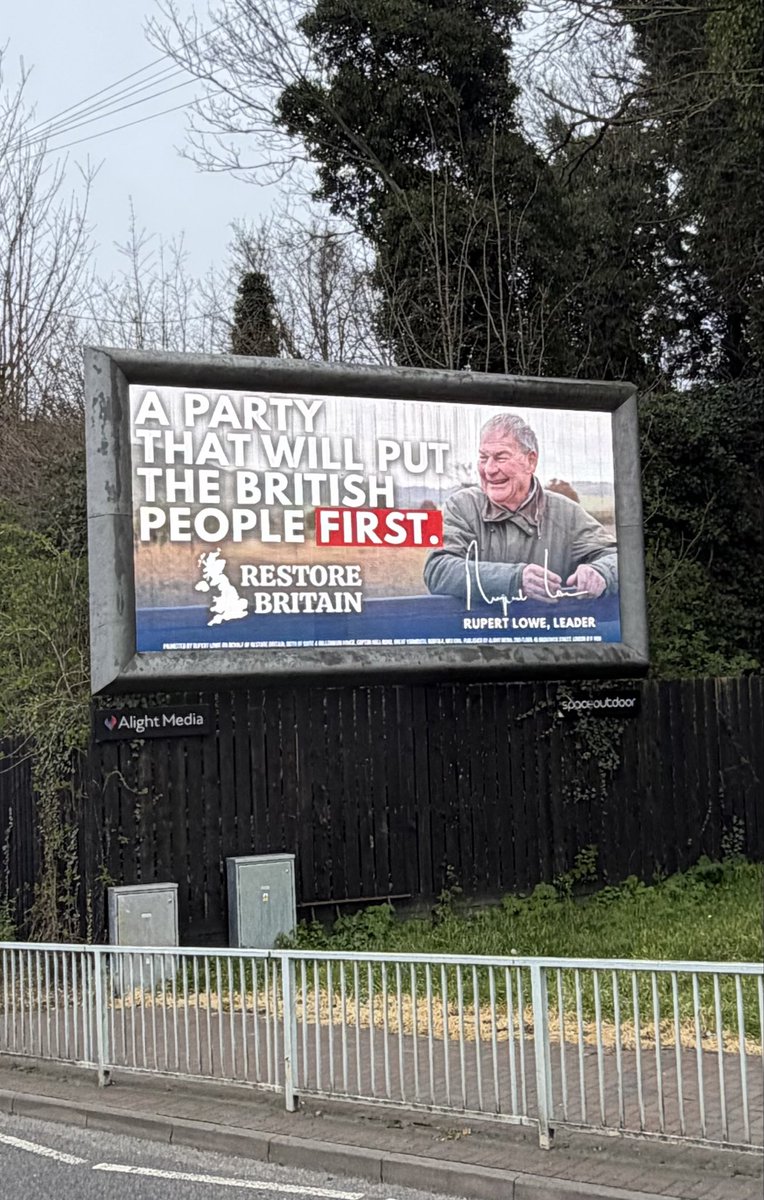
@WorldByWolf The point is to increase name recognition whilst having effectively a media blackout to force the blackout to stop. As well as forcing polling companies to prompt them.
@angloid0@MrHreviews I think that if they ran they obviously wouldn't win, but if they finish third or forth, it might force the pollster's to start prompting Restore, which may be the point.
@torfaencouncil why are your election workers in the polling station not asking for ID? They are just asking name and address but when I offered photo ID to prove it they said it's not needed. I could have used anybody's name and address in that ward and logged a fraudulent vote.
@PaulEmbery@BasilTheGreat This is naive. Starmer will and has put considerable pressure on the CPS to prosecute alongside thier standard ideological proclivities. To think they are impartial is the wrong assesment.
The police will arrest on any claim they think CPS might prosecute on.
A lot of chatter about ancestry, identity, and what being British means over the weekend.
I am not a Restore Britain spokesperson. I'm a supporter, hopeful about the prospect of an authentically anti-establishment political party run by good men I know.
Rupert has made Restore Britain's position clear. That is the position I will vote for.
Here's my personal position:
I am neither an ethno-nationalist, nor a civic nationalist.
Civic nationalists say being British is a matter of having "British values", or of being born in Britain without holding those values, or of being given a British passport without being born here or having "British values." And you don't stop being British if you commit a horrible crime which violates "British values". Totally incoherent.
Ethnonationalism has become a bogeyman for civic nationalists. What unsettles people about ethnonationalism are the people who say anyone, regardless of their good character and relationships with native British people, should be expelled from the country based on their ethnicity.
That is not my position.
My position is that Britain is not a nation of values. Being British is not just a matter of having a British passport.
The English, Scottish, Welsh, and Irish are ethnic groups. To count yourself among them, you have to have at least one English, Scottish, Welsh, or Irish parent.
Heritage is an important part of national continuity. Nations are built upon, as Paul Moreland says, ‘The myth of common ancestry’, which modern science can validate through DNA tests.
Culture is most commonly passed down from parent to child. As Bernard Yack points out in Nationalism and the Moral Psychology of Community, if you break that chain of lineage, through rapid demographic and cultural change, then you sever the horizontal bonds of solidarity and belonging that keep a society together.
As Orwell wrote, English civilisation "is continuous, it stretches into the future and the past, there is something in it that persists, as in a living creature. What can the England of 1940 have in common with the England of 1840? But then, what have you in common with the child of five whose photograph your mother keeps on the mantelpiece? Nothing, except that you happen to be the same person."
To remain a family, its members have to be related. People can marry in, but you can't replace all its members and remain the same family. You can't remain the same nation if you replace all of its families.
The constituent nations of the British Isles have never been propositional. To be British meant to belong to the political union of England, Scotland, Wales, and (now Northern) Ireland. To belong to those nations, you had to be part of an English, Scottish, Welsh, or Irish family.
These are facts. This is not "ethno-nationalism." Otherwise, George Orwell, Rudyard Kipling, and Winston Churchill were "ethno-nationalists" by this definition.
This is the same standard practised in Israel. And if it's good enough for them, then it's good enough for us, too.
This was not controversial until very recently. Britain was demographically and culturally homogeneous until the post-War period.
As Ed West wrote about in The Diversity Illusion, 90 per cent of Brits in 1927 could trace their ancestry back to 927, when King Æthelstan of Wessex conquered the last remaining Viking kingdom in York.
The Norman Conquest left less than a 5 percent genetic imprint. The oft-cited handful of Jews and Huguenots who moved here were so few in number, caused no trouble, and so weren't worth worrying about. We have never been "a nation of immigrants".
So, "British" when used for those of immigrant heritage was shorthand for "One of us", or "In our club." They were considered "basically British" because they were our friends, fit in well enough, and passed the social tests for belonging to our tribe.
It is only because we have had more immigration, unwanted and from distant lands, with no requirement to fit in, since 1997 than between 1066 and the Second World War, that we're even having this conversation.
A set of legal and political decisions, following the fall of the British Empire, muddied the waters. It separated British identity from national identities, declaring anyone with the appropriate documents is as British as I am.
Those passports have been handed out like participation trophies. I don't think we should be giving out any new citizenship grants for the foreseeable future. And plenty of people who have been given them, who hate us, our country, and our way of life, should have them rescinded and be sent on their merry way. As Rupert said, millions must leave.
If we got to that place, this wouldn't be a problem.
But the conversation is coarse and contentious because people, quite rightly, feel their backs are against the wall and that we will be persecuted minorities in our own country by 2063, if not sooner.
I don't endorse any inconsiderate or cruel conduct. Never have, never will. I don't act that way.
What I think most people are asking when they say "Is my friend (of immigrant heritage) British?" is, "Are you going to mistreat my friend because of their heritage." And the answer to that is no. I don't in my personal life, and so I don't advocate for any political platform that would.
To be clear: being English, Scottish, Welsh, and Irish is a matter of ancestry. Being British is still a matter of belonging to one or more of these nations.
We may choose to consider people of other ancestry "basically British" because they are our friends, we love them, and they have done more than just hold a British passport. I know people like this, as I'm sure you do to.
On the topic of representation:
The primary concern of any political party should be the British people. That doesn't mean rejecting support from our friends with foreign ancestry. It simply means not pandering to various imported ethnic and religious groups.
The price of Admission to 10 Downing Street should not be appeasing sectarian "communities", but currently all parties (bar Restore Britain) do this.
And immigrants and their descendants, who recognise that British people possess the primary claim to their country, agree. If they wanted to be governed by foreign people and cultures, they could move to the countries already owned by them. They don't. They want to belong to Britain, and be governed by British people. And I agree.
Foreign nationals should not vote or stand in our elections. Per the 1948 and 1981 British Nationality and Representation of the People Acts, they can. They should be repealed and replaced.
Who should be eligible to stand in elections?
I expect Restore Britain will say that only British nationals, born in Britain, should be able to stand as MPs. The same standard as the Act of Settlement 1701. The same standard that the United States has for who is eligible to run for President. It seems like the most sensible compromise.
I would say the same standard should apply for eligibility to be employed by the civil service. If you're dealing with the business of state, your loyalties cannot lie elsewhere.
I said previously that it would be reasonable to bar people without any English, Scottish, Welsh, or Irish ancestry from elected office. I said that I like Suella Braverman, having met her on a few occasions, and I believe she tried to do the right thing while Home Secretary. But for every Suella, there is a Naz Shah, Aspana Begum, Sayeeda Warsi, Yasmin Qureshi, Iqbal Mohammed, Ayoub Khan, Priti Patel, Sajid Javid, Rishi Sunak... and so on.
Politicians who spend their time lobbying for the sectarian ethnic interests of their section of the Indian Subcontinent; who lobby for preferential treatment for India or Pakistan in trade deals and foreign policy; who push for more migration from their nations of origin; who campaign more on Gaza or Kashmir than their own constituencies; who deny the Pakistani rape gangs or downplay the threat of Islamic terror, out of a tribal sense of solidarity with the community that produces the perpetrators...
I said that a constitutional change to prevent such MPs from turning Parliament into a patronage network for biraderi clans and foreign "communities" would be imperfect, but acceptable.
It doesn't mean the children of immigrants can't be good politicians. But most have not put the British people first, above all others.
No party is proposing that policy. I simply said I would support it, as an imperfect and precautionary measure, even if it excluded good people from standing as candidates, because it would minimise the risk of ethnic nepotism, patronage to immigrant groups, and the privileging of foreign countries (like India and Pakistan) by immigrant-heritage politicians.
And as far as religion is concerned:
We are a Christian country. Private observance is a matter of individual conscience. But the state shouldn't be giving funding or a public platform to foreign faiths and cultures.
No, you shouldn't be using Parliament to lobby for your religion's interests. I don't care if you're Muslim, Hindu, Jewish, or Sikh. This is Britain, and we do things according to our culture, inextricably based on the Christian faith. If you don't like it, move somewhere else. There are plenty of countries that do things differently.
Some of the outrage about this has been driven by people who feel such a standard would threaten their political career. It hasn't been driven by good-faith fears that they or their foreign-heritage friends might be mistreated — a fear I hope I have allayed here.
I would remind them that this isn't about you. It's about fixing the country. I don't want to be an MP. I don't care if you do. In fact, if you're so desperate to be one that you demand we make special concessions for you, then you're the last person I would want in power.
So, to recap:
> I am neither an ethno-nationalist nor a civic nationalist.
> The English, Scottish, Welsh, and Irish are ethnic groups.
> Being British has meant belonging to the nations of England, Scotland, Wales, and (Northern) Ireland.
> We might extend "British" identity to those of foreign heritage who are our friends and fit into our tribe. But people are less inclined to do so, because "British" has been rendered meaningless by post-War civic nationalism and mass migration.
(The category might not have as hard a border as some would like, but Orwell and others observed that easy-going hypocrisy is a very English trait.)
> The British people deserve primary concern and representation in their own national politics.
> Foreign citizens should not be able to vote. Those born abroad should not be eligible to stand in elections.
> We should not spend political time and energy pandering to foreign faiths, cultures, and "communities". It is just as sectarian when the Conservatives do it to Hindus, and Reform do it to Sikhs, as when Labour and the Greens do it to Muslims.
Hope that clears that up.
10.9 million abortions - 10.7 million immigrants. In Britain we're welcoming in people from other lands to replace the children of our own we've killed.
it was not invented as a non-ethnic term. The act of union in 1707 was followed in 1714 by the formation of The Most Honourable and Loyal Society of Ancient Britons which was for ethnic Welshmen. It was known at that time as the ethnonym of the Iron Age population and those who descend from them
@pegobry_en The Plantagenet's did a good job I will grant you that. However the British Empire was Anglo driven and clearly eclipsed their achievements.