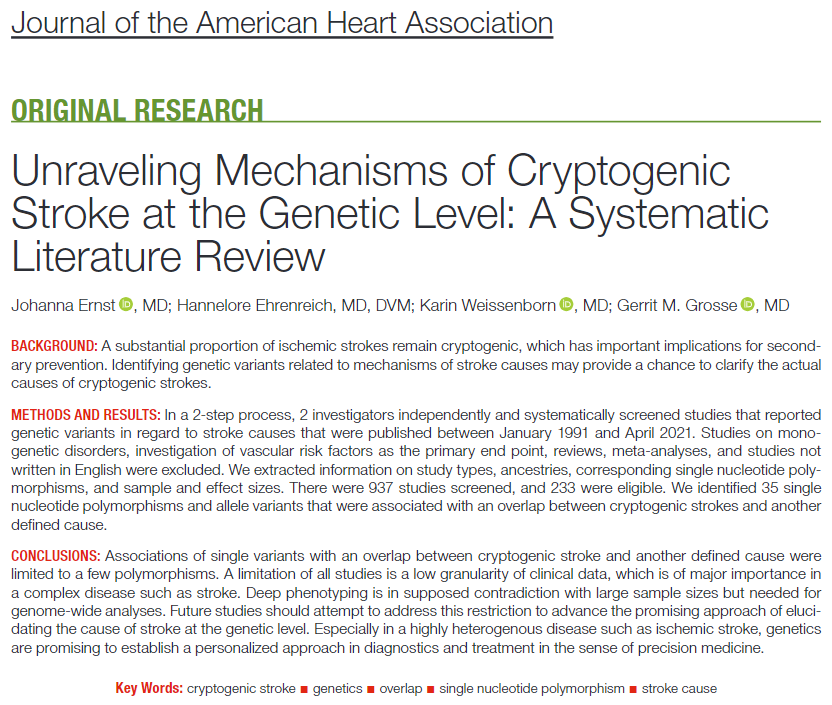
Just published in @JAHA_AHA: https://t.co/TwcWkZotYZ
In this systematic literature review, we provide an overview on the current evidence on how genetic variants may help to elucidate the actual mechanism of cryptogenic #stroke. @Johanna_Ernst_ @MHH_life @PRACTIS_MHH@dfg_public
Just published: ADAMTS-13 activity in stroke of known and unknown cause. We show that ADAMTS-13 activity is inversely correlated with the number of vascular risk factors across different stroke etiologies. @MHH_life @PRACTIS_MHH@FrontNeurol https://t.co/WHqS2XORdC
Unser BREATH-Nachwuchswissenschaftler Jan-Christopher Kamp ist Teilnehmer bei @PRACTIS_MHH, dem Clinician Scientist Programm der @MHH_life 👨🔬 Was er dabei über die vaskulären Veränderungen bei Lungengefäßerkrankungen 🫁 herausgefunden hat, lest ihr hier: https://t.co/Idk2swxs7S
Our CORE100 fellow Dr. Goldschmidt shows that modern working-time-models are possible to combine children and a career in clinic and research. #MHH#ClinicianScientist
https://t.co/BhE9VRsKth
@CorneliaDewald, Becker, Meine retroperspective analysed the percutaneous hepatic perfusion as palliative therapy in patients with inoperable liver metastases. #MHH#ClinicianScientist
https://t.co/eRxWgfe3v5
@TFKaireit already showed, that flow-related enhancement (FREE) is feasable for the lung. @JulianGlandorf transfered that this non-contrast approach to FREE braun perfusion imaging. #MHH#ClinicianScientist
https://t.co/95KCjVdaMz
Lena Becker showed, that the risk of post-interventional spinal cord injury could be better estimated by a deeper knowledge of Artery of Adamkiewicz and amount of collateralization. #MHH#ClinicianScientist
https://t.co/rMLS7Uj6Rj
@Dr_Hensen, @CorneliaDewald discuss the differences in the expectations and preferences of physicians, patients and medical layments during descision making.
#MHH#ClinicianScientist
https://t.co/f5QLoe1dQC
Why do people attempted a suicide by self-inflammation? @nadjim1990 & Khaled Dastagir did analyze epidemiologic characteristics in intensive care burn patients over the coure of 14 years. #MHH#ClinicianScientist
https://t.co/1tREL46fQt
@BastianEngel co-investigates the relationship between acute liver injury and SARS-CoV-2 vaccines. #MHH#ClinicianScientists
https://t.co/mKToQIL0Zx
https://t.co/iwJbjl1Lzq
Read the latest article co-authored by our fellow Lena Becker from the department of Radiology. Angio-CT scan with 3D reconstruction demonstrating the arteriovenous fistula aneurysm. Great work, great collaboration! #MHH#ClinicianScientists
https://t.co/c9p9WWIFcZ
Jan Kamp and co-authors (@BenSeeliger) show that COVID causes secondary lobular microischemia due to microvascular occlusion and the association with increased intussusceptive angiogenesis. #MHH#ClinicianScientists
https://t.co/uQWjx3JFTa
https://t.co/CFYgdrVYos
@Dr_Hensen shows how thermometry using hyperpolarized 129Xe can be used in turbo spectroscopic imaging. #MHH#ClinicianScientists
https://t.co/ibinvg9777
@Dr_Hensen shows how thermometry using hyperpolarized 129Xe can be used in turbo spectroscopic imaging. #MHH#ClinicianScientists
https://t.co/ibinvg9777
Microembolic signal detection using transcranial doppler might have the potential as non-invasive method to evaluate unbalanced antithrombotic therapy in patients with left ventricular assist devices (@gerritgrosse, Ernst & Hanke). #MHH, #ClinicianScientis
https://t.co/CWZNGyXIPe
Our fellow Khaled Dastagir describes a safe, standardized, and reproducible human model for
investigating nerve regeneration processes, aiming to evolve the current "gold standards". #MHH#ClinicianScientists
https://t.co/AsGW1RTr8F