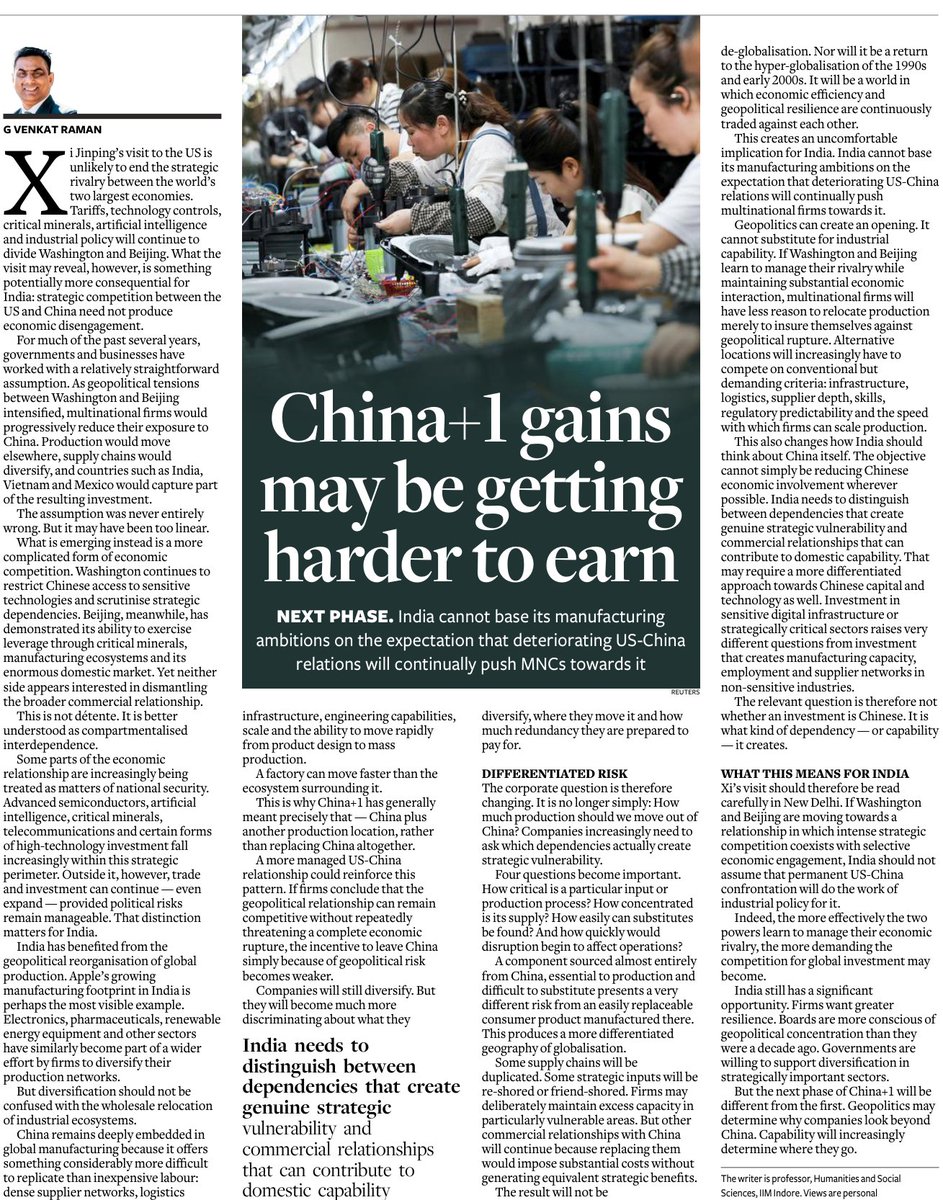
What happens to India if the US and China learn to compete and coexist simultaneously?
One consequence may be visible in China+1. US-China tensions can create opportunities for India, but they will not automatically deliver investment.
As rivalry becomes more managed, firms may become increasingly selective about what they move out of China and where they move it.
Geopolitics can create the opening. It cannot substitute for industrial capability.
For India, attracting factories is only the beginning. The larger opportunity is to build the capabilities and ecosystems around them.
Link: https://t.co/NrPcsldg8l
#India#China#SupplyChains#Manufacturing#Geoeconomics
My recent op-ed in The Hindu | “The paradox of de-Sinification in global production”
Factories can move. Industrial ecosystems are much harder to relocate.
As firms diversify production beyond China, the deeper question is whether supplier networks, specialised capabilities, skills and industrial know-how can move with them.
For India, the implication matters: our China strategy cannot assume permanent US-China confrontation.
Links: https://t.co/HyddNZsmeP
https://t.co/aw2V536coD
Two recent pieces on Xi Jinping’s US visit and what it tells us about the changing US-China relationship:
In The Indian Express | Why the Trump-Xi bonhomie doesn’t mean an end to US-China rivalry
In Moneycontrol | The new US-China equilibrium
The common argument: this is not détente. Strategic competition remains intense, but Washington and Beijing are increasingly trying to manage it — combining rivalry with negotiation, deterrence with dialogue, and economic coercion with continuing interdependence.
China’s push into brain-computer interfaces and Japan’s diversification in satellite connectivity point to a larger shift: countries are trying to anticipate technological dependencies before they become strategic vulnerabilities.
The real test of de-risking is whether dependence on China can be converted into domestic capacity to innovate, manufacture and scale—and ultimately, greater strategic choice.
https://t.co/BIuBxXak3X
My latest essay in The Interpreter looks at three responses to geopolitical fragmentation:
Japanese firms → diversification
Chinese firms → localisation
SpaceX → de-Sinification
I use 'de-Sinification' to mean removing Chinese inputs from the supply chain itself.