PROTECT is a multi-institutional project funded by NIEHS that studies exposure to environmental contamination in PR and its contribution to preterm birth.
This project will pilot a flow-through electrochemical reactor using biomass-derived carbon electrodes to remove & degrade contaminants w/o added chemicals, supporting the transition from lab innovation to field-ready systems. Read more about the work. ⤵️ https://t.co/DlXKJSjs7Z
In February, Project 3 Lead Ingrid Padilla and Project 4 Researcher Fahad Ehsan were awarded a $150,000 Advanced Research Grant from the Puerto Rico Science, Technology & Research Trust to advance decentralized water treatment solutions. https://t.co/DlXKJSjs7Z
ICYMI: The ECHO Opportunities & Innovation Fund (OIF) provides grants to early-career investigators for research introducing new tools & technologies. Materials from this recent #ECHODiscovery presentation from Dr. Linda Adair of @UNC are now available: https://t.co/YB5Ic4QhPg
In March, Project 3 Lead Ingrid Padilla received the Dr. Freeman Hrabowski III Legacy Award for her outstanding contributions in science, technology, engineering, & mathematics across academia, industry, & government. Congratulations, Ingrid! 🎉 https://t.co/SDdbF5xtFr
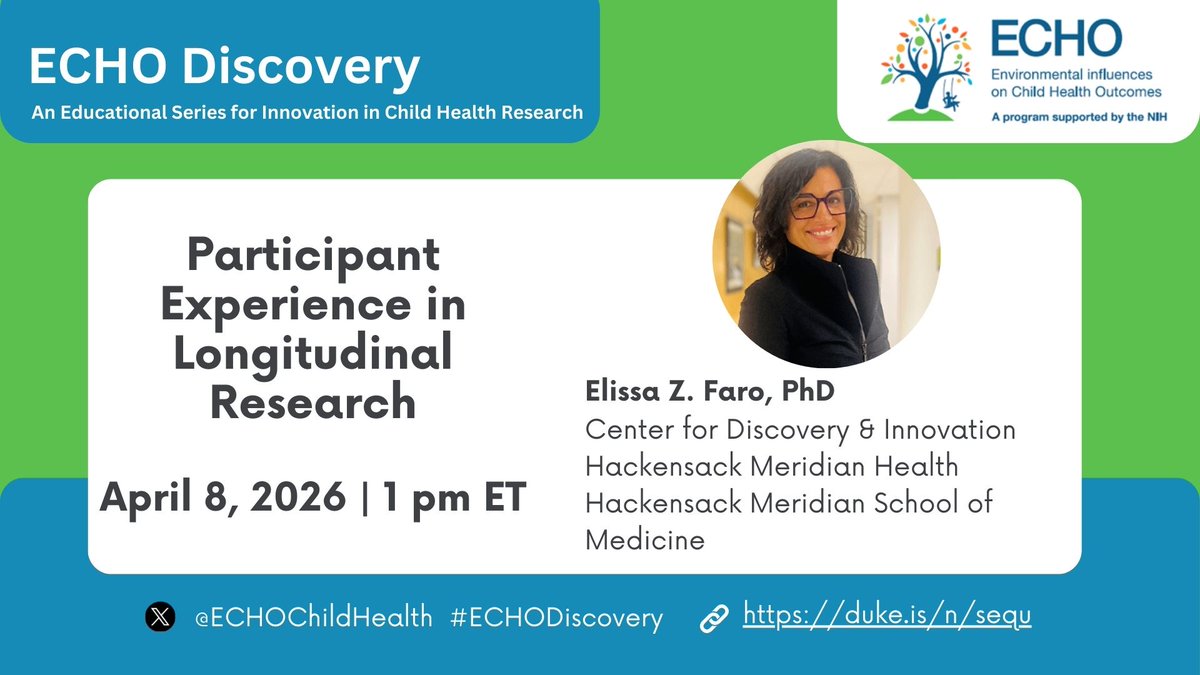
Join us online Wed. 5/13 @ 1 pm ET to see Dr. Linda Adair of @UNC present our next free, public #ECHODiscovery webinar on the ECHO Opportunities & Innovation Fund (OIF) and the accomplishments of OIF awardees: https://t.co/YB5Ic4QhPg
We’re live with opening remarks! #ECHOSymposium2026 kicks off today at NIH & online. Follow along as we explore how science translates into action for children’s health. Join live: https://t.co/I4oR6UXaYc
ICYMI: Many different factors contribute to whether participants in longitudinal studies, like ECHO, report a positive experience. Materials from this recent #ECHODiscovery presentation from Dr. Elissa Faro of Hackensack Meridian Health are now available: https://t.co/0vd1JU2jwQ
ICYMI: Read about a new PROTECT publication describing a multi-year effort led by trainee Zlatan Feric to harmonize birth outcomes and arsenic data across three birth cohorts. ⤵️
A new PROTECT publication led by DMAC trainee Zlatan Feric describes a multi-year study harmonizing and analyzing birth outcomes and arsenic data across three independent birth cohorts, including PROTECT. https://t.co/zeI66yGOj0
Today at 1 pm ET: Join us for a free public #ECHODiscovery presentation from Dr. Elissa Faro of Hackensack Meridian Health Center for Discovery & Innovation on the patient experience in longitudinal studies like ECHO: https://t.co/0vd1JU2jwQ
Read more about the publication and the challenges and benefits of harmonizing environmental health data on the PROTECT site. ⤵️ https://t.co/zeI66yGOj0
A new PROTECT publication led by DMAC trainee Zlatan Feric describes a multi-year study harmonizing and analyzing birth outcomes and arsenic data across three independent birth cohorts, including PROTECT. https://t.co/zeI66yGOj0
Investigators were able to harmonize data and increase sample size across cohorts. However, they faced problems harmonizing certain variables due to cohort-specific social and environmental contexts. This demonstrates the unique challenges of retrospective data harmonization.
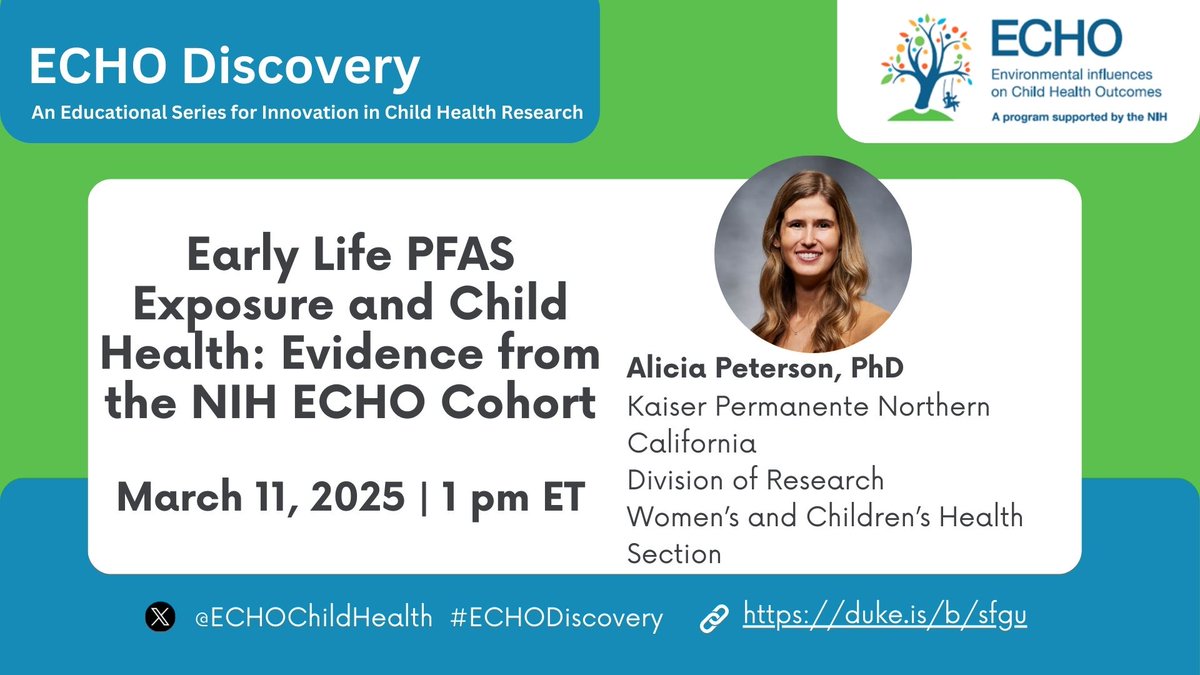
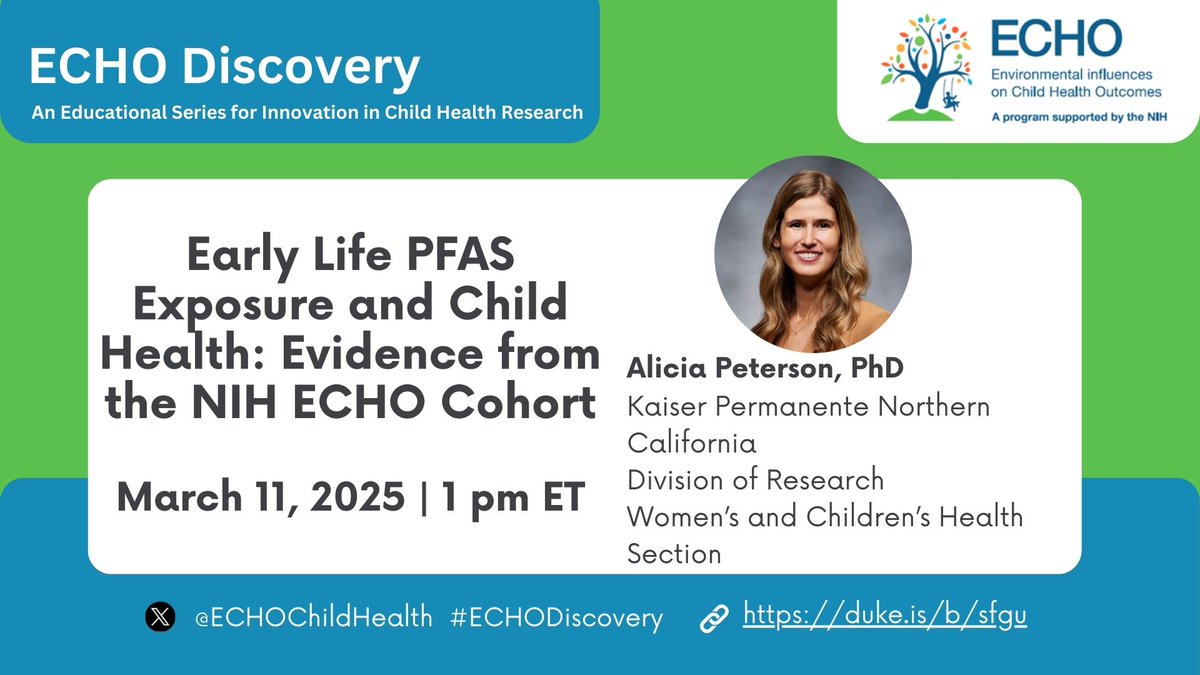
Today at 1 pm ET: Join us for a free public #ECHODiscovery presentation from Dr. Alicia Peterson of @KPDOR on the potential influence of prenatal & early life exposure to #PFAS on a range of #childhealth outcomes: https://t.co/o1u1FHSsML
Exposure to fine #particulatematter#airpollution during the first 5 weeks of #pregnancy was linked to babies being slightly smaller at birth, according to recent #ECHOChildHealth Cohort research. Learn more: https://t.co/x1d1qhE1RV
Join us online Wed. 3/11 @ 1 pm ET to see Dr. Alicia Peterson of @KPDOR present our next free, public #ECHODiscovery webinar on the effects of prenatal and early life #PFAS exposure on #childhealth outcomes: https://t.co/o1u1FHT0Cj
📄 A recent publication led by former Project 4 trainee Amir Taqieddin investigates how the small pores inside granular activated carbon (GAC) particles influence the ability of water to be cleaned in electrochemical treatment systems. https://t.co/TdEWsOeVPy
From this, Amir provides three design principles for developing carbon electrodes: (1) optimize porosity to maximize water access & prevent bubble blockage, (2) optimize particle size to improve mass transfer & reactive surface exposure, & (3) use controlled pore structures.