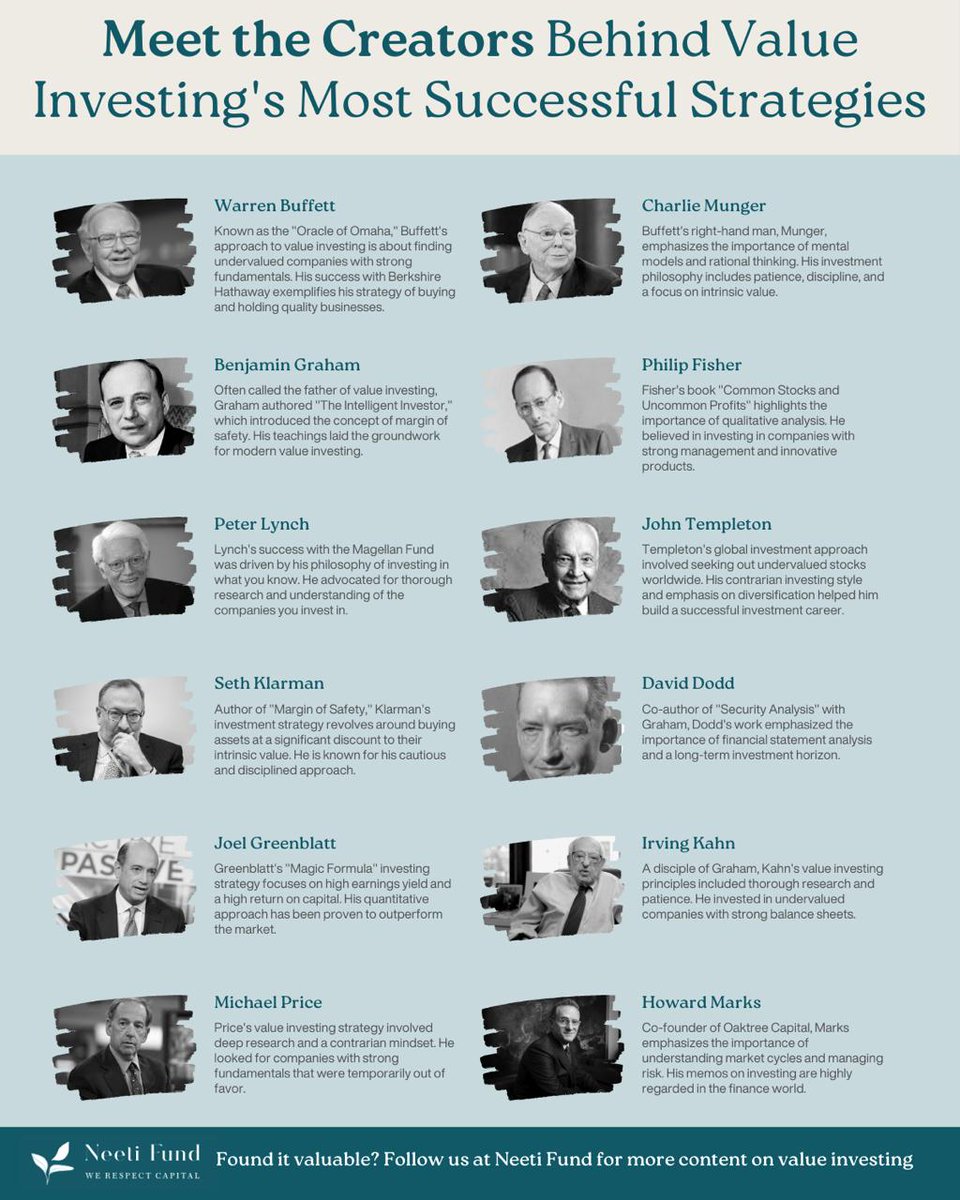
Forget "get rich quick"!
The OG moneymakers of value investing built fortunes on patience & smarts.
Here are the 12 creators behind value investing's most successful strategies:
Every time you log in during a market decline, you face a choice.
Hold or sell.
The right answer is almost always hold.
But the experience of watching the number fall creates pressure that rational analysis alone cannot overcome.
The more you check, the more often you face that pressure.
Buffett's favorite holding period: forever.
That sounds extreme.
Until you see what it produced.
Coca-Cola: bought in 1988. Still held today.
The original investment has multiplied more than 20 times.
Time did most of the work.
Investors who check their portfolios less frequently make better decisions.
Not because they are less informed.
Because they have fewer opportunities to act on short-term discomfort.
Every check is an invitation to interrupt.
The discomfort of watching a position fall is temporary.
The cost of selling prematurely is permanent.
Most investors experience the discomfort.
Few are still invested long enough to receive the permanent gain.
1942. Buffett is eleven years old.
Buys Cities Service Preferred at $38.
Falls to $27. Holds, nervously.
Recovers to $40. Sells. Relieved.
Stock later rises to $200.
He learned what impatience costs before he could drive.
The market does not reward activity.
It rewards patience.
Most investors confuse movement with progress.
Design your portfolio to minimize unnecessary decisions.
Every decision is an opportunity to make the wrong one at the wrong time.
Peter Lynch's Magellan Fund returned 29% per year from 1977 to 1990 - one of the greatest investment records in history.
The average investor in the fund lost money.
They bought after good years and sold after bad ones.
The market rewarded patience.
Not the investors.
The stock market returns ~10% per year over long periods.
The average equity investor earns ~3-4%.
Same market. Same funds.
The difference is not intelligence.
It is interference.
That is the standard Neeti Fund is built around — patient capital, structural patience, aligned managers.
If it resonates, this week's full newsletter is at link in bio.
Subscribe free. One essay a week.
The curve bends sharply upward at the end.
But only for those who are still there.
Most investors are not still there.
They interrupted the compounding when it felt necessary — during a crash, during underperformance, when something else looked better.
Munger's rule is simple. The behavior is not.
Most investors understand compound interest in theory.
They can calculate the numbers.
But they don't feel it.
And because they don't feel it, they don't protect it.
They interrupt it.
Because the short-term discomfort is immediate and the long-term reward is distant.
Forgotten capital is not negligence. It is intentional design.
This week's newsletter explains the difference — and how to build it into your own capital structure.
Subscribe at link in bio.
Munger's rule: "The first rule of compounding is to never interrupt it unnecessarily."
He was not being clever.
He was describing how compounding actually works.
It requires time. Time requires patience.
Patience requires not acting when action feels necessary.