Inspired by @PerishOrPublish, we're stepping up our research-promoting game.
Fill out this form & we'll share tweet-sized findings: https://t.co/AM2ILazd68
No need to be a full paper, but if there is one, we'll link to it or quote your 🧵(or just tag @PSfindings & we'll RT!)
Not only do voters fail to correctly interpret interest group cues, they misuse them: voters assume interest groups agree with *them*, and thus reward politicians for positive ratings from groups they disagree with. #polisciresearch
NEW w @aaronrkaufman & @GabeLenz:
Every political scientist learns in grad school that voters use interest group ratings to help hold elected officials accountable
The problem is...we don't actually know this!
We find reality is not so encouraging...🧵
https://t.co/VaQTkbrUor
On average, voters instead act as if unknown interest groups agree with *them*:
When voters see a supportive instead of unsupportive rating, they infer their MC's issue position matches theirs and say they're more likely to vote for their MC. We call this "heuristic projection"
Does financial aid raise political participation?
@GeynIgor and I use data on 16.4 million FAFSAs and a RD design to show that each of California's 2.6 million tuition-free college awards increased a student's 2020 voter turnout by an average of 4 to 12 percentage points.
In case you were wondering whether the inability to distinguish parties on policies (even major ones like abortion) like in the quoted tweet here is rare -- even right after the 2020 election, ~1 in 3 voters could not correctly distinguish Biden and Trump's positions on abortion:
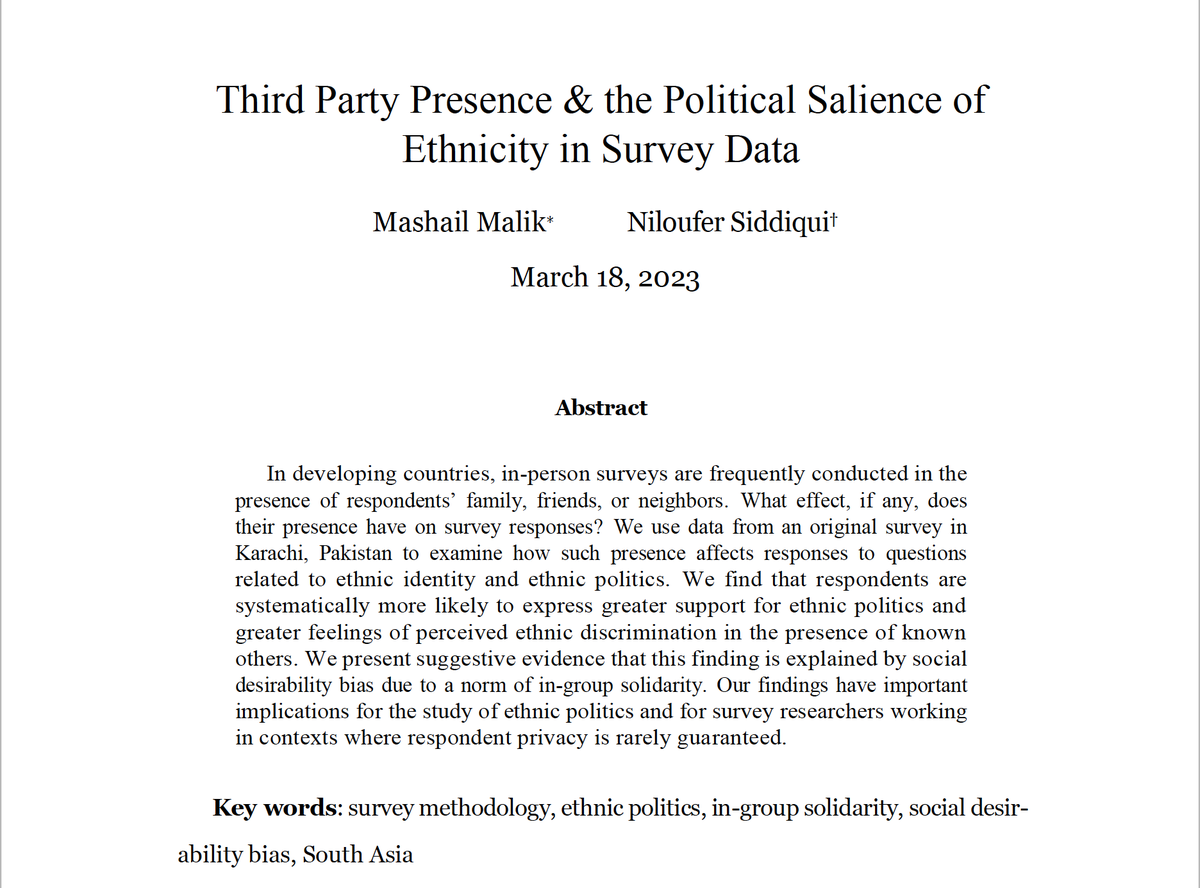
In the presence of others, people more often say that
-their ethnic group is discriminated against
-people should vote for coethnics
- coethnic politicians are more likely to serve their interests
-they fear violence on the basis of their ethnicity
More in 🧵👇#polisciresearch
Such a great new paper by @YamilRVelez on Latinos & issue attitudes. Some highlights that stuck out:
-asking for deeply important issue in own words shows immigration ranks as 8th & 11th "core issue" for Latinos in 2 studies
-non-immig issues outweigh immig in shaping vote choice
Super useful paper from @Matt__Graham on how to minimize information search in online surveys. Apparently a pledge not to cheat can cut it in half https://t.co/Vph3dYHdwN
Why is pro-immigration politics so rare even when public attitudes are positive? My new @BJPolS shows anti-immigration voters always care more about the issue. This creates a political advantage for anti-immigration causes anytime migration is in the news https://t.co/wtK6XboSXU
People learn less about political events when they use platforms where news is more intermittent, short-term, and geared toward brief reviews. #polisciresearch
🔓Open Access🔓 “News snacking & political learning: changing opportunity structures of digital platform news use and political knowledge”
Drs @dscheykopp & @CMothes study the impacts of consuming brief & intermittent news in digital spaces
▶️https://t.co/RrDMbvhujv
@apsa_itp
New lobbying working paper!
Hiring Faithful Agents, Expertise, or Connections? A Conjoint Survey Experiment on Lobbyist Hiring Decisions
with @BCEgerod @hjghassell @DrDRMiller
https://t.co/Vh04l38bis
Now forthcoming at @qjps_editors! @joshmccrain and I show that lobbying firms gain substantial increases in revenue when their lobbyists enter a government position. Larger gains for connections to congressional staff than federal bureaucrats. Preprint: https://t.co/qXkcg5jjci
Cues about political experience indicate competence to people in Switzerland. This advantages experienced candidates electorally.
But providing political experience cues does not crowd out group-membership cues such as candidate migration background. #polisciresearch
It’s disappointing that John Lott’s paper on 2020 vote fraud is forthcoming in *Public Choice*. Justin Grimmer and I wrote a response and asked the editor to reconsider. I want to explain our position and speculate about how this all happened.
A lot of cool findings in our forthcoming @qjps_editors. My favorite: political connections allow lobbying firms to charge more from existing clients - they don't bring in new clients. Political connections may be a premium service. Link 👇👇 #polisciresearch@PSfindings
Legislator speeches were generally negative toward immigration from 1870-1940.
Congress tried to close the border 4 times and was eventually successful.
A shift toward more positive speeches after World War II and perhaps responding to Cold War. #polisciresearch
I have a new paper out @PNASNews with Ran, @jurafsky, @dallascard and co-authors. We trace 200,000 Congressional speeches about immigration from 1870-present. Speeches are:
🔸More positive now than ever
🔸But more polarized by party
https://t.co/5mwda3D0XY
Increasingly, Democratic legislators use positive frames (e.g. families), and Republicans use negative frames (e.g. crime) to talk about immigrants.
Dehumanizing metaphors associated with immigration (animals, cargo, etc.) are more common in Republican speeches. #polisciresearch
Excited to share that our paper on the history of immigration discourse in congress has now been published (open access) in PNAS! https://t.co/PvR6AbI5K8
When tribes manage CWA enforcement, do they use that authority to shirk regulation or enforce more rigorously?
We found tribes with primacy inspected wastewater facilities more than twice as often as those regulated by the EPA--with biggest differences in small systems (2/3)