COVlD Update - July 8, 2026 (US)
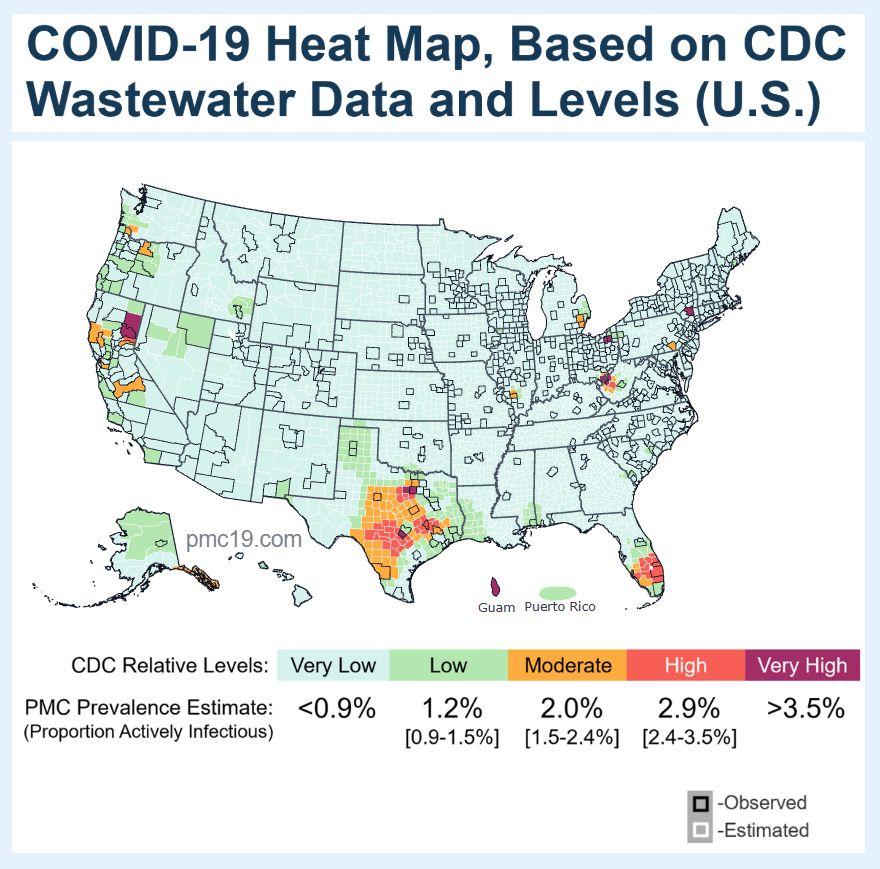
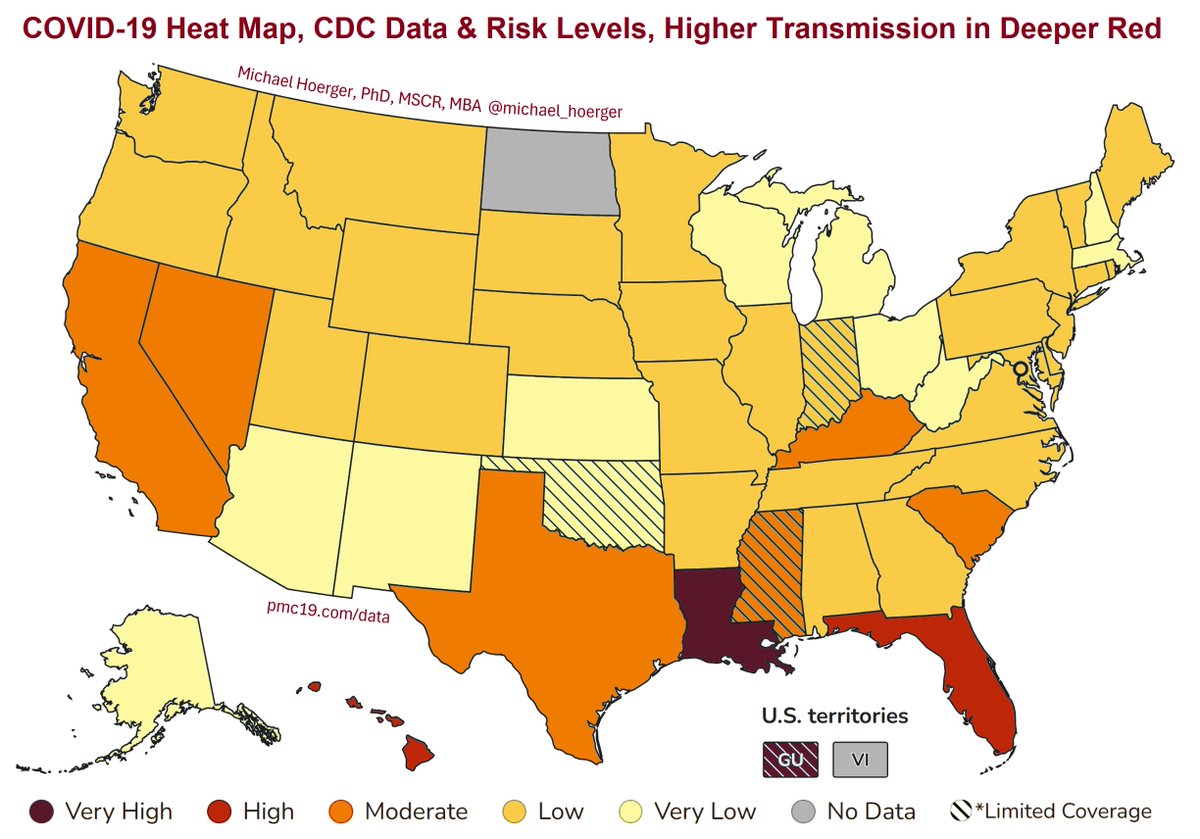
The US has 7 hot spots presently, per CDC data (link in next).
The Texas and Guam outbreaks persist. SE Florida has picked up. Other upticks are more isolated.
Houston:
We are keeping a close eye on Houston. The PMC map is conservative in depicting median very low levels (2 sites very high, 2 low, 4 very low). Harris County (Houston) had 67 sites report in May, but only 8 today, with 5 rising meaningfully to precipitously. The very high levels in the adjacent county of Fort Bend have fallen, whereas the very low levels in the adjacent county of Montgomery have risen quickly. Houston is basically teetering between a wave and a return to calm, and could flip either way (or may have already). With the World Cup, especially, everyone in the area should track this closely and continue to advance layered mitigation. We began encouraging boosters there a month ago.
Florida:
The wave in SE Florida has worsened steadily.
California:
The levels in Plumas (CA) are exceedingly high, similar to 2/3 the level of the national BA.1. Omicron surge. Different dashboards have shown different isolated hot spots across central/northern CA the past month.
Nationally:
Levels are still at their lowest in about 5 years. The states that were picking up early last summer (west coast, HI, Gulf South) have had more isolated or transitory increases thus far, which is a good sign. However, the data are lagging, most recently from June 27. The CDC update on July 17 will be most telling with regard to post-Independence Day increases. If no increase noted by July 24, we would be headed into a different place on COVlD. Any minimizing before then would be premature.
There is no PMC Report this week due to the delayed CDC data. However, the interactive map *HAS* been updated; link in next.
Mitochondria are not just power plants.
They are decision-makers.
They regulate inflammation, aging, and disease.
A quick breakdown:
🔵 Energy signaling, not just energy production
Mitochondria don’t just make energy.
They decide how energy is produced, where it’s used, and when cells change their behavior.
Energy itself acts as a signal that tells cells what to do.
🟣 Inflammation control
When mitochondria are damaged, they release internal components into the cell.
The immune system interprets these as danger signals and turns inflammation on, even without infection.
🟡 Aging regulation
As we age, cells become worse at clearing damaged mitochondria.
These dysfunctional mitochondria build up, increasing oxidative damage and low-grade inflammation that drives aging.
🟢 Why many diseases look different but share the same root
Neurodegenerative disease, heart disease, diabetes, obesity, autoimmune disease, sepsis, and cancer all involve failure of mitochondrial function.
Different organs. Same underlying problem.
🟠 Why “antioxidants” alone miss the point
The problem isn’t just damage.
It’s where the damage happens, why it happens, and whether the cell can remove the broken machinery afterward.
🔴 Why this changes how we think about health
You don’t treat dozens of unrelated diseases separately.
You support mitochondrial health—and multiple systems improve together.
What this all means:
• Mitochondria are control centers, not batteries
• Inflammation often starts as an energy problem
• Aging reflects declining cellular maintenance
• Many diseases are the same biology showing up in different tissues
Health isn’t just chemistry.
It’s how cells manage energy.
And mitochondria sit at the center of the system.
Doi:10.1038/s41392-025-02253-4
Did you know the @CDCgov has official guidance for schools on how to reduce absenteeism by cleaning the air?
It's a hot mess of a website puzzle, so we (Clean Air Allies) created this summary. @cleanairschool
It's great for your school advocacy efforts.
https://t.co/z9Y2ITXczW
Biobot data were also released today and show the same pattern as the CDC data with a large spike in SARS2 transmission.
As of early December, the Northeast (orange) was already approaching its summer peak.
Grateful for @drpatrick raising lymphopenia awareness, echoing my 2020 hypothesis on CD8 apoptosis from Covid
https://t.co/9HXV9UytXV
Early warnings from med students deserve a nod too. Let’s collaborate on curating pieces on the finite nature of adaptive immunity
#NewOrleans remains in a relative "lull" on SARS-CoV-2 transmission at 7% of the recent peak.
Rather than fiddle around with WastewaterSCAN, use the PMC shortcuts. https://t.co/zdZ2Ghm33j ➡️ click on the WastewaterSCAN link.
Replace "louisiana" with any state in lowercase.
We’re now in the 6th year of the COVID-19 pandemic.
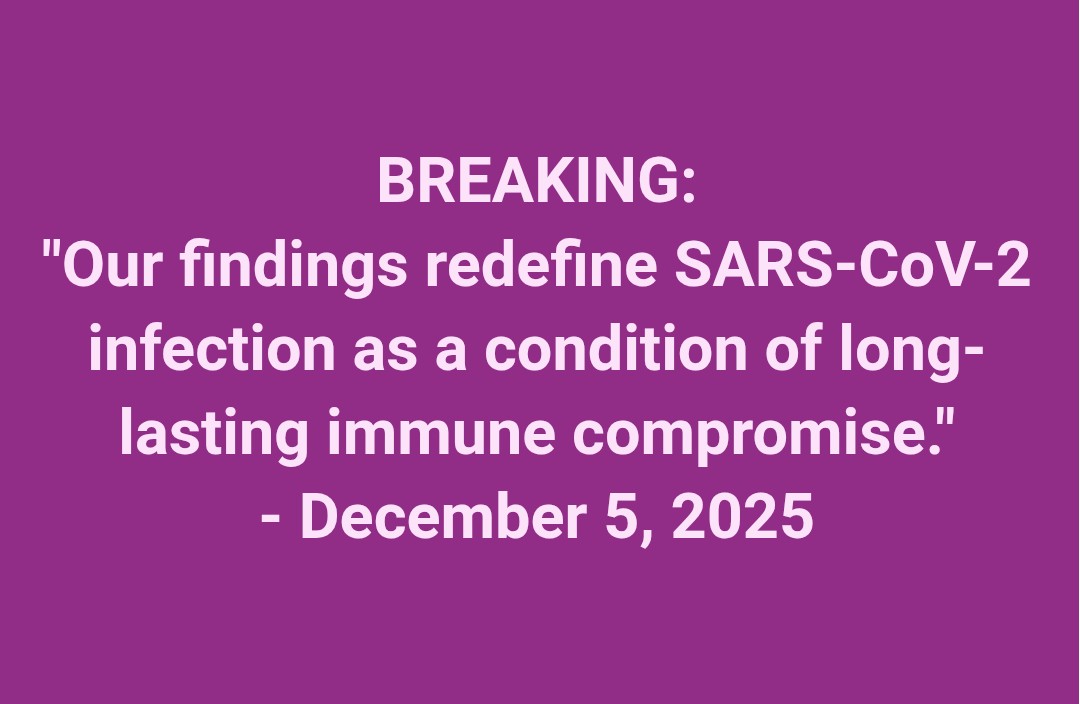
➡️ What began as a respiratory illness has evolved into something deeper — a prolonged impact on the immune system.
This is what some call the ‘Leonardi Effect’, after immunologist @fitterhappierAJ
➡️ He warned early that SARS-CoV-2 could hyperactivate T-cells — the cells that drive our immune defense.
This overdrive may:
• Cause tissue damage
• Exhaust T-cells
• Reduce immune memory
• Leave us less protected against future infections. 1/
“I think there’s a collective amnesia right now about COVID-19”
SARS-CoV-2 infections have been rising in the past month, and limited surveillance is hampering health strategies
https://t.co/gtjbgcPXhD
PMC COVlD Update, Oct 27, 2025 (US)
Transmission typically accelerates in mid-November.
We are currently in a relative 'lull.' We estimate about a quarter-million new daily infections with 1 in 185 people actively infectious. Still bad, likely to get worse.
1/9 🧵
PMC COVlD Update, Oct 20, 2025 (U.S.)
Transmission (red) was closely tracking two years ago (yellow), but not anymore!
The current pattern does not fit with any prior year. This will make for a less predictable winter.
🧵4/11
New study: SARS-CoV-2 doesn’t just lower white cell counts - it reshapes the T-cell landscape. Both the numbers and the quality of T-cells drop, especially in older and severely ill patients. And this has consequences. 🧵
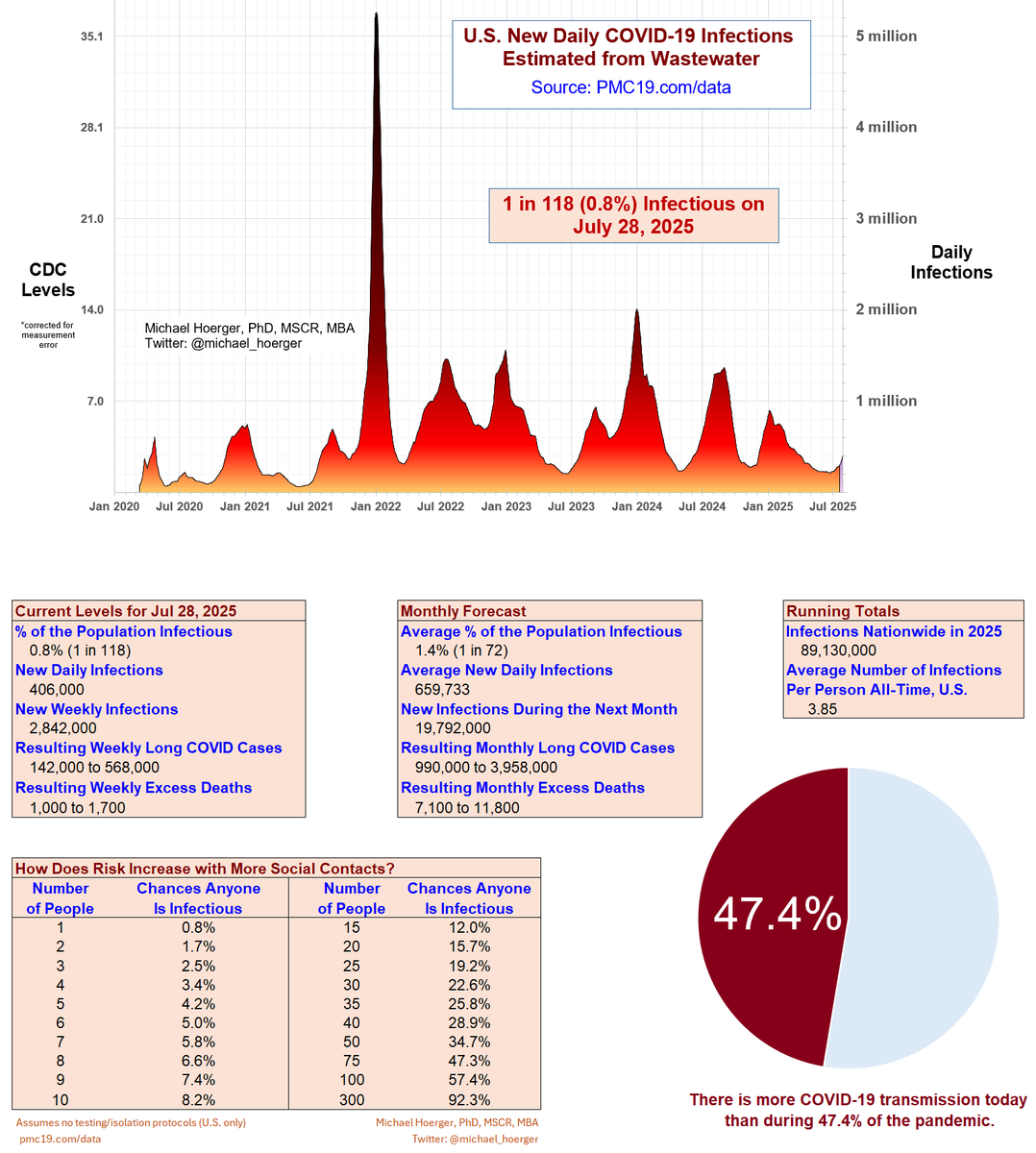
PMC COVID Dashboard, July 28, 2025 (U.S.)
🧵7/12
Today you experienced a typical day in the last 5.5 years of the pandemic, with transmission higher than 47% of days, and lower than 53%.
Typical means that in a room of 35 people, there's a 1 in 4 chance of exposure.