I had several people ask about how the IR-SENSE film works with smartphones. This video by @RogerSeheult offers a great summary and a direct link for the discounted @medcram price. https://t.co/2eCg4gx1A7
The light spectrum we are exposed to at any given time is a collection of light from all sources around us.
As long as we have NIR enhanced light bulbs installed or regular glass windows, then the indoor spectrum will be more or less balanced between visible light and infrared.
The light spectrum we are exposed to at any given time is a collection of light from all sources around us.
As long as we have NIR enhanced light bulbs installed or regular glass windows, then the indoor spectrum will be more or less balanced between visible light and infrared.
Recent article from Scientific American. @MitoPsychoBio
"Could disruptions in the flow of energy through mitochondria cause everything from type 2 diabetes to Alzheimer’s?"
https://t.co/daUpTYHIF4
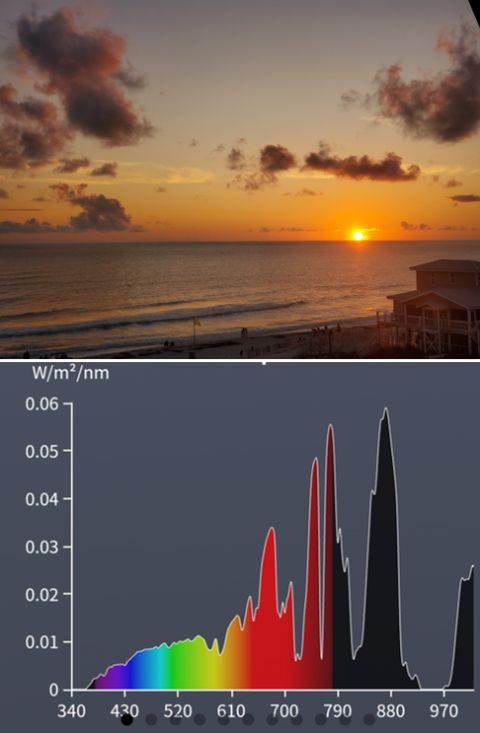
Spectrum of the sunset over the ocean.
When the sun is low on the horizon, sunlight travels through more of the atmosphere, and the blue light is significantly scattered, leaving mostly the longer red and near-infrared (NIR) wavelengths.
The red/NIR absorption (telluric) lines are also stronger because some of the longer wavelengths are further attenuated by more water vapor and oxygen in the Earth's atmosphere.
According to available comparisons, an LED with IR-CAP produces more beneficial NIR (650-950 nm window) per watt than an equivalent-power incandescent. Thus a lower-wattage LED+IR-CAP (typically well under 60 W) can match or exceed a 60 W incandescent’s output in that key range. Total longer-wave IR/heat remains lower because LEDs convert energy more efficiently overall. Exact figures vary by bulb design.
Spectrum of the sunset over the ocean.
When the sun is low on the horizon, sunlight travels through more of the atmosphere, and the blue light is significantly scattered, leaving mostly the longer red and near-infrared (NIR) wavelengths.
The red/NIR absorption (telluric) lines are also stronger because some of the longer wavelengths are further attenuated by more water vapor and oxygen in the Earth's atmosphere.
@RosalitoEhs@Anti5GWarrior@grok No. You need to add dedicated IR LEDs plus additional electronics inside the bulb to use it for Li-Fi. These type of bulbs are not suitable for such purpose.
@RosalitoEhs@Anti5GWarrior Only the USB/DC-powered NIR enhanced LED lamps have zero flicker. Any bulb than runs on AC (Alternating Current) will flicker, including incandescents.
Recent article from Scientific American. @MitoPsychoBio
"Could disruptions in the flow of energy through mitochondria cause everything from type 2 diabetes to Alzheimer’s?"
https://t.co/daUpTYHIF4
@Anti5GWarrior@ze_rusty LiFi requires actual infrared (IR) LEDs added inside the bulb. The IR-CAP technology converts part of the blue/white light from any standard LED into healthy IR. It's totally optical with no electrical components. Check out this video on how it works.