Ivory Coast grows almost half the world's cocoa. 🤯
Almost every chocolate bar you've ever eaten probably started there.
Right now, 700,000 tons of it is sitting in warehouses. Unsold. Unpaid. Rotting.
Not because demand disappeared, but because global prices shifted, multinational buyers stopped purchasing, and the farmers who actually grew it have no way to sell to anyone else.
❌ They don't set the price.
❌ They don't choose the buyer.
❌ They don't have access to the market.
They just grow the product, hand it off, and hope the system works, but it doesn't always work.
Some of these farmers haven't been paid in two months. Some had to destroy their own harvest because it went bad before anyone came to buy it.
This is what global trade actually looks like for the people at the bottom of it. The world runs on what they produce, but they have zero direct connection to the economy that profits from it.
A farmer in Duekoue can grow a product that ends up on shelves in Paris and New York, but can't sell it to a single buyer without going through a chain of middlemen, government councils, and commodity exchanges in cities he'll never set foot in.
When any one link in that chain breaks, he's the one who doesn't eat.
This is the gap nobody talks about.
Not access to information. Not access to the internet. Access to trade. The ability to participate directly in the economy your labor already supports.
That's what needs to change.
Ivorian farmers are being forced to store unsold cocoa beans in their homes and accept low prices for their harvest as demand slumps and prices fall https://t.co/8A4XVUkDP6
This is the most accurate map of where crypto actually is. 👇
Every transformative industry has walked it, mocked at first, then regulated, then woven so deeply into daily life that no one thinks about it anymore.
Crypto is just the latest to make the trip.
⚡️The pattern of how new infrastructure gets absorbed:
First it is mocked.
Then it is used by criminals and speculators.
Then it creates bubbles.
Then the bubble bursts.
Then regulators arrive.
Then incumbents build wrappers.
Then laws define the perimeter.
Then the state separates sanctioned/hostile use from compliant use.
Then institutions normalize access.
Then the surviving layer becomes boring infrastructure.
That pattern has repeated across railroads, oil, telecom, internet, payments, derivatives, cloud, and now digital assets.
Bitcoin is moving through that arc.
Crypto garbage is dying in one lane.
Bitcoin infrastructure is being institutionalized in another lane.
There's a major flaw in crypto that we need to talk about. 👇
The whole promise was to reach people the banking system ignored.
The farmer, the street vendor, the worker sending money home to a family two countries away.
People whose effort holds up the global economy, while the economy itself keeps them at arm's length.
For most of its history, crypto has not reached them.
It has circled the same people who already had bank accounts, already had access, already had options.
The revolution mostly happened among people who were already free.
Here's why that is, and why the popular fix makes it worse.
The idea that crypto works best when governments stay out sounds like freedom.
For someone living without a stable currency, without a bank, without legal protection for what they own, it's the opposite. They cannot build a life on money their government treats as illegal, their bank refuses to touch, and the merchant down the street will not accept.
Standing outside the system was never the goal. Getting inside it was.
The thing that makes crypto feel revolutionary to the people who already had everything is the exact thing keeping it useless for the people who have nothing.
Permissionless is a luxury when you already have permission everywhere else.
Real adoption, the kind that changes a life instead of a portfolio, only happens when this technology becomes money that people can actually use where they live.
Legal. Stable. Trusted. Accepted by the shop, the bank, and the government all at once.
None of that gets built by hiding from the people who write the rules. It gets built by working with them until the rules finally include everyone.
That is the entire reason a regulation-first approach exists.
I do not deny that many people in the aid world are trying to help.
The problem is that they keep treating symptoms as if they were causes.
Hunger, bad schools, dirty water, and girls dropping out are real problems, but they are not separate mysteries.
If poverty is underneath all of it, then managing poverty better will never be enough.
You have to let wealth creators create.
This is the most important map of the next 30 years and one of the biggest opportunities that has ever existed, yet almost everyone looks at it and sees the exact opposite. 👇
What they see is the worry. A huge young population, not enough jobs to go around.
Taken at face value, that fear makes sense, but it's reading the map wrong.
The problem was never whether these young people are capable, it's that they can't get into the systems that turn work into income.
The ambition is there, the opportunity isn't, so the talent sits idle because nothing connects it to a paycheck.
This is the moment the world usually reaches for aid, and it's worth saying plainly: no country has ever escaped poverty on aid.
Aid pays for today's meal and builds nothing that lasts. It keeps people alive without ever making them self-sufficient.
The thing that actually lifts people out, every single time, is trade. The ability to make something, sell it to anyone, and keep what you earn. That's what turns a young population from a cost into an engine.
Now look at the map again with that in mind. 👇
The youngest, fastest-growing population on Earth, full of people ready to build, sitting just outside the systems where building turns into prosperity.
Imagine the door opens. Imagine that whole generation, all that energy and ambition, plugged into the global economy with the tools to make something and sell it anywhere.
That's the biggest wave of new builders, makers, and businesses the world has ever seen, waiting on nothing but access.
By 2050, one out of every four people on Earth will be African.
The continent has the youngest population in the world, with a median age of 19.
So the question isn't whether Africa matters. It's what kind of future those young people are going to live in.
If they can't find jobs where they are, they're going to migrate.
And no border wall on earth will stop millions of people looking for a decent life.
1.4 billion people don't have a bank account and 900 million of them are holding a phone right now. 🌎
The global economy runs on what they produce and they can't access any of it.
That's the problem Peace Through Trade was created to solve.
Our Founding Partner @BeckmannPTT down with @SDGNews_ to break down exactly how.
Worth the read 👇
https://t.co/YNN6dLIXgd
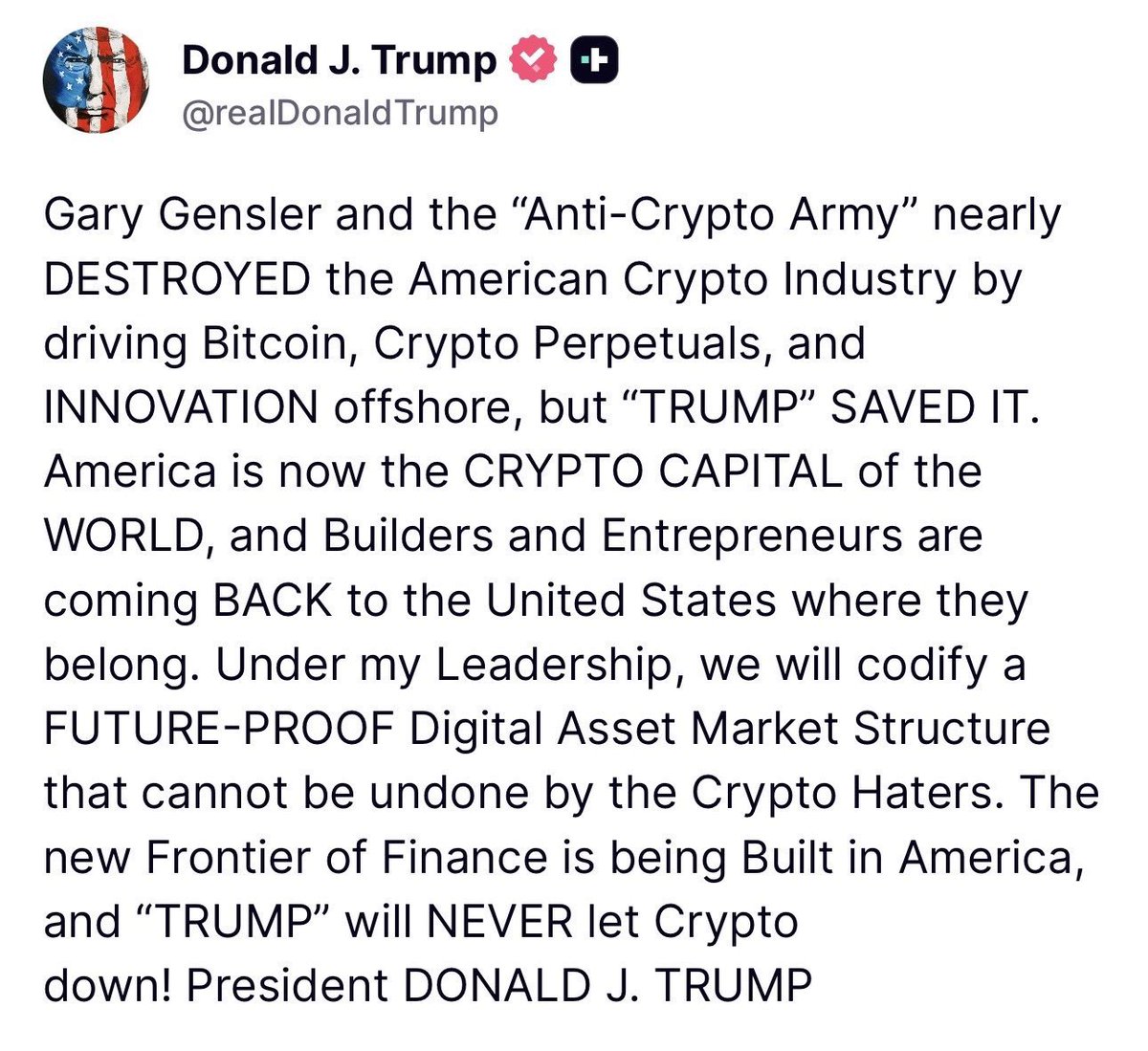
Regardless of where you stand politically, what's happening in the U.S. right now for crypto regulation is a big deal for the entire industry globally.
Five years ago the SEC was suing every crypto project it could find. Banks were closing accounts for touching anything blockchain-related and founders were leaving the country just to build without getting shut down.
✅ Now JPMorgan is tokenizing Treasuries on Ethereum.
✅ BlackRock launched a tokenized fund on-chain that crossed $2.5 billion.
✅ The Senate just advanced the most comprehensive crypto market structure bill in U.S. history.
✅ Tokenized U.S. Treasuries crossed $15 billion on-chain for the first time.
This is an entire industry going from "we might shut you down" to "how do we build this together" in less than two years.
Every previous cycle was driven by retail hype, but this one has nation-state adoption, institutional infrastructure, and regulatory clarity behind it. That's a completely different sport.
We here at Peace Through Trade believe the Clarity Act will be good for the space and long overdue.
Clear regulation is what separates an industry that lasts from one that doesn't.
Every light you see is a Chinese fishing boat stealing food out of another country's ocean 👇
China overfished its own waters until the stocks collapsed so it sent the largest fishing fleet on earth into everyone else's.
A local fisherman with one boat and a net is supposed to compete with this. He can't. He was never going to. His family has fished these waters for generations and now his livelihood is disappearing.
When the fish disappear, those families lose everything and that's when the domino effect kicks in.
Communities that can't eat don't care about conservation. Desperate people strip whatever's left to survive another week. Poaching, illegal logging, unregulated mining, it all accelerates the second people run out of options.
Then when entire regions lose economic stability, conflict follows, EVERY SINGLE TIME. The relationship between economic exclusion and armed conflict is one of the most studied patterns in modern history.
The environment and peace are always the first casualties of financial instability.
Who's enforcing this? Who's protecting these fishermen? Is anyone even paying attention? Drop your take below
REPOST if this needs more attention.
LIKE if you think local fishermen deserve protection.
COMMENT what you'd do about it.
Argentinian Navy Patrol Aircraft Monitoring The Illegal Chinese Fishing Boats Inside Argentina's Waters!
Chinese fleets expanded across the world largely after Beijing overfished and depleted stocks in its own coastal waters.
@JeffBezos@NASAMoonBase Every frontier in human history followed the same pattern. Exploration first, then infrastructure, then trade. The moon won't be any different. Exciting to watch this phase start in real time.
You know what else is wild? A billion people still can't access basic financial infrastructure.
No bank account. No way to trade. No connection to the markets their labor already feeds.
We're planning for Mars while half the world can't send or receive a payment.
Millions of people are sleeping on their roofs tonight because it's too hot to go inside.
Only 8% of Indian households have AC. When the power grid fails during heat waves, even they're out of luck.
You know who was in this exact position 30 years ago? Urban China. In the mid-1990s, 5% of households had AC. Today most households have more than one.
What changed?
Trade access opened. People could afford to cool their own homes.
Air conditioning is a poverty problem.
This shouldn't be complicated but people keep making it complicated. 👇
When people have access to the global economy, they build. They grow. They prosper.
When they're locked out, they don't. They can't.
That's it. That's the whole thing.
900 million people are sitting right now with a phone in their hand and no way to participate in the economy their own labor supports. They grow the cocoa, mine the cobalt, sew the clothes.
The global economy runs on what they produce and they can't access any of it.
We could literally change that tomorrow. The technology exists. The infrastructure exists. We built it.
Peace Through Trade is the bridge between a phone in someone's pocket and the global economy they've been locked out of their entire life.
The rails are built. The compliance is built. The app is built.
The only thing missing is you knowing about it.
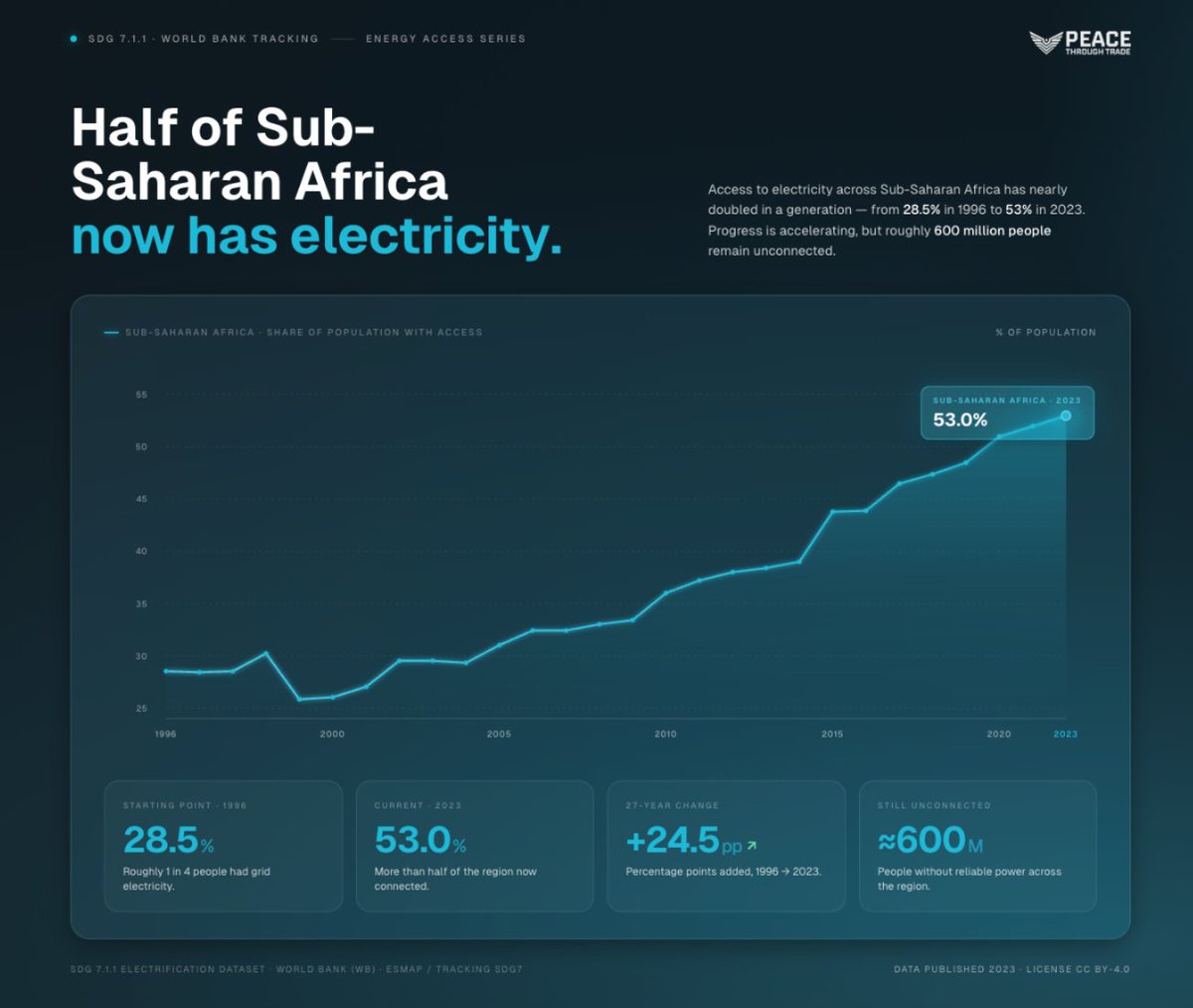
Every country that pulled itself out of poverty did it with cheap energy first.
South Korea, China, Singapore, all of them.
You can't run factories, move goods, or build anything at scale when electricity is unreliable or unaffordable.
565 million people in sub-Saharan Africa don't have access to electricity at all, and that number is growing because population growth is outpacing new connections. Even in areas with access, reliability is a constant problem.
You can send all the aid you want, but nothing works without power. Energy is the piece that makes every other piece possible.
Did you know that the United States recently admitted that foreign aid DOES NOT work? 🌍
$200 billion in foreign assistance has been sent to Africa since 1991, and the the State Department just came out and said it barely moved the needle. 😲
The people who spent that money are now calling their own model "fundamentally wrong."
They even called out the aid industry by name, using the phrase "NGO industrial complex" and admitting that too much of the money gets eaten by intermediaries before it ever reaches the people it was meant for.
Want a specific example? South Sudan has received $9.5 billion from the US since 2011. Corruption in the country actually got worse.
So after 30+ years and $200 billion in evidence, the new direction is trade instead of aid, investment instead of assistance.
Which is worth paying attention to, because trade is the only thing that has ever consistently moved countries out of poverty at scale. East Asia proved it. China proved it. No aid-dependent country in history has ever replicated what trade-driven economies did in a single generation.
The biggest donor in the world just admitted the model is broken. That should be front page news everywhere.
Did you know that the United States recently admitted that foreign aid DOES NOT work? 🌍
$200 billion in foreign assistance has been sent to Africa since 1991, and the the State Department just came out and said it barely moved the needle. 😲
The people who spent that money are now calling their own model "fundamentally wrong."
They even called out the aid industry by name, using the phrase "NGO industrial complex" and admitting that too much of the money gets eaten by intermediaries before it ever reaches the people it was meant for.
Want a specific example? South Sudan has received $9.5 billion from the US since 2011. Corruption in the country actually got worse.
So after 30+ years and $200 billion in evidence, the new direction is trade instead of aid, investment instead of assistance.
Which is worth paying attention to, because trade is the only thing that has ever consistently moved countries out of poverty at scale. East Asia proved it. China proved it. No aid-dependent country in history has ever replicated what trade-driven economies did in a single generation.
The biggest donor in the world just admitted the model is broken. That should be front page news everywhere.