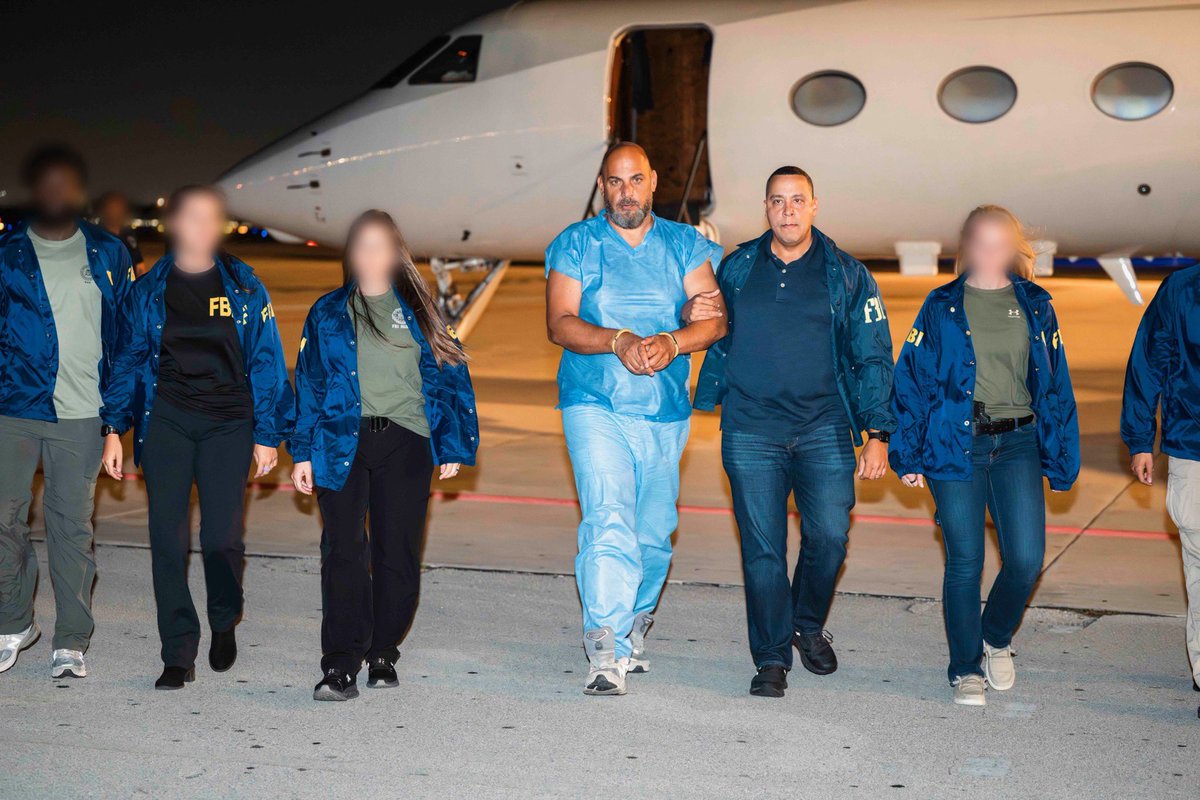
“Ibrahim Khaldoon Hilmi is charged with one of the biggest Medicare scams in history - allegedly orchestrating a massive $3.7 BILLION scheme to defraud Medicare. He’s been on the run since May of 2025 - but we got him.
Thanks to outstanding work from FBI Miami, the Justice Department, and our partners in Turkey, Hilmi was apprehended overseas and after a Foreign Transfer of Custody, he is back in the U.S. to face justice.
This is yet another massive win for this FBI’s war on fraudsters with the White House Task Force led by VP Vance - and a monumental victory for the Trump administration showing that any criminal actor who steals from the American taxpayer will be caught, no matter where they try to hide.
Special thanks to Ambassador Tom
Barrack who continues to be an invaluable partner to us - this case could not have been accomplished without his tireless work.
Fifty million naira, banned from every court in Nigeria, and the apex court called his filing "trash" in writing. This is not just a bad day. This is a permanent record.
Brutal! 🤦♂️
If you are a Nigerian student with strong academic ability and wish to study in the US on a full scholarship, register now:
https://t.co/OP1CBr2iuY
Children in privileged private schools have enjoyed this for years.
It’s open to any child from any school regardless of your family background.
It closes in 9 days.
If I weren't there at the very start of a Nigerian telco, I would believe the trope people always put out that things "were guaranteed." Nothing could be further from that.
Let's start with the licensing. You first had to put up a $20m deposit before you could bid. If you bid and won but were unable to pay for your license, you forfeited $20m. Mike Adenuga lost that amount then, and it was a lot of money. It is still a lot of money.
For Econet Wireless, to get that amount the first time, Oceanic Bank had to put it up, backed by guarantees from Delta State, which managed all their federal allocation payments. Getting that first $20m was one of the hardest things I have seen.
Oboden Ibru didn't trust the Zimbabweans; he believed they didn't have any money to invest, and his bank would have to commit more to save the $20m, and he was eventually right.
Even forming the consortium and selecting partners was a difficult and heartwrenching process. There were meetings that lasted long into the night. I still can't forget a trip I took to Delta and Akwa Ibom to present documents to the state governments, inviting them to invest. Another competing party tried to beat me to Uyo by chartering a private jet as I drove like a maniac and got there by road.
After the bid was won, raising the $285m was the most beautiful financial engineering process I had ever witnessed. The late Osaze Osifo was a genius and one of the smartest people I had ever met. I learned so much from what he and his HSBC Capital team did. Other investment bankers, like the late Laolu Mudashiru of Vetiva, watched and learned, too.
After paying for the license, we now had to raise money for working capital. I personally raised 7 million Naira from New Nigeria Bank to pay for the office rent. Got furniture from Chair Center and another company on credit. My guy, Elias Igbinakenzua, was then an Executive Director at Zenith Bank, and we managed to negotiate a 500m Naira overdraft facility to start the business.
Everyone was broke and stretched. We took a loan from New Nigeria Bank to cover our share of the equity, and the interest on the loan was accruing at 1.8 million Naira per day. We eventually sold half of the shares at a profit to cover the cost. Before then, we were juggling CPs and BAs to cover the initial $20m and dodging Oboden Ibru, who was at wits end.
To add to that, we had a technical partner who lied about bringing in 40% of the capital. They, too, could not raise money, so the pressure was on the existing shareholders, who eventually kicked him out but still left him with 5% for the brand thanks to the intervention of Delta State, represented on the board by David Edevbie.
Today, that company is now Airtel Nigeria, and someone will tell me that "Demand was guaranteed. " Idiots.
Rolling out the service was another story. Educating the market and competing with MTN, who had smarter people and deeper pockets, was brutal. Dem Eleso, their CTO at the time, was a telco savant. Funny thing was that we were offered his services first, but rh Zimbabweans rejected him. MTN snatched him. He became our nightmare.
To every man building something worth handing down, a child, a name, a family, or a better version of himself, happy Father's Day. The work you do quietly, the burdens you carry without applause, they matter. Here's to fathers, father figures, and men still preparing to be one.
Nigerian regulators have begun to pay close attention to data privacy. As a business, you have certain important obligations. Put this session on your calendar!
I dated a woman for two years who told me she was a virgin. I want to be clear that this was not something I had asked about. She offered it early in the relationship, deliberately, with the weight of someone making a significant disclosure. I received it as such. That was my first mistake…
The $1M conversation on Nigerian Twitter is funny because the first thing you should do when you come into money in bulk is to leave it. Pretend it doesn't exist for at least 3 months. Never jump into investing in anything you don't know very well. I am talking from experience.
When fuel prices were rising from under ₦900 to over ₦1,300 per litre, Nigerians were given plenty of reasons. Rising crude oil prices, tensions in the Middle East, global market pressures and more. Now crude oil has dropped significantly, yet only about ₦75 has been taken....
....off the pump price.
Nobody is saying fuel must drop by the exact same percentage as crude oil. The question is simple: if those factors justified the increases, why don't they justify a more meaningful reduction?