@Z__McCarthy But can you blame him? IMO if he didn’t have this (admittedly extremely one-sided) connection to O’Brien I think he would’ve gone mad even before meeting Julia. It’s O’Brien who he starts to write the diary to in the first place
(2/2)…did any of it really happen ~vibes~, also like end of the aforementioned film. Winston is stuck in a world where it seems everyone else is complicit except him. Maybe I’ve found Christian Bale’s next project… #iykyk
(1/2) Getting an almost American Psycho vibe from Winston. Multiple times he’s fantasized about brutally attacking his acquaintances, seems like it’s only a matter of time before he does. But with BB (Winston’s job specifically) being able to change the past, also gives off…
@deakinbooks Forwarding the point in all seriousness, some make the argument Monopoly is just capitalism propaganda for the impressionable youth of America disguised as a family friendly board game. Seems as bit extreme in my opinion but still worth mentioning
I’m just so stuck on the conversation Winston has with Syme about Newspeak. So many one liners about the destruction of language which is insane, but “…the range of consciousness always a little smaller”(52) is just so purely evil sounding to me. At a cafeteria nonetheless…
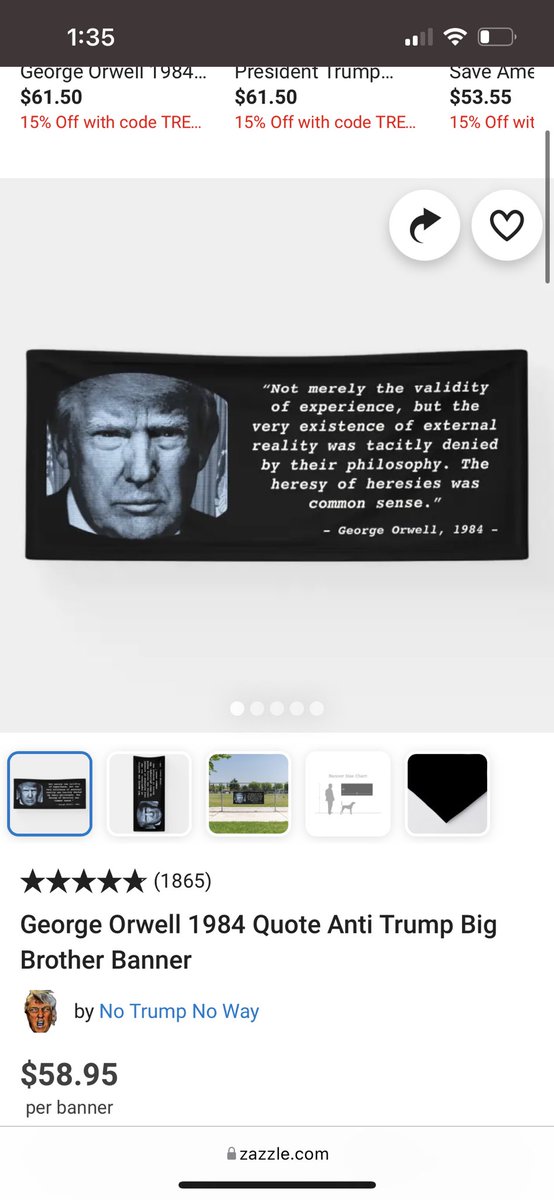
“In 1981, the book was challenged in Jackson County, FL for being pro-communist.” So naturally 40 years later we get an Orwell quote with a trump photo 🤨
I’m getting the sense that I’m definitely in the minority of this being my first read-through of 1984 so I wasn’t fully aware of literally how painfully obvious all the Soviet Union comparisons are…which is also funny that it’s banned for being pro-communist in parts of the US.
Which would check out with Le Bon's argument of the crowd being less attentive, easier to convince, etc. Just think it's funny this happened hundreds of years ago but Gus is writing about it now because it seems "hypnosis" has revealed these truths or some b.s. like that.
During the Persian Wars, Themistocles wants to convince other Greek city-states to take control of their naval forces. Using what I'd consider as Le Bon logic, he tried to convince a council of Greeks rather than individual kings because in his mind the "crowd" is easier to sway
Le Bon by his own logic would be the biggest supporter of trade school in present day, right? Working with your hands while learning from another person (apprenticeship) has to be his dream scenario for a young person entering the workforce…wonder what he’d think of NFTS…
Agreed, I feel like especially in this time period the idea of a preparatory school was to mold the minds of young men with maybe not memorization of textbooks per say, but the ability to critically think and most importantly to write, and write well at that (which Westy def did)
@IggyIm22 His definition is weird, for sure. I do agree, though, that there can be a lack of critical thinking in "Latin Education" (Go Choate). The "error that intelligence is developed by the learning by heart of textbooks" is a problem. HCDB invites us to think critically, fortunately.
@deakinbooks Correct me if I’m wrong but I think military forces mean on this idea of “laying your life on the line for your fellow soldier” or something similar
(2/2) which makes it even easier to participate in a crowd both on an accessibility level and on an anonymity level, being even less likely to feel the repercussions of ur actions
(1/2) like to apply our readings to present day, and Mary Su brings up a good point. I find it ironic how “the crowd” has gotten pretty objectively worse since 1895 and yet it quite literally isn’t a physical crowd at all, but it’s the very thing we’re using right, social media..
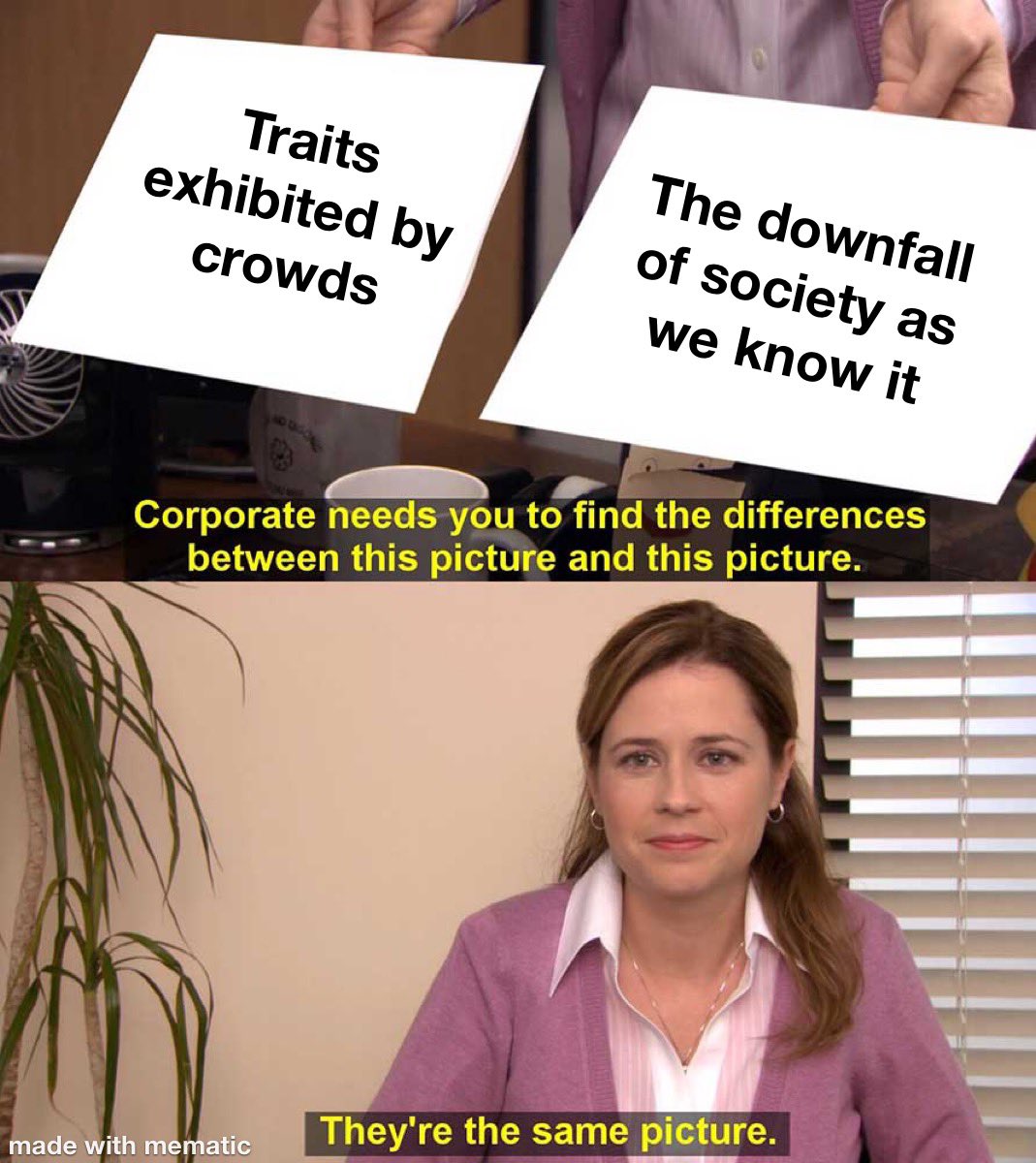
And “the crowd” mentality/traits have arguably only gotten worse in this day and age, so while he was wrong about the downfall of society back at the turn of the 20th century…who knows now
@deakinbooks Because of this fact I'm convinced there is not good or bad culture...well maybe a bit of an exaggeration but Arnold in his attempt to conquer the idea of culture has only left it more convoluted for a reader 200 years later