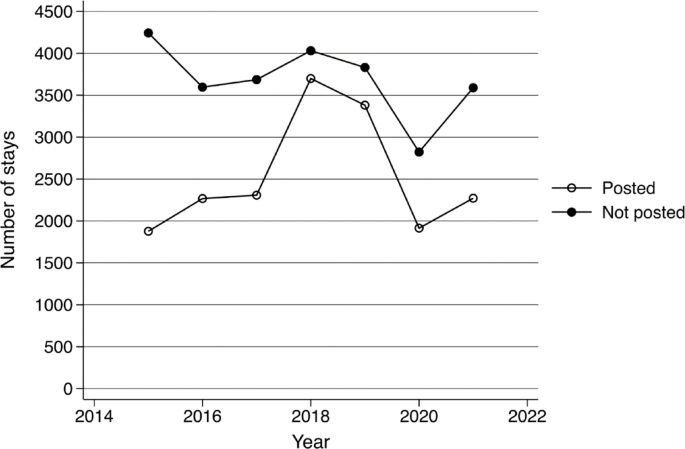
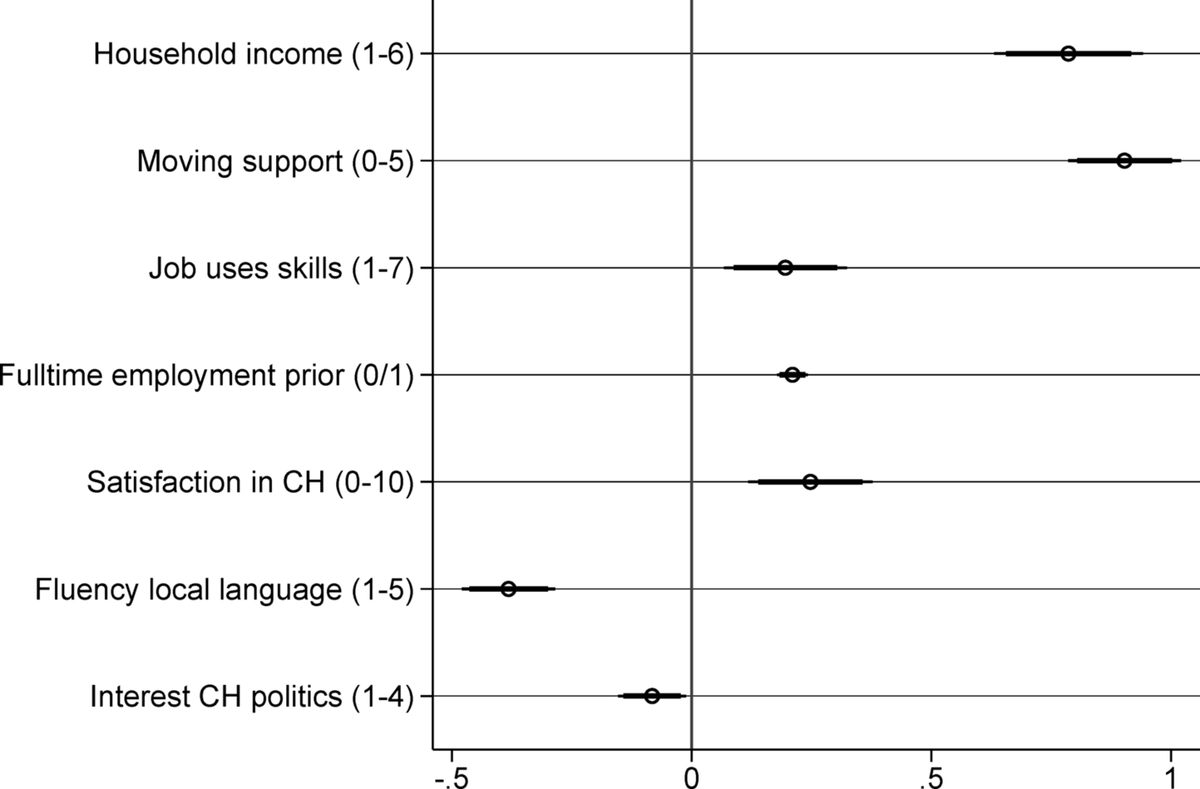
This “market model” of migration makes up for nearly half of non-EU labour migration to Switzerland. By emphasising temporality, it avoids politicisation but can also lead to unequal treatment.
Read more in our two new articles 👉 https://t.co/GASmUTo9D0
https://t.co/cxuKU3tyeo
Much of labour migration happens quietly. Our new research looks at business migration in Switzerland — posted workers, managers, consultants, transferees. Temporary, facilitated, but often with limited rights and little long-term integration or stay prospects (1/2).
🚨 New in Comparative Migration Studies:
@LutzPhilipp & co. conceptualize ‘business migration,’ a rising form of mobility at the crossroads of trade law, labour markets and migration studies.
They show why it matters, with Switzerland as a case study. https://t.co/znkUvYySje
📣 Postdoc vacancy! I am looking for a qualitative postdoc (3 years, 100%) to join my ERC project #RESTATE (Refugees’ Political Participation and State-(Re)Making in Displacement, 85%) and my project #SYREALITY (Syrian Imaginations of Europe meet Reality, 15%).
📢Apply for the 24-month Postdoc position on “Governing Migration Across Borders” at the Migrations and Society Research Unit (URMIS)
⏳Application deadline: Aug 1, 2025
📅Preferred start date: October 2025
🔗All the details:
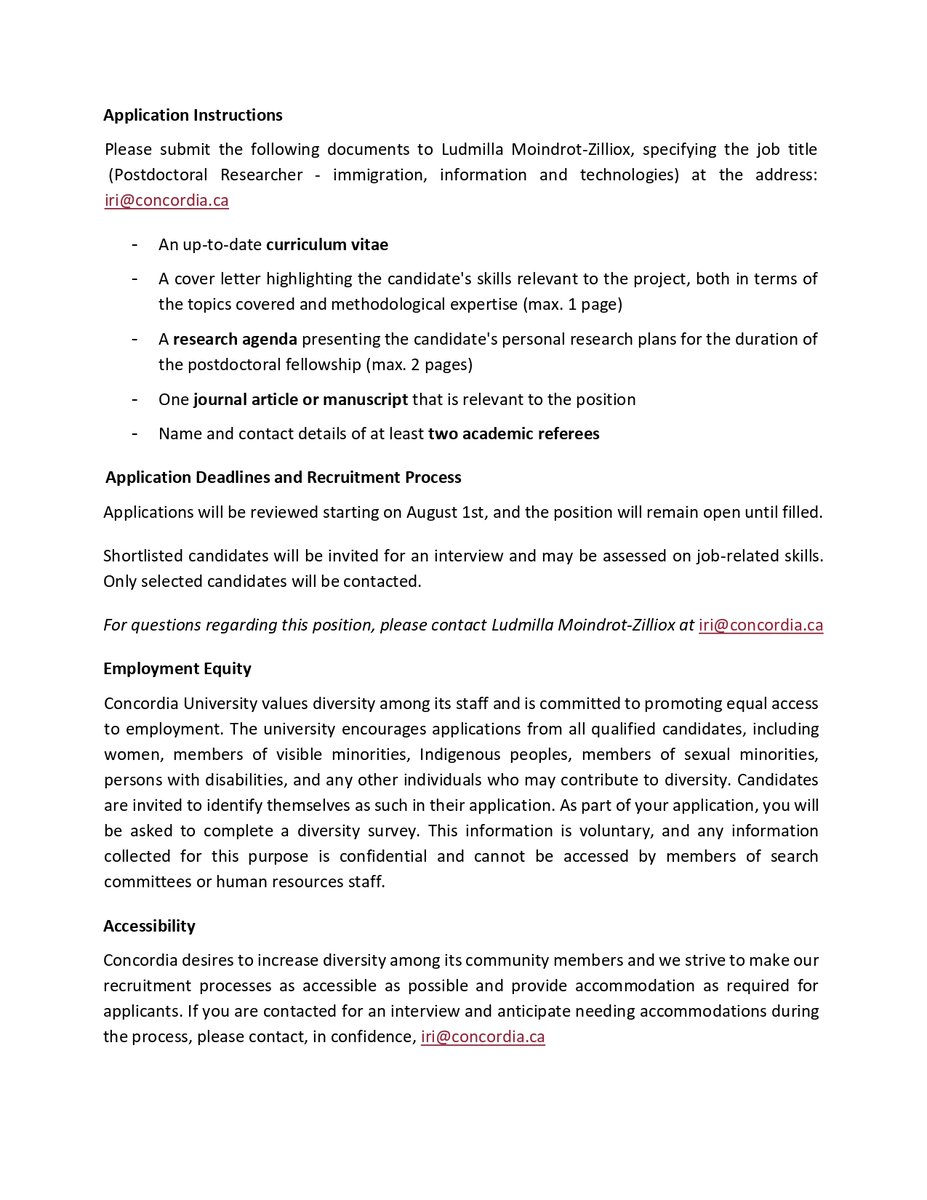
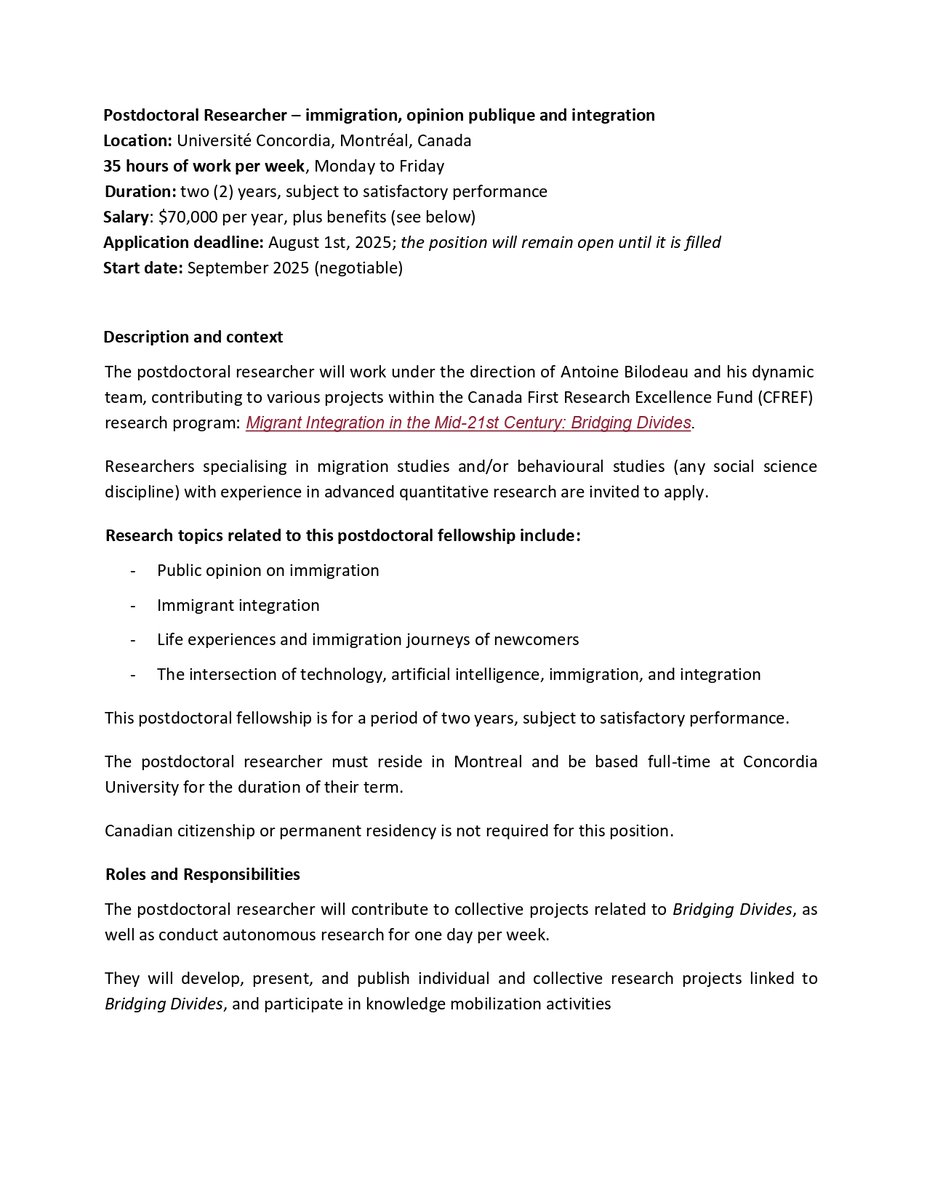
📢Postdoc Opportunity- immigration, opinion publique and integration
The Immigration Research Initiative @Concordia (Montréal) is hiring a 2-year Postdoctoral Researcher!
⏳Application deadline: August 1st, 2025
🚀 Start date: September 2025 (negotiable)
🔗All the details:
🌟 Ready to boost your PhD journey?
Apply now to become a member of the @IMISCOE PhD Academy! your gateway to global networking & academic growth in migration studies!
⏳Deadline: 27 Aug 2025
📌More info & apply here: https://t.co/JsnVJtbE0q
📲Or scan the QR code below!
I look forward to discuss our chapter w Sandra Lavenex, Mariana Alvarado & @LutzPhilipp on business mobility as temporary labour migration next week at the @ILO_Research - join us to learn more about the links between trade and migration and implications for migrant rights!
📢 Join us on 15 May for the launch of Temporary Labour Migration: Towards Social Justice? — a new ILO volume exploring the challenges, gaps, and governance issues in temporary labour migration.
More info 🔗 https://t.co/z1gxRihvSX
#LabourMigration#SocialJustice#Migration
📖New publication! Our chapter "Business mobility as a privileged form of temporary labour migration" w @LutzPhilipp and Sandra Lavenex shows how trade agreements & national policies increasingly privilege temporary work over rights—even for highly-skilled migrants.
⬇️
Temporary migrant workers deserve protection!
Many face unfair working conditions and exclusion from labour laws.
It’s time for policies that ensure fair migration and decent work.
📚 Read the ILO’s latest book to learn more: https://t.co/FY7m87C3f7
📢 Call for Contributions📢
🎓The Neuchâtel Graduate Conference 2025 is coming to the University of Neuchâtel on July 8-9, 2025.
Don't miss out! Submit your contributions by March 15, 2025.
ℹ️ More info https://t.co/RBBdBYZ0Dv
🚨 #Data alert 📣 We just released #ParlLawSpeech – full texts of more than 40k bills, 28k laws, and 3 mio. parliamentary speeches from 7 countries (AT, CZ, DE, DK, ES, HR, HU) and the EU! If you study democracy with #Text-As-Data / #NLP methods, this is for you! A short 🧵 (1/3)
Are you a policy professional working on migration in Europe and/or Africa? How do you think about the causes of migration ?
Take a look at our new blog-post and see how you can get involved in our project/survey:
https://t.co/EeAz4NKiOk
I have created a searchable list of 80+ migration-related movies, offering various perspectives on human movement, identity, and mobility.
What movies would you add?
#Migration#MigrationStudies#MigrationStories
https://t.co/k05UzzuTJK
Categorising certain forms of human movement as ‘migration’ and others as ‘mobility’ has far-reaching consequences.
Our article on the migration-mobility nexus is now published on volume 58 of @sociologyjnl.
https://t.co/kCTDzsktUr
New article: Does restricting immigrant rights reduce public opposition to immigration? Not necessarily. Citizens are however more permissive towards immigrants that they believe will contribute to the economy and commit to integration. @nccr_onthemove
https://t.co/W8E6D1q4oD
Wie die #NoAfD es geschafft hat, fast alle Parteien in eine Anti-Migrations-Einheitsfront zu drängen, welche Folgen das haben dürfte und was dagegen helfen könnte - darüber haben @MXPichl und ich uns hier Gedanken gemacht 👇
https://t.co/TFsgnnqnOi
🌍📢 Call for Visiting Fellows – Spring 2025!
Join us for 2-3 months of research collaboration! Open to PostDocs, PhDs, & Master's holders.
Apply by Oct 15, 2024! More info & eligibility details: https://t.co/s4YbUVdQxY
Wenn demokratische Parteien und Politiker weiter die Idee nähren, dass man in Deutschland leicht die absolute Kontrolle über Asylantragszahlen haben kann, wird das auf Dauer nur weiter die Extremisten stärken.
Die Wahrheit ist: Im Rahmen der EU und des Rechtsstaats gibt es keine Möglichkeit, die Zahl der Asylanträge direkt zu begrenzen. Man kann vieles ändern, die EU-Partner in die Pflicht nehmen, Integration vorantreiben und Radikalisierung besser bekämpfen oder Verfahren beschleunigen. Aber die Idee, dass Asylsuchende ganz einfach an der Grenze gestoppt werden können - sie ist die Büchse der Pandora, weil man dafür eigentlich die EU verlassen, Schengen aufgeben, das Grundgesetz missachten und die Menschenrechte brechen müsste. Wem Migrationskontrolle wichtiger ist als rechtsstaatliche Prinzipien, der wird dafür Maßnahmen ergreifen müssen, die mit unserem Gesellschaftssystem unvereinbar sind.
Very happy that our article on migration control in EU tarde agreements is now out with an issue number! In it, Sandra Levenex, @LutzPhilipp map the migration control content of PTAs and assess potential drivers of this contentious linkage ➡️https://t.co/eN8EuN73af
Why and when do 🇪🇺 trade agreements include migration control/readmission clauses? In our #openaccess article with Sandra Lavenex and @LutzPhilipp we find that institutional factors matter more than trade leverage or actual migration numbers ➡️ https://t.co/eN8EuN7AZN @JCMS_EU