How do people interpret vague descriptive phrases like "may or may not" when reading contracts 📝 and financial disclosures 💵📄? Check out our new #research paper on @CFPB's working paper series, or see 🧵 for findings. https://t.co/4xmZJBKNtz
Thanks to coauthors @Dan_J_Benjamin, @profsimons, and @cfchabris, and to all the chess players who participated in our research.
Preprint/OA: https://t.co/WHDwP8OA6a
Open archive including study preregistrations, materials, and data: https://t.co/Dw4RQpxl2f
New in Psychological Science: what happens to overconfidence when people have access to objective, accurate feedback about their own skill? We find that #overconfidence persists despite years of precise, public, and continuous feedback. 📊♟️
https://t.co/qPZx6cOxJW
These results suggest that overconfidence in one’s own abilities (and the #DunningKruger effect), persists even in information-rich environments that should diminish it.
@SannaTenhunen@susankuivalaine@OS_Mitchell In the final highlight from this issue, @P_Heck, Ratcliffe and Tibbitts investigate how different versions of the Financial Well-Being scale (5-scale and 10-scale) can impact FWB scores.
🔗https://t.co/wOma1GiDqX
#JnlFLW#FinLit
In @Newsday, Banking while Black: Study that includes Nassau County finds disparities in small business lending
A secret-shopper study conducted by @CFPB found “significant disparities” in the way Black borrowers were treated vs. white peers https://t.co/DGfdqEyoS8
Congrats to Joachim Krueger, Dave Freestone, and @GruningJ on this target article, out today in Psych Inquiry. This paper started when I was still in graduate school and has been a colossal intellectual challenge, as was reviewing the commentaries! 🧠🎊
https://t.co/TEyV3ReZyI
How well do people know their own social abilities? @P_Heck, Matt Brown, and I ran two studies (N=927) that each showed a surprising pattern: a negative relationship between people's self-rated skill and actual performance for social ability. People who rated their social skills higher did worse on a three-test objective measure of social ability (r = –.26 & –.37, N=505 & 422). This pattern was not observed for general intelligence: people who rated their intelligence higher were not meaningfully worse at tests of cognitive ability (r = –.04, N=422).
Full open access article: https://t.co/bS9lWlqcbc
My new study just came out in @Nature!
The paper introduces "Option C Thinking". This approach is an experimental enhancement that produces the type of policy-based evidence that the science of scaling demands from the beginning. You can download for free here: https://t.co/g67AvWrovn
Huge thanks to the supremely talented editor,
@meharpist
Without her astute guidance and wisdom this study would have remained in my imagination.
‼️ At Geisinger we have several open positions for empirical researchers at the intersection of behavioral science & health:
• Predoctoral fellow (starting ASAP)
• Postdoctoral fellow (ASAP)
• Faculty, open rank (flexible)
Ads & application info:
https://t.co/ViyJCuuW1h
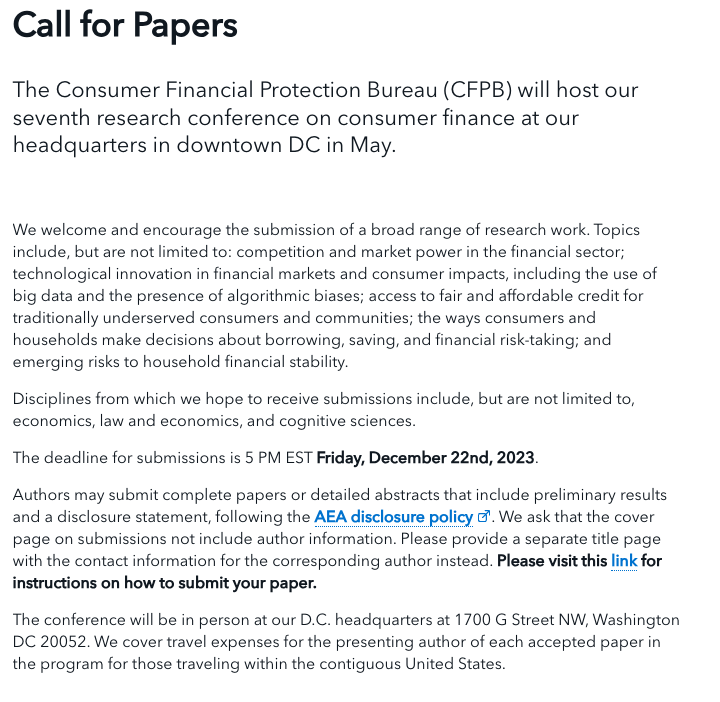
🚨Submit your consumer finance papers for the 7th @CFPB research conference 🚨
Deadline: Friday, December 22, 2023
Conference: May 2024
How to submit: https://t.co/GZ4du3oFQl
My team is hiring! If you're passionate about household finance and want to want to use your behavioral science, economics, and data skills to improve financial outcomes for families, this is a great place for you.
https://t.co/1VHIj1IDbG
My newest paper, titled "Do People Desire Optimism During a Novel Global Crisis?" was recently accepted in Journal of Behavioral Decision Making 🎉🎉
Preprint here: https://t.co/2ALDB87BZb
This work was done with @uiowa JDSC Lab, coauthors: @jstrueder97@pikpik22301@pwind44
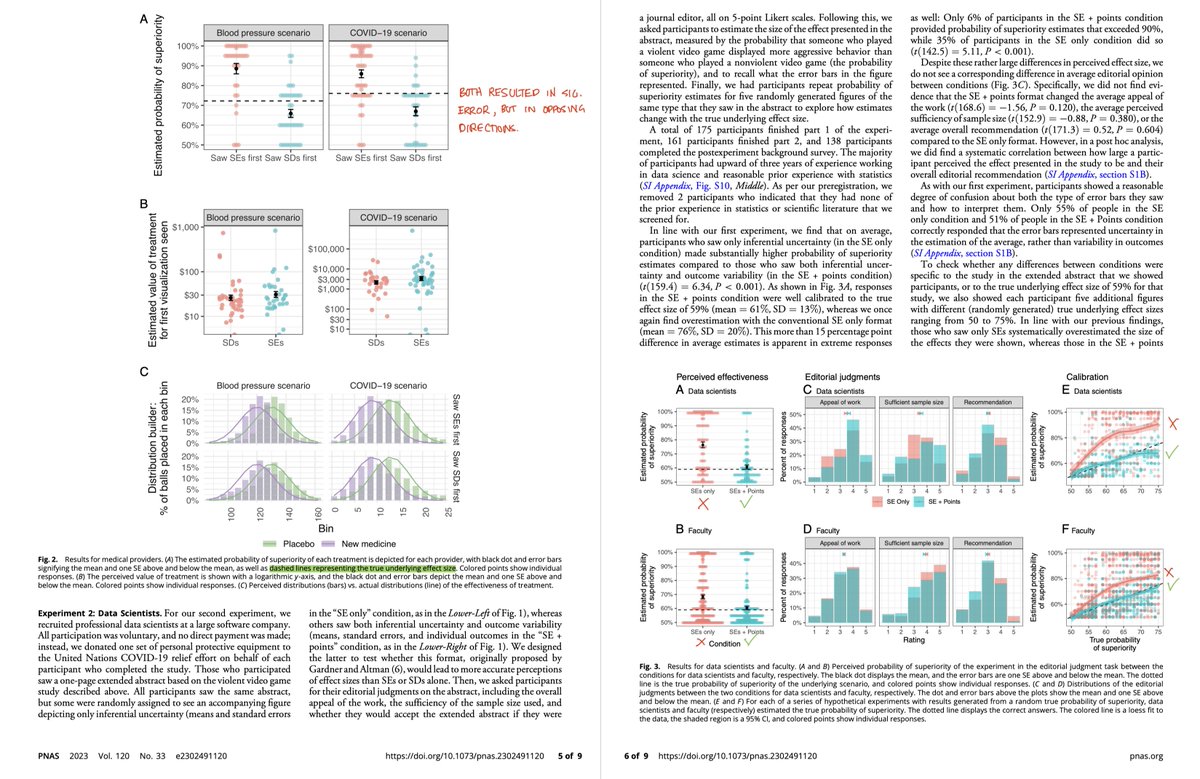
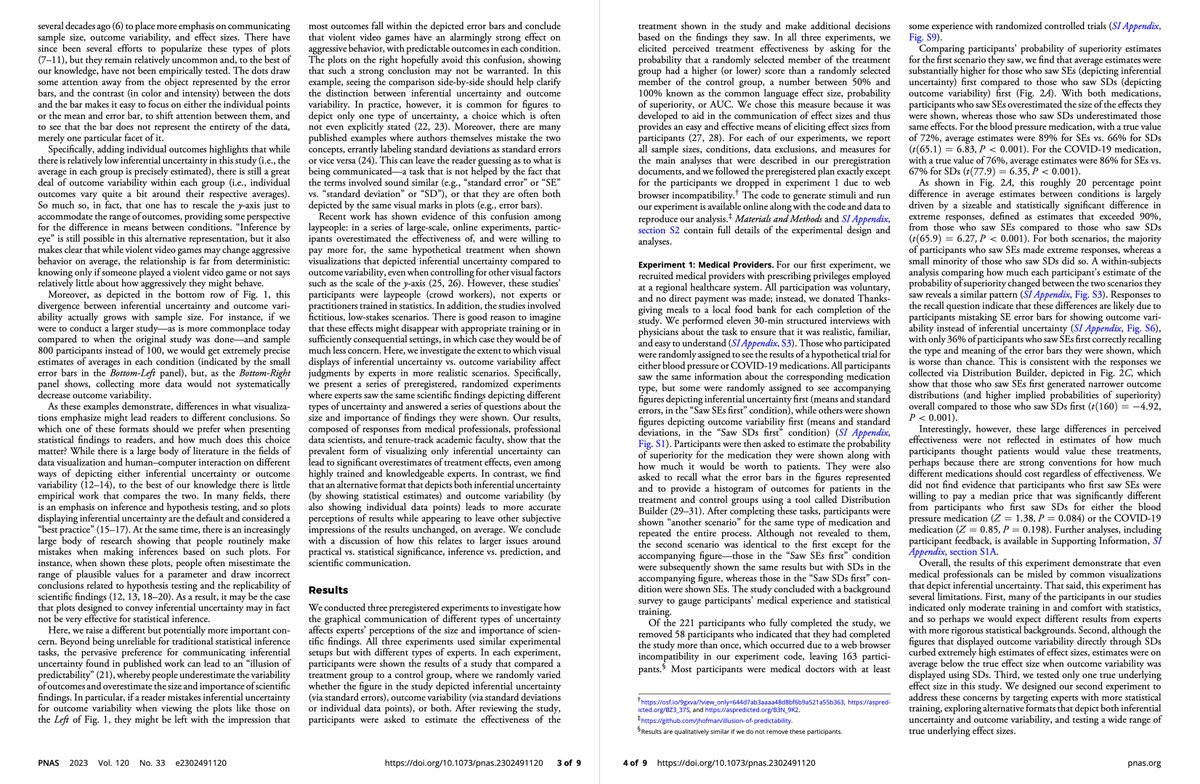
Excited to announce a new paper in PNAS today!
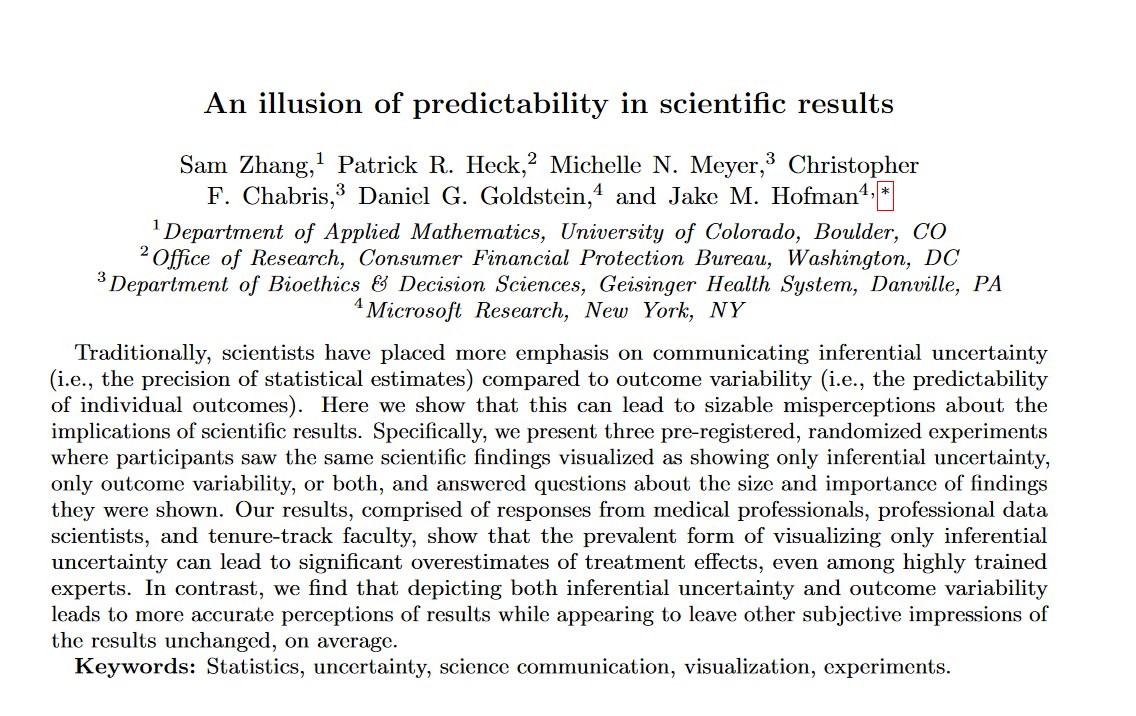
An illusion of predictability in scientific results: Even experts confuse inferential uncertainty and outcome variability
https://t.co/wfhRN1pq9L
Joint w/ great coauthors @_szhang, @P_Heck, @MichelleNMeyer, @cfchabris & @dggoldst
We are visualizing our data all wrong.
Typically, academic graphs show statistical confidence intervals or standard errors. This paper shows that everyone from doctors to tenured faculty misread these graphs, assuming effects are larger. Show variability! https://t.co/Md5SU4E63C
@ChelseaParlett We have a paper on this! Showing some of the consequences of choosing one over the other (even when experts are the target audience).
https://t.co/A4hJopYURg
Hi #aps23dc! Are you interested in the Psychology of information, or in working in applied settings like government, industry, and health? Come to our panel tomorrow at 9:00am: we will take questions about life in applied settings and how to conduct more policy-relevant research.
New work out today via Consumer Financial Protection Bureau on inflation, bank account balances, and markers of financial distress among historically underserved consumers in the South. #inflation#finance#banking https://t.co/UASxWNPzjA