La Medicina es un arte antiguo y una ciencia joven. La Medicina hipocrática tenía más humanismo que ciencia y se relacionaba más con el enfermo. En la Medicina contemporánea, hay más ciencia que humanismo y se relaciona más con la enfermedad.
Hoy una chica de 15 años se asustó al oír que tenía "ovario poliquístico", cosa que no tiene en absoluto.
Todos los meses veo mujeres con alopecia que nunca pensaron que vendría de un "ovario poliquistico"
El que piense que este cambio de nombre no tiene sentido se equivoca
#SOMP
#Pacientes | ➡️ Cambio de nombre para el #SOP
🗣️“Es necesario que todos hagamos un esfuerzo para que permee en la sociedad”, señala el Dr. Pablo Fernández Collazo, de la @sociedadSEEN, sobre el síndrome de ovario poliquístico
https://t.co/lR0bYNeZ0K
El cambio de nombre del #SOP no es solo una cuestión terminológica.
💡Es una oportunidad para mejorar la comprensión clínica y social de la enfermedad.
El Dr. @Pablofcollazo de @GrupoGIDSEEN comenta el cambio 👇👇
#Pacientes | ➡️ Cambio de nombre para el #SOP
🗣️“Es necesario que todos hagamos un esfuerzo para que permee en la sociedad”, señala el Dr. Pablo Fernández Collazo, de la @sociedadSEEN, sobre el síndrome de ovario poliquístico
https://t.co/lR0bYNeZ0K
Un estudio realizado con más de 700.000 hombres de Finlandia y Noruega ha encontrado que la relación entre inteligencia e ingresos no desaparece en los niveles altos de CI. Al contrario, cuanto más arriba se asciende en la distribución de ingresos, más fuerte es la asociación entre capacidad cognitiva y ganancias económicas. Las personas con puntuaciones cognitivas más bajas prácticamente desaparecen entre los grandes perceptores de ingresos, mientras que las más altas están sobrerrepresentadas.
El resultado cuestiona la idea popular de que existe un «umbral» (a menudo situado alrededor de los 120 puntos de CI) a partir del cual la inteligencia deja de aportar ventajas económicas. Lo llamativo es que este patrón aparece en dos de las sociedades más igualitarias del mundo, Finlandia y Noruega. Aunque factores como la personalidad, la educación, las redes sociales o la suerte siguen siendo importantes, los datos sugieren que la inteligencia continúa siendo un predictor relevante de los ingresos incluso en los niveles más altos de capacidad cognitiva.
https://t.co/5j8DcdqeGh
No es verdad que las redes estén destrozando nuestra atención:
En este artículo Tommy Blanchard desmonta con datos y serenidad uno de los grandes pánicos morales de nuestra época: la idea de que las redes sociales y los vídeos cortos nos han reducido drásticamente la capacidad de atención.
Aunque casi la mitad de la gente en encuestas cree que su atención ha empeorado, los investigadores que llevan décadas estudiando la atención (como Edward Vogel o Gemma Briggs) afirman que no existe evidencia científica de un declive real en la capacidad cognitiva básica de los adultos sanos.
El autor explica que el concepto de “attention span” es engañoso: la atención no es un músculo que se encoge, sino que depende completamente de la tarea, el contexto y la motivación. Muchos estudios solo muestran efectos temporales (después de scrollear mucho cuesta más concentrarse), pero no un daño permanente ni un “brain rot”.
Incluso el famoso dato de que tenemos menos atención que un pez rojo (8 segundos) es completamente inventado. Asimismo, los famosos estudios de Gloria Mark sobre cambios de tarea en el trabajo han sido malinterpretados y exagerados por los medios.
Paradójicamente, mientras se dice que ya no podemos concentrarnos, la gente consume películas de tres horas, series completas de una sentada y videoensayos larguísimos en YouTube.
En resumen, es cierto que hoy es más fácil distraerse porque llevamos un dispensador de dopamina en el bolsillo, pero nuestros cerebros no se están deteriorando.
https://t.co/sTcqug1OAw
Retatrutide phase 3 obesity trial just came out and the results are genuinely insane:
- 28.3% bodyweight lost on 12mg over 80 weeks
- 70.3 pounds on avg. or 31.9 kg
- 45.3% of patients hit 30%+ weight loss (this is bariatric surgery territory)
- 30.3% weight loss (85 lbs) at 104 weeks in higher-BMI patients
- 65.3% of 12mg patients dropped below the obesity BMI threshold
- 19% loss on 4mg over 80 weeks (47.2 lbs) with fewer dropouts than placebo (4.1% vs 4.9%)
- significant drops in blood pressure, triglycerides, non-HDL cholesterol, waist circumference, and hsCRP
- no cardiac or liver signals
Retatrutide is going to completely overshadow tirzepatide and semaglutide, and take the throne as the best-selling drug of all time.
El artículo con el que oficialmente cambia de nombre el "Síndrome de ovario poliquístico (SOP)" a "Síndrome ovárico metabólico poliendocrino", en The Lancet (2026).
Se une a la lista:
🔵 Diabetes Insípida -> Deficiencia de Arginina Vasopresina (AVP-D) o Resistencia a la Arginina Vasopresina (AVP-R)
🔵 Viruela del mono (Monkeypox)-> Mpox
🔵 Cirrosis Biliar Primaria -> Colangitis Biliar Primaria (CBP)
🔵 Hígado graso -> Enfermedad Hepática Esteatótica Asociada a Disfunción Metabólica (MASLD)
🔵 Síndrome de ovario poliquístico (SOP) -> Síndrome ovárico metabólico poliendocrino
https://t.co/3O93s10lns
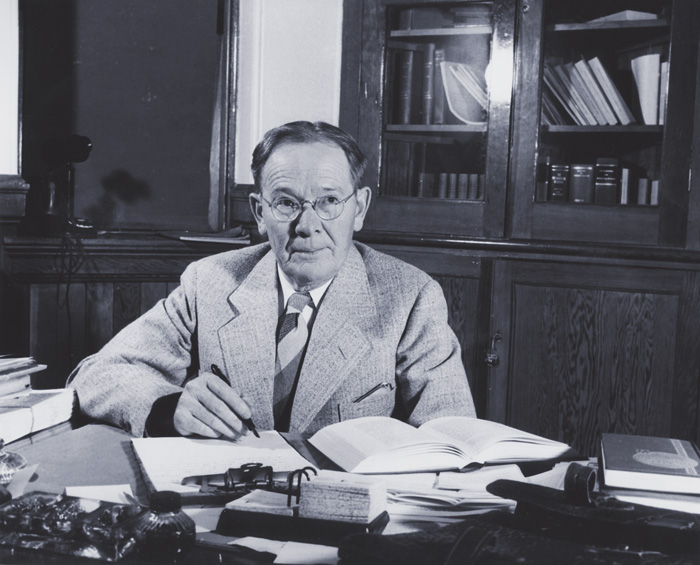
A Stanford psychologist spent 35 years trying to prove that high IQ produced genius. He selected 1,528 of the smartest children in California and tracked them for the rest of their lives.
Not one of them won a Nobel Prize. Two of the boys he had rejected from the study won the Nobel Prize in Physics.
The trait he had built his entire career on did not predict the thing he thought it predicted.
His name was Lewis Terman. The study is one of the most honest accidents in modern psychology.
In 1921, Terman was the most famous psychologist in America. He had translated and adapted the original French intelligence test into the version that would dominate American schools for the next 50 years.
He called it the 'Stanford-Binet'. He believed, with the certainty of a man who had built a career on a single idea, that intelligence was the master variable behind every form of human achievement. The doctors, the inventors, the senators, the artists, the great writers and great scientists. All of them, in his model, were sitting at the top end of the same bell curve. If you could find the children with the highest scores, you could predict the future leaders of the country.
So he set out to prove it.
He sent his research team into California schools and screened roughly 168,000 children. He had teachers nominate their brightest pupils. He gave the nominees the Stanford-Binet. He kept the ones who scored 135 or higher, which placed them in roughly the top one percent of the population. The final sample was 1,528 children, average age 11. They had a name in his lab notebooks within a year. Termites.
He planned to follow them for the rest of their lives. He died in 1956 having tracked them for 35 years. Stanford kept the study going. The last surviving Termites were tracked until the 2000s. The data set is one of the longest continuous psychological studies in human history.
Here is what the data showed.
The Termites did well. They went to college at higher rates than their peers. They earned more money. They became professors and engineers and lawyers and physicians at higher rates than the general population.
Terman was not entirely wrong. High IQ is correlated with conventional success. The correlation is real and the effect size is meaningful.
But that was not what he had set out to prove.
He had set out to prove that high IQ produces genius. The kind of genius that wins Nobel Prizes, writes great novels, founds new fields, and reshapes the technological direction of the world. And on that specific question, the dataset turned on him.
None of the 1,528 Termites won a Nobel Prize. None of them won a Pulitzer. None of them became world-class musicians. None of them produced a single piece of work that historians of science or art still talk about. They were accomplished. They were comfortable. They were not, in any sense Terman would have recognized in his original ambition, geniuses.
The detail that haunts the study is what happened to the children he rejected.
In the screening phase, his team had tested two boys named William Shockley and Luis Alvarez. Both scored below the cutoff. Both were sent home. Shockley went on to co-invent the transistor and win the 1956 Nobel Prize in Physics, the same year Terman died. He founded the company that seeded the entire ecosystem we now call Silicon Valley. Alvarez won the 1968 Nobel Prize in Physics for his work on subatomic particles, and later proposed the asteroid impact theory of dinosaur extinction that turned out to be correct, too.
Two of the most consequential American physicists of the 20th century had been measured by Terman's own instrument and judged not gifted enough to be worth tracking.
There is an important caveat here that the more honest critics have raised in recent years. A 2020 simulation study from researchers at Utah Valley University showed that even with a perfect IQ test, the base rate of Nobel Prizes is so vanishingly low that Terman would have been statistically unlikely to catch a future laureate in any sample of his size, no matter where he set the cutoff.
The Shockley and Alvarez story is dramatic but it does not, on its own, prove that IQ does not matter. It proves that rare outcomes are hard to predict from any single variable, including a very good one.
That caveat is real. It is also not the most important thing the study showed.
The most important thing the study showed is what Terman himself eventually admitted, late in his career, in a quieter voice than he had used for the previous three decades. He wrote that the relationship between intelligence and achievement was, in his words, far from perfect. Within the Termite sample itself, the highest-IQ children did not become the most accomplished adults.
The variation in outcomes inside the group of geniuses was enormous, and IQ explained almost none of it. Some of the Termites had unremarkable careers. Some of the Termites had remarkable ones. The thing that distinguished the two groups was not the score he had used to select them.
What distinguished them, when researchers eventually analyzed the data more carefully, was a cluster of traits Terman had not been measuring. Persistence. Curiosity. Health. Stable family circumstances.
The willingness to keep going when a project stopped being interesting and started being hard. Most of the Termites who went on to do meaningful work were not the ones with the highest scores. They were the ones who had spent decades grinding on a single problem.
The lesson is the part that should change how anyone reading this thinks about talent.
The trait you select for is the trait you optimize for. If you measure children on a test of pattern recognition and verbal recall, you will find children who are good at pattern recognition and verbal recall. You will not find the children who will spend 30 years thinking about a single equation. You will not find the children who will quietly read the same difficult book six times.
You will not find the children whose curiosity is wider than their working memory. Those traits do not show up on the test you are running, which means they do not show up in the dataset you build.
Terman spent his life trying to find genius and ended up proving that he had been measuring the wrong thing all along. The kids he rejected were not stupider than the kids he kept. They were running a different program underneath, and his instrument could not see it.
The trait you can measure is almost never the trait that actually matters.
Most people building careers, hiring teams, and raising children are still selecting for the version of the trait that fits on a test.
No confundas la pluraridad de opiniones con la ausencia de sesgo. Cuando tildamos a alguien de sesgado lo hacemos bajo la asunción de que tiene un conjunto de ideas muy alineadas ideológicamente hacia un mismo sitio. Pensamos, en consecuencia, que si nuestra panoplia de ideas está más desconectada entre sí, es más diversa, apunta a más puntos cardinales entonces claramente nosotros estamos menos sesgados.
Pero es necesariamente así.
Aunque es estadísticamente improbable que un paquete ideológico cerrado acierte en todo de forma objetiva, una mezcla personal de ideas no es necesariamente superior. Ese eclecticismo suele ser producto de arbitrios, casualidades y preferencias estéticas, naciendo de un proceso tan poco crítico como el gregarismo.
Así, la pluralidad de opiniones, por sí sola, no garantiza la objetividad ni elimina el sesgo; a veces solo dispersa la arbitrariedad. Al final, un conjunto ecléctico de ideas puede ser simplemente una «curaduría personal» de sesgos estéticos o emocionales, tan desconectada de la realidad como el dogma más rígido de un grupo ideológico.
El error suele estar en creer que el sesgo se combate con el contenido de lo que pensamos (qué ideas tenemos), cuando en realidad se trata del proceso (cómo llegamos a ellas y cómo las ponemos a prueba).
Hoy, en Sapienciología: https://t.co/Y5wSt331D6
Male age preferences for a wife track his own age across the lifespan, not a fixed younger target. Under 32, his ideal range extends a couple years above his own age. Past 32, the ideal shifts to his own age or younger. His acceptable range widens further younger as he ages. Even at 45, women in their mid-20s remain in his acceptable range. The “all men want a 20-year-old” claim may be true for casual preferences but it’s not what most men look for in a wife. (Keeper data)
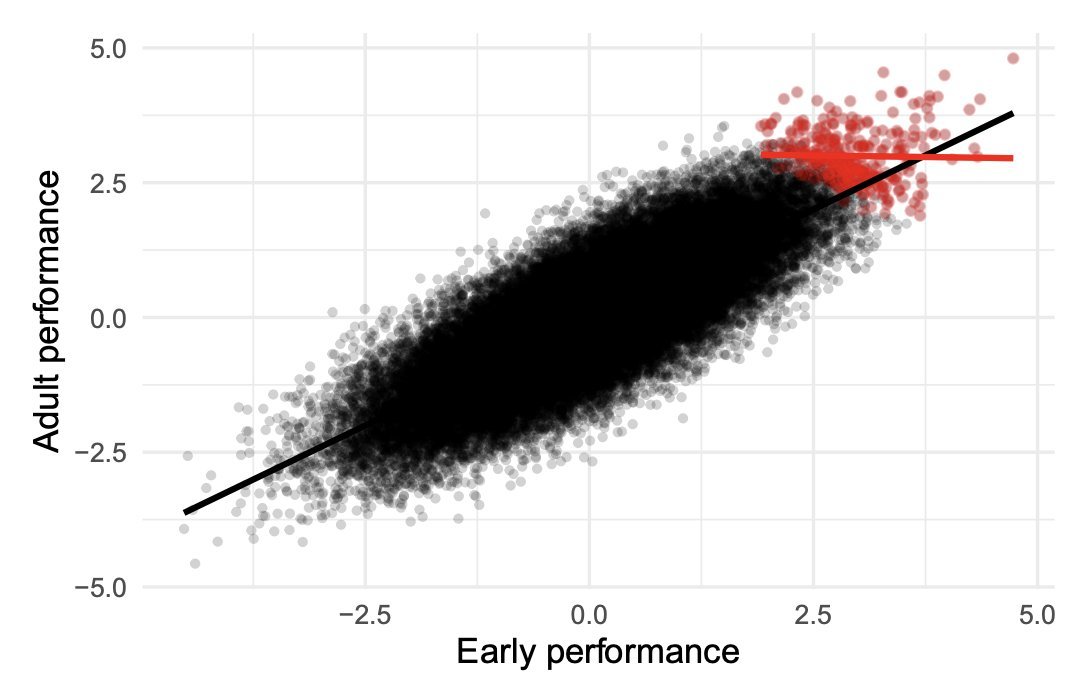
Among elite chess players, those with the lowest IQ are the best.
Among NBA players, the shortest ones are the best.
Among Hollywood actors, the least attractive are the most talented.
Among elite academics, those with poorer early academic performance are the best.
Among people with high LDL & high plaque burden, LDL is barely correlated with plaque burden.
Learn collider bias. Nice catch by @AlexTISYoung
Un gran análisis de 10 estudios científicos (con más de 4.600 participantes) concluye que tomar un descanso completo de las redes sociales no mejora ni empeora la salud mental. Ni el estado de ánimo positivo, ni el negativo, ni la satisfacción con la vida cambiaron de forma significativa cuando las personas dejaban de usar redes sociales durante períodos que iban desde un día hasta casi un mes.
Los beneficios esperados (menos estrés, menos envidia, más tiempo libre) parecen compensarse con los aspectos negativos (aburrimiento, sensación de aislamiento o FOMO).
En resumen: dejar las redes sociales de golpe (“digital detox”) no es una solución mágica para sentirse mejor. Los investigadores sugieren que estrategias más moderadas, como limitar el tiempo o desactivar notificaciones, podrían ser más útiles que abandonarlas por completo.