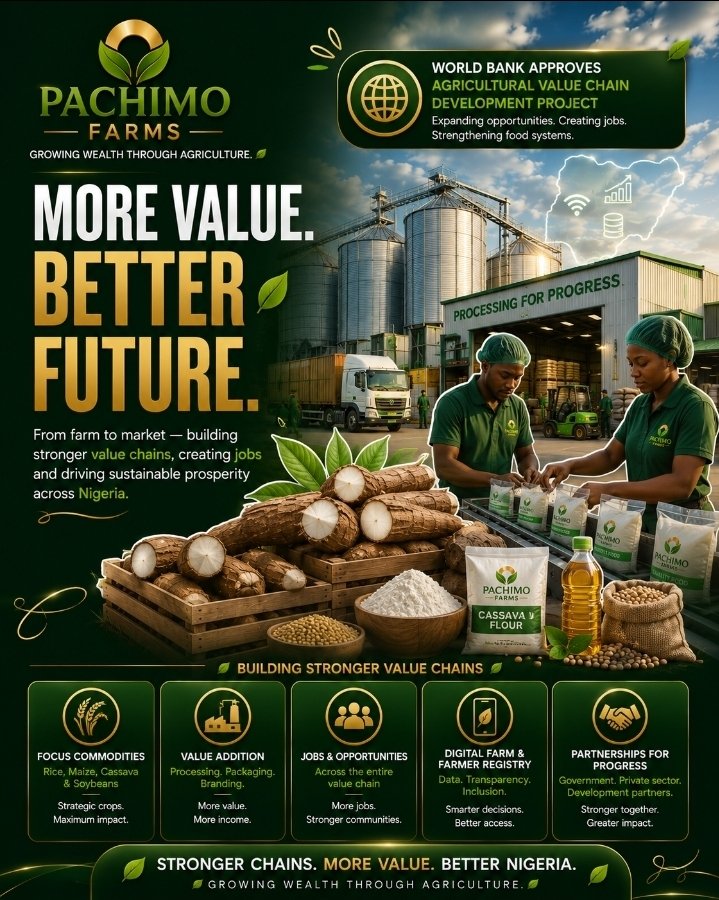
Pachimo Farms was built from a simple but serious belief: agriculture should create value, dignity, and long-term growth. What started as a farm story is now becoming a brand story, one rooted in real operations, real products, and a real vision for the future.
PART 1:
THE CONVERSATION NIGERIA IS HAVING
Yesterday, 26 June 2026, Nigeria's First Lady, Senator Oluremi Tinubu, @SenRemiTinubu made remarks about akara, roasted corn, and kuli-kuli businesses, explaining that they are businesses that can be started with relatively little capital. She also stated that beneficiaries of the Renewed Hope Initiative were given grants instead of loans to help them start businesses.
As expected, the statement quickly sparked conversations across Nigeria.
Some people agreed.
Some disagreed.
Many responded with sarcasm, satire, memes and criticism.
Rather than joining either side, we decided to ask a different question.
What is the actual economics behind these businesses?
This series is not political.
It is not an endorsement of any government.
It is not an anti-government campaign.
It is not financial advice.
It is simply an honest, statistical look at three businesses that millions of Nigerians see every day.
Because whether we like them or not...
They are businesses.
And businesses deserve to be understood before they are judged.
Over the next few posts, we'll look at:
• Why Micro, Small and Medium Enterprises (MSMEs) matter
• The economics of Akara
• The economics of Roasted Corn
• The economics of Kuli-kuli
• Why value addition changes everything
• The biggest lesson every entrepreneur can learn from this conversation.
Let's begin.
PART 6:
THE BIGGER LESSON
After all the debates...
After all the memes...
After all the arguments...
Perhaps the biggest lesson isn't about akara.
Or roasted corn.
Or kuli-kuli.
Perhaps it's about perspective.
Many people dream of starting with millions.
Very few are willing to start with what they have.
History reminds us that some of the world's largest companies began in garages, bedrooms, small workshops, roadside stalls, and family kitchens.
Small beginnings do not limit big futures.
What limits people is refusing to learn, improve, innovate, and scale.
At Pachimo Farms, we believe agriculture is more than farming.
It is business.
It is manufacturing.
It is logistics.
It is technology.
It is branding.
It is exports.
It is wealth creation.
Most importantly...
It is value creation.
So perhaps the question isn't whether akara, roasted corn, or kuli-kuli are "small businesses."
The real questions are:
Can they create income?
Can they feed families?
Can they employ others?
Can they grow into larger businesses?
Can they become brands?
Can they create generational wealth?
Because every giant enterprise was once somebody's "small idea."
Start where you are.
Build with excellence.
Scale with intention.
Think globally.
Grow sustainably.
Pachimo Farms
Growing Wealth Through Agriculture.
PART 5:
KULI-KULI IS REALLY ABOUT VALUE ADDITION
This may be the most interesting business of the three.
Why?
Because kuli-kuli is not just a snack.
It is value addition.
Groundnuts are processed into oil.
The remaining paste becomes kuli-kuli.
One agricultural product.
Multiple income streams.
That is exactly how modern agribusiness works.
Instead of selling raw commodities only...
you process.
You package.
You brand.
You distribute.
You create more value.
The business isn't just making kuli-kuli.
The business is turning an agricultural raw material into a branded consumer product.
This is where agriculture becomes manufacturing.
Where farming becomes industry.
Where commodities become brands.
This is the future Pachimo Farms believes in.
Not simply producing more.
Producing smarter.
PART 4:
ROASTED CORN IS REALLY A TRAFFIC BUSINESS
Roasted corn teaches a completely different business lesson.
Unlike akara, roasted corn isn't driven primarily by production.
It's driven by location and traffic.
Imagine buying fresh corn during peak harvest when prices are lower.
Your costs include:
• fresh corn
• charcoal or firewood
• transportation
• seasoning
• labour
Your success now depends on:
Where you sell.
How many people pass your location.
Weather.
Season.
Timing.
A busy roadside can outperform a beautiful shop with little foot traffic.
That's because roasted corn is a volume business.
Small profit on many sales.
Not huge profit on one sale.
The lesson?
Location is an asset.
Traffic is revenue.
Consistency is profit.
PART 3:
THE ECONOMICS OF AN AKARA BUSINESS
Let's look at akara from a business perspective.
Not emotions.
Not politics.
Just numbers.
(Illustrative scenario using current market prices. Actual costs vary by location and season.)
Assume a vendor purchases:
• Beans — approximately ₦10,000–₦15,000
• Onion, pepper and seasoning — ₦1,500–₦2,500
• Cooking oil allocation — ₦3,000–₦6,000
• Firewood or gas allocation — ₦1,000–₦4,000
• Water, transport, labour and miscellaneous expenses — ₦3,000–₦8,000
Estimated operating cost:
₦19,000–₦35,500
Now imagine that same vendor produces and successfully sells 1,000 akara balls at ₦100 each.
Gross revenue:
₦100,000
Estimated gross operating margin before owner salary, equipment replacement and longer-term overheads:
Approximately ₦64,500–₦81,000 under this illustrative scenario.
Notice something important.
The money isn't made because akara is magical.
The money comes from:
• buying ingredients wisely
• controlling oil usage
• reducing waste
• choosing a busy location
• maintaining quality
• serving customers consistently
Akara isn't just food.
It's operations.
It's inventory management.
It's pricing.
It's customer service.
It's entrepreneurship.
Small businesses survive because of discipline, not because they are small.
PART 2:
WHY MSMEs ARE THE BACKBONE OF EVERY ECONOMY
One of the biggest misconceptions in business is believing that only billion-naira companies matter.
They don't.
Every economy is built from the bottom upward.
Before there were multinational corporations...
there were market traders.
Before there were food factories...
there were women frying akara.
Before there were packaged snacks...
there were people making kuli-kuli by hand.
Before logistics companies...
there were people carrying produce from farms to markets.
Every large company started somewhere.
Nigeria has millions of Micro, Small and Medium Enterprises (MSMEs).
Collectively, they employ millions of Nigerians and support countless households.
These businesses:
• feed families
• create employment
• circulate money within communities
• supply local markets
• reduce unemployment
• train apprentices
• create future entrepreneurs
Many of us were raised by parents or grandparents whose businesses would today be classified as MSMEs.
Some sold roasted corn.
Some sold akara.
Some sold vegetables.
Some processed cassava.
Some traded in palm oil.
Some operated kiosks.
Some repaired shoes.
Some were tailors.
Some were mechanics.
None of those businesses looked glamorous.
Yet they paid school fees.
Fed families.
Built houses.
Raised professionals.
There is dignity in honest work.
The challenge is not starting small.
The challenge is staying small in mindset.
Africa possesses one of the greatest agricultural opportunities in the world.
The continent is estimated to hold around 60% of the world's uncultivated arable land, yet many African countries still rely heavily on food imports.
That gap is not just a challenge.
It is an opportunity.
With better infrastructure, mechanisation, financing, processing, technology, and regional trade, Africa has the potential to become a global agricultural powerhouse.
The future of African agriculture is not simply producing more food.
It is building stronger value chains, expanding agro-processing, improving logistics, creating jobs, and increasing exports.
Agriculture has the power to strengthen economies, improve food security, and create opportunities for millions of young Africans.
At Pachimo Farms, we believe Africa's greatest resource is not only its land.
It is the people willing to transform that land into lasting prosperity.
🌱 Growing Wealth Through Agriculture.
#PachimoFarms #Africa #Agribusiness #AfricaRising #FoodSecurity #Agriculture #InvestInAfrica
Nigeria's agricultural sector remains one of the country's greatest economic opportunities.
According to the World Bank's World Development Indicators, agriculture accounted for 25.9% of Nigeria's GDP in 2024. It is also a major source of employment and a key pillar of national food security. (https://t.co/1z4W5xAsSL�)
Yet the biggest opportunity is not simply growing more crops.
It is creating value through processing, storage, branding, logistics, exports, and technology.
Nigeria is already the world's largest producer of cassava.
Demand continues to grow for poultry, livestock, oil palm, rice, maize, soybeans, and other agricultural value chains.
The question is no longer whether agriculture matters.
The question is who will build the businesses that unlock its full potential.
Agriculture is not only an economic sector.
It is a strategic asset for national development.
At Pachimo Farms, we believe Nigeria's future prosperity will depend on how effectively we transform agricultural production into sustainable businesses.
🌱 Growing Wealth Through Agriculture.
#PachimoFarms #NigeriaAgriculture #Agribusiness #InvestInAgriculture #FoodSecurity #ValueAddition
One Farm Can Transform an Entire Community
A successful farm does much more than produce crops or livestock.
It creates jobs.
It supports transporters, processors, market traders, equipment suppliers, veterinarians, agronomists, logistics companies, and retailers.
Across Nigeria, commercial farms and outgrower programmes have shown that agriculture can stimulate local economies, create employment opportunities, and improve rural livelihoods.
When farmers succeed, communities grow stronger.
Young people find opportunities closer to home.
Small businesses emerge.
Local markets become more active.
Economic activity expands.
Agriculture is one of the few industries where the success of one business can positively impact hundreds of other people.
That is why investing in agriculture is also investing in communities.
At Pachimo Farms, we believe sustainable agribusiness should create value far beyond the farm gate.
🌱 Growing Wealth Through Agriculture.
#PachimoFarms #CommunityDevelopment #Agribusiness #Agriculture #FoodSecurity #Nigeria
Strong Families Grow Strong Nations
Agriculture has always been more than an occupation.
It is one of the strongest foundations for building resilient families.
A productive farm can provide food, create income, generate employment for family members, and build assets that are passed from one generation to the next.
Unlike many businesses that depend entirely on consumption, agriculture creates real value. It transforms land, labour, knowledge, and time into products that feed people and sustain economies.
Families involved in crops, livestock, processing, or agricultural trading often build multiple streams of income while strengthening household food security.
More importantly, they build knowledge, discipline, and resilience that can benefit future generations.
Agriculture is not simply about producing food.
It is about producing opportunities.
At Pachimo Farms, we believe every successful farm has the potential to become a lasting family legacy.
🌱 Growing Wealth Through Agriculture.
#PachimoFarms #FamilyBusiness #Agriculture #FoodSecurity #Agribusiness #Legacy
Agriculture Starts With One Decision
Many people believe you need millions to build wealth.
In reality, many successful agribusinesses began with something much smaller—a few birds, a small cassava plot, a fish pond, or a handful of seedlings.
Agriculture remains one of the few industries where individuals can start modestly, learn continuously, reinvest profits, and build sustainable businesses over time.
Take cassava as an example. Nigeria is the world's largest producer, yet much of its economic potential lies beyond the farm. Cassava can be processed into garri, flour, industrial starch, ethanol, livestock feed, and many other products. One crop can support multiple income streams when approached as a business rather than simply as farming.
The same applies to poultry. Beyond selling birds, there are opportunities in egg production, feed supply, hatcheries, processing, and distribution.
Agriculture rewards knowledge, patience, and value creation.
Every successful agribusiness started with one decision—to begin.
At Pachimo Farms, we believe wealth doesn't always begin with large capital.
Sometimes, it begins with one seed.
🌱 Growing Wealth Through Agriculture.
#PachimoFarms #Agribusiness #Agriculture #Entrepreneurship #InvestInAgriculture #FoodSecurity
Nigerian agriculture is no longer just a farming conversation.
It is an investment conversation.
While many people still see agriculture as planting and harvesting, the smartest investors are looking at something much bigger: value chains, processing, logistics, exports, food security, and industrial production.
Recent developments across the sector tell a clear story.
Government-backed initiatives are expanding access to land, financing, mechanisation, and farmer support.
International institutions are committing hundreds of millions of dollars to agricultural development and value-chain expansion.
Private-sector players are announcing multi-billion-dollar agribusiness partnerships focused on processing, distribution, and food production.
Why?
Because the fundamentals are undeniable.
Nigeria has:
• Over 200 million consumers
• Growing food demand
• Large areas of arable land
• A rapidly expanding population
• Significant import substitution opportunities
• Untapped export potential
Yet many agricultural value chains remain underdeveloped.
This gap represents opportunity.
The future winners in agriculture will not simply be those who produce crops.
They will be those who build systems around production:
→ Processing
→ Storage
→ Logistics
→ Branding
→ Packaging
→ Distribution
→ Export Infrastructure
→ Agricultural Technology
Take cassava as an example.
Most people see cassava as a farm crop.
Investors see:
• Garri
• High-quality cassava flour
• Industrial starch
• Livestock feed
• Ethanol
• Glucose syrup
• Export products
One crop.
Multiple revenue streams.
The same principle applies across livestock, poultry, palm oil, maize, soybeans, rice, and other agricultural value chains.
The next decade of wealth creation in Africa will not come only from technology.
It will come from the intersection of technology, agriculture, logistics, finance, and industrial processing.
At Pachimo Farms, we believe agriculture should be approached as a business, not merely an activity.
The goal is not simply to farm.
The goal is to create value, build sustainable systems, strengthen food security, generate jobs, and develop assets that can grow for generations.
Nigeria's agricultural opportunity is enormous.
The question is no longer whether agriculture matters.
The question is who is positioning themselves to benefit from its future.
Pachimo Farms
Growing Wealth Through Agriculture.
#PachimoFarms #Agribusiness #Agriculture #InvestInAgriculture #FoodSecurity #NigeriaBusiness #ValueAddition #AgriculturalInvestment #SmartAgriculture #FutureOfFarming
Today, we celebrate the fathers.
The men who wake up early, work quietly, carry heavy responsibilities, and make sacrifices that often go unseen.
The fathers who plant seeds of hope, nurture dreams with patience, and build stronger futures for their families through hard work, faith, and perseverance.
Whether in the farm, the office, the workshop, the marketplace, or at home, fathers play a vital role in shaping generations and strengthening communities.
At Pachimo Farms, we understand that agriculture itself is built on many of the same values that define fatherhood — commitment, resilience, stewardship, patience, and the belief that what we invest in today can create something greater tomorrow.
Today, we honor every father, grandfather, mentor, guardian, and father figure who continues to lead with strength, wisdom, and love.
Thank you for the sacrifices you make.
Thank you for the lessons you teach.
Thank you for the legacy you build.
Happy Father's Day from all of us at Pachimo Farms.
🌱 Growing Wealth Through Agriculture.
#FathersDay #HappyFathersDay #PachimoFarms #GrowingWealthThroughAgriculture #Legacy #Family #Agriculture #Leadership #Community
NIGERIA'S AGRIBUSINESS IS SHIFTING: WHAT CHANGED THIS MONTH? Nigeria’s agricultural sector is transforming, becoming more structured, technology-driven, and focused on long-term growth. Here are the major developments this month:
Value Addition Is Becoming More Important Than Raw Production The real opportunity lies in processing, packaging, branding, storage, logistics & distribution.
Cassava, maize, rice, soybeans etc. are now seen as industrial & commercial opportunities not just farm produce.