Today we announced the Claude-led discovery of a molecular machine that we suspect could represent a new gene editing mechanism. Its precise function, biotechnological utility (if any), or level of significance is not yet clear, but at minimum it is work I would have been proud to do as a PhD student. The work was done mostly, though not entirely, by Claude: our life sciences team suggested a broad area of research, Claude read through the literature and a bunch of genome data and discovered something interesting, then Claude proposed experiments to verify the discovery and our team carried them out.
It’s easy to dismiss this as a one-off or curiosity, but we’ve repeatedly seen a pattern where AI performance in new intellectual domains goes from weak to superhuman in a matter of a few years. In 2023 models struggled to do math at the level of an average high-school student. In 2024 they started to do well on math competitions for the best high-schoolers in the country, in 2025 they started to solve minor open problems, in early 2026 more significant open problems, and in late 2026 they are beginning to solve the top few open problems in all of mathematics. We believe AI for biology is on a similar exponential trend.
The main difference between biology and mathematics, of course, is that math can be done purely theoretically, while biology requires experimentation. Some have used this to draw the conclusion that AI’s utility in biology will be limited. We think this is wrong. As we’ve demonstrated today, humans can collaborate with AI to perform the experiments, validate key results in a few weeks and, if necessary, work with the AI to iterate on what they find. Eventually it may even be possible for Claude itself to safely perform the experiments by autonomously controlling lab equipment, with appropriate safeguards in place, but we aren’t doing that today (our lab is also a BSL1/BSL2 facility that doesn't handle materials dangerous to humans).
More broadly, biomedical advancement has many stages — from fundamental biology discoveries, to translational research, to drug discovery, clinical trials, and finally the actual delivery of medicines and health care to patients. We are also interested in these later stages, but even simply accelerating the first stage of fundamental biological discoveries has the potential to speed up and broaden the entire pipeline. Improving our understanding of biology and sharpening biologists’ tools can drive forward all of the later stages, for example by identifying new drug targets, finding new therapeutic modalities, allowing for more precise measurement, and speeding up the experimental loop which itself further accelerates our understanding of biology. This will not in itself speed up clinical trial times, but if it succeeds it could greatly increase the number of promising candidates that go into the pipeline — an increase in throughput even though latency remains.
In Machines of Loving Grace, I wrote about AI’s potential to “cure most diseases in 5-10 years” — a goal that sounds impossible, but one I believe is just barely possible if AI is applied to every stage of the pipeline. The first step is showing that AI can first help with, and then drive, biological discoveries.
Claude’s discovery is the latest in a line of related prior work that goes back decades, beginning with systems like CRISPR, and continuing with discoveries like the bridge recombinase and VIPR in the past few years. Recently, there has been heightened interest in systems based on reverse transcriptase (RT) enzymes, the enzyme underlying the system Claude identified. And most recently, a Stanford team working independently described a novel RT system with an associated non-coding array that is in some ways similar to the one Claude found, though they are distinct systems that evolved independently from each other. I believe that we’re at the very beginning of finding such systems and developing them into powerful tools for biotechnology.
I’m proud of the resources Anthropic has invested in accelerating the public benefits of AI through the life sciences, and we’re aiming both to grow our life sciences team and to work with other scientists to extend this approach to a broad range of problems. If you have a proposal for a research collaboration or are interested in joining our life sciences team, please reach out.
Carta de un cura de barrio a Silvia Abril:
Estimada Silvia:
Me llamo Francisco Javier. Soy un sacerdote del montón que vive y trabaja en un barrio obrero del sur de Madrid, en Leganés. En mi día a día no hay focos ni maquillaje; aquí la vida es muy auténtica.
👇
🚨Comparto con mucha ilusión mi último artículo, un análisis discursivo de cartas electorales, en @ItinerariosUW
Puedes descargarlo aquí 👇🏻https://t.co/2752dzOBPg
Muy feliz de ver publicado mi artículo sobre este libro tan relevante para la dignidad y la memoria de las víctimas del terrorismo @LourdesPerez_RC@EduMadina@bsemper. Gracias, @RevBibBabel 😊
🗓️La exposición sobre el atentado de la cafetería Rolando, perpetrado por ETA en 1974, llega a la @urjc. Merece la pena verla para no perder la memoria de la primera masacre indiscriminada de esta organización terrorista @MemorialVT
Hoy me ha llegado un SMS de phising de "Correos". Como mi socio estaba reiniciando servidores y no podía trabajar, he pensado... pues me voy a divertir un rato.
Si este hilo le sirve a alguien para entender un poco más como funcionan estos timos, eso que hemos ganado. 🧵⬇️
Introducing Sora, our text-to-video model.
Sora can create videos of up to 60 seconds featuring highly detailed scenes, complex camera motion, and multiple characters with vibrant emotions.
https://t.co/YYpOAcrXQ3
Prompt: “Beautiful, snowy Tokyo city is bustling. The camera moves through the bustling city street, following several people enjoying the beautiful snowy weather and shopping at nearby stalls. Gorgeous sakura petals are flying through the wind along with snowflakes.”
Ha sido un placer participar en este volumen de @PeterLangGroup 😊. Hablo sobre Análisis del discurso, poder y guerra de informaciones en la comunicación sobre la invasión rusa de Ucrania. https://t.co/A8HnWulUUx
Me hace muy feliz compartir el enlace del artículo en abierto que me acaban de publicar, "Ámbito lingüístico, estrategia ideológica y discurso político de ETA (1959-2011)", por si fuera de vuestro interés. Gracias🙂 @CISDEinfo https://t.co/RVoDExPe3V
Hoy, Día de Internet, queremos celebrar la revolución digital y el cambio que ha supuesto en nuestra manera de vivir. ¡Feliz día de Internet!
#DíadeInternet#weareclevertask#wearealten
Acaba de publicarse mi reseña del 📖 "Héroes de la retirada. La disolución de ETA pm", coordinado por @GaizkaFS y @saraorellan@EditorialTecnos y @MemorialVT, en la revista @urjc Studia Humanitatis Journal . Podéis leerla aquí: https://t.co/lTFRKOub1n
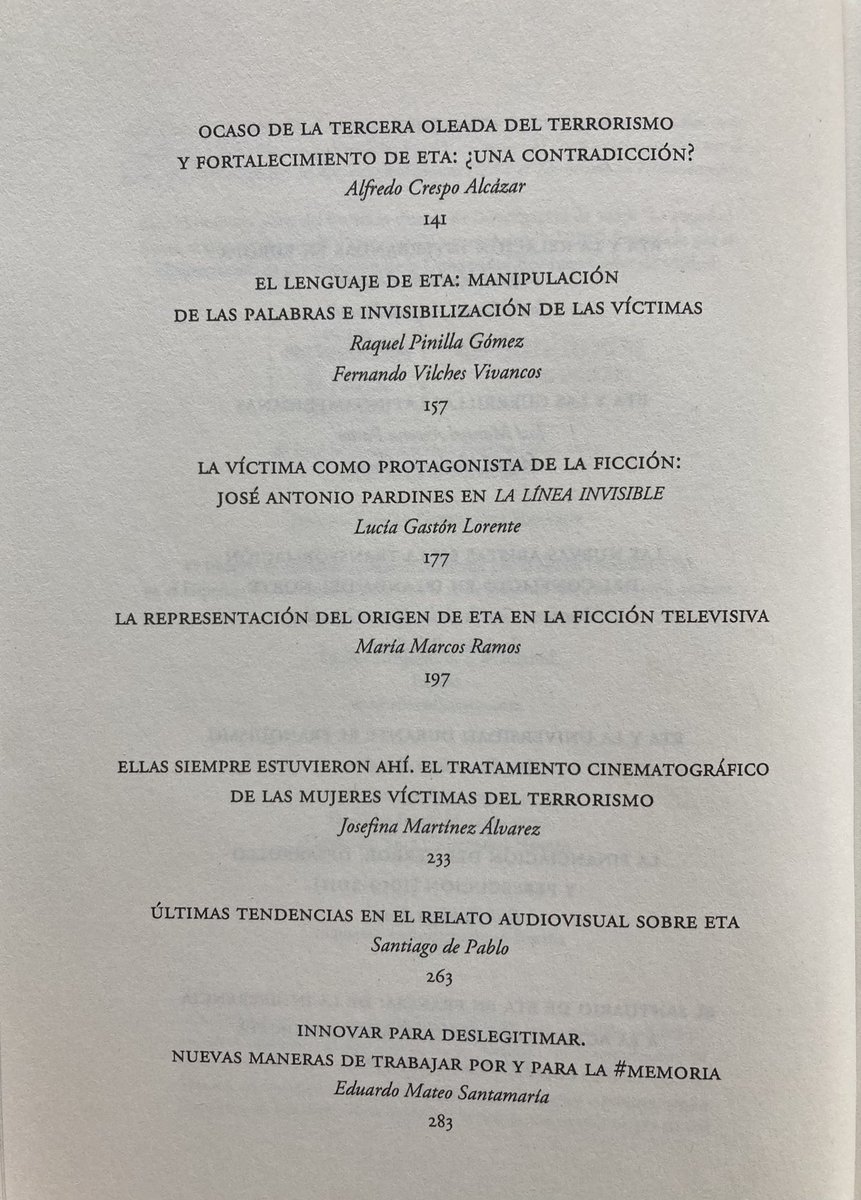
Hay trabajos que son algo más que resultados de investigación. Este es uno de ellos y acaba de publicarse ☺️. “El lenguaje de ETA: manipulación de las palabras e invisibilización de las víctimas“. No podemos estar más satisfechos 😌@silexediciones
En la presentación de “Héroes de la retirada” @EditorialTecnos, un📕 necesario para comprender la disolución de ETA pm, primer hito del final del terrorismo de ETA; coordinado por @GaizkaFS, del @MemorialVT. Lectura muy recomendable ✅
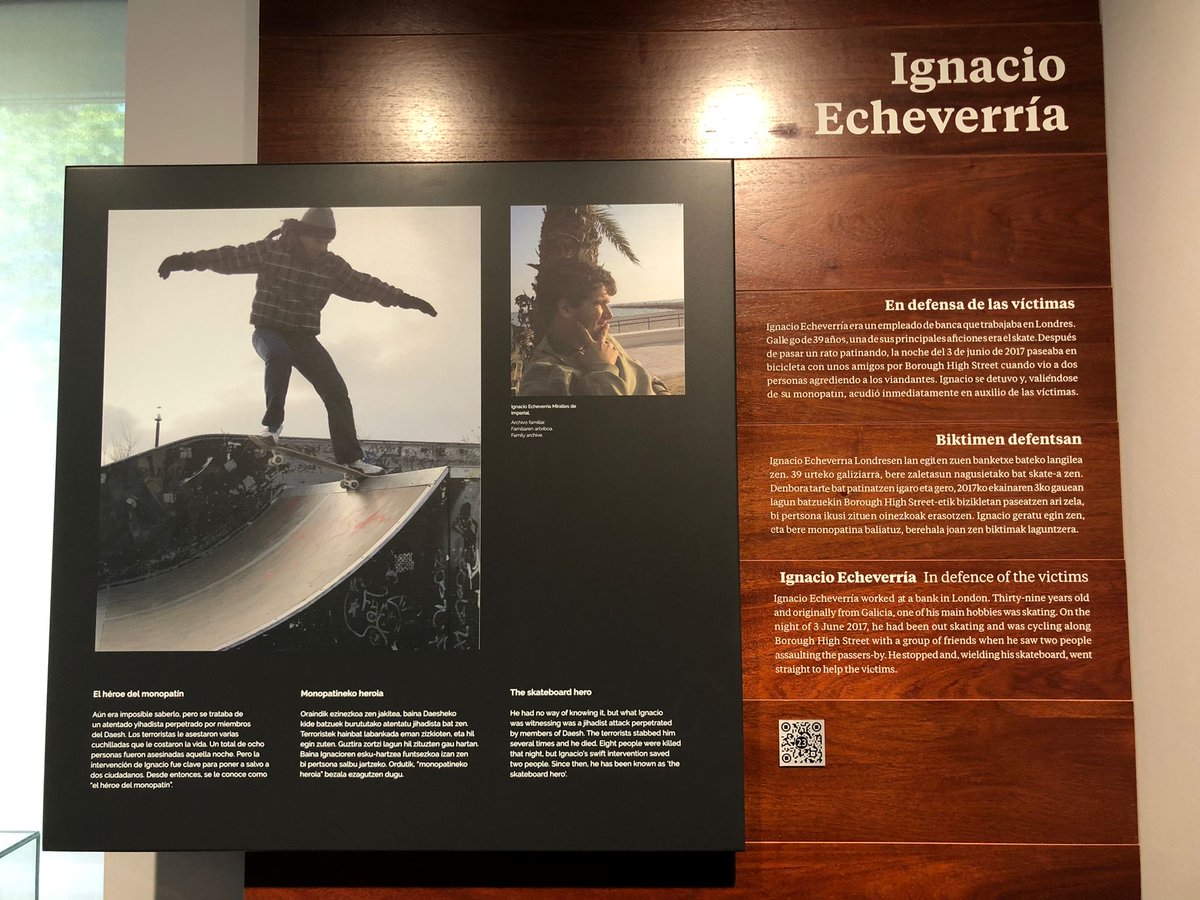
Una persona me manda este comentario adjunto a estas fotografías. Mi agradecimiento Estuve en Vitoria este verano y me gustó mucho ver cómo muchas personas, de aquí y extranjeras, se detenían a leer sobre Ignacio. Siempre en el recuerdo❤️
Adentrarse en la lectura de “Todos los futuros perdidos” @EduMadina@bsemper@LourdesPerez_RC es el mejor ejercicio para reflexionar profundamente sobre todo el mal que sembró ETA y deslegitimar su relato. Libro imprescindible 🙂