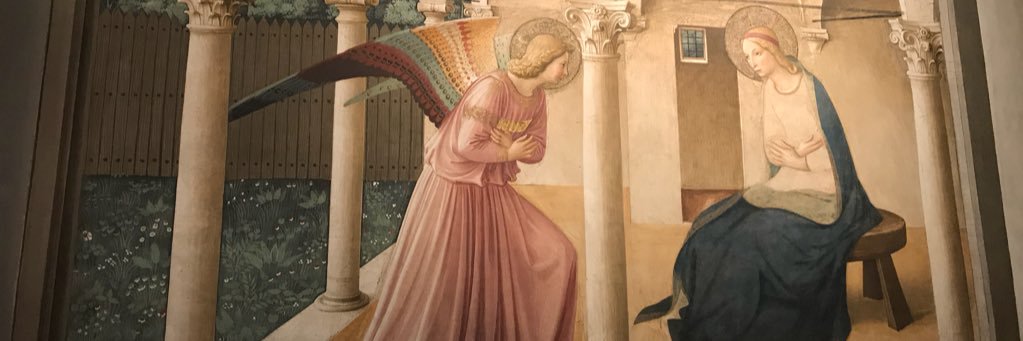
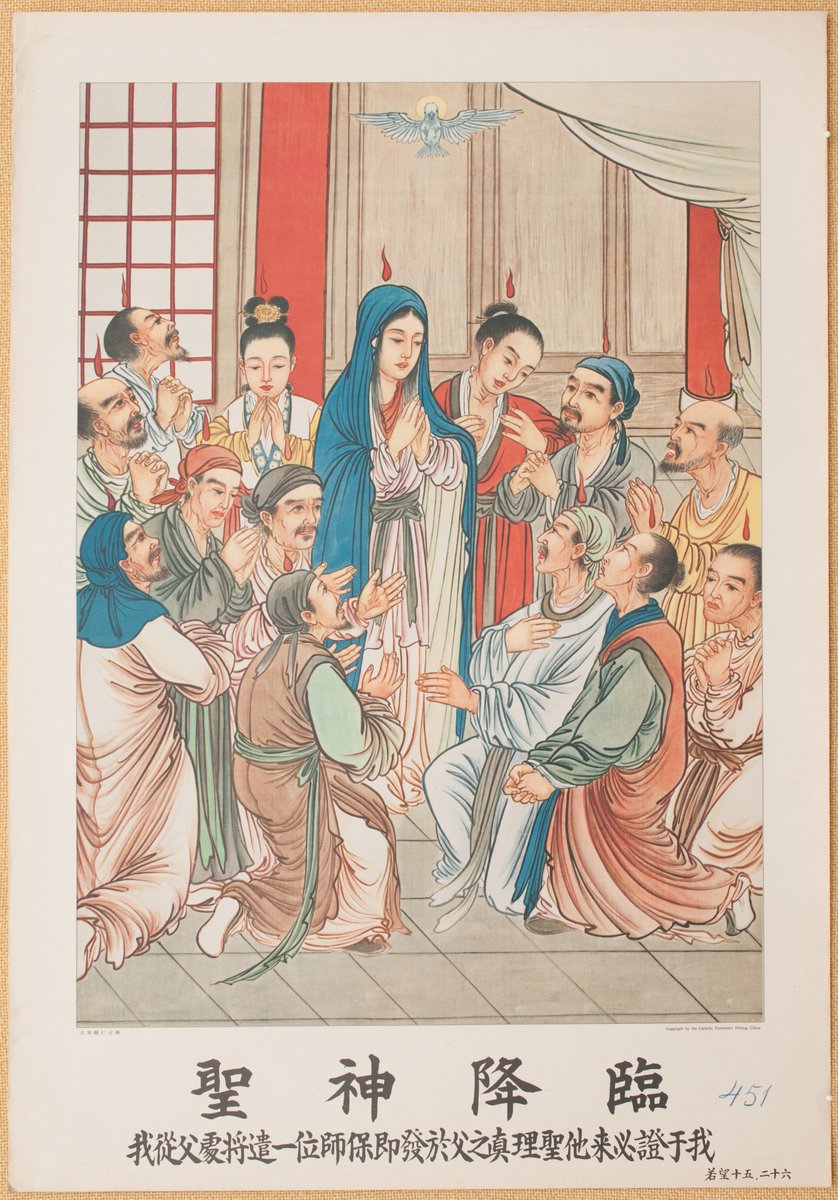
@DioceseToledo seminarians chant the Ave Maria for the 2026 Priest Convocation. Continue to pray for more priests and religious for our parishes and schools!
A Catholic moment in Japan that will be hard to forget.
At Mass today, a girl received her First Communion. Her family prepared commemorative bags of rice for every parishioner.
Each package was personalized with her baptismal saint.
I had never seen anything like it.
Churches, whether they be enormous, dramatic edifices in the middle of a bustling city or humble structures in a small town or on a country road, stand as symbols.
They're symbols of God's presence right here, where we live.
For a while, the power of the church building has been denigrated - "the church isn't the building" - which is true. But that sentiment ignores the reality that human beings aren't pure spirit. We're embodied and we live in the material world, and this is how God reaches us - through who we are, where we are.
Traditions of church architecture of all kinds and styles reflect this and churches - now I'm pivoting mostly to the Catholics - should embrace this truth.
People are drawn to beautiful and interesting churches - that approach is an evangelizing moment. Their curious, open gaze is an opportunity - not to grab people and yap at them, but to let the building and the interior speak. Give them the assistance they need in the form of pamphlets, websites, explanatory plaques and such, to understand, at least.
I've gone into many church buildings all over the world. Some do this very well (I saw quite a few in France) but many not at all.
A reflection along this score written after my 2023 visit to, you got it, Sagrada Familia:
https://t.co/x4G35yau7I
Every morning Saint Francis de Sales recommends meditating on this:
God had no need for you, yet He made you
He made you out of nothing
He did not need you, and you do not add to Him
Yet out of nothing, He made you solely out of Love.
Consider also the times you’ve betrayed God, but specifically how He brought you back when you repented…
Likewise, you betrayed God, but He brought you back
He had no need to bring you back, but He did.
Solely out of His immense love for you, and you in particular
Remember that God loves you.
June is the month dedicated to the Sacred Heart of Jesus - emphasized this year by the @USCCB bishops' consecration of the US to the Sacred Heart.
In a time and culture in which hardly any of us understand what love actually is, in which we seem to be surrounded by dehumanizing hate and horrifying violence as well as public discourse characterized by contempt and judgment, a daily prayer focused simply on love might just have surprising power.
O Heart of love, I put all my trust in Thee; for I fear all things from my own weakness, but I hope for all things from Thy goodness.
In a time and culture in which human beings hear, from the moment that they can understand words, that they will be valued for their abilities, their achievements and their appearance, to hear the Good News that no, this is not so, that a Heart pours out love for us just because we are – can mean the difference between life and death.
In a church culture which often reflects contemporary values that emphasize achievement and self-actualization and fulfillment by doing the Next Big Amazing Thing in Your Very Big Amazing Life, a daily prayer centered on opening ourselves to sharing the love pouring forth from the heart of Jesus in ordinary ways might provide a welcome refocus as we get our bearings for summer.
More at link in comment.
Image from my Loyola Kids Book of Catholic Signs and Symbols.
A 3D reconstruction of a pregnant woman at 32 weeks gestation.
Evidence.
Babies in the womb aren’t body parts.
They are living, unique, dependent, and developing human beings, intrinsically valuable and worthy of life.
A nursing mother sat in a Carthage prison in 203 AD and wrote down her own dreams.
She knew she was going to die. She wrote anyway.
What she left behind is one of the most extraordinary documents in Christian history.
On April 29, 1991, at 11:00 a.m., a sergeant from the Military Police entered the parish rectory in Salgueiro, Pernambuco, in Brazil, and shot the parish priest five times. Death was immediate.
The priest was 63 years old. His name was Father José Maria Prada, and he died because he refused to officiate an invalid marriage.
Born in 1928 in northeastern Portugal, Father José Maria joined the Redemptorists at a young age and was ordained a priest in 1953. Two years later, he left as a missionary to Angola, where he spent more than two decades serving the people through a demanding life of missionary work.
He later came to Brazil, serving first in the interior of São Paulo before being sent to the backlands of Pernambuco in the 1980s. After ministering in several cities, he eventually arrived in Salgueiro, where he became pastor of Saint Anthony Parish.
Those who knew him remember him as a simple priest—close to the people and unwavering in his convictions.
The situation began like many others: a man approached the priest seeking to be married in the Church.
Father José Maria did what any faithful priest would do—he investigated the situation. He soon discovered that the man was already sacramentally married to another woman.
The Church’s teaching is clear:
“Thus the marriage bond has been established by God himself in such a way that a marriage concluded and consummated between baptized persons can never be dissolved.” (CCC 1640).
Given the circumstances, there was nothing to negotiate. The answer was no.
The man persisted, returning several times. He tried pressure, offering money, and finally threats.
But Father José Maria would not yield. He did not alter records, minimize the situation, or look for a “shortcut.”
According to reports from the time, he even said he would rather die than celebrate that marriage.
On April 29, the sergeant returned.
He entered the rectory and opened fire.
There ended the life of a priest who remained faithful to his beliefs until the very end.
The funeral drew the bishop, priests from across the region, and a multitude of faithful Catholics.
One detail deeply moved those present: the bloodstained shirt Father José Maria was wearing at the time of the murder was carried at the front of the funeral procession.
Nothing needed to be explained. It said everything.
His heart was later preserved in Saint Anthony Church beneath the inscription:
“Martyr for the sanctity of marriage.”
To this day, there is no formal beatification process underway in Rome. Yet the memory of Father José Maria remains alive in the community.
It is not difficult to understand why.
He did not die over a mere formality. He died defending something concrete: fidelity to marriage, the truth of the sacraments, and the unity between faith and life.
His story recalls that of John the Baptist, who was also killed for refusing to legitimize an unlawful union.
This is not merely a story from the past.
It still matters because it touches something every person eventually faces:
What do you do when telling the truth begins to cost you?
https://t.co/8esurFBC87