12 Things Kids Need From the Caring Adults in Their Lives
As a therapist, educator, former principal, and parent, I've learned something that both research and experience continue to reinforce:
Children don't need perfect adults. They need caring adults who consistently show up.
The small moments day after day are often what shape a child's confidence, character, and future.
1. Your Presence
Why it helps: Feeling seen and valued is one of the strongest protective factors for mental health.
Try this: Put your phone away for 10 uninterrupted minutes. Listen. Make eye contact. Be fully there.
2. Unconditional Love
Why it helps: Kids thrive when they know love isn't earned through perfect behavior.
Try this: Correct the behavior without rejecting the child. Remind them, "I love you no matter what."
3. Calm During Their Storm
Why it helps: A regulated adult helps regulate a child's nervous system.
Try this: Slow your breathing, lower your voice, and respond instead of react.
4. Encouragement More Than Criticism
Why it helps: What we notice grows. Encouragement builds confidence and resilience.
Try this: Catch them doing something right every day and tell them specifically what you noticed.
5. Safe Boundaries
Why it helps: Consistent expectations create security and predictability.
Try this: Be firm, fair, and consistent. Explain the "why" whenever possible.
6. Natural & Logical Consequences
Why it helps: Kids learn best when consequences are connected to their choices—not meant to shame or punish.
Try this: If a toy is left outside, it may be unavailable for a while. If homework isn't finished, they experience the school consequence. Focus on learning, not revenge.
7. Responsibilities That Matter
Why it helps: Chores build confidence, responsibility, independence, and a sense of belonging. Kids feel proud when they know they're contributing.
Try this: Give age-appropriate jobs at home and thank them for helping the family—not because they're paid, but because they're part of the team.
8. Someone Who Believes in Them
Why it helps: Sometimes children borrow our belief until they develop their own.
Try this: Remind them of past successes and say, "I believe you can do hard things."
9. Patience While They're Learning
Why it helps: Kids aren't born knowing how to regulate emotions, solve problems, or communicate well. Those are learned skills.
Try this: Ask, "What skill do I need to teach?" before asking, "How do I stop this behavior?"
10. Opportunities to Be Heard
Why it helps: Children who feel heard are more likely to trust you and come to you when life gets hard.
Try this: Listen to understand before trying to fix.
11. Hope
Why it helps: Kids learn resilience by watching how trusted adults respond to setbacks.
Try this: Let them hear you say, "This is hard... and we'll figure it out together."
12. Joy
Why it helps: Play, laughter, and shared experiences strengthen relationships and become lifelong memories.
Try this: Play a game. Go for a walk. Tell silly jokes. Laugh often. Childhood should include plenty of joy.
At the end of the day, kids probably won't remember every toy you bought or every lecture you gave.
But they'll remember how you made them feel.
Safe. Loved. Heard. Capable. Valued.
The greatest gift we can give a child isn't perfection.
It's a caring adult who shows up, believes in them, and keeps showing up—even on the hard days.
One caring adult can change the trajectory of a child's life.
Join a community of educators, mental health professionals & other caring adults at the “Maslow Before Bloom” Facebook group: https://t.co/ISWliSZQkh
“I wasn’t asking them to read complex text. I was really asking them to survive it.”
When Luke said this, we both paused. 🫣
In this episode, we talk about what it really means to support students when texts get difficult. 🎧 https://t.co/oYDJRvya2e
Research shows that a strong instructional leader can add up to three additional months of learning for students every year.
Find out more – and get tools to support your work – via @NewLeadersOrg:
https://t.co/QbdfLjdTx4
Scroll by—that’s fine.
Just know you’re passing up the most legendary collection of creative challenge worksheets ever assembled in the history of the universe. No cap.
https://t.co/8Y4Lf0Brve
Reading comprehension is complicated, but that doesn’t mean it has to feel overwhelming. 🫣
We’ve rounded up our best podcast episodes, all organized by theme, to help you dig into the research, routines, and real talk about comprehension. 👀
🔗 https://t.co/FB9coWySOK
🧠💬 Teaching kids how to explain their thinking? Try the “Because, But, So” strategy!
🟠 Because – explain why
🟢 But – show contrast
🔵 So – show result
https://t.co/ajjyohtHhj
A 12 year old needs sleep, conversation with peers, boredom, books, and a chance to figure out how to navigate the world independently.
It harms them to hand over a thousand dollar device powered by algorithms that interrupts all the above, often because that’s “just how things are now.”
I think we all know this. We just don’t act like it.
Here all fixed...
So I just finished this book!
This book should be a required reading for all teachers.
It is a small book, but every page is content-driven and packed with clear information/research, and examples, and voided of any fillers or distractions. It is easy to read.
It is a gem!
I highly recommend it to anyone who wants to delve into explicit instruction or anyone who wants to fine-tune their explicit instruction skills!
@MrZachG
What if we didn’t stop at Maslow before Bloom—what if we expanded the lens? Imagine education rooted in safety and belonging (Maslow), enriched by individual strengths (Gardner), deepened by meaning and self-awareness (Jung), and elevated by emotional intelligence (Goleman). That’s how we truly educate the whole child.
Coming 7-11-25 on Amazon…
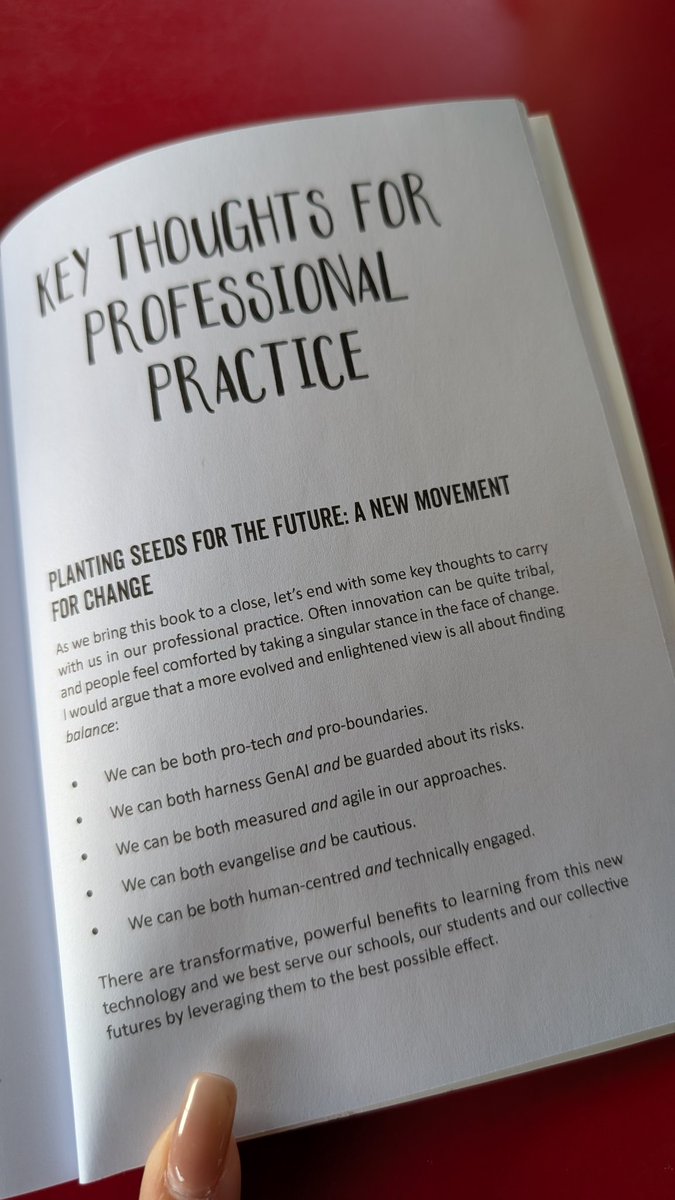
The Department for Education has recently published guidance for schools about the use of AI. This little guide by Laura Knight, focusing on Generative AI in the classroom is really good! A clear & compact guide packed with ideas & advice.