What we just saw is a disgrace, this is supposed to be the pinnacle of motorsport, yet we have cars built with ChatGPT that don't know how to accelerate in the rain
Peter Thiel makes a very important point in his latest interview: we moralise far too much. Think German Energiewende.
Thiel explains that moral judgement has increasingly replaced functional judgement. Instead of asking whether something actually works, we rush to classify it as morally good or evil.
The confusion starts with the word “good”, because it has two completely different opposites:
- The moral opposite of good is evil.
- The functional opposite of good is bad.
These are two entirely different axes. Yet public discourse increasingly folds them into one. Particularly the progressive left wants to occupy the moral high ground. So everyone virtue-signals — or pretends to, often without the slightest competence to judge the virtue in the first place.
Enter the climate crisis. Too much CO₂ is declared evil. Overnight, everybody knows we are in a climate emergency. Any doubt becomes morally suspect. After all, the IPCC consensus has declared it so. A Ferrari can now be declared morally “evil” because it burns too much fuel. Yet it remains an exceptionally good car.
And here lies the political trap: once something has been declared morally good, its advocates start treating that moral classification as evidence that it is also functionally good — that it actually works. And even if it works demonstrably worse, it doesn’t matter. It’s virtuous..!
But obviously the two may have absolutely nothing in common. A policy advertised as virtuous can be functionally terrible: incompetent, ruinously expensive or incapable of achieving its stated objective. Worse, once all its consequences are counted, it may turn out not to have been virtuous in the first place.
Germany’s Energiewende is the textbook example. Nuclear was morally branded “Hochrisikotechnologie” by @Die_Gruenen — high-risk technology — from the 1970s onwards. Dangerous. Irresponsible. Wind & solar became the virtuous alternative: “renewable”. And once that moral hierarchy was established, the engineering and economic questions became irrelevant: Does the resulting electricity system actually work better and cheaper?
Of course not. Nuclear power was one of the great scientific achievements of the 20th century: enormous quantities of cheap electricity from tiny quantities of energy-dense uranium, virtually no operational CO₂ emissions, little land use and dispatchable generation from massive rotating machines that also contribute to grid stability.
More importantly, it is also one of the safest forms of electricity generation mankind has ever developed. Yet German Greens spent decades morally slandering it. And Germany was hardly alone. Across much of the West, nuclear became something morally suspect rather than an extraordinary feat of engineering.
Doubt, rather than gratitude, accompanied nuclear. The doubt of the ignorant. Yet by some obscure moral code, ignorance itself suddenly earned a seat at the table. Expertise became optional; moral conviction became qualification. A child could command a global audience on questions of energy systems. How dare you?
Meanwhile, physics doesn’t care about false virtue signalling. A TWh of solar is not functionally identical to a TWh of nuclear — not at night, not in winter and not even at noon on a summer day if it is generated in the wrong place or exceeds consumption at that moment.
Why? Bc an electricity system has never been about producing enough TWh over a year. It has always been about timing and location too. Electricity must be produced at the precise time and location it is demanded, while generation and consumption must remain continuously balanced because the grid itself cannot store electricity.
That is Thiel’s message: The Energiewende — replacing nuclear with wind and solar — proved neither functionally competent nor virtuous. It was one gigantic $2 trillion amateur hour.
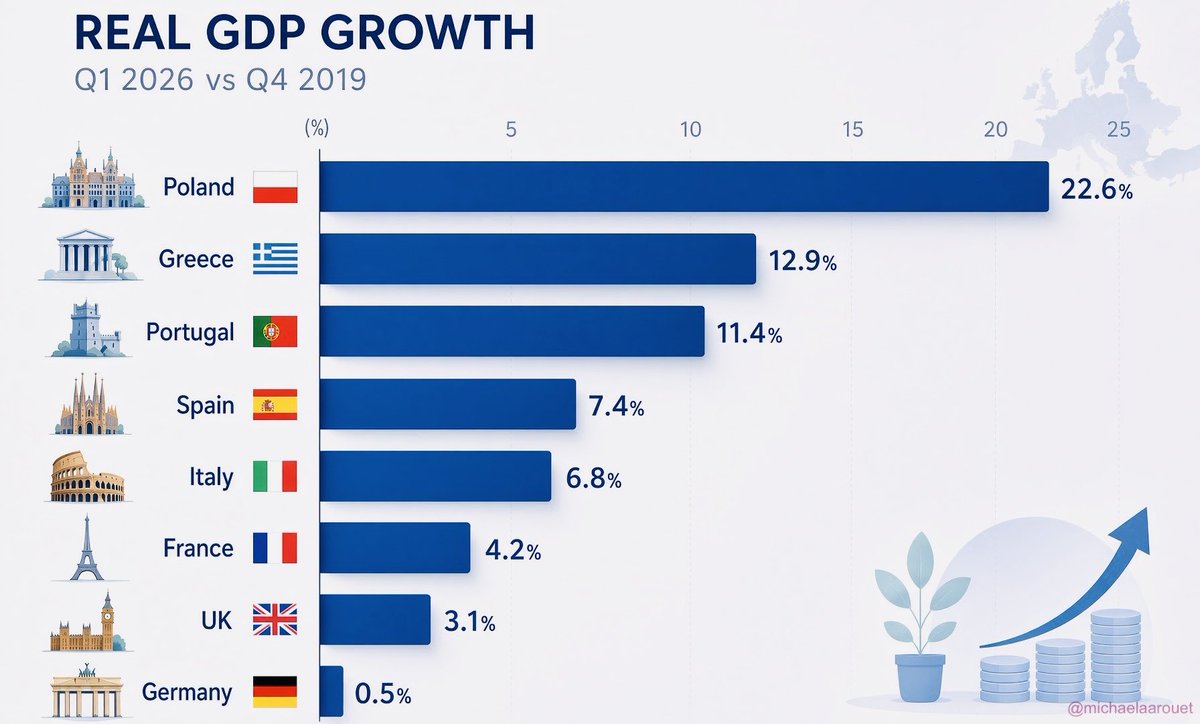
Germany’s 0.5% real GDP growth from 2019 to 2026 is the visible result of bad left-green choices and policies that compounded for years.
Overregulation and bureaucracy have turned entrepreneurship into a compliance exercise, firms spend more time filling forms and waiting for permits than building products. High taxes and social contributions punish work and investment, while a redistribution mindset treats private success as something to harvest rather than encourage. Energy prices remain structurally high after the irresponsible nuclear exit and the loss of cheap gas, raising costs for industry that competitors do not face.
Complacency and arrogance completed the picture. For too long the assumption was that the export machine and the Mittelstand would keep delivering regardless of policy. They did not, private investment and industrial output have been weak, the only expanding part of the economy is government spending, much of it debt-financed. Public consumption and transfers grow while the real productive base contracts rapidly.
Germany did not lack talent or capital, its engineering used to be world-famous. What happened in Germany will one day be seen as the deepest self-sabotage of an advanced economy.
Recovery will require the opposite policies: less bureaucracy, lower energy costs, lower taxes on production and innovation, and an end to the idea that more state spending can substitute for a growing private economy. Germany can still recover, but each year of continued bad policies makes recovery harder, at some point the gap to the competition will become too large to close.
In a brilliant essay in The Sunday Times, Matthew Syed writes the following: “If extremism is defined as acting out of proportion with context, history or consent, I suggest Merkel’s tenure represented the high point of postwar European extremism.”
I agree with Syed’s analysis. But there is one aspect of Merkel’s legacy to which we need to pay particular attention.
In Merkel’s own country, Germany, the political centre is collapsing. Nationwide opinion polls suggest that the three establishment parties that rebuilt Germany after the Second World War now command the support of only around a third of the electorate between them.
Nor is Germany the only country where the political centre is collapsing. The same is happening in France - a development that puts the future of the centre at issue in next year’s presidential election.
In my view, Angela Merkel bears a grave responsibility for the collapse of the centre and the growing ability of the political extremes to set the agenda.
The almost one-third of voters who would support Alternative für Deutschland in a national election are not fascists or Nazis. A substantial proportion are disillusioned CDU voters.
What has disappointed these voters? First, what I see as Merkel’s failures on so many fronts: immigration. Security. Energy. A sustainable strategy for business and economic growth. Digitalisation. Infrastructure maintenance. The list is almost endless.
Second, the extraordinary denial of reality that, in my assessment, Merkel allowed to take hold when it came to immigrants’ responsibility for antisemitism, violence against women, terrorism and gang crime.
Coming from Denmark, where we have reliable statistics on all these matters, I find it frankly shocking to listen to the nonsense coming from Germany’s political elite.
But I would also trace back to Merkel the rise of what is often called “Islamo-leftism” - a tendency that has recently gained ground in Sweden and is also growing in Germany. In Sweden, polls have indicated that 85 per cent of Muslim voters support parties to the left of centre, with almost one in five supporting the Left Party, Vänsterpartiet - a party tainted by antisemitism and the glorification of terrorism. I see no compelling reason to assume that the pattern in Germany is fundamentally different.
My argument, then, is that it is not only the rise in support for the AfD that can be traced back to Merkel. The same applies to the growing support for parties on the German left that promote the political and religious views of a significant proportion of the people, Merkel invited to Germany. Not least on the Gaza question.
Merkel’s role in Europe’s political destabilisation deserves far closer scrutiny.
We need to discuss this openly and honestly. Otherwise, we cannot understand why the political centre is collapsing in so many countries today.
Merkel's legacy for Germany and the EU is devastating. Many leaders of the 2010s whom we once heralded as liberal defenders of Western democracies have proven to be the exact opposite.
From shuttering nuclear power and building dependence on Russian gas to acceding to Putin's weaponisation of migration to test European resolve, her legacy is catastrophic.
At the height of the 2015 migrant crisis, more than 10,000 people were entering Germany's southern border daily. Over 90% of arrivals were not checked !The political consequences are evident now.
At the time, I was close to the Brexit negotiations. The migrant crisis was decisive in the British public's vote for Brexit, alongside the unwillingness of European leaders to offer David Cameron something substantial he could present as evidence of 'EU reform'.
Of course, the greatest irony of all is that everything we thought these leaders stood for is undermined by an actual assessment of their legacy.
We are at a similar turning point with AI.
The decisions we make now about energy, sovereignty and growth will shape the balance of power for decades and determine whether Western democracies remain strong enough to defend their ideals.
Amid the public hysteria about AI wiping out humanity, we should remember how much damage can be done when moral certainty takes the place of political judgment.
"Stop AI" is the new "Stop nuclear," "Go green,” or “Wir Schaffen Dass.” Each promises a simple answer while avoiding the harder questions: How do we sustain innovation, generate prosperity and retain control over our own future?
And we need to be honest about trade-offs. What does it mean for the United States (as Europe is no longer in contention), if it cedes its technology advantage in the age of Intelligence production?
Europe's experience over the last decade shows us that the road to hell is paved with good intentions. We cannot afford to learn that lesson all over again with AI.
The US is the standard-bearer now. IMHO, the existential risk is not that AI ends humanity: it is that the West (and US) stops leading it.
BREAKING: Ukraine fired more than 1,600 drones at Russia overnight, its largest drone attack since WW2, striking the Kapotnya oil refinery in Moscow. It is the city's only refinery, which supplies about 40% of the region's fuel, and is now on fire.
Trump claimed just six days ago that Ukraine had agreed to stop hitting Russian energy targets, that Russia had agreed likewise, and that the world's diesel price rise "is mostly caused by the Russia/Ukraine War, not Iran."
Zelensky named the Pelican among the weapons used, its first ever usage in combat.
Oil markets open in 7 hours.
The UK's bond market is collapsing.
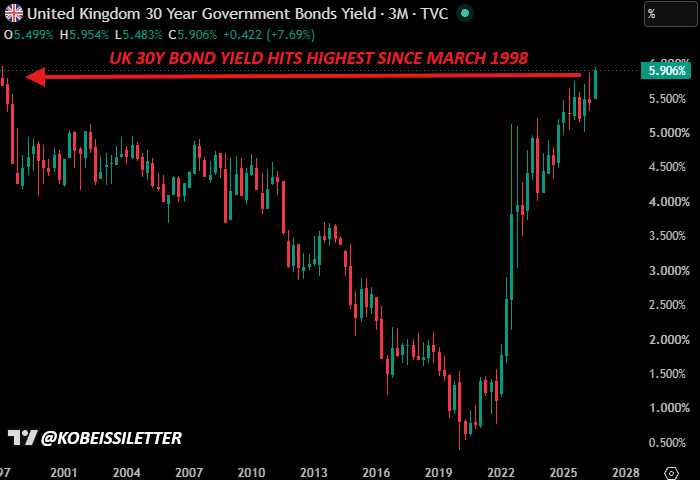
Today, the yield on a 30Y Bond in the UK hit 5.95%, its highest level since March 1998.
Yields in the UK are now 15 TIMES above 2020 levels, with the highest borrowing costs among G7 countries.
What is happening? Let us explain.
(a thread)
Rund fünf Milliarden Euro für Bau, Betrieb und Verschluss über ein Jahrhundert. Deutschland zahlt allein 2026 rund 29,5 Milliarden Euro, damit der Strom nach der Abschaltung funktionierender Kernkraftwerke nicht noch absurder teuer wirkt. Zwei Monate dieser Dauerinfusion finanzieren ein ganzes finnisches Jahrhundert Endlagerung.
Zuerst wurden zuverlässige Kraftwerke aus ideologischen Gründen zerstört. Dann wurden Erneuerbare subventioniert, bis der Preis explodierte. Jetzt holt sich der Staat das Geld beim Bürger zurück, um die selbst verursachte Teuerung zu kaschieren.
Die Politik verspricht Rettung – aber dabei ist sie es, die das Leben der Menschen erst ruiniert und schließlich zerstört. Sie führt einen schleichenden Krieg gegen die eigenen Bürger. Durch willkürliche Eingriffe macht sie Energie unerschwinglich, legt damit den Grundstein für Lebensmittelknappheit, zerstört die Wirtschaft und erzeugt so Massenarbeitslosigkeit. Energielockdowns sind dabei nur der nächste logische Schritt auf dem Weg in die offene Planwirtschaft – jenes System, das in der Geschichte noch nie Wohlstand, sondern stets nur Mangel und Knechtschaft hervorgebracht hat. Wer Preise und Produktion durch Zwang lenken will, zerstört systematisch die spontane Ordnung des Marktes, jenes wunderbare, dezentrale Zusammenspiel freiwilliger Handlungen, das allein echten Wohlstand erzeugen kann.
Hört endlich auf, von der Politik „Anreize“ und „Lösungen“ zu erbitten! Regierungen können weder Wohlstand schaffen noch Arbeitsplätze noch wirtschaftliches Wachstum. Sie können nur eines: durch Gewalt und Enteignung die Bedingungen zerstören, unter denen freie Menschen beides von selbst hervorbringen.
Der Atomausstieg ist der Kardinalfehler Deutschlands
Man hat eine unglaubliche Menge an Nachteilen dadurch produziert
- schlechte CO2 Werte
- hohe Kosten
- Importabhängigkeit im Sekundentakt
- obszön komplexes und teures Netz
- Netzinstabilität
- Tausende unnötige Dispatchaktionen
- Aufgabe eines technologischen Exportsektors
- politisch-fossile Anhöngigkeit auf Dauer
- EU Strafzahlungen
- Verlust aller innovativen Zukunftsindustrien
- sinnlose Mehrfachinfrastruktur
- sinnlose Mehrfachkapazität
- räumliche Fehlallokation der Erzeugung
- zeitliche Fehlallokation der Erzeugung
- schlechte Stromqualität
……..
-
Liz Truss was forced to resign because bond yields rose, and the mainstream blamed her mini-budget.
Four years and three interventionist budgets later, the UK 30-year gilt yield is at 5.9%, the highest since 1998, and the highest long-dated borrowing cost in the G7. The 10-year is above 5.2%.
No one is demanding resignations. Now Burnham wants to double down.
What can go wrong?
Data: UK Treasury, Factset, Bloomberg. Image Perplexity Finance.
🛢️Diesel cracks just hit record highs.
Here's why:
Global waterborne diesel exports fell to 175.7 million barrels in August, down 47 million from a year earlier, per S&P Global.
The below chart shows exactly where that supply vanished: 🇷🇺Russia and 🇸🇦Saudi Arabia.
Russia and the Middle East together used to supply roughly half the world's spare diesel.
Both are now sidelined.
Russia's export ban runs through September 30, and August shipments fell to just 504,600 tons from 743,000 in July.
Ukrainian drone strikes have knocked out roughly 3 million barrels a day of Russian refining capacity, hitting 80% of its refineries.
The Strait of Hormuz disruption is just as large.
Middle East product exports are down 3 to 4 million barrels a day, with no bypass route the way crude found one.
Between 2 and 3 million barrels a day of diesel are effectively missing from the market (S&P Global).
The US is filling the gap and running refineries flat out.
Utilization hit 98% in August.
US diesel exports set an all time record at 54.2 million barrels for the month, even as the domestic crack spread hit its own record above $96 a barrel.
US stocks still sit 7.4 million barrels below their 5 year seasonal low.
Crude -4.450MM, Exp. +60K
Gasoline -1.173MM
Distillates +796K
Cushing +80K
Production 19kb/d
SPR down 3.1MM barrels to 287 million, just 17 million away - or one month of drain - from record low.
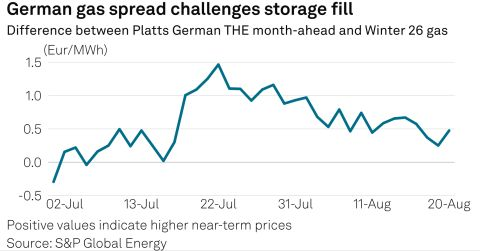
🇩🇪 50% is where German gas storage sits right now, against 76% at the same point last year and an EU average near 62%.
The reason is pure economics near-term gas prices have consistently outpriced winter futures, so energy companies make more money selling gas today than storing it to sell in January, and the benchmark Dutch TTF contract has more than doubled since January largely because of the Iran war.
Berlin has spent months insisting this is a market problem with a market solution and lowered its own official target to 60% this week, calling that sufficient.
But the energy ministry just shifted its language, saying it's "preparing the necessary courses of action" it could deploy quickly if the situation worsens, while still holding that "winter stockpiling remains, for the time being, the task of the market." Germany's own gas grid operators say the current pace makes the filling target hardly achievable, and that a cold snap or an outage from here could turn a comfortable winter into a tight one.
https://t.co/diviUyWBvs
Diesel and gasoil crack spreads (i.e., refining margins) are at their highest level *ever* on a 10-day moving average basis.
Jet fuel cracks still slightly off prior pinch-point crises in March and before that in 2022; while diesel driving it, jet fuel naturally comimng along for the ride.
Boom! LME copper prompt spreads are ripping higher! All this is playing out while spec length is heavily clustered on Comex and LME is lagging hard.
Look, fair points on the copper tail risk flags, but seeing this magnitude of backwardation on the curve is unequivocally bullish.
On the cross asset tape, anyone noticing the macro correlation breakdown between gold, crude, yields, and the USD?
DXY is no longer linearly hitching a ride on higher oil and yields, and gold stopped blindly getting sold off every time oil catches a bid.
This is a massive macro regime shift for the broader metals complex. Good luck out there!
#copper #gold
Diesel prices are about to surge even more.
GCC crude supplies are mainly medium/heavy grades, which yield more middle distillates like diesel.
Refineries sourcing these grades are optimized for them.
To help replace the lost supply, ~90% of US SPR releases have been medium/heavy crude.
The problem?
Only ~60% of the SPR was sour crude to begin with.
Once that buffer runs low, refineries will have to bid increasingly aggressively for the remaining medium/heavy barrels
Those that can't secure the crude grades they need will have to use more light/sweet crude, reducing diesel yields.
Diesel is about to get even tighter.
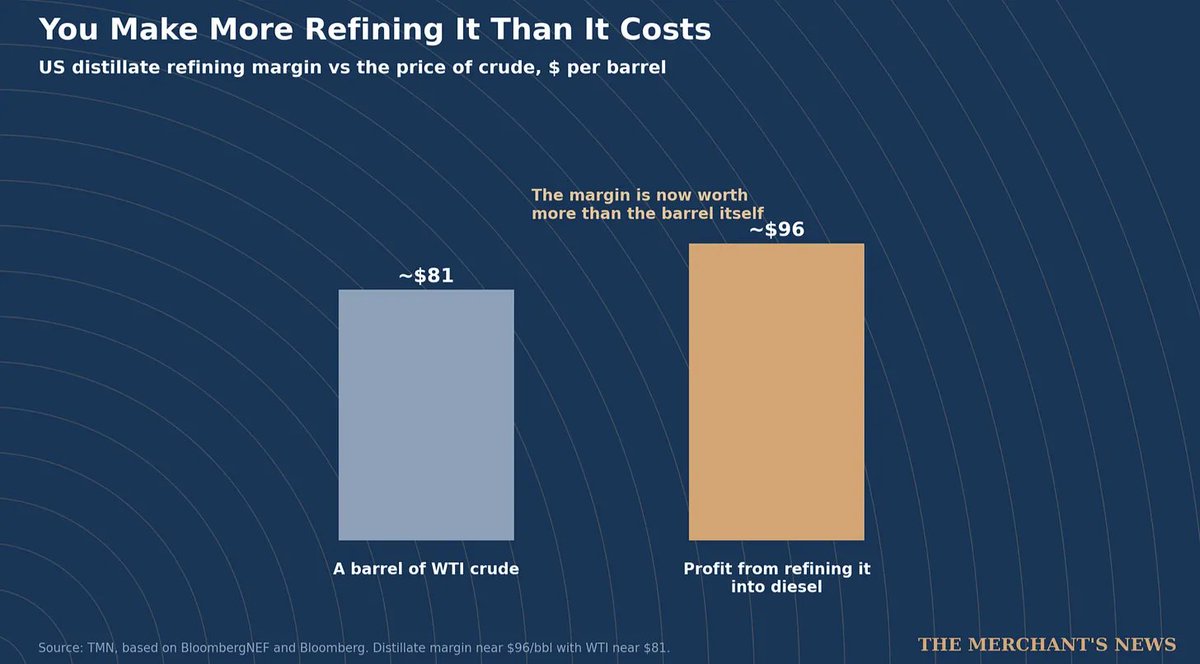
🚨🛢️The diesel crack spread just hit $94 a barrel.
Highest since at least 2007.
Gasoline is close behind at $50.
A barrel of WTI crude costs about $81.
Refining it into diesel right now earns about $96.
The margin is worth more than the barrel itself.
https://t.co/2kQxVkWisz
Backwardation squeeze in copper
Meanwhile, China is drowning in copper inventories. I just don’t buy the Western squeeze.
Likely some guy like Bintas from Mercuria having his LME inventories removed to some unreported warehousing. Plus US tariff rubbish. Who knows. Easy to play the visible to invisible inventory game in metals anyway.
I could be wrong. I didn’t do enough hard data crunching for some time so no conviction. Just a hunch. But definitely more irrational hoarding (perhaps West vs China) than economically healthy underlying demand.