Ghosts Still Watch from the Torreón: Lincoln’s Ancient Stone Fortress of Fear
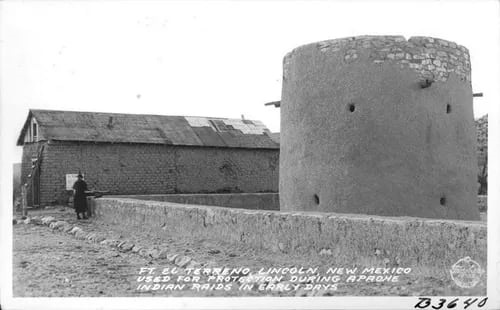
As you drive through Lincoln, New Mexico about halfway down that storied main drag something ancient and brooding catches your eye on the Northside. A squat, round stone tower, weathered by centuries of wind, sun, and blood. Your mind instantly races: What kind of terror could drive an entire village to cram inside this thing, praying the walls would hold? This is The Torreón, and once you know its story, you’ll never look at it the same way again.
Built in 1852 by Enrique Trujillo, the Miranda family, and a handful of hardened Spanish settlers, the Torreón wasn’t just a landmark…it was a last line of defense in a land that didn’t forgive weakness. The frontier was raw. Apache raids were a constant, nightmare threat. So these pioneers built their fortress with thick, rounded stone walls that could shrug off arrows and bullets alike. Portholes stared out like watchful eyes. The top once bristled with breastworks where men could steady their rifles and answer violence with violence.
The settlers didn’t waste time. While the Army was still hammering together Fort Stanton just 15 miles up the Bonito River, these families were already carving out “La Placita del Río Bonito.” They threw up jacales (rugged little houses of wooden posts and mud) clustered protectively around the tower. They dug hidden trenches so people could scramble from home to safety without ever stepping into the open. Inside the walls they built an oven amd fireplace, so even under siege they could cook. The entire settlement became one tight, defiant plaza with the Torreón at its beating heart.
The original tower possibly stood three or maybe even four stories tall. When the alarm sounded, the whole village poured inside. Livestock herded into the protective 10 foot wall. Women and children huddled on the ground floor. Armed men took the upper levels, rifles ready at the portholes. For days, sometimes, they waited in the dark, listening to the world outside, wondering if dawn would bring rescue… or fire.
And it wasn’t just Apache raids…during the brutal Horrell War, the Horrell brothers and their gang turned Lincoln’s streets into a shooting gallery. One terrified night, young Amelia Bolton Church, her sister Ella, and their mother squeezed into the Torreón with 24 other souls while gunfire ripped through the town. Years later Amelia remembered huddling against her mother, trembling in the darkness, but waking up alive. “Quite safe in the old tower,” she said. Safe… but forever changed.
The Lincoln County War the one that made Billy the Kid a legend, also swept through these walls. Alexander McSween had bought and owned the lots including the Torreón, but Dolan’s men seized it anyway during the 5 day battle. Susan McSween herself marched over and demanded they get out.
By the time Fort Stanton officially opened back in 1855, only about 100 souls called this place home. They lived with one foot in paradise and one in hell…farming rich river bottom land while never forgetting that safety was only a sprint to the Torreón away.
Today the tower stands restored and ready for visitors. It's on the National Register of Historic Places, very quiet now and peaceful.
But step inside anyway…peer through those ancient portholes. Climb to the roof and let the New Mexico wind hit your face. Look out over the same valley where settlers once drove their children into the stone and embrace the security of the tower. Close your eyes for just a second…You can almost hear the distant hoofbeats. The shouts. The prayers whispered in the dark.
Even today, this humble stone tower still has the power to raise chills on the back of your neck. Lincoln’s Torreón isn’t just history. It’s a heartbeat from the frontier… still pulsing. #WildWestHistory
For more follow the trail in the comments!
Masked Bandits in Suits: The Silencing of Frontier Medicine
In the raw Wild West of the 1800s, medicine was unpredictable. Surgeons amputated limbs with patients drunk on whiskey and biting leather straps to endure the pain. Doctors, physickers and apothecaries relied on prairie herbs, opium laced laudanum, mercury, iodine and quinine. Then ether arrived in the 1840s, dramatically demonstrated in Boston’s Ether Dome in 1846 eerily silencing the screams during surgery. As far as great cures, a simple 2% iodine solution from seaweed ash became a frontier miracle: it fought infections from gunshots and snakebites, prevented gangrene, and cured goiter.
This wild, nature based era was risky but full of possibility.
“Let food be thy medicine and medicine be thy food.” ~Hippocrates.
Then everything changed.
Around 1910, oil baron John D. Rockefeller turned his gaze to medicine to protect his petroleum chemical empire. He bankrolled the notorious Flexner Report, written by Abraham Flexner and commissioned by the Carnegie Foundation. Rockefeller’s foundations poured over $180 million (roughly $3.5 trillion today) into the effort between 1910 and 1930.
The report branded herbalists, homeopaths, and users of non patentable “weeds and waves” including a high dose of iodine as "dangerous quacks and frauds". It demanded one rigid standard: lab based medical education focused on surgery, synthetic coal tar and oil derived drugs, The outcome? A healthcare system designed for dependency, focused on treating symptoms instead of addressing underlying issues.
Using massive grants, Rockefeller and Carnegie rewarded compliant schools and forced the rest to close. By 1925, more than half of America’s medical schools were gone. Homeopathic, eclectic, and naturopathic institutions vanished. These turncoats and opportunists gladly took the Rockefeller and Carnegie grant money, dropped herbal remedies and nutrition, and pivoted hard to patentable synthetic drugs tied directly to Rockefeller’s chemical empire.
The goal was monopoly, not better medicine. Why promote a cheap, one time cure like iodine when patients could be hooked on lifelong synthetic drugs?
Ironically, at one time, Rockefeller pushed basic iodized salt for deficiency prevention, but dismissed higher therapeutic doses as “dangerous.”
The result: a healthcare system engineered for lifelong dependency. Today it’s a multi trillion dollar industry keeping patients hooked on ongoing care instead of real cures.
In the independent spirit of Wild West sawbones, drawing wisdom from nature, was crushed. In its place rose a drug focused empire serving the oil dynasty.
As frontier healers might have said around the campfire:
“The true thieves weren’t wearing masks… they wore suits.”
And the silenced remedies? They may still hold answers the system never wanted you to rediscover. #HiddenHistory #wildwestmedicine
For more visit the link in the comments!
Ashes to Echoes: The Cursed McSween Site 1878 Inferno After Billy the Kid fled the blazing siege that killed Alexander McSween in the Lincoln County War, the ruins were scraped clean by 1880. Enter George Barber: Marries widow Susan, runs butcher shop ON THE SPOT! Thrives... then mysteriously burns down too! Site leveled again 1910s, Fresquez home built over foundations, still stands, altered by time.1924 Billy book sparks 1930s treasure raids. 1986 dig uncovers bullets, relics, cavalry artifacts. Marker relocated, history's ghost lingers!
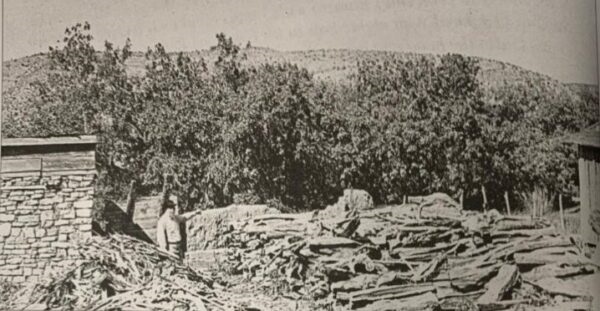
Image: George Coe points to the rhe ruins of the McSween site in the 1910s. #BillyTheKid #OldWest #LincolnNM @Pals1878
On this day in history, John H. Tunstall was born on March 6th, 1853 in the Hackney district of London, England...
John was one of six siblings, and the only son of John Partridge Tunstall and Emilie Ramie.
From London's bustling streets to the wild frontiers of Canada and California, young John Henry Tunstall chased fortune with ambition, charm, while dreaming of his own empire in the American West.
But it was in Santa Fe, at a dimly lit hotel on Burrow Alley, that one persuasive conversation changed everything... Alexander McSween promised riches in Lincoln County. Tunstall listened, and stepped into history.
What happened next sparked the Lincoln County War and immortalized Billy the Kid.
The full journey of the man behind the myth: his letters, loves, mishaps, and tragic end → follow the trail below!
https://t.co/hjQVxVFxuM
The Youngest Mountie. One Deadly Secret. Eternal Silence
In 1911, the ink still fresh on Governor William Mills' signature, Fred Lambert, then just 24, received the call that would mark him as the youngest full time member ever sworn into New Mexico's Territorial Mounted Police. The elite "Mounties" were the territory's last line against chaos: hard riding, hard shooting men who chased fugitives across endless mesas and canyons. Fred joined the hunt for lingering remnants of the Wild Bunch, members of Butch Cassidy's gang still drifting through the high country, their names whispered like warnings around campfires.
But danger lurked closer than any outlaw trail. As early as 1909, two years before Fred pinned on the badge, powerful figures had already moved in the shadows, pushing to abolish the Mounted Police under the thin veil of "economic necessity." Whispers linked them to darker deeds: indirect ties to the 1908 murder of Pat Garrett, the lawman who'd ended the living legend of Billy the Kid, and older vendettas tied to the notorious Santa Fe Ring. It was that web of land barons, politicians, and opportunists who had long bent justice to their will.
The campaign succeeded in 1913. The Mounted Police were disbanded overnight, their badges stripped, their files scattered. Fred, unwilling to let the silence stand, sought out Captain Fred Fornoff, one of the lead investigators in Garrett's killing. In a low, guarded conversation, Fornoff's words carried the weight of buried truth:
"They know that I know about the Garrett plot and the big money interests in the Fountain killings. As long as we exist, they are in danger. Having no police means there's less danger of any new evidence seeing the light of day. I've always said, our time is about over."
Fornoff laid it bare: what had started as a calculated scheme to ruin Garrett financially; to strip his land, drive him out, break him…had twisted into cold, deliberate murder. Names, motives, connection…these were details that could unravel fortunes and reputations. Fred listened, committed every fragment to memory, and sealed it away forever.
But the questions linger like smoke in an empty saloon: What names did Fornoff whisper that day? Whose fortunes hinged on Garrett's silence? In the haunted corridors of New Mexico history, where the Santa Fe Ring's influence once stretched like a long shadow…Fred Lambert, chose silence over scandal. A lawman who faced down outlaws without hesitation and yet guarded the biggest secret of all until the end.
What truths remain sealed in those confidential files, and who still benefits from their darkness? The Old West never fully closes its cold cases. #NewMexico
A new sheriff rides into the blood soaked streets of Lincoln County, New Mexico.
George Kimbrell, freshly elected in November 1878, pins on the badge and takes office on January 1st 1879. But here’s the question that still echoes across the dusty plains: Was Sheriff Kimbrell a secret ally of Billy the Kid...or his deadliest foe? Kimbrell played a dangerous game: he took part in a staged arrest of the infamous outlaw, part of a shadowy deal that could have ended the Lincoln County War.
Billy surrendered… then boldly walked away, thumbing his nose at the shady agreement with Governor Wallace. Now the sheriff faced an impossible choice: hunt down the Kid and his Regulators with everything he had… or look the other way? This faded, handwritten letter, we dug up dated May 1879, complete with a cryptic coffin sketch, was sent directly to Sheriff Kimbrell during that tense time. A chilling warning? Or a taunt from Billy the Kid himself? The words start off: George Kimbrell, you son of a bitch and that ominous drawing…Could this be a lost message from Billy the Kid? #billythekid #OnThisDay
The Most Unusual Christmas Dinner in the Wild West: 1880
Imagine this on Christmas Day, 1880, in the dusty New Mexico Territory...
Notorious outlaw Billy the Kid and his gang ; Dave Rudabaugh, Tom Pickett, and Billy Wilson , are shackled in chains after their capture at Stinking Springs.
Yet, they're sitting down to a proper holiday meal, watched closely by the stone cold lawman Sheriff Pat Garrett himself.
The unlikely host? The gracious Alex Grzelachowski at his ranch near Puerto de Luna, offering a moment of frontier hospitality amid gunfire and grudges.
A rare glimpse of Christmas truce in the lawless Old West!
Images below are of the historic ranch then (circa late 1800s) and recently, the very place where this legendary meal went down.
Who knew outlaws got turkey (or whatever was on the menu) for Christmas?
Merry Christmas, from the frontier!
#billythekid #OnThisDay #truecrime
Tom "O" Folliard: The Loyal Shadow of Billy the Kid
On the cold, foggy night of December 19, 1880, in Fort Sumner, New Mexico, Sheriff Pat Garrett and his posse lay in wait beneath a porch and in the surrounding shadows. As Billy the Kid’s gang approached through the heavy mist, Garrett called out for them to throw up their hands. At the same instant, the posse opened fire. Gunshots shattered the silence, and one man fell. The others scattered into the darkness.
Tom Folliard, Billy’s closest companion and a towering figure known as “Bigfoot,” had been hit. Bleeding heavily, he was helped down from his horse by the posse and carried into a nearby house.
Barney Mason, one of the deputies, leaned over the wounded man and said, “Take your medicine boy.”
Posse member Jim East later recalled: “I got Tom some water and gave it to him; he cussed at Garrett and died about 30 minutes later.”
When the posse searched Tom’s saddlebags, they discovered a letter he had written to his grandmother in Texas. In it, he promised that he and Billy would soon come to visit her. Tom, like his letter, would never make it.
Orphaned by smallpox in Mexico as a child, raised by reluctant relatives, and hardened by a life of loss, Tommy Folliard had arrived in Lincoln County at around seventeen. There he found a brother in Billy the Kid. He stood shoulder to shoulder with him through the bloody Lincoln County War, enduring the fiery siege of McSween’s house. When the conflict gave way to rustling and revenge, Tom remained steadfast, sharing the dangers and the thrill of the outlaw trail, until that fatal December night.
Buried beside Billy in the old military cemetery at Fort Sumner, Tom Folliard’s life remains a testament to loyalty, tragedy, and the untamed spirit of the American frontier.
Who was the man behind the myth? Dive into the true tale of Billy's closest PAL, before Hollywood got it wrong at the link in the comments!
#billythekid #Wildwest #OnThisDay
The Forgotten Fury Behind Billy the Kid's Downfall.
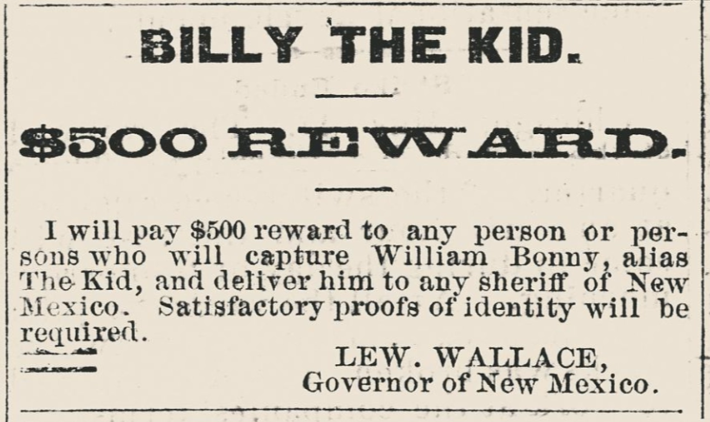
Everyone knows about Governor Lew Wallace's $500 reward for Billy the Kid, plastered in the Las Vegas Gazette on December 15, 1880. But buried in the same issue? We found a scorching editorial revealing the real heat: Citizens of Las Vegas, New Mexico, were so desperate to end the outlaw terror that they pledged to raise $5,000 themselves, 10x the governor's bounty!
The Gazette (see photos) pulled no punches, rallying the community to fund a massive manhunt:
"Governor Wallace has at last offered a reward for the capture of the notorious Billy the Kid. This executive act is as good as far as it goes, but the amount offered, $500, is too small. But perhaps he has done all that the law permits, in that case his judgment is good in setting the price on the kids head at the highest allowed. Surely some recompense should be made to the brave fellows who take their lives in their hands to hunt down the outlaws. It is no Jack rabbit hunt that Garrett and his band, Frank Stewart and his panhandle boys and the White Oaks Rangers are engaged in, but a determined campaign against lawless fellows who have nothing to fear, as the remainder of their lives will be passed behind bars to pay the penalty of their crimes, if they are ever caught. What should be done by the people of this and neighboring counties is to raise a purse of $5,000 to be paid to the men engaged in this campaign provided they drive the desperados from our borders."
This wasn't just lawmen vs. outlaws, it was everyday people declaring war on chaos.
The push worked: Sheriff Pat Garrett assembled a powerhouse posse of deputies, Texas cowboys, and White Oaks vigilantes. Just days later, they surrounded Billy and his gang at Stinking Springs, capturing the Kid on December 23, 1880. (Though the full $5,000 wasn't raised upfront, people across NM later donated thousands privately to reward Garrett and his men, worth a fortune in today's dollars!) This overlooked detail explodes the lone hero myth. It was community outrage and fear that turned up the pressure and sealed Billy the Kid's fate.
Or did it? Pat Garrett’s “good deed” would soon dissolve as the prisoners later escaped, one by one.
Billy the Kid escaped the Lincoln County Jail, killing both Garrett’s deputies on April 28th 1881.
In December 1881 Dave Rudabaugh escaped the Las Vegas Jail with 5 other prisoners including JJ Webb by digging and crawling out of a 7×20 inch hole in the wall.
On September 9th 1882, Billy Wilson, Milton Yarberry, George Pease and another man overpowered the guard for the key to their shackles and from the rooftop made their escape out of the Santa Fe jail by dropping off the side of the building and wandering off into the darkness.
Sheriff Garrett and his party had a burden on their shoulders. #TrueCrime #billythekid #OnThisDay
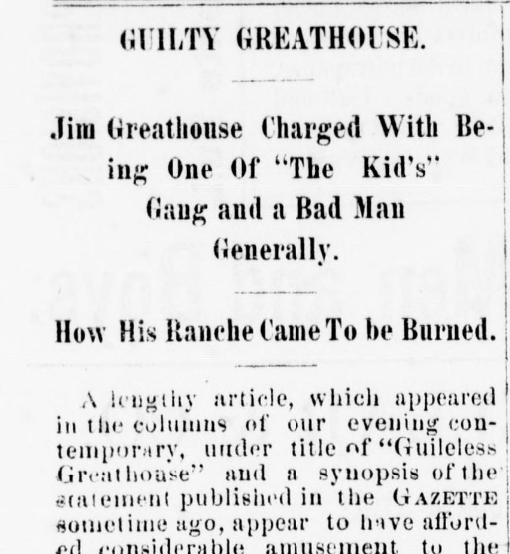
November 15, 1880, Billy the Kid, ridin’ with Dave Rudabaugh, Billy Wilson, and a handful of rough riders, was cuttin’ a trail from Las Vegas to White Oaks. They reined in at Jim Greathouse’s ranch station, a weathered outpost where whiskey flowed like a desert spring. “Whiskey Jim,” a man with an eye for a deal, took a likin’ to the gang’s 16 horses, likely rustled from Alexander Grzelachowski, if the cantina talk’s to be believed and bought a few for his spread. With their pockets heavier, the boys spurred on to White Oaks, stashin’ their remainin’ ponies at Dietrichs’ Livery Stable.
Tales ‘round the poker table say the gang swaggered into a general store, grabbin’ supplies and skippin’ out without droppin’ a dime. Some reckon they paid with counterfeit loot, just enough to square Wilson’s stable bill. But Barney Mason, a yella bellied snitch, spotted the crew and ran to tell Sheriff Will Hudgens.
The sheriff, a hard man with a badge, rustled up a posse, includin’ J.W. Bell and James Carlyle, a blacksmith turned deputy and a pal of Hudgens. The posse tracked the gang to their hideout at Coyote Springs, where the outlaws were settin’ camp. Without so much as a howdy, they let loose a volley, droppin’ two horses. The Kid and his boys, ridin’ double, lit out for Greathouse Station, where they holed up.
On November 27, at the Greathouse Station, the posse circled the house like vultures, rifles at the ready. Joe Steck, the station’s cook, poked his head out, only to find a dozen barrels starin’ him down. He threw up his hands, and Sheriff Hudgens, cool as a rattlesnake, handed him a note demandin’ Billy’s surrender. Steck, sweatin’ bullets, shuffled inside and passed the paper to the Kid...
“I handed it to Billy the Kid,”
The Cook, Joe Steck, recalled,
“I took the note in and delivered it to the one I knew to be Billy the Kid, “He read the paper to his compadres, who all laughed at the idea of surrendering.”
He stepped back out into the dusty road, alongside Jim Greathouse, carryin’ a message from the saloon that there’d be no surrender. One of the posse hollers for Billy Wilson to give himself up, but Wilson, stubborn as a mule, shouts back, demandin’ James Carlyle come inside for a parley. Sheriff Hudgens, nods and lets Carlyle head in to jaw with the outlaws. Greathouse stays put outside, eye-in’ the posse.
When Carlyle crosses the threshold, it’s just shy of midday. The boys frisk him for iron and sit him down at a rickety table. Inside, the gang’s schemin’ to hunker down till nightfall, plannin’ to bust out under cover of darkness.
Steck recalls the Kid, with a glint in his eye, pushin’ a bottle of rotgut whiskey on Carlyle, gettin’ him so liquored up that just past noon, things start to blur.
Steck: "Carlyle was under the influence of liquor and insisting on going outside.”
A couple hours drag on, when a voice bellows from the dusty street, “Come out, or we’ll put a bullet in Greathouse!” Silence grips the saloon for a spell, till posseman Joe Eakers’ six shooter goes off accidently with a crack. The shot spooks Carlyle somethin’ fierce; thinkin’ Greathouse is done for, he dives headfirst through the front shut window, crashin’ into the snow outside, his coat torn up with bullet holes.
Steck: “I stopped and turned, when, crash, a man came through the window, bang, bang, the man’s dying yell, and poor Carlyle tumbled to the ground with three bullets in him.
The posse boys swore up and down that Billy’s gang gunned down Carlyle from inside the saloon. Billy, though, spun a different yarn, claimin’ the posse’s trigger happy panic lit up Carlyle when he busted through that window in a desperate leap. In the end, no one faced a noose for the killin’, pointin’ fingers at the posse as the ones who put Carlyle in the ground.
Come nightfall, Billy and his crew saddled up and rode out slick as you please, not a scratch on ‘em, while the posse, likely the ones who accidentally sent Carlyle to his maker, scattered like coyotes in a storm. They slunk back at dawn, buried Carlyle in the cold dirt, and torched Greathouse’s place to ashes.
The full story at the link in the comments as well as links to videos we made at The Greathouse station and Coyote Springs! #billythekid #TrueCrime
Calling All Carrizozo History Hunters!
Hidden somewhere in the high desert winds of Carrizozo, New Mexico, lies a forgotten gem of the Wild West, a ranch once co owned by Thomas B. Catron, the powerful “Santa Fe Ring” lawyer and U.S. Senator, and his brother in law Edgar A. Walz, who later built a national empire protecting hotel owners from deadbeat guests.
This very ranch was more than a cattle spread: it was home to Edgar and Luella Walz in the late 1880s, where Luella gave birth to two of their children under the vast New Mexico sky. Before Walz became president of the National Hotel Keepers’ Protective Association and a coast to coast traveler, this rugged outpost was ground zero for his American dream.
The Mission (if you choose to accept it):
Can you, local explorer, history buff, or drone pilot, track down this historic ranch site? Snap a photo, mark the spot, and help resurrect a lost chapter of Lincoln County lore.
Reward?
Bragging rights, a shoutout to @Pals1878, and the thrill of standing where the Old West met ambition. Bonus points for sunset shots or old foundation stones.
Who’s in? Tag a friend in Carrizozo and let’s find it!
Billy the Kid's Bloody Vow: "A Bullet for the Governor!"
Santa Fe, New Mexico Territory, May 1881,
He was supposed to hang.
Instead, Billy the Kid blasted his way out of Lincoln County Courthouse jail, leaving two deputies dead in a hail of gunfire. The West's most wanted outlaw, barely 21, with ice blue eyes and a grin, vanished into the night.
Now, a chilling letter from the Governor's own wife reveals the terror gripping New Mexico's capital:
"The Lincoln County War’s reign of terror is not over...and we hold our lives at the mercy of the desperados and outlaws. Chief among them Billy the Kid, who was captured and escaped, and now swears that after he has killed Governor Wallace, the Sheriff and the judge who passed sentence upon him, then he will surrender. These are his words...
“I mean to ride into the plaza at Santa Fe, hitch my horse in front of the palace, and put a bullet through Lew Wallace." ~Mrs. Susan Wallace,
in a letter to her children in Indiana.
Governor Lew Wallace, famed author of Ben Hur, had just signed Billy's death warrant. Now his wife writes of sleepless nights and guards pacing the palace roof.
Will the Kid make good on his threat?
One thing's certain: In lawless New Mexico, even the Governor's mansion isn't safe.
Follow us for more, this outlaw's legend is just beginning. #billythekid
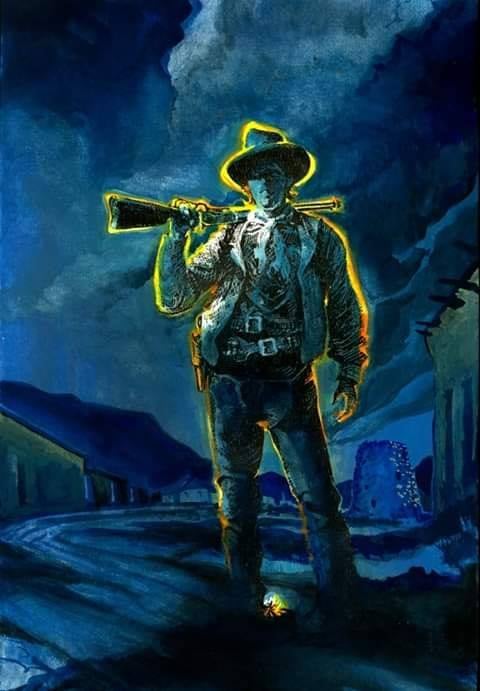
Image: Artwork by B.B.B. "The Illustrated Life and Times of Billy the Kid"