Be honest: how many times a day do you search your own keyword to check your rank?
One look is one rank, under one zipcode, on one device, with no record of the conditions. It can’t tell you why anything moved.
What works better is a timeline. I wrote the six steps in the first comment.
Your keyword rank didn’t drop. Your exposure did.
Organic #4 on Monday, organic #4 on Friday. Same number. But if four sponsored rows moved in above you, you went from 5th on the page to 8th, below the fold.
This is why checking one rank number tells you almost nothing. Link to the full breakdown in the first comment.
Full breakdown here: How to Monitor Amazon Keyword Rankings, a six-step method for building a timeline you can actually explain. It covers the three ranks people mix up, what every snapshot should store, and how to set alert thresholds without false alarms.
https://t.co/85wPIgXPtr
Your keyword rank didn’t drop. Your exposure did.
Organic #4 on Monday, organic #4 on Friday. Same number. But if four sponsored rows moved in above you, you went from 5th on the page to 8th, below the fold.
This is why checking one rank number tells you almost nothing. Link to the full breakdown in the first comment.
Yes, it was clearly better in our own testing. The copy had specifics instead of filler, because the model was working from real competitor wording, shopper questions and complaints instead of memory. Not a formal benchmark, so I’d trust your own comparison more: same product, with and without the research step, bullets side by side. What are you writing listings for at the moment?
AI writes Amazon listings fast, but from memory. Feed it live shelf data over MCP first: competitor titles, shopper questions, critical reviews. Two copy-paste prompts, the new itemName and itemHighlights limits, and a credit budget. https://t.co/00eAdaiUyh
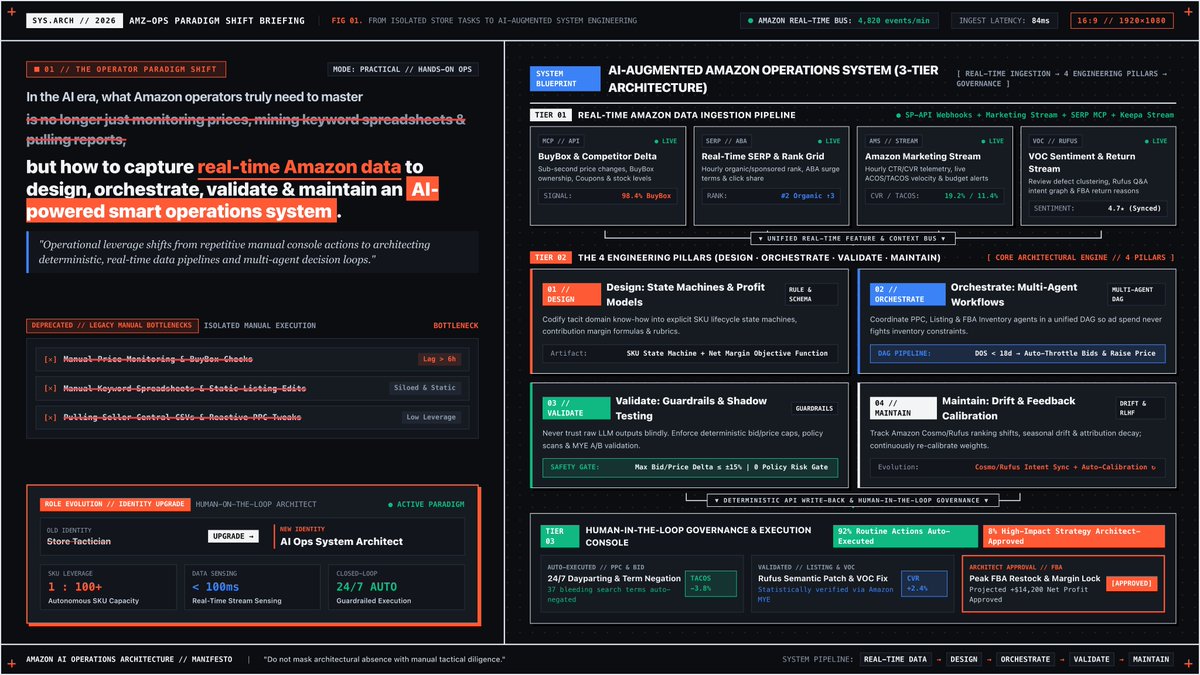
In the AI era, what Amazon operators truly need to master is no longer just how to manually stuff keywords, write listings, and tweak PPC bids, but how to tap into real-time Amazon data to design, build, validate, and maintain an AI-driven automated growth system.
#RealtimeAmazonData #pangolinfo #ScraperAPI
Thanks for writing this all out, it genuinely sharpened the idea. Your privacy-screen example is the exact failure I want to avoid: a number that describes the view instead of what the action touches.
Honest answer: today we count lines with no evidence attached, and the writer does the labelling, so it’s a score for the labelling as much as the work. Your metric, lines where an id was available and not attached, is the better scoreboard. I’d track both: unverified says the data pull was thin, available-but-unattached says the writer slipped.
I also agree the label shouldn’t come from the writer. A separate pass that checks each claim against the raw tool output seems right. We haven’t tested whether the counts cluster or hold across reruns yet, so for now it’s a reading, not a measurement. Thanks again for the push.
Most AI product research is confident guessing. A live-data MCP pipeline for Amazon selection: funnel stages, an IP kill gate, Alexa questions as demand signal, a credit budget and an evidence ledger, plus a copy-paste prompt. https://t.co/5EhjZvseUX