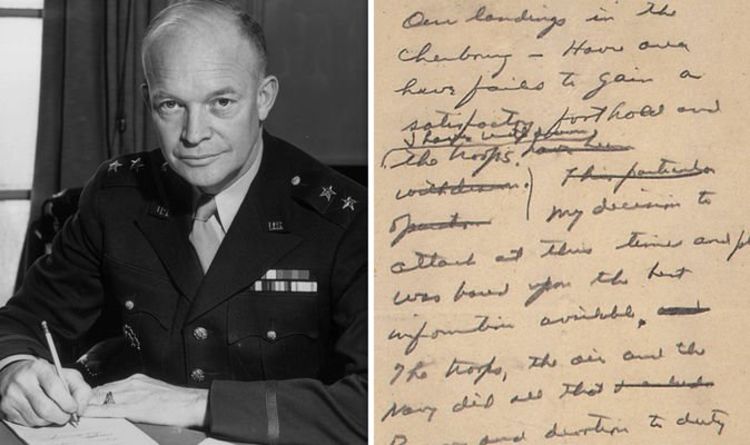
On the night of June 5, 1944, Eisenhower stood on a tarmac in England and watched 13,000 paratroopers board their planes.
He already knew what Air Marshal Leigh-Mallory had told him in private: up to half of them might not survive the night. 6,500 men. Dead before a single soldier touched the beach. Eisenhower had approved the mission anyway, called the decision "soul-wracking," and said nothing to the men.
Instead he drove out and visited them.
He chatted. Laughed. Asked where they were from. Shook hands. Cracked jokes. Not one of them knew their general had just signed what might be their death warrant.
When the last plane disappeared into the dark sky, his driver Kay Summersby looked over at him.
There were tears running down his face.
He drove back to Telegraph Cottage in silence. Then he sat down, picked up a pencil, and wrote a note he prayed no one would ever read.
"Our landings in the Cherbourg-Havre area have failed to gain a satisfactory foothold and I have withdrawn the troops. My decision to attack at this time and place was based upon the best information available. The troops, the air and the Navy did all that bravery and devotion to duty could do. If any blame or fault attaches to the attempt it is mine alone."
Look at what he edited.
He had first written "This particular operation." He crossed it out and replaced it with "My decision to attack." Then he pressed the pencil down hard and drew a long, firm line under the words "mine alone."
He misdated it July 5 instead of June 5.
He was so consumed with dread he had forgotten what month it was.
He folded the note and put it in his wallet. He carried it there as 156,000 men stormed the beaches of Normandy. When word came back that the beachhead had held, he took it out, crumpled it, and threw it in the trash.
An aide quietly pulled it out and saved it.
That note is now behind glass at the Eisenhower Presidential Library in Abilene, Kansas. You can still see where the pencil pressed hardest.
Right under the words "mine alone."
82 years ago tonight.
USA. Summer. It is 95 degrees outside, and I am shivering inside a sandwich shop.
I have discovered how Americans forge strong souls.
Outside, the sun is trying to kill everyone. Inside this small restaurant, it is winter. My breath does not fog, but it is thinking about it. A man near me is eating a cold sandwich while wearing a jacket. In summer. Indoors.
In Japan we would simply turn it down. Americans do not turn it down. And now I understand them better than they understand themselves.
This cold is not an accident. This cold is a gift.
The owner has built, inside his shop, a second season. He invites you in from the brutal heat and hands you the one thing the sun has denied you all day: a reason to be cold. To endure it is to be tempered. You walk in soft and sweating. You walk out sharp and clear, a slightly stronger person than you were.
So I did not complain. I removed my outer layer and offered it to the woman at the next table, who was hugging herself. She said, "Oh, no, I'm fine, thank you." She was not fine. Her lips were blue. But she, too, understood the training. She would not break first. I respected her deeply.
The owner asked if everything was okay.
"It is perfect," I said, through my teeth, which were chattering. "Thank you for the winter."
He said, "...I can turn the AC down if you want?"
I told him no. A man does not ask the mountain to be shorter.
I stayed two hours. I ordered a hot coffee to survive. Then a second one, to hold. By the end I could no longer feel my hands, but my spirit had never been clearer.
So now, on the hottest days, I seek out the coldest rooms. I sit. I shiver. I sharpen.
And when I finally step back out into the summer heat, and it wraps around me like a warm bath, I feel it.
Reborn.
A man who has survived the winter, in August, indoors, for the price of a sandwich.
USA. A potluck. Everyone brings one dish. I have never been so out of my depth in my life.
I was invited to a gathering. "Just bring a dish to share," they said. Simple words. I did not sleep for three days.
Because I understood instantly what this was. A summit. Every guest, a lord of their own house, arriving bearing tribute. And tribute is judged. Tribute is ranked. To bring the wrong dish to the wrong table is to fall in standing before your peers, possibly forever.
So I prepared. I made my finest dish. I carried it to the door with two hands and a straight back, braced for the weighing of my worth.
The first lord arrived with a bowl of orange powder noodles. Macaroni and cheese. The crowd roared. He set it down at the center of the table. The CENTER. I noted this. The center is the seat of power.
The second lord brought a tower of small brown meat orbs in red sauce. "Meatballs," he announced, like a man laying down a sword. They were placed beside the macaroni. A strong showing. An alliance, perhaps.
I studied the table like a battlefield map. Potato salad: defensive, reliable, old money. A vegetable tray, untouched, clearly a hostage offering no one expected to win. And then a woman walked in, raised a flat box overhead, and the entire room turned and CHEERED.
Pizza. She had brought pizza. Store-bought. Still in the box.
I was stunned. She had not even cooked it. And yet the people rejoiced as if a king had entered. I revised my entire understanding of the hierarchy on the spot. Effort means nothing here. Only the roar of the crowd decides rank.
I placed my dish down, humbly, near the napkins. A peasant's position. I accepted it.
And then a man tapped my shoulder, pointed at my dish, and said the words that changed everything.
"Whoa, did you make this? This is amazing. Everybody, you GOTTA try this guy's thing."
The room turned. The room came. The room ATE. My dish vanished in ninety seconds. The pizza woman herself took a second helping and looked at me with respect.
I had won the summit. By accident. With a dish I placed by the napkins.
I understand nothing about this country. I have never been happier. I am hosting the next one.
So tell me, America.
Is there a system to the potluck? A secret rank? A hidden law?
I have decided there is not.
You just bring the thing you love, and everyone eats it, and somehow everybody wins.
It is the most insane way to hold a war.
I will fight in every single one.
You know those "content creators" who post outrageous things on X? Every time you respond, quote, or otherwise engage with them, you are paying them for making you mad. Just keep scrolling.
84 years ago today, four Japanese aircraft carriers were burning in the Pacific because of a man who went to work in a smoking jacket and slippers.
Washington took his job, buried his name, and blocked his medal for 44 years.
This is the story of Joseph Rochefort, the codebreaker who saved Midway.
December 7, 1941. Pearl Harbor burns. Rochefort, head of a Navy codebreaking unit on Oahu, takes it personally. He tells a colleague that an intelligence officer has exactly one job: to tell his commander today what the enemy will do tomorrow. On December 7, he believes he failed at it.
He decides he will never fail at it again.
His unit is Station HYPO, hidden in a windowless basement at Pearl Harbor that his men call "the Dungeon." It is cold, damp, and lit like a morgue. Rochefort wears a smoking jacket over his uniform to fight the chill and slippers because the concrete floor wrecks his feet. He works 20 hour days, sleeps on a cot in the basement, and lives on coffee.
His team is just as strange. Brilliant misfit cryptanalysts like Joe Finnegan and Ham Wright, plus the surviving bandsmen of the battleship USS California, sunk on December 7. The musicians turn out to be naturals at running the IBM punch card machines. Sailors who played trombones in November are reconstructing an enemy cipher by March.
Their target: JN-25, the Imperial Japanese Navy's operational code. Tens of thousands of code groups, layered with additives, changed regularly. On a good day HYPO can read maybe 10 to 15 percent of any message. They rebuild the rest from fragments, traffic patterns, callsigns, and Rochefort's freakish memory. He had spent three years in Japan learning the language. He could hold months of intercepts in his head at once.
By May 1942, processing up to 140 decrypts a day, HYPO sees something enormous taking shape. Admiral Yamamoto, the architect of Pearl Harbor, is massing nearly 200 ships for one decisive battle. The target appears in the intercepts as two letters: AF.
Rochefort is certain AF is Midway Atoll.
Washington is certain he is wrong. The Navy's own codebreaking office, OP-20-G, argues for the South Pacific. Others fear Hawaii again, or even the West Coast. The Army wants planes held back to defend San Francisco. If Nimitz bets his last carriers on Midway and Rochefort is wrong, the Pacific is lost.
So HYPO sets one of the great traps in the history of intelligence.
The idea comes from staffer Jasper Holmes. The order goes to Midway by undersea cable, which the Japanese cannot tap: broadcast by radio, in plain language, that your water distillation plant has broken down.
Midway sends the fake distress call.
Two days later, HYPO decrypts a Japanese intelligence report to fleet commanders: AF is short of fresh water.
Two letters, confirmed. The argument is over.
Now Nimitz goes all in. The carrier Yorktown, mauled in the Coral Sea and given 90 days of repairs, is patched up in 72 hours and sent back out. Three American carriers slip northeast of Midway and wait at a spot on the map they name Point Luck.
On May 27, HYPO cracks the Japanese date and time cipher, the final piece. Nimitz's intelligence officer Edwin Layton, Rochefort's closest friend and partner, gives Nimitz a prediction of nearly insane precision: the Japanese carriers will be spotted on bearing 325 degrees, 175 miles from Midway, around 0600 on June 4.
On the morning of June 4, 1942, a PBY scout plane radios in the sighting. Nimitz turns to Layton and says: well, you were only five minutes, five degrees, and five miles out.
What follows are the most consequential ten minutes of the Pacific war. American dive bombers catch the Japanese carriers with fueled planes and stacked ordnance on their decks. By nightfall, Akagi, Kaga, Soryu, and Hiryu, four of the six carriers that hit Pearl Harbor, are gone, along with thousands of men and the irreplaceable core of Japan's elite naval aviators. Six months after Pearl Harbor, Japan's advance across the Pacific is broken. It never recovers.
A basement full of misfits had handed the US Navy the greatest ambush in its history.
Then came the knives.
The same Washington officers who had called Midway wrong now claimed the credit. They whispered that Rochefort was difficult, an ex-enlisted man without the right pedigree. Nimitz recommended him for the Distinguished Service Medal. Washington killed it. Nimitz tried again. Killed again.
In October 1942, four months after the victory he made possible, Rochefort was pulled from HYPO. The man who outwitted Yamamoto spent much of the rest of the war commanding a floating dry dock in San Francisco Bay.
He never lobbied for himself, never wrote a self-serving memoir, and rarely spoke of it. He said his real reward came at Midway itself. He died in 1976, unknown to the public, medal denied.
His old shipmates refused to let it go. Layton and others fought the Navy bureaucracy for years with the declassified record. In 1985 the Navy relented, and on May 30, 1986, President Reagan presented the Distinguished Service Medal to Rochefort's children in the Roosevelt Room of the White House.
44 years late.
One man in slippers, in a basement, out-thought an empire and was punished for being right.
PRESIDENT TRUMP: "Today, we're taking historic action to bring down the price of energy and the cost of living for all Americans with the power of clean, beautiful coal... As a result of the $700M investment that I'm announcing today, we will protect 14 coal plants and 42 coal mines, and build 2 new coal plants and one massive new export terminal... these actions will support over 14,000 jobs and save the American people $50B in electricity costs."
Dear @WhiteHouse, my name is Rodney Smith Jr., founder of Raising Men & Women Lawn Care Service in Huntsville, Alabama. Through our 50 Yard Challenge, over 6,000 kids across the country have signed up to mow free lawns for the elderly, disabled, veterans, active-duty military, first responders, and single parents. With America celebrating its 250th birthday this year and me also being born on July 4th, I wanted to humbly ask if a few kids from our program and myself could travel to Washington, D.C. to help mow the White House lawn for this historic celebration.
More than anything, I want these kids to see how a simple act of service something as ordinary as mowing a lawn for someone in need can lead to extraordinary places. What better lesson in community service than showing them that helping others can take them all the way to our nation’s capital? I’d also love to bring my American flag-themed mower in hopes that the President might sign it, so I can later auction it off and donate 100% of the proceeds to a nonprofit supporting veterans. It would be a once-in-a-lifetime opportunity to highlight the importance of service, patriotism, and the impact young people can have when they choose to make a difference. 🇺🇸
To test the zeitgeist of the Maine Senate race my son wore a "Graham Platner 2026" shirt today. He's been verbally abused twice, spit on and smacked with a shoe. Who knows what will happen when he finally leaves the house.
It's Beat the System. I bought this and played it at the next college skate night and other students refused to believe it was Petra. Such a great sound.