Tucker Carlson once said: "Gerald Posner is maybe the best known and most thorough investigative journalist in this country. There aren't many left."
He called CASE CLOSED "a very great book," "exhaustive," and "most likely what happened."
That was before he left Fox.
Since then, he's drifted into Oliver Stone/Joe Rogan territory: CIA masterminds, shadowy cabals, a deep state behind every curtain.
I've called it out. His softball Fuentes interview. The uncritical hour with Darryl Cooper. His role in feeding an anti-Israel, isolationist current inside MAGA.
Today is the 63rd anniversary of JFK's assassination. The evidence hasn't changed. Tucker has.
I miss the version who respected facts more than conspiracy speculation.
🎥 My JFK interviews, including the ones with Tucker: https://t.co/6XC0tVrsI3
This sadly says more about your lack understanding of banking history and your curiosity for finding out more, unfortunately.
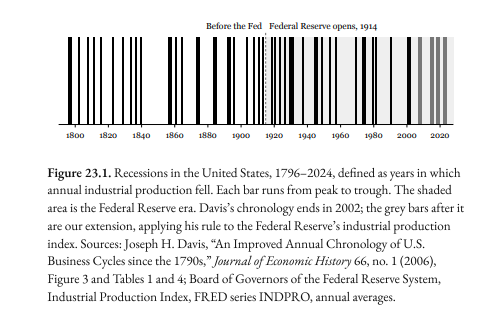
1) You are relying on a data set that is out of date. You have economists on both sides of the aisle (Davis here and Romer as well) say that the pre-Fed data set incorrectly measures recessions.
2) The era before the Fed was the exact opposite of laisezz faire. And it's well known by banking historians that the regulatory regime caused the bank panics and financial crisis of the period.
And this was primarily a United States problem. As economists Charles Calomiris and Stephen Haber put it, “No other country had a banking system anything like this.”
Take Canada to the North. No Central Bank. No Deposit Insurance. No bank panics and very few bank failures.
3) Your claim about deposit insurance is also historically ignorant.
The United States was the only country in the world to ban banks from opening multiple branches. This is tantamount to a ban on diversification.
The result was that the law made banks too small, underdiversified, and fragile.
The US had 30,000 banks before of this law. Canada has 18, all with hundreds or thousands of branches.
During the Great Depression the US had 10,000 banks fail. Canada has zero.
And in the US, it is well known that the political debate around deposit insurance was framed as a choice between deposit insurance or simply allowing banks to branch.
All the small banks supported deposit insurance because they didn't want to have to compete with larger city banks.
Of the states that passed deposit insurance laws before the FDIC, *all* of them were unit banking states (they banned branching). Of the states that allowed branching, *none* passed deposit insurance because they didn't need it.
Henry Steagall, who's name is on the legislation that created the FDIC, was a staunch opponent of branching and say Federal deposit insurance as the way to make the ban survivable.
So is this was Classical Liberalism means to you? To bank banks from diversifying in order to produce politically connected banks from competition and creating a government program to bail them out and make the cronyism survivable?
If you still have doubts about Oswald's guilt read @geraldposner book Case Closed. Here is my distillation of the man from Conspiracy.
Lee Harvey Oswald was born in New Orleans in 1939 and joined the U.S. Marines in the 1950s, where he received riflery training. Contrary to what Oliver Stone has one of his character’s say in his film—that Oswald “shot Maggie’s Drawers,” meaning he couldn’t even hit the target—in fact Oswald scored the second highest rating possible in riflery, making him a sharpshooter.
Politically, Oswald was an avowed Communist who defected to Russia in 1959, worked in a radio factory in Minsk for two years, and married a Russian woman named Marina. After he grew disenchanted with the USSR, in 1962 he moved back to the United States, to Dallas, Texas, shortly after telling friends that he wanted to move to Cuba to join Castro’s communist revolution. This background helps establish a motive for killing Kennedy, as the President was avowedly anti-Communist, and after the failed Bay of Pigs invasion of Cuba, also clearly anti-Cuban and anti-Castro.
Temperamentally, Oswald was emotionally unhinged and suffered from delusions of grandeur, telling people he had ambitions to someday do something to make himself famous. He was very likely a sociopath, and quite possibly expressed the personality traits of psychopathy, narcissism, and Machiavellianism—the “Dark Triad”—dark because the combination often leads to malevolent actions.
While in Dallas, Oswald encountered the anti-Communist crusader Edwin A. Walker, a retired general who was himself something of a conspiracy theorist, once accusing the U.S. Supreme Court Justice Earl Warren of plotting to destroy the United States by banning prayer in schools and promoting civil rights for minorities. In April of 1963, just eight months before he assassinated Kennedy, Oswald attempted to assassinate General Walker by shooting at him from around 100 feet outside his home. Walker was struck with bullet fragments to his forearm and survived, and after the Kennedy assassination it was determined that Oswald used the same firearm for both: an Italian-made 6.5 mm caliber Mannlicher-Carcano bolt-action rifle, which he purchased by mail order in March of 1963, along with a .38 Smith & Wesson revolver, leaving a paper-trail investigators later uncovered. That same Mannlicher-Carcano rifle was found among some boxes near the sniper’s nest on the sixth floor of the Texas School Book Depository building, and in the sniper’s nest were three spent Carcano cartridges scattered on the floor.
After Oswald tried to kill General Walker, he told his wife Marina what he had done, and according to her he also planned to assassinate Richard Nixon when the former Vice President (and future President) visited Dallas, but she locked him in the bathroom to stop him. (After the JFK assassination the Warren Commission determined that it was Oswald who attempted to murder General Walker.)
That summer of 1963 Oswald created the New Orleans chapter of the pro-Castro organization called Fair Play for Cuba (he was its only member there), and he was arrested for getting into fights with anti-Castro Cubans, further evidence of his violent tendencies.
In September 1963, after his wife talked him out of hijacking a plane to Cuba, Oswald traveled to Mexico City in order to procure a visa to Cuba, but the Cuban embassy said they would give him a visitor’s visa only if he was returning to the Soviet Union with his family, which he refused. So he went to the Soviet embassy where he encountered three undercover KGB agents, who later reported that Oswald seemed unhinged, so they put him off.
Oswald then returned to Dallas, where on October 16 he started work at the Texas School Book Depository Building. Conspiracy theorists have made much of the fact that the building was on Kennedy’s parade route, but that route wasn’t determined until the week before the president’s visit to Dallas, well after Oswald got the job there.
Co-workers saw Oswald on the sixth floor of the Book Depository building shortly before JFK’s motorcade arrived and saw him exit shortly after the assassination.
The sniper’s nest on the sixth floor of the Book Depository building was constructed out of boxes, which had Oswald’s fingerprints on them.
Three bullet casings were found in the sniper’s nest indicating that he took three shots. This matches what 81 percent of eyewitnesses in Dealey Plaza reported hearing—three shots.
Subsequent tests with the Mannlicher-Carcano rifle, particularly that of the 1977 House Select Committee report, found that three shots can easily be taken in the eight seconds that Oswald had to shoot (and some researchers put it at 10 seconds). In fact, with the first bullet already chambered, it would have taken only 3.3 seconds to squeeze off three shots.
The three shell casings found in the sniper’s nest carry distinct ballistic markings on them showing that they were fired from Oswald’s rifle, and the one recovered bullet at the Parkland Memorial Hospital where Kennedy and Texas Governor Connally—who was also hit by the first bullet to hit JFK—were taken, showed matching ballistic markings indicating that it had been fired from that rifle.
After killing Kennedy, Oswald went home and picked up his .38 Smith & Wesson revolver and left again, shortly after which he was stopped by Dallas Patrolman J.D. Tippet. Oswald shot him dead with four bullets, an act witnessed by ten observers, and the bullet casings at the scene matched his .38 Smith & Wesson.
Oswald then fled the scene and ducked into a nearby theater without paying. The police were summoned to the theater where they confronted Oswald. Oswald pulled out his revolver and attempted to shoot the first officer, but the gun was wrestled away from him and he was arrested, saying, “Well, it is all over now.”
Actually, it was all over for Oswald two days later, when at 11:21am CST on Sunday November 24, a Dallas nightclub operator named Jack Ruby walked into the Dallas Police Headquarters when Oswald was being transferred to the city jail and shot him dead at point-blank range. In yet another eerie coincidence, Oswald was rushed to Parkland Hospital and pronounced dead, two days to the hour after President Kennedy died in that same hospital.
No, no, no. This is the conventional narrative about Dalton, and it is mostly wrong.
Did audiences want more of Moore? Sure. But actually *watch* The Living Daylights, don't just think about your *memories* of that movie. Watch it.
It is striking how the first half of the movie is clearly just a bunch of left-over gags from the Roger Moore era which have been recycled.
Then about half-way through the movie, it's like the producers suddenly realized "woah, this guy isn't Roger Moore!"
The problem with the Dalton films is that they are *bad* -- they are poorly conceived, poorly written, badly made movies.
That's why audiences failed to connect with Dalton but later did connect with Craig -- because Casino Royale is a good movie, which is well written and well made.
The Living Daylights is a confused, dreary snooze-fest with underwhelming villains and terrible pacing.
License to Kill both lacks the wit, charm, and fun of the Moore-era but also lacks the high production values and sharp writing of the Craig-era. It's a joyless slug fest with an overly convoluted plot, and one which can't fully commit to the darker, grittier take on Bond (e.g. they shoe-horn Q into the film). It doesn't *feel* like a Bond movie. Audiences can dig a darker, grittier Bond movie as long as it *feels* like a *Bond* movie!
Timothy Dalton arrived as Bond at exactly the wrong moment. After years of Roger Moore's raised-eyebrow charm, the late-eighties audience still wanted the familiar cinematic version of the character - the suave, quipping adventurer the films had turned him into. What Dalton gave them was something closer to the literary Bond: a colder, more professional operative who carried the weight of the job and didn’t feel the need to wink at the camera.
The Living Daylights remains one of the strongest pure Bond films of the series, with Dalton bringing real danger and precision to the role in a way that felt fresh and closer to Fleming.
Licence to Kill took a different turn. It pushed his Bond toward the bruised, physical heroes of the late eighties - Indiana Jones, John McClane - more than the untouchable fantasy figure the series had long sold. This Bond is bloodied, battered, and driven by personal revenge in a way no previous Bond had been. The trouble was the film still had to live inside a franchise whose audience expected something lighter and more playful. Caught between those two worlds, it never quite settled with either. Dalton never got a third film to resolve the tension; the 1988 writers' strike and the legal freeze that followed simply ran out the clock on his version.
I still think Dalton remains the actor who came nearest to Fleming's version, but the public had already settled on the cinematic one. No one since has really closed that gap either. With Pattinson now cast and Amazon finally in charge, there's at least the possibility of a genuine reset - if they actually have the nerve to let Bond be the literary figure again instead of the movie star people already know.
@DefiyantlyFree I find it very bizarre that any American would give a rat's ass about the Czar or his family. Maybe if he hadn't been such a shitty monarch, he wouldn't have ended up in that position.
It says a lot that zero people who defend The Living Daylights do so on the basis of any scenes set in Afghanistan or basically any part of the second half of that film. People forget that entire half of the movie exists, because the film itself doesn't care about it either.
@MaelstromHarbor It's very telling that NO ONE who defends The Living Daylights defends it by pointing to ANY scene from the second half of the film or any of the scenes when Bond is in Afghanistan.
@Chris_divine "Let's pretend the Roger Moore bufoonery that's in the movie isn't in the movie."
May as well pretend the movie is a completely different movie then!
@Knorssman Yeah, if there's an example of random Jews showing up and just kicking people off their land at the point of a gun prior to 1945, I'm unaware of it.
I don't take a strong position on Israel's founding, but this seems like a basic point which is hard to argue. Regardless of what happened in 1948 or the years preceding it, what happened in the years after matter more.
When Arab governments drove out their Jews, forcing them into Israel, they forfeited their right to oppose its existence. You cannot drive out your Jews, force them to seek refuge in Israel, and then oppose the existence of the country that took them in.
The Jews have nowhere to go back to, and that was an Arab decision.
Israel is here to stay, "Go back to Poland" notwithstanding. Anti-Zionism is a cruel hoax, and will only lead to more suffering, regardless of how you see the history of the 1940s.