For a long time, Bitcoin miners secured the network…
without fully controlling what happened around their own hashpower.
That’s part of what @rootstock_io ootstock and @DMND_Sv2 are trying to change.
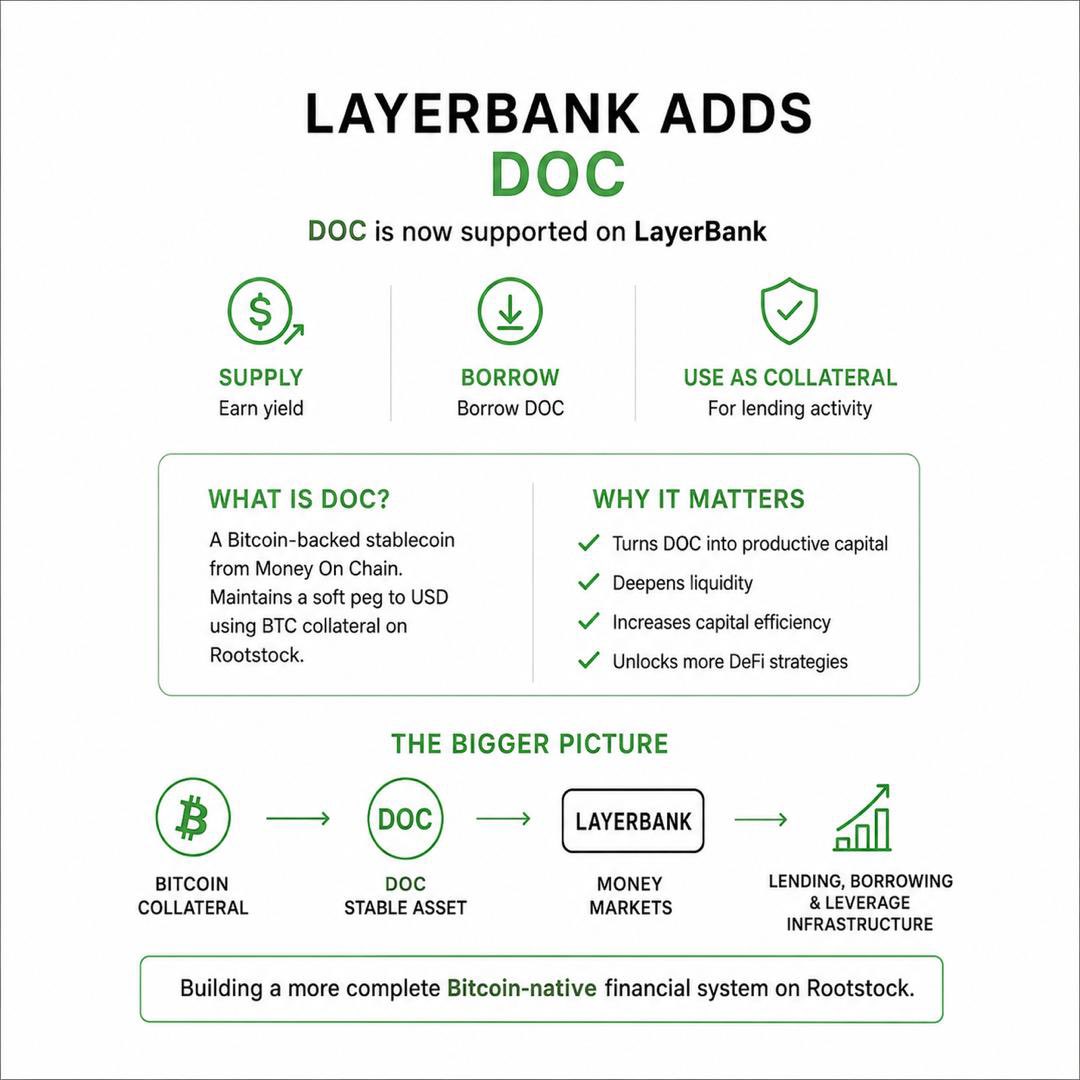
In a recent turn of events @LayerBankFi just added $DOC as a supported asset on @rootstock_io
On the surface it looks like a small integration.
But structurally, it’s a meaningful step for Bitcoin native DeFi.
Moving assets into @Rootstock_io isn’t hard because of bridges.
It’s hard because of choices.
Users must decide:
• which bridge to use
• which route is cheapest
• which route is fastest
• where liquidity is actually deep
Most users just guess and that’s inefficient.
Tier list
🟩S: @rootstock_io→ merged-mining BTC secured & EVM compatibility provides broader developer base
🟨S: Liquid→ Instead of math + energy relies on: trust-based model
🟨D: Stacks→ Uses STX (not BTC) as native asset
🟥E: wBTC→ BTC is locked → IOU issued on Ethereum
Bridging assets usually feels like homework 😭
But @okutrade said:
“what if we made it rewarding instead ? And Bridge some of your @rootstock_io assets to get some rewards “
What happens when money can react to business activity on its own?
That’s the direction $USDb by @paystand on @rootstock_io is pushing toward.
Not just digital dollars.
Programmable dollars on Bitcoin infrastructure.
Just in ,@RootstockColl just dropped V11.0.
Quietly becoming one of the more interesting incentive systems in Bitcoin DeFi.
Not just “do tasks, get points.”
More like:
participate in the ecosystem and build an on-chain reputation over time.
On @rootstock_io a different idea is taking shape:
Bitcoin isn’t just something you hold.
Because sitting on a balance sheet, BTC is safe…
but it’s also idle.
No yield. No liquidity. No structure.
What if miners didn’t have to sell?
With @rootstock_io , BTC becomes productive capital:
•BTC to RBTC (via peg-in)
•Deploy into smart contracts
•Access liquidity while holding BTC exposure
Same Bitcoin. More utility.
Let me explain more :
“What if the risk isn’t using your Bitcoin… but not using it at all?”
On @rootstock_io a different approach is used
From custody to capital.
Companies like MicroStrategy and Galaxy Digital hold large amounts of BTC.
But holding is only step one.
The next step is utilization
In an exciting new update @LayerBankFi just showed up inside @bexowallet on which supports @rootstock_io
and I don’t think people realize what that actually means yet.
What if risk wasn’t the problem… but how it was distributed?
On @rootstock_io that question hits differently.
Think back to 2022 ,firms like Three Arrows Capital weren’t short on capital
they were concentrated.
Same trades.Same failure points.
When one thing broke, it collapsed
Tier list
🟩S: DOC → Bitcoin-aligned
🟩S: USDB → Built on Bitcoin (@rootstock_io), programmable infra
🟨C: USDT → Centralized, freezes
🟥E: USDC → Institution-heavy, not crypto-native
USDB isn’t just stable value it enables payroll, treasury movement & automated transactions
Foreigners may not understand but locals live it.
In Zim, “credit” for some businesses has meant being handed NNCDs: non-negotiable, 0% instruments payable years into the future.
No interest. No liquidity. No exit.
This is why systems like @tropykus and @rootstock_io matter.
7 years on, and still we run. Not from progress but from unnecessary complexity. Atlas on Rootstock is a correction: simplicity, utility, truth in motion. BTC ⇄ $rBTC
@rootstock_io
Atlas is live on @rootstock_io
Built on Rootstock, secured by Bitcoin, designed to remove that complexity.
With fast confirmations, low fees, and seamless swaps and bridges, everything comes together in one intuitive interface. What you need, without the noise. $BTC to $rBTC.
So how are tokenized stocks actually minted on @sailingprotocol ?
It starts off-chain.
Real shares are bought and held in custody first.
Then on @rootstock_io via Sailing Protocol, tokens are minted against those shares (1:1 or fractional)
No backing = no minting
Simple as that.