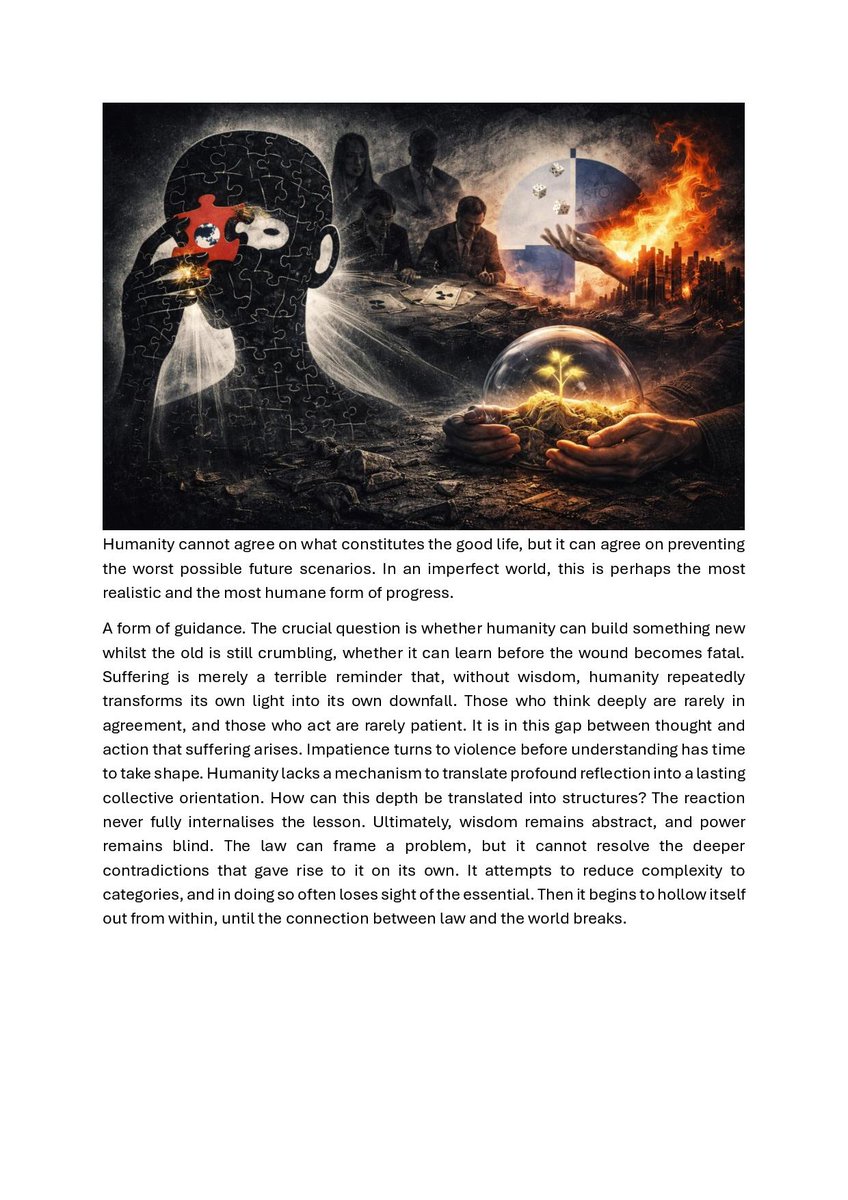
Two of the three main theatres of war are slowly blooming, while the third will pause. The time, crucial as it allows for one to be certain.
All goals can be achieved by 2045. The question is how many trees will fall until the emergences of 2050s - the forest keeps growing.
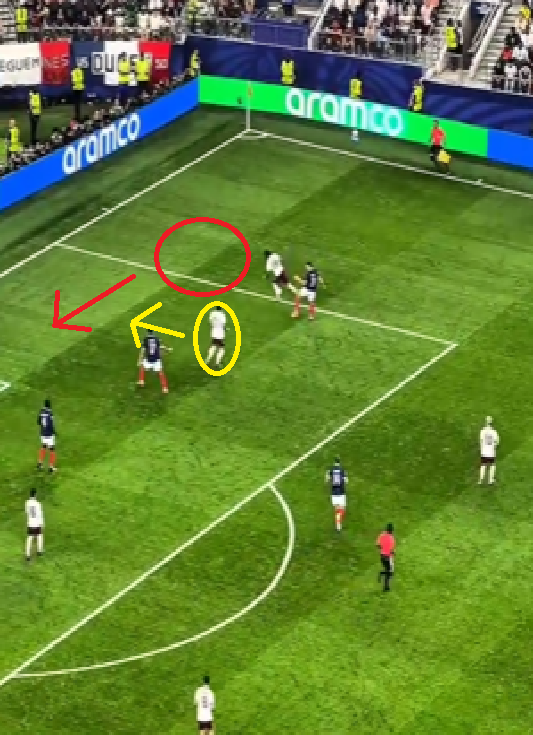
Part of playing "dirty" is to get fouls and the best outcome is a penalty.
Yamal had two option:
1. Let Digne shoot, the outcome would be a loss of the ball and a possible need to re-attack.
2. Leap into the ball, the outcome would be a loss of the ball, but with the possibility of a penalty or a possible transfer of the ball to Oyarzabal.
The way Yamal tried to take the ball, was impossible for him to play afterwards with it - his back is turned to the ball.
It would be "luck" if that jump would transfer the ball to Oyarzabal. Even if Oyarzabal would get the ball, Saliba and Upamecano were there as well to block any movement to the goal.
Thus, the best assumption is, that Yamal tried to get the penalty, by that leap and off angle.
Under IFAB Law 12, a foul is given if a challenge is deemed careless or reckless. Even though Digne had no intention of kicking Yamal and didn't see him coming, the blind clearance remains a foul.
Kicking an opponent in the penalty box while trying to clear the ball is a penalty.
Their both top players and he should have had the awareness, which for France, sadly led to this outcome.
Das Gespräch verengt die Lage auf einen einzigen Hebel: Wer setzt sich militärisch in der Straße von Hormus durch?
Die Realität ist kein Schalter mit nur zwei Positionen, sondern ein Geflecht aus Abschreckung, Sanktionen, symbolischer Eskalation, indirekten Verhandlungen und innenpolitischem Druck auf mehreren Seiten.
Der erste Denkfehler ist, dass „gescheitert“ hier als klarer Endpunkt behandelt wird. In solchen Konflikten ist ein Rahmenabkommen oft nicht einfach tot oder lebendig, sondern halb offen, halb blockiert. Technische Gespräche, politische Drohungen und diplomatische Kanäle können parallel laufen. Das Gespräch tut aber so, als hätte ein Satz von Trump die Lage endgültig besiegelt.
Der zweite Fehler ist die Überinterpretation von Hormus als reines Militärproblem. Die Straße von Hormus ist vor allem ein Druckmittel. Sie kann nicht nur durch offene Kriegshandlungen gestört werden, sondern auch durch Drohkulissen, kleine Zwischenfälle, rechtliche Deutungen, Versicherungsrisiken und die Angst vor weiterer Eskalation. Das Gespräch behandelt das Ganze, als ginge es nur darum, ob die USA „frei durchsetzen“ oder nicht. Dadurch verschwindet die Grauzone, in der solche Krisen tatsächlich laufen.
Drittens wird die Logik beider Seiten zu linear beschrieben. Als würden die USA erst angreifen, dann kaufen, dann wieder angreifen. In Wirklichkeit sind solche Signale oft gemischt und widersprüchlich. Sie dienen nicht nur einem „Plan“, sondern mehreren Zielgruppen zugleich: dem Gegner, den eigenen Wählern, Verbündeten, Märkten und Verhandlern. Das Gespräch liest jede Bewegung als Ausdruck eines einzigen Masterplans oder dessen Scheitern. Das ist analytisch fehlgeleitet für Internationale Politik und Außenpolitik.
Viertens wird unterschätzt, dass Irans Verhalten nicht nur von militärischer Stärke abhängt, sondern von Abschreckung und asymmetrischer Macht. Der Iran muss die Straße nicht „beherrschen“, um Wirkung zu erzielen. Schon die glaubhafte Fähigkeit, Störungen zu verursachen, reicht oft aus, um Schifffahrt, Ölpreise und politische Reaktionen zu beeinflussen. Genau deshalb ist die Lage so zäh: Nicht die volle Kontrolle entscheidet, sondern die Fähigkeit, Kosten zu erzeugen.
Fünftens wird Europa als fast handlungsunfähig und China als möglicher Retter dargestellt. Das ist zu bequem. Europa hat tatsächlich begrenzte militärische Hebel, aber diplomatisch, wirtschaftlich und über Koordination mit Partnern kann es sehr wohl Einfluss nehmen. China wiederum hat Interessen, aber keine Garantie, dass es für Stabilität so weit geht.
Das Gespräch macht aus komplexer Interessenpolitik eine Art Zuschauertribüne.
Am stärksten verkennt das Gespräch aber den Punkt, dass eine Krise nicht nur daran scheitert, dass niemand lösen will, sondern oft daran, dass alle Lösungen teuer sind. Genau das fehlt hier. Es wird so geredet, als sei das Problem vor allem persönliches Unvermögen oder Planlosigkeit.
Kurz gesagt: Das Gespräch macht aus einer vielschichtigen Eskalationslage eine dramatische, aber zu einfache Erzählung. Es sieht nur Schlagworte wie Krieg, Kaufen, Scheitern und freie Schifffahrt, übersieht aber die eigentliche Maschine darunter: begrenzte Zwangsmittel, wechselseitige Abschreckung und strategische Mehrdeutigkeit.
Der größte Fehler ist, dass du den Krieg als bilateralen Konflikt USA gegen Iran, obwohl die eigentliche Ebene längst systemisch und multipolar ist.
Das Ergebnis ist nicht in Kategorien von "Sieg" oder "Niederlage" zu verstehen ist, sondern als Neujustierung einer multipolaren Ordnung, in der mehrere Akteure gleichzeitig begrenzte Gewinne erzielen und zugleich ungelöste Konflikte bestehen bleiben. Das Interview bleibt dagegen weitgehend auf der Ebene eines regionalen militärischen Konflikts und vernachlässigt diese größere geopolitische Dimension.
Hinzukommt, dass das MOU ebenso völlig fehlinterpretiert wird, wodurch es auch zu der fehlgeleiteten Analyse kommt.
Wer sitzt am Tisch? Wer will was?
Es entsteht eine natürliche Kluft zwischen Außenstehende, wie sie die Lage interpretieren und was dort wirklich entschieden wurde.
Einen Tipp gebe ich ihnen: Das Rätsel der sechzig Tage
Es wäre schön wenn sie als Professor mehr als nur pointierte Schlagzeilen und persönliche Herabwürdigungen hervorbringen.
Wissenschaft lebt von analytischer Distanz, sauberer Argumentation und der Trennung zwischen belegbaren Fakten und persönlichen Werturteilen. Wer einen Politiker wiederholt als "Narr" bezeichnet oder ihm pauschal Planlosigkeit zuschreibt, verlässt die Rolle des nüchternen Analytikers und bewegt sich in Richtung politischer Kommentierung. Das ist zwar von der Meinungsfreiheit gedeckt, wird aber der besonderen Verantwortung eines Hochschullehrers nur eingeschränkt gerecht. Gerade Studierende orientieren sich an der wissenschaftlichen Arbeitsweise ihrer Lehrenden. Sie sollten lernen, komplexe Zusammenhänge anhand von Evidenz und konkurrierenden Erklärungen zu analysieren, statt politische Akteure über persönliche Zuschreibungen zu bewerten. Ein Professor darf eine klare Meinung haben, sollte sie aber in einer Sprache vermitteln, die wissenschaftliche Integrität und intellektuelle Fairness erkennen lässt.
You haven't read my clear examples how Mamdani is directly responsible for the living cost price increase. Instead you repost the exact evidence that it increased prior to the Iran war, when he took office. There in January and February the prices already rose again under him.
Do you disagree with the NYC Comptroller that recurring spending exceeds recurring revenue and that this creates a structural fiscal problem?
You never defend your previous claim once it has been challenged. You simply replace it with a new explanation.
Likewise, if you claim Trump's policies explain New York's higher living costs, that is also your burden to prove. Simply asserting "Trump did it" is not evidence.
It is getting absolute funny as you post an out of context image of property prices from China as we talk about rent. Simply saying China's property prices did this or that does not tell us whether Mamdani's policies caused or alleviated affordability problems in New York. China has a fundamentally different institutional framework, land ownership model, local government financing structure and housing market. A comparison only has value if you demonstrate that the same causal mechanism applies.
Is the current budget structurally sustainable, and did the Mayor's policies contribute to affordability pressures?
Instead of addressing that, you continuously redirect the discussion to external events or different countries.
Why is the NYC Comptroller wrong about unsustainable spending growth despite record tax revenues?
Why does a balanced budget automatically imply structural sustainability?
Why do local taxes, rent regulations and spending decisions have no effect on local prices?
At least you should analyse the whole graph not a specific part.
I've noticed a pattern: when one argument fails, you don't defend it, you replace it. Iran becomes Trump, Trump becomes AI, AI becomes China, then wealth redistribution. That's not engaging with the discussion, it's changing the subject. Until you address the original argument, we're just going in circles.
None of these answers the original question. None of those answer whether the current budget is structurally sustainable or whether local policy affects affordability.
You are repeating the same mistakes again and again. That is absolutely incredible. Besides that, you aren't even able to address a single point I made nor are able to answer my question.
First, NY was net positive before as well. That is another concept that you completely mix up. New York City being a net contributor to Albany does not mean the city’s own budget is healthy or that it can simply keep the state taxes it sends upward. No mayor has done that before.
Secondly, even the NYC Comptroller has said the FY2027 gap was driven by unsustainable spending growth despite record tax revenues, which points to a structural budget problem, directly enacted by Mamdani. You even admit to yourself that the bailout was necessary, meaning he received enough to close the deficit substantially and open another chapter - he did not. The budget is currently only balanced because it relies on one time measures, short-term pension savings, reserve reversals - yet he increased the budget plan again, a policy choice.
Thirdly, no mayor in any city in the world can simply raise the tax indefinitely. That argument makes even less sense as, the administration itself had previously projected a $3.70 billion property-tax increase for FY2027 before reversing it, which shows this was a policy choice and not a categorical impossibility.
Fourthly, in the end you conflate everything into one singularity that "without better wealth distribution you will never solve the issue". You confuse who pays with why prices are high and you mix up equity with economic efficiency.
The ideological slogan sounds morally attractive but is analytically false. It does not change how much housing exists, how much energy costs, how productive the economy is, or how much food is supplied. This is why countries with extensive redistribution still experience housing shortages, inflation, and high living costs.
Then it gets more and more confused with your argumentation.
Again you are using the Iran war to blame the overall cost onto it. Very convenient. No education required. New Yorkers spend far more on housing, local taxes, insurance, utilities, labour-intensive services, and city-regulated costs - plus what I mentioned before. Furthermore, you haven't even looked at the statistics at all. Your Iran explanation is already contradicted by the timeline. The item prices already rose from January and February, two months prior the Iran war, when he took office.
Now it is getting funnier as you fail to understand the role of the Congress. Also, the bill just being proposed does not excuse Mamdani's rent and property policy. The bill is still expected to become law even without Trump's signature because it passed Congress with overwhelming bipartisan majorities. His refusal was a political protest over an unrelated voting bill, not the defeat of the housing legislation itself.
Suddenly we reached the level "aliens exist therefore Mamdani is not responsible for the budget". AI is not the reason New York's overall cost of living is rising. The effect is concentrated in specific electricity markets and infrastructure systems, not a universal explanation for rent, groceries, healthcare, transportation, and other costs. It also makes absolutely no sense as you continuously blame the past for it. New York's affordability crisis existed long before the AI boom. Blaming AI data centres for New York's overall cost is like blaming mobile phones for rising rent prices.
Then you go on and say, that he kept his promises. You assume every policy that gives immediate relief is automatically a solution to rising costs.
The cost must be covered through taxes, borrowing, or reductions elsewhere. He cuts the NYPD, software subscription, office space, government position. He delays pension, education and rental assistance program spending. The list is too long to continue here.
The worst argument you could have brought forward is to assume that there is no link to Mamdani's policy and the price increase. Its as if you assume that any Mayor's policy is not responsible. Yet, it is directly tied to the economic trade-offs of his democratic socialist platform.
The mandatory rent freeze on rent-stabilized units, partly protected a small fraction of current tenants but inadvertently contributed landlords to hike free-market rents to offset uncapped utility and maintenance overheads. The Bay Ridge apartment is a perfect example of it.
The property taxes led business to raise the prices of goods and services. Here the "triple-net" leases reflect directly on the Queens mall. Because the tenants have NNN leases, that additional money is allocated among them according to their leased space. The Bodega answered this with higher prices, even though the tax was initially levied on the property.
Yet, this continues on with more and more proposing alternatives by Mamdani, such as the incoming New York corporate tax rate, which is a tax pass-through. Managements of such are forced to delay investment,
reduce staff, increase prices, again ending up into the daily overall cost.
The Iran war, federal housing legislation and AI data centres may affect partly the economy, but none of them demonstrate that New York City's budget became structurally sustainable or that the Mayor's own policies had no effect on affordability.
Your argument also treats every increase in living costs as if it must have an external cause. That isn't how economics works.
Finally, "he kept his promises" is a political statement, not an economic argument. The relevant question is whether those promises improved New York's long-term fiscal position. Simply pointing to external events does not answer that question.
Is Mamdani's budget structurally sustainable, and did his policies contribute to affordability problems?
You are continuously reframing the discussion. Then your position retreats to an easier claim using non sequiturs, equivocation and whataboutism.
Given the budget that exists today, is it structurally sustainable?
Do you agree or disagree with the NYC Comptroller that the FY2027 gap is driven by unsustainable spending growth despite record tax revenues?
Yes or no.
Stop using straw man excuses...
You are not arguing from facts. Your explanation changes depending on what is convenient: first it is "the Iran war", then "waste, fraud and corruption", then "it's someone else's fault." In each case, you reduce a complex economic issue to a single cause without providing evidence.
This stems highly likely from the lack of education that you have received.
Your first claim, that "the whole world is experiencing price increases because of the closed Strait," is simply false.
Inflation is driven by many factors, including monetary policy, housing costs, wage growth, supply chains, tariffs, fiscal policy and commodity prices.
Furthermore, you ignore the post-pandemic recovery, expansionary fiscal and monetary policies, and labour and housing shortages as important drivers.
Your argument also fails a basic reality check. Rents, restaurant prices, healthcare costs and university tuition do not all rise because of the Iran war.
A disruption in the Strait can increase oil prices and shipping costs, which may contribute to inflation. But that is only one factor. Even the IMF's research concludes that shipping disruptions raise inflation through higher transport costs, not that they explain inflation by themselves. https://t.co/0cziHMiJvu
If the Strait were the primary cause of inflation, countries would experience similar inflation. They do not. Instead, some countries have low inflation, others have persistent inflation, others experience deflation in certain sectors.
Second, "The mayors before Mamdani caused the budget deficit", doesn't answer whether new spending proposals are financially sustainable. Then you go on rumbling everything into "There is enough money for social programs. The issue is waste, fraud and corruption." You again automatically make a false assumption, that the amount of waste is large enough,
it can realistically be eliminated, the savings are recurring and those savings are sufficient to fund all proposed programs.
The relevant question is whether the city's finances became structurally stronger or whether the gap was closed with external support. The state itself announced that this additional funding was used to close the City's budget deficit.
My point was never that inflation is caused by Iran, nor did I argue that living costs depend on the war. You're arguing against a position I didn't take.
Likewise, saying the previous administration created much of the deficit does not answer my argument either. Even if that is true, it does not demonstrate that the current budget is financially sustainable. Responsibility for creating a deficit and responsibility for solving it are separate questions.
Unless you can show that recurring revenues now sustainably cover recurring expenditures without relying on extraordinary support or pushing costs into the future, you haven't addressed my argument. You've simply changed the subject.
If your argument is that Mamdani's proposals are financially sustainable because "there is enough money," then demonstrate it with numbers.
Show:
how much his proposals cost annually,
how much recurring savings can realistically be achieved,
over what timeframe those savings occur,
and why those savings are sufficient.
Otherwise, you're replacing a fiscal analysis with a slogan.
Once again, you’re reducing everything to a simplistic explanation that the problem must be due to the war with Iran, which is completely wrong. The issue of financial sustainability is structural; it is not a situation dependent on that external factor. You tie again the living cost to Iran, the classic deflection strategy of Mamdani, but completely untrue.
Furthermore, describing this as “balanced and transparent” is misleading. A budget can be legally balanced yet structurally unsustainable. In addition, the budget shows that the financial sustainability issue has not been resolved.
The point is he did not make it better, instead he made it worse. Those young people that trusted him, will pay the price for the overlapping future costs.
The whole New York state is already paying the price. The 8 billion are a clear bailout. The same for the desperately requested 6 billion. A jurisdiction can be a net contributor to the state while simultaneously requiring state assistance to close its own budget gap. Those are two different concepts, that you mix up again.
Its a classic blame deflection strategy by Mamdani Narrative. You are crushing down macro and micro level indicator into one deflection strategy.
Iran does not decide if a developer wants to convert an empty warehouse in Brooklyn into a 100-unit apartment building, their biggest hurdles are NYC's strict zoning laws, lengthy city permitting processes, and soaring local property taxes.
A war in the Middle East does not change the price of a local plumber fixing a pipe or the city's mandate for building maintenance; those are entirely local financial pressures passed down to the tenant.
In addition, federal spending changes do not build apartments or set city-level occupancy rules.
Furthermore, he received a 8 billion dollar bailout, which makes the years before meaningless, the cost had been covered.
The spike in the New York metropolitan area's consumer price index is heavily driven by domestic factors: grocery costs are dictated by U.S. agricultural yields, regional trucking logistics, and local retail labour wages, while the local power grid relies almost entirely on domestic natural gas, nuclear power, and Canadian hydropower.
The Iran war does not determine the price of every product or service. It may indirectly increase transportation costs through higher fuel prices, but it is not the explanation why nearly every consumer good or service has become more expensive.
The same goes for crime rate and so on. You conflate everything upside down and through nothingness.
Likewise, a federal housing bill may affect funding or incentives, but it does not prevent the city from reforming zoning, streamlining approvals, converting vacant buildings, or encouraging new development.
The fact that Mamdani desperately needs those 6 billion shows that the fiscal imbalance has not been resolved but instead shifted onto state support.
The pension restructuring illustrates the same fiscal problem. It creates short-term budget relief but does not reduce the city's long-term obligations.
Ironically, the youth that trusts him has to bear the postponing of those billions after he leaves office.
@ThomasPitt44325@jaegerthomas2 Nach ihrer Logik, macht es auch nichts aus, wenn die USA ihre Truppen und Material nicht mehr in die EU liefern und ihre Steuerzahler priorisiert.
Würde den amerikansichen Steuerzahler gefallen.
So hat halt jeder seine Priorität.
@dr_piotr@jaegerthomas2 Darum geht es nicht. Sondern um den gesamten Posts in den letzten 1 Stunde. @jaegerthomas2 schreibt die Posts nicht zusammen wodurch es nicht möglich ist auch darauf zu antworten.
Immer diese Hysterie und diese panikmachende Hasskampagne. Ich bin wirklich überrascht, dass Sie Professor sind.
Der von Madrid kurz vor dem NATO-Gipfel im vergangenen Jahr vorgestellte 10-Milliarden-Euro-Plan zur Aufstockung der Ausgaben sieht rund 4 Milliarden Euro für Telekommunikation und Katastrophenschutz vor. Ein Großteil davon kann in Zukunft im Rahmen des NATO-Rechnungslegungssystems für Militärausgaben nicht berücksichtigt werden.
Madrid verkauft dies als NATO Beitrag. Wenn man weiter auf die Ausgaben schaut, lehnen sich die meisten Beiträge aus den 34 Milliarden auch auf den dual-use interpretation an. Somit hat Spanien immer noch nicht ansatzweise die 2% Marke erreicht.
Washington gefällt dieses whitewashing der Zahlen nicht. Würde mir auch nicht gefallen.