Our clinical trial is now live, coast-to-coast! We're proud to share that all three Connect-One clinical study sites – University of California, Davis, Massachusetts General Hospital, and University of Michigan – are open and recruiting.
The road to restoring communication runs through all of them.
Learn more: https://t.co/bAdro7ryLt
Many ECoG proponents claim their modality is equivalent to intracortical when it comes to brain-computer interface (BCI) performance – but the science says otherwise.
Intracortical BCIs record single-neuron conversations, while surface-level ECoGs record the noisy, averaged activity of 50,000+ neurons. Even when using powerful AI signal processing downstream, ECoG devices simply cannot recoup the resolution that intracortical BCIs record in the first place.
This difference is apparent in speech restoration applications, where intracortical BCIs have demonstrated sub-1% error rates and real-time decoding from 125,000-word vocabularies. ECoG's best clinical results plateau at a three-year-old's vocabulary with multi-second delays.
ECoG certainly has its place in recording large sections of the brain, like in seizure and functional cortical mapping. But for advanced neuroprosthetics that demand high-fidelity data, you need access to rich, high-dimensional neural data – and that's only possible through intracortical BCI.
Our latest blog explores the neurophysiology, the physics of signal attenuation, and the clinical evidence that shows why intracortical is the leading modality for complex applications. Read on for more.
#BrainComputerInterface #Neurotechnology #NeuralEngineering #BCIresearch
https://t.co/rR0xIdNXSE
Accessing the brain unlocks more capabilities than most companies are building for. We're starting to ask what else is possible.
Paradromics CEO and Founder @Matt_R_Angle recently joined journalist Moira Gunn at @SynBioBeta 2026 to reveal what happens when you treat neural data as a platform rather than a pathway to a single application.
The same hardware that helps someone regain the ability to communicate can be repositioned to help control a robotic arm. Place the device in areas of the brain involved in mood and cognition, and you're reading out something entirely different.
Each time you place the device in a new brain area, you open up new frontier applications.
Without the ability to get data in and out of the brain reliably, a camera is just a camera and a robotic arm is just a robot. With a brain-computer interface (BCI), they can become eyes and arms.
People should never lose their voice, and mental health should never be guesswork. As BCIs make the brain more accessible for healing, the realm of possibilities will expand.
Read the full interview where Matt explores how we're working to create a true interface between biology and technology: https://t.co/zrvYVWlSpq
Last week, we had the honor of joining a golf event in support of the ALS community – families, clinicians, and advocates all working toward the same goal: better outcomes, more options, and reminding those living with ALS they are not alone.
As a team working to expand communication options for people living with ALS, being part of this community matters deeply to us.
The Connect-One Clinical Study is now enrolling. Learn more: https://t.co/bAdro7ryLt
The U.S. leads in BCI tech. But China already has national pricing guidelines, a brain science fund backed by ¥11.6B, and a level of regulatory-commercial coordination that should have U.S. policymakers paying attention.
Read on for our take: https://t.co/RVeDmM4tRL
Paradromics CEO @Matt_R_Angle and our VP of Capital Formation & Strategy Justin Smith recently traveled to Asia to connect with investors and collaborators who share our vision: using advanced brain-computer interface technology to build a world where living with impairment no longer means inability.
#braincomputerinterface #neurotech
No new surgical capital. No unfamiliar procedures. No steep learning curve. Any neurosurgeon can be trained to implant Connexus confidently and safely, shortening the path to patients, and hospitals don't need to overhaul their infrastructure to offer this treatment.
The University of California, Davis has received Institutional Review Board approval to begin recruiting for the Connect-One clinical study. All three clinical sites are officially enrolling, signaling a major milestone for the program. Learn more: https://t.co/3H3PC3jQlL
Paradromics CEO @Matt_R_Angle joins @twiststartups to weigh in on how brain-computer interfaces translate intention into action -- and what this means for the millions of people living with impairment today.
Dive into the full episode: https://t.co/x2yZINjuU8
We are pleased to announce the launch of the APEX Partnership Program, designed to bolster neurotechnology discovery by connecting leading academic researchers with Paradromics' BCI platform.
The future of #BCI is built on collaboration. Learn more:
https://t.co/91OQaAFb6k
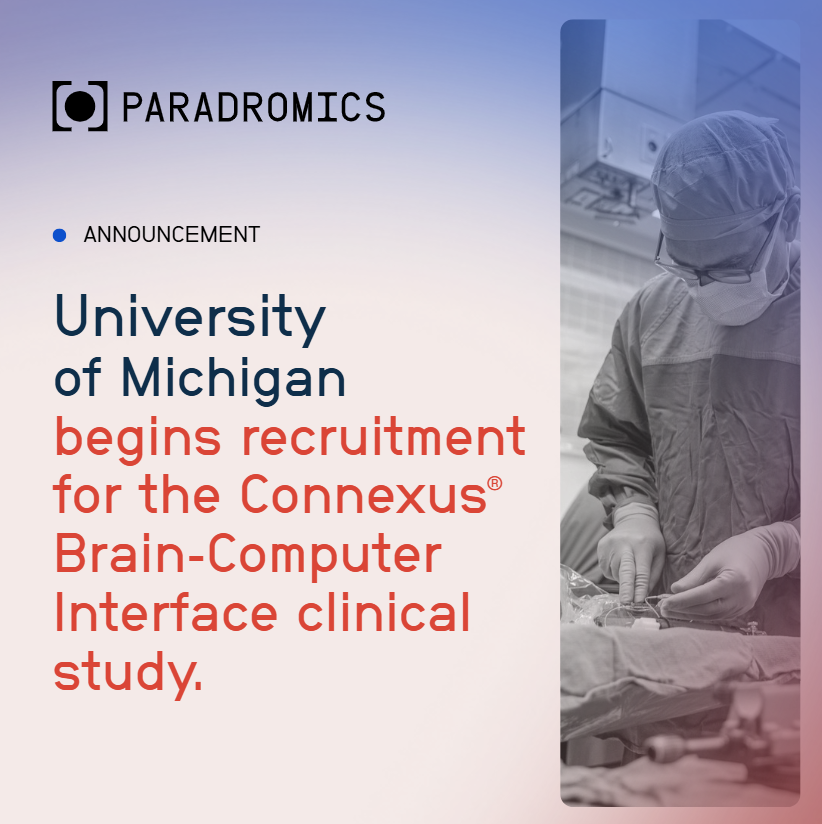
The University of Michigan's Institutional Review Board (IRB) has given approval to start recruiting for the Connexus® Brain-Computer Interface (BCI) clinical study.
View study qualifications here: https://t.co/PUfHE8Sgq6.
Ever had that "uh oh" moment where you KNOW something went wrong? Your brain actually fires a measurable signal when that happens, and brain-computer interfaces (#BCIs) can detect it.
CEO Matt Angle weighed in on where the #BCI industry stands in its race toward FDA approval in this week's STAT article. Read on: https://t.co/sblNiZDe9Q
Better algorithms can only take you so far. What happens when the data itself is the problem? Our latest blog explores why #AI alone cannot unlock the brain, why neural data is the true bottleneck, and what this means for the future of #BCIs.
Read more: https://t.co/iIMxy7Or4Z
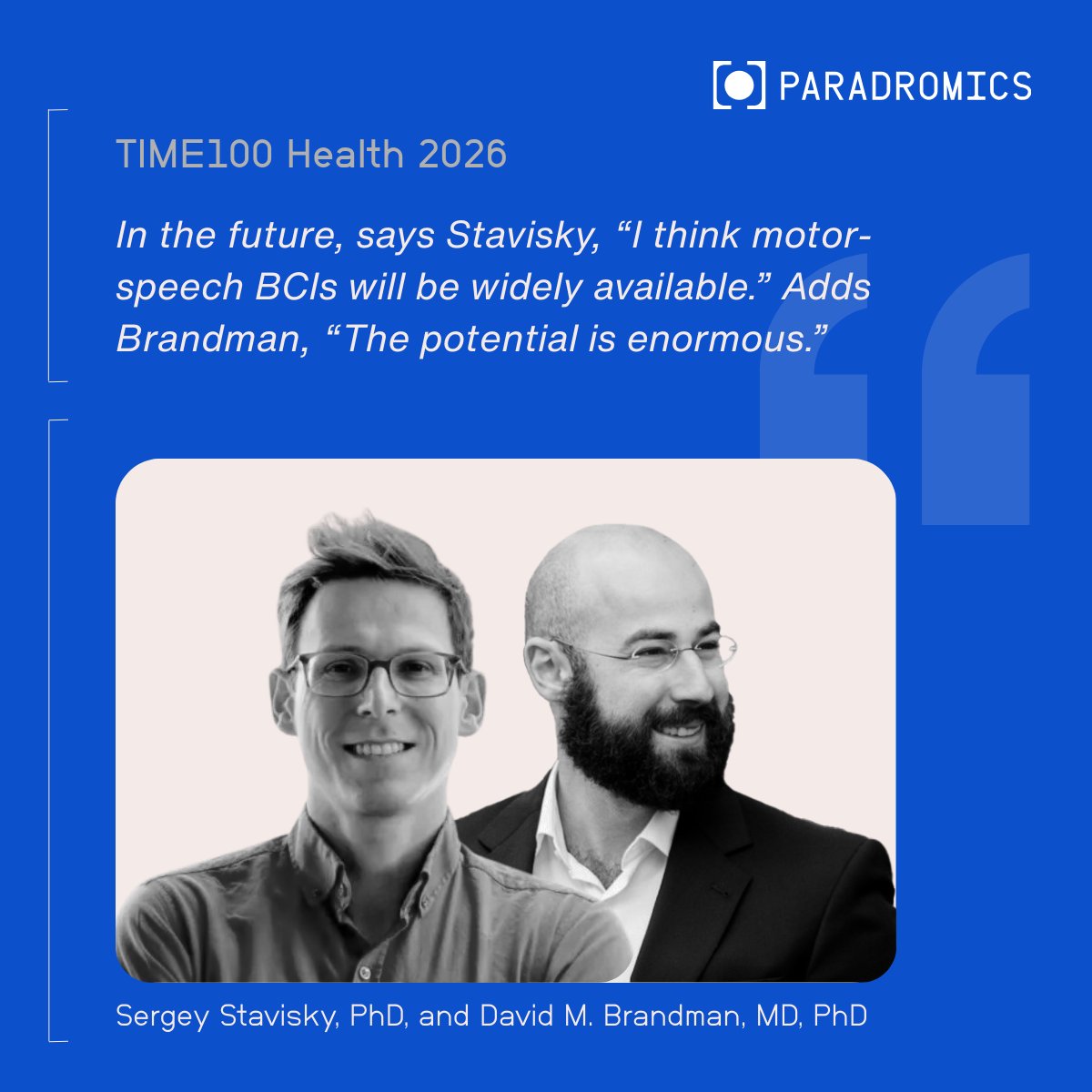
Congrats to David Brandman, MD, PhD and Sergey Stavisky, PhD on making the #TIME100Health list. Dr. Brandman is a lead investigator for #Paradromics' first clinical study, & his vision for restoring function alongside agency, identity, & connection aligns deeply with our mission.
A 2024 study says #BCI is overengineering — that task completion is enough. We disagree. That's why we're building BCIs that preserve the full spectrum of being human.
Read more: https://t.co/mOp1XQwOpP
Step into the next era of BCI technology, where the future runs on thought.
Introducing our new logo. The circle represents the neuron – humanity and the people we serve. The square frame is our interface – the technology that bridges the gap between two worlds.
In this clip from Austin Next, @Matt_R_Angle, Conor Glass (@phantom_neuro), and @Jason_A_Scharf discuss how BCIs mirror the rise of cloud computing, beginning with clinical impact and evolving into a flexible platform for deeper human connection with technology.
In this clip from Skeptic with @michaelshermer, @Matt_R_Angle notes that the future of BCIs runs through medicine and therapy. Efforts aimed at AR and VR will also help to restore vision. Efforts aimed at machine control will also return independence to people with paralysis.