SynBioBeta 2027 Super Early Bird pricing is available through Friday, June 15.
Join the AIxBio founders, biopharma leaders, investors, and startups building the future of biology.
Presenting sponsor: Pumpkinseed
May 3–6, 2027 | San Jose, CA
Lock in your pass early.
https://t.co/oDyS6XJ0Q4
Weeding a garden is the most labor intensive part of any farming endeavor, whether that be growing flowers or food for a million people. What if you could spray a protein that only hits the weed, leaves the crop standing, and is gone before the next planting?
That's what Quercus Biosolutions is building. I got the chance to catch up with Jonathan Lightner earlier this month to learn more about their recent $5M raise and their aspirations for a new era of plant management.
Twenty years ago a Midwest grower planted, waited for the weeds, drove through once with glyphosate, and everything died. Today that same field takes three to five herbicides in combination to get the same control.
Every herbicide works by jamming one piece of plant machinery the plant can't live without. That target is the site of action. By the 1980s the industry had found about twenty. Then it stopped. 21 of the 31 known sites of action are now compromised.
As Jon Lightner put it to me, when you have a niche, nature finds things that fit the niche. A weed can evolve resistance in a few years. A new chemistry takes more than 11 years and about $300M to reach the market. Evolution is moving at twice the speed of the industry.
Part of the reason is how herbicides get found. You push millions of small molecules past a plant and keep whatever kills it. Small molecules need a pocket to wedge into. Many of the most interesting plant proteins don't have one. The list of sites of action is a record of what small molecules could reach, not the plant biology worth attacking.
Pharma hit the same wall and got past it with proteins. Quercus is bringing that toolkit to the field, designing mini-protein binders with an AI platform originally built for human drug discovery.
The mechanism of action is where it gets interesting. A protein doesn't have to compete for the active site the way a small molecule does. In some of their advanced programs, Jon says the active site is physically too small for their protein to reach, so it has to be inhibiting the enzyme some other way. A weed that evolved resistance in that pocket isn't necessarily protected from a protein gripping a different surface.
Proteins also solve the problem that has haunted crop protection. Jon's view is that half the unintended consequences come from molecules that persist too long. Proteins have the opposite problem. Most organisms that encounter one treat it as food. So Quercus designs for stable enough, but not too stable:
- Rainfast fast
- Gone before the fall cover crop goes in
- No target in butterflies or mammals walking through the field
- Small and expressible, because cost scales with size
Jon ran biotech at @DuPont_News Pioneer and was CSO at Genus PLC. Co-founder @EnergyCrisp founded @BensonHillInc. Their $5M seed, led by @serraventures, includes farmer-backed funds like @IowaCorn and @sdcorn.
The full story is available on the @SynBioBeta website, link in the comments.
Huge congratulations to Ilya Captain on another sold-out DataDrivenPharma West.
I've been coming to Ilya's events since early 2024. This year every conversation landed on the same question: what makes data worth having?
As a recovering data scientist, I've watched the field go from R and Python, to Snowflake and Tableau, to today's agentic, chat-based era. Go to most bio events and you'd assume AI is everywhere. Talk to the people implementing it and you get the real picture.
That's who fills #ddpwest26. Bioinformaticians, biostatisticians, data scientists, and data vendors from @Amgen, @genentech, @GileadSciences, @LillyPad, and @AstraZeneca. Asked what's holding AI back, the room's biggest answer was "Data." Not models.
Three questions kept coming up.
1. What data are we missing?
The design space for proteins, DNA, and RNA is massive, and we've measured a fraction of it. Even big pharma's best models are only proven in the chemical space they've already worked in. No single company has enough data on its own.
Accuracy drops as molecules move away from the training data. The practical rule for agents: stop iterating when uncertainty gets high.
2. What data actually helps you decide?
Useful data gets you to a defensible go or no-go, fast. Most late-stage failures aren't chemistry. Teams didn't understand enough about who took the drug.
That puts weight on negative data. Every success is probably an edge case. Most of what we learn is failure, buried in an ELN. The catch is trust. Was the hypothesis wrong, or did someone mix up the tubes? Data that doesn't reproduce should be rerun, not cleaned.
Benchmarks are one way to price data. Show a frontier model fails on it, then show the lift after training. But every seller picks the benchmark they win on. The simpler test: 100,000 curated cancer patients sells itself. Raw records from 1,000 hospitals doesn't.
3. Can anyone actually use it?
A typical multimodal program spends 8 of 9 months on setup and 2 to 4 weeks asking questions. The first question pays for the setup. The twentieth is nearly free.
Batch effects go unsolved because wet lab records were never linked to the analysis. Agents rebuild context from scratch every morning. Reasoning without memory produces answers. Reasoning with memory accumulates science.
The value sits where all three meet. Data where models are blind, tied to a decision, in a form someone can use.
Can't wait for next year's DataDrivenPharma West. Looking forward to seeing it even bigger than this year.
#DataDrivenPharma #DrugDiscovery #AI #Bioinformatics
Biotech still runs on who owns the patent and who approves the drug.
That was my takeaway from @alexkesin's session at DataDrivenPharma West last week.
Alex wrote one of the most widely shared analyses of China's biotech rise this year, and it has become a reference point in the policy debate. He also co-hosts @approvedfm with [@MatthewPech], a podcast on how drugs get discovered, developed and sold. He walked a room of operators through where the value sits now.
Four quick hits:
- 1:3. Doing the work in China costs a half to a third of the US price.
- Rent, don't sell. Beijing's new export controls block the sale of biotech platforms. Licensing, partnerships and contract research stay open.
- 3x. China tripled its university patent conversion rate in two years, to 10.1%.
- 8% to 32%. China's share of the global early-stage pipeline, from 2015 to 2024.
The first hit explains the last five years. China got cheap and fast, and the West bought what it built. Most of those deals were fast-follows on targets Western labs discovered. The West owned the original IP and rented China's speed.
The other three point to the next five.
The export controls dropped the same morning as the session. Read them next to the new five-year plan, which makes biotech and biomanufacturing a national priority through 2030. The strategy looks clear to me. Generate IP faster than the US, keep ownership at home, and let the world license it.
Pipeline share has quadrupled. Patents are moving out of universities and into companies. Nine out of ten still sit unused, so there's plenty of room to grow.
Patents are still the currency. Regulators still set the exchange rate. The FDA turned away a Chinese PD-1 copycat because its trial ran only on Chinese patients. To get paid in the US, you still need FDA approval and a partner who can launch here.
What changes is who holds the paper. When the West generated the IP, licensing meant Western companies owned the value and paid for speed. As more IP is generated and kept in China, the same deal structure sends more value the other way. The West ends up renting the molecule instead of owning it.
This is a gold rush for intellectual property. The question is who can generate novel IP in a specific area, and do it first.
Therapeutics is the beachhead. The US market pays enough for new drugs that the long road through the FDA still earns a return.
In this gold rush, anyone can be a miner. The fastest ones will have the best maps.
And maps only come from data.
#ddpwest26
🔥 Week 43! 40 Bay Area Bio-economy events, Oct 19-25 🔥
🔗 https://t.co/wjeVllvRjr 🔗
New this week: the sheet has two tabs.
📅 By Day runs in calendar order, so you can plan your week.
🗂️ By Topic groups every event by field, so you can jump straight to yours.
𝗕𝗬 𝗧𝗢𝗣𝗜𝗖
11 💊 Drug Discovery & Trials
9 🧬 Genomics, Proteins & Omics
7 🚀 Capital & Dealmaking
5 🌱 Industrial & Environmental Bio
3 🏥 Clinical & Care Delivery
3 🧠 Neuro & BCI
1 💪 Human Performance & Wellness
1 🌸 Women's Health & Fertility
𝗕𝗬 𝗙𝗢𝗥𝗠𝗔𝗧
11 Seminar / Lecture
6 Webinar
5 Workshop / Hands-on
4 Mixer / Social / Outdoor
4 Panel / Salon
4 Vendor Lunch & Learn
3 Conference / Symposium
2 Pitch / Demo Day
1 Info Session
𝗕𝗬 𝗟𝗢𝗖𝗔𝗧𝗜𝗢𝗡
12 Virtual
11 San Francisco
5 Berkeley
4 San Carlos
3 South San Francisco
3 Stanford
1 Fremont
1 Oakland
𝗕𝗬 𝗗𝗔𝗬
7 Mon Oct 19
7 Tue Oct 20
13 Wed Oct 21
10 Thu Oct 22
2 Fri Oct 23
1 Sun Oct 25
100+ people signed up for tonight's Laptop and Learn in Walnut Creek. For a Thursday night event east of the tunnel, that's kind of wild.
The format is simple. People in bio show each other how they actually use AI at work. One-minute pitch to the room, then 15-minute demos around laptops. No slides.
Here's who's demoing tonight:
Rupert Yip and Sarosh Naseem of Mithrl will show Mithrl-1, their biomedical world model.
Frederik Schulz of @jgi is bringing an AI scientist benchmark and next-generation bioinformatics tools.
Jim Dickey of Agentis will walk through their AI approach to designing antibodies and nanobodies against cancer neoantigens, on a timeline of weeks after biopsy.
Sean Jungbluth of BioKEA is demoing a workflow that goes from a prompt to a 3D-printed biological tool prototype.
Robin Green, founding scientist at a stealth startup, will show data pipelines built in Claude and how wet lab scientists with no coding background can build their own tools.
Erika Trauzzi of @Agilent will show how to pitch a product idea in one step.
Dion Whitehead of metapages is bringing open source AI artifacts that let you build with any AI while keeping control of your data.
Ahmad Salehi of Donor Network West will talk through organ donation in Northern California.
Flavius Miron of Human Squared will show AI creators producing short-form video for brands.
Plus demos from Zack Zheng of Vazyme, Haotian Guo of Ailurus Bio, and a Saint Francis High School student who built a de novo protein design pipeline targeting avian flu.
5:00 drinks and networking
6:00 demos, three rounds
7:00 more drinks, more networking
Free, thanks to our friends at @Acrisure and @humaninterest. Steps from Pleasant Hill/Contra Costa Centre BART.
Request a spot: https://t.co/HH1KJoXgI2
See you at 1350 Treat Blvd tonight.
@SynBioBeta #AI #biotech #synbio
Boston lab space is 28.9% empty. The Bay Area is at 30.7%. Houston is at 26.3%.
The XBI is up more than 20% this year. So why is no one moving back into these labs?
Honestly, it shouldn't surprise anyone. Back in 2021 and 2022, the whole game was cramming as many researchers and benches into a building as you could. A few things changed that pretty fast.
- AI-native biotechs lease about a third less space per person.
- Pharma is licensing molecules and sending manufacturing overseas. When we ran a talk at MBC Biolabs, we heard that close to 80% of the companies there outsource some or all of their manufacturing to Chinese firms.
- Later-stage companies want office, not lab. They're managing assets already in trials.
The lab of 2026 just looks different. Teams are smaller. The science is AI-native. And a lot of the actual work isn't happening in Boston or SF anymore. It's happening in Shanghai and Suzhou.
The R&D that does happen here is smaller, leaner, and set up to scale out somewhere else. Those teams don't need rows of benches. They need machines. If your building has 500 benches but not a single mass spec, liquid handler, or flow cytometer, nobody's going to want it. The equipment is the real bottleneck for early-stage work.
The few groups that still want big footprints are building them around robots and power. @LilaSciences grabbed about 244,000 sq ft at Alewife Park in Cambridge for autonomous labs. @medra_ai put hundreds of robots into a concrete industrial building in SF.
So here's the uncomfortable part. These buildings were built for a tenant that doesn't exist anymore. That tenant isn't coming back. Leaving the space empty and hoping 2021 returns isn't a plan.
You have to rebuild it for who actually needs space now.
- Deep tech and hard tech. I've been talking with groups here in SF, and a lot of robotics and hardware teams are looking for exactly this kind of space. Strong floors, real power, good ventilation. Retrofitting a lab is way faster than building new.
- Incubators built around machines, not benches. Rip out the bench rows and put in the instruments early-stage companies can't afford on their own.
MBC Biolabs is already doing this. Shared instruments, shared equipment, small teams that don't need 50,000 sq ft.
Landlords who follow that blueprint will fill their buildings. The ones waiting on 2021 are going to keep sitting empty.
@sensible_bio secured $47M in combined financing to scale cell-based mRNA design, screening and clinical-grade manufacturing.
https://t.co/yJjnyfNiiu
Want to stay ahead in biotech? Subscribe to our newsletter for more 🧬 https://t.co/dImIAAFas9
When the hen is the bioreactor, flock health is process control.
Neion Bio engineers hens to make biologic drugs in their eggs. Now it is bringing in Barnwell Bio, whose founders come from COVID wastewater surveillance, to watch the health of its flocks.
Subscribe to our newsletter and get the biggest biotech news straight to your inbox 🧬
https://t.co/jNY376Ss1v
"Neion uses chickens to manufacture recombinant proteins. Barnwell provides the intelligence needed to understand and protect the health environment in which those chickens live," says Dimi Kellari, cofounder and CEO of Neion Bio
Two #Manhattan biotechs, one unusual partnership.
Visit the #SynBioBeta website to read the full article.
https://t.co/KB2fezEMGg
@bigideaventures is accepting applications for its food-innovation accelerator and direct-investment pathways across food, agtech and sustainable materials.
https://t.co/gM9FmTvAyF
Want to stay ahead in biotech? Subscribe to our newsletter for more 🧬https://t.co/dImIAAFas9
@SuntheticsML , @scrippsresearch and @UCLA are using a $19.5M NSF award to build an open-access, closed-loop autonomous chemistry lab.
https://t.co/U5FypNhujz
Want to stay ahead in biotech? Subscribe to our newsletter for more 🧬 https://t.co/dImIAAFas9
Deisseroth, Hegemann and Nagel won the 2026 Nobel Medicine Prize for the discoveries behind light-gated ion channels and optogenetics.
https://t.co/PAwplG8JJ7
Want to stay ahead in biotech? Subscribe to our newsletter for more 🧬 https://t.co/dImIAAFas9
Xaira reports that X-Design produced progressable antibody leads in weeks, including an antagonist for a GPCR target that resisted prior discovery methods.
https://t.co/sneuFZawZ3
Want to stay ahead in biotech? Subscribe to our newsletter for more 🧬 https://t.co/dImIAAFas9
@CochranLab at @Stanford went looking for a peptide against one cancer target and found one that binds five. Its spinout @TwoStep has now raised $71.2 million and has FDA IND clearance to begin human trials
TwoStep Therapeutics grew out of the Stanford labs of #NobelPrize laureate Carolyn Bertozzi and Jennifer Cochran, with oncologist Ronald Levy as a co-founder.
Subscribe to our newsletter and get the biggest biotech news straight to your inbox 🧬
https://t.co/jNY376Ss1v
Its targeting molecule, PIP, is 33 amino acids long. The lab was screening for a binder to one integrin. The peptide that kept winning binds five.
"It was a serendipitous discovery."
@CaitlynBioE , CEO and co-founder, TwoStep
That breadth matters. A tumor needs to express only one of the five for the drug to find it.
TwoStep just raised a $62.5M Series A and won FDA IND clearance for TS-104.
Visit the SynBioBeta website to read the full article:
https://t.co/W08gbm5xoJ
@theEVERYcompany is expanding OvoPro with Huvepharma and ADM as precision fermentation moves from pilot capacity toward commercial manufacturing.
https://t.co/krF0WnshM7
Want to stay ahead in biotech? Subscribe to our newsletter for more 🧬 https://t.co/dImIAAFas9
PreferCo appointed Shakthi M. Nagappan as CMD as it builds an integrated precision-fermentation platform spanning strain engineering through scale-up.
https://t.co/XTQyXIvWqb
Want to stay ahead in biotech? Subscribe to our newsletter for more 🧬 https://t.co/dImIAAFIhH
@LonzaGroup and @AsimovBio are combining LV Edge stable producer cells with process development and GMP manufacturing for scalable in vivo lentiviral vectors.
https://t.co/aRpUIdszNM
Want to stay ahead in biotech? Subscribe to our newsletter for more 🧬 https://t.co/uNrxaa7z6R
Biomay and @Synthego are linking cGMP mRNA, Cas9, plasmid, LNP and sgRNA capabilities to simplify manufacturing for CRISPR programs.
https://t.co/70Bv06ZcPp
Want to stay ahead in biotech? Subscribe to our newsletter for more 🧬https://t.co/dImIAAFas9
@ARPA_H is betting it can stop neurodegeneration at the first misfolded protein. Post Translational Medicines is part of one of the teams.
The San Francisco startup is one of 7 industry partners on a team that won up to $51.7 million from ARPA-H's BIOGAMI program. It will use its Surveyor platform to measure protein states directly inside cells.
Subscribe to our newsletter and get the biggest biotech news straight to your inbox 🧬
https://t.co/jNY376SZR3
Visit the SynBioBeta website to read the full article
https://t.co/KTteLddnJ2
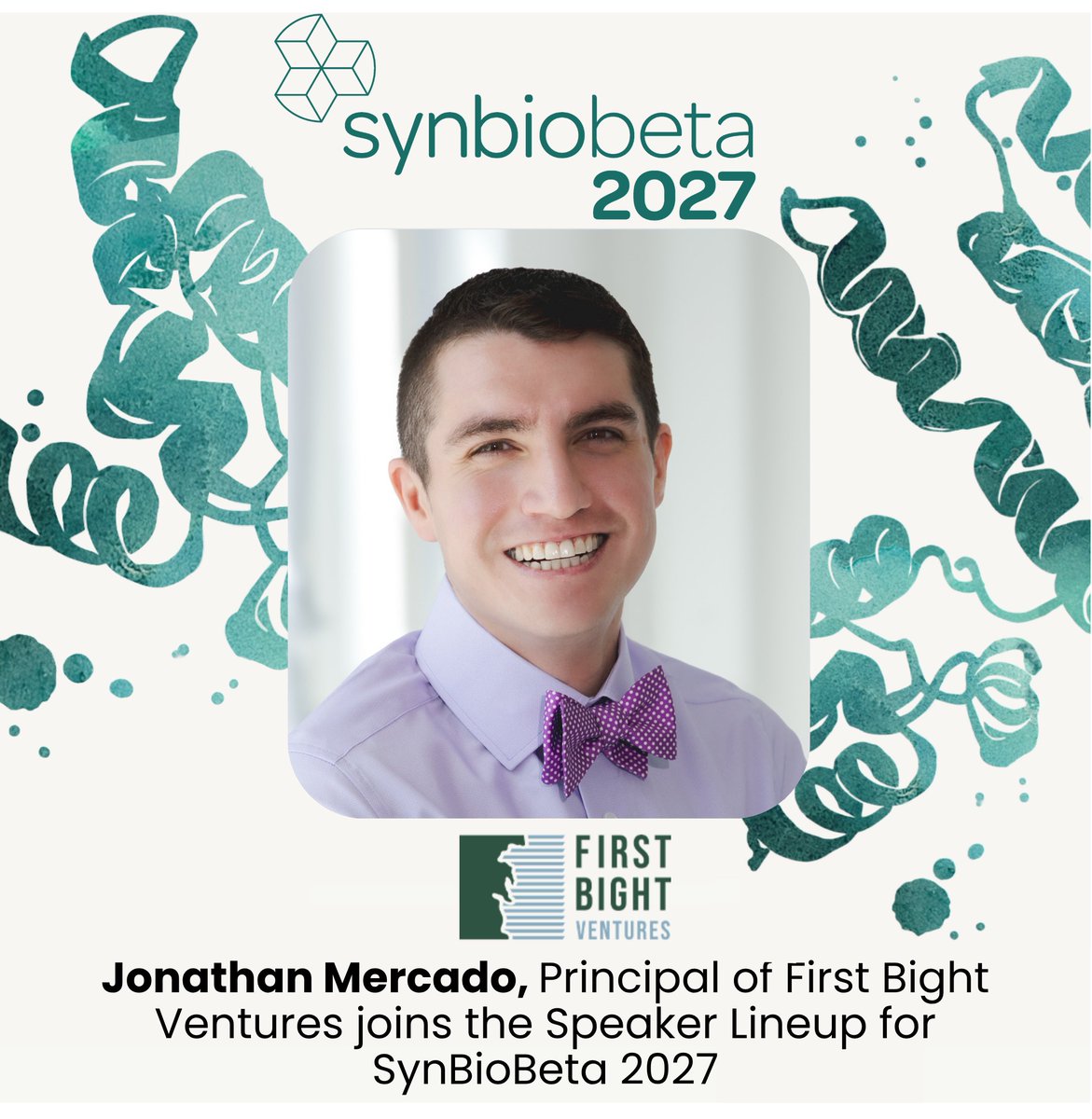
If you're building in biomanufacturing and looking for someone to lead your round, look no further than Jonathan Mercado.
He drives the thesis at @FirstBight Ventures, a fund that leads seed through Series A, takes board seats, and is about as founder friendly as investors get.
First Bight is a Houston fund that invests at the hardest point in industrial biotech: right after proof of concept, right before commercial scale. That's the stretch where great science runs out of runway. It writes checks from $100K to $5M, and its first fund backed seven biomanufacturing companies across chemicals, materials, food ingredients, agriculture, and energy.
The thesis is built on studying failure. First Bight's "Industrial Biomanufacturing Graveyard" report looked at 30 failed biomanufacturing ventures and found that more than 80% didn't fail on the technology. They picked the wrong market, underestimated what it costs to sell, or assumed customers would switch. Jonathan's version is simple: in this space, the science is rarely the bottleneck. Asset selection and go-to-market strategy are.
In 2027 he joins us at @SynBioBeta as a speaker.
What the First Bight portfolio has been up to:
- Led the $5M seed round for @Algenesis_, which makes plant-based, biodegradable materials
- Backing @Visolis3, @iMicrobesInc, @CapraBio, @PersephoneBio, @r2dio, and VIA Biofuels
- Three portfolio companies, Visolis, Industrial Microbes, and Algenesis, landed a combined $5.25M from the Department of Defense's Distributed Bioindustrial Manufacturing Program
- Launched BioWell, a Houston bioindustrial accelerator, which took over a 33,000 square foot pilot plant in Richmond, Texas, to give startups real fermentation capacity
Jonathan came to venture the long way, through the bench and the tools business:
- @bcmhouston, where he earned his PhD in molecular and cell biology (2015-2020), after undergrad at @UTAustin
- IsoPlexis (2021-2023), the single-cell proteomics company whose platform measured what individual immune cells secrete. He was its "single-cell evangelist," working with researchers and partners on translational projects, through IsoPlexis' 2023 merger with Berkeley Lights
- @brukercellular (2023), after Bruker acquired the combined company, managing scientific alliances
- First Bight Ventures (2023-present), starting as an associate and now a principal, sourcing, evaluating, and supporting early-stage biomanufacturing companies
This year he wants to talk about something founders rarely hear from investors: how to fund early biomanufacturing through revenue-generating partner projects instead of another dilutive round. He wants to be the investor a founder calls last, after the decks are done, when the question is what to build and who will actually buy it.
If you're building in chemicals, materials, ingredients, or ag and trying to cross the gap from pilot to plant, Jonathan is the person to find.
Come find him in San Jose, May 3-6th.
@Ginkgo details an enzyme-engineering stack spanning ~6B genes, AI + physics design and autonomous labs, with reported >80x activity gains in one program.
https://t.co/9KlSkKjmgM
Want to stay ahead in biotech? Subscribe to our newsletter for more 🧬 https://t.co/dImIAAFas9