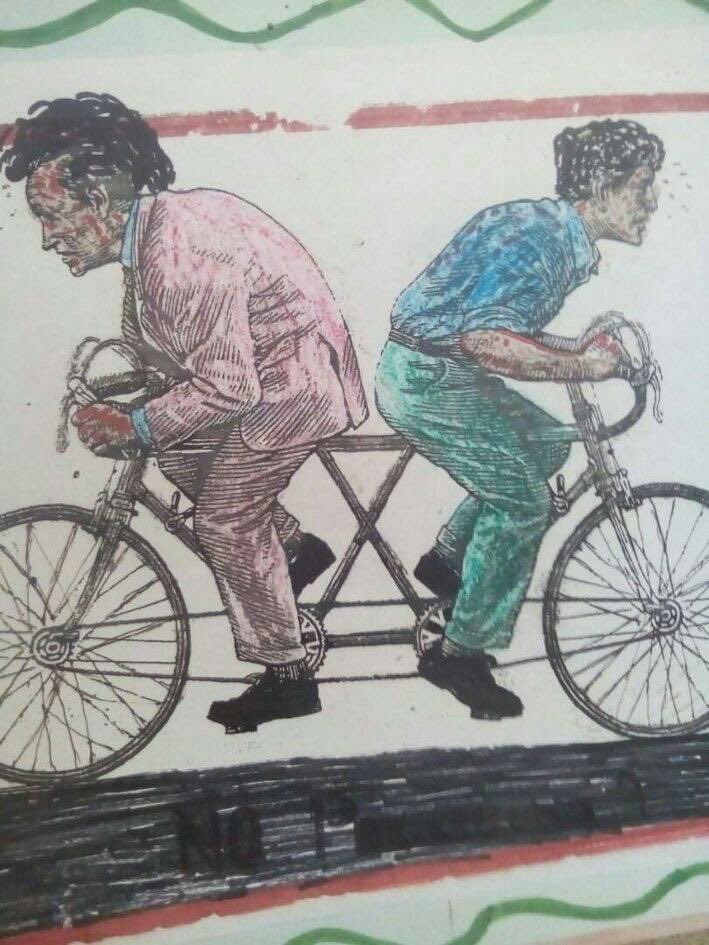
@freemanchari The Argentina England clash is top billing too. The football rival have roots in the famous 1986 clash. 1998 match up proved the hostilities were still 🔥 👌. Can England avenge the 1986 "robbery" by Diego Maradona or the 1998 Beckham-Simeone saga will be settled?
@freemanchari The semifinal vs.France will probe questions previously not asked & provide answers to what we didn't know. Without jealousy, they are playing very well which is a continuation of their 2024 Euro triumph.
@daddyhope Very sad. Something that needs 2 be discussed is how to respond to an accident scene. A fireball could have wiped off more people in that accident. I once saw a response to a fuel tanker being more devastating. The response was pretty quick, however, uncoordinated & at huge risk.
After the usual small talk, where my accent always gives me away, people almost always ask the same question: “So when are you heading back to Zimbabwe permanently?”
I smile, pause for a moment, and reply, “I’m based here now. This is home.” Then I add gently, “I visit family every year or two, but Zimbabwe will always be home too.”
My answer never quite satisfies them. I can see the faint confusion in their eyes, sometimes even slight disappointment. As if belonging must be absolute, as if one place must eventually claim you completely.
They don’t understand that home has become layered for me. The rural areas and small towns of Manicaland where I grew up, and the ghettos of Harare where I spent most of my adult life, still live in my bones. At the same time, my life here has taken root just as deeply. I carry both places with me, not torn between them, but enlarged by them.
The conversation usually moves on, but that small exchange always lingers. It’s a quiet reminder that in the diaspora, identity is rarely simple. We are not “on our way back.” We are building something new, while still honoring what came before.
Making Zimsec compulsory; What problem is GoZ trying to solve for?
Zimbabwe has well over half a million children who should, in theory, be approaching O Level. Yet only about 200,000 register as school candidates for 5 or more ZIMSEC subjects. The rest vanish into the mist, some repeat, some abscond, but many simply fall out of the system because they cannot afford to stay on the conveyor belt. With extreme poverty in Zimbabwe estimated at about 49%, that is the real scandal sitting in plain sight. Millions of kids are dropping out of high school.
Yet, in its infinite wisdom, GoZ has decided that the urgent national problem is the tiny sliver of pupils who prefer Cambridge GCSEs. In effect, it wants to make ZIMSEC compulsory. Conservatively 10K pupils sit Cambridge GCSE exams in Zimbabwe. That is a rounding error against the full O Level age population and only about 5% of the ZIMSEC school candidate stream. This is the classic bureaucratic trick; ignore the collapsed bridge and the thousands of stranded villagers and fine the man crossing the river in his canoe.
The question Cabinet should answer is simple: what problem is this decision trying to solve? The real issue is the children who never get to the exam room at all, the family that cannot raise exam fees, the rural child who drops out quietly, the parent choosing between food and registration. Instead of confronting that national failure, the state has gone after the tiny 2% sitting outside its examination monopoly.
Copied from Millenial Mum page on Facebook
************
I’m sitting in my car doing my NVQ, and I just had a very uncomfortable realization about life in the UK.
When I came here, I met some people who were carers, and I would ask them, “So you’ve been a carer for how long?”
“10 years.”
And that would really shock me.🤔
I met people who were doing deliveries too, and I used to think, how can you still be doing deliveries for that long?🤔
So I realized something.
After four years of being here, I’ve realized that the UK can actually make you feel busy all day without any tangible https://t.co/MFHhx824PH do your shifts.
School run.
Laundry.
Cooking.
Sleep deprivation.
Repeat.
And somehow, you can still end the day feeling like you’ve done everything.
Because here, you’re able to pay bills.There’s predictable https://t.co/5kxJ8H66Pb can survive on shifts.
And the system works enough that chaos is https://t.co/UpQKN4rhw2 it gives you enough to eat and enough to put money aside so that you can stay in the system for years and years and years.
It’s not luxury.
It’s not wealth.
It’s just enough stability to make you pause your bigger dreams.And to be honest, it’s dangerous.
I think these are some of the things our sisters who came here a long time ago had to deal with.
Because if you look back at Zimbabwe, and even parts of South Africa, pressure was brutal.
You would not stay in the house if there was no sadza or food.
That pressure would make you go to Mbare and sell.
I was in Mbare. I sold vegetables there once.
I sold perfumes around Gweru, crossed borders to sell ma Klites , you remember that season?
I have literally done anything to survive.
We were constantly thinking of the next move.
Then you come here and start thinking:
“At least I can survive on my carer’s salary.”
And honestly, with the pressure of raising children and paying bills, sometimes you don’t even want more pressure.
Then months turn into years…
and you realize you’ve been surviving, but not necessarily building.
That’s why I believe discipline inside stability is a real skill in the https://t.co/X3hF52jUIw’s a skill.
Because exhaustion is not alwsts progress.
I was listening to a podcast ,"force yourself to get things done" , and one thing they said really stayed with me:
15 minutes matters.
15 minutes studying.
One application.
One business idea.
One small step daily.
Work on it.
Otherwise, this system we are in can make us very comfortable with survival.
And comfort can be dangerous too.
Anyone else feel this?
Zimbabwe’s doctors and pharmacists should stop mistaking lobbying for reform. If nearly 90% of Zimbabweans have no medical aid, the medical fraternity has a far better weapon than prohibition: form a mutual or health cooperative fund, pool modest monthly contributions from households, churches, SMEs and workers, then contract doctors, clinics and pharmacies in the cooperative on transparent tariffs, generic medicines and primary-care packages.
Spain’s Espriu Foundation and America’s Kaiser Permanente both show, in different ways, how providers and patients can be aligned through cooperative or integrated health-financing models. If the existing medical aid system is so flawed, build a better one. Destroying it will not send patients rushing to private doctors; it will send them out of formal healthcare altogether.
.@ProfJNMoyo wants me to explain to him in detail why I say #NoToCAB3. I don’t really have time to engage him individually, but if there’s sufficient interest from all of you, I’ll find time.
So if we can get 1k RTs, I’ll do a series of posts/videos explaining each issue. Deal?
I hired a general hand to do some manual landscaping tasks on a property I own. We agreed on a price. I left.
When I came back to check on progress, I realised that he wasn’t doing the work himself. Instead, he hired two guys to do the work for him, so I paid him to hire some guys that he then paid.
Akaisa zino, as they say. I feel uncomfortable with what he did. I feel it’s not right.
Anyway, I later got the contacts of the two guys who did the actual work. Going forward I will just give them the assignments. I respect the guys who do the actual work, not some smart Alec trying to be an intermediary.
I think if Zumbani was in western world, someone would made a killing during Covid.
But even upto today we still use it same way it was used 100 years ago by our forefathers, no "take this Zumbani twice a day for flu" in pharmacies.
We import 90% of our medicines but Zumbani for example we have it, mumvee we have it, those who came before us gave us pointers, but we never improved their findings. Whats wrong with us? Could it be our education system?