Today + tomorrow I'm at @aclmeeting '26, and early this morning, I received the 2026 ACL Computational Linguistics Doctoral Dissertation Award!! 🙀🏆👩🎓It's the icing on the cake of my excellent PhD experience in Edinburgh @Edin_CDT_NLP@EdinburghNLP. (1/3)
Many web agents add memory, skills, or workflows online at test time.
🚨 These augmentations can help, but they also consume extra inference tokens. So we asked a simple question:
❓ Are the gains still there when the total token budget is controlled?
🧵 Thread below 👇
Can we release all the weights of an LLM but still provide differential access to privileged users?
Yes! We introduce: 𝗧𝗶𝗲𝗿𝗲𝗱 𝗟𝗮𝗻𝗴𝘂𝗮𝗴𝗲 𝗠𝗼𝗱𝗲𝗹𝘀 (𝗧𝗟𝗠𝘀). Define access tiers corresponding to different computation graphs over the same set of LLM parameters!
🚨 I’m happy to share that I'm joining Saarland University as a tenure-track Professor in the Department of Language Science and Technology, and the German Research Center for AI (@DFKI) as a Scientific Director, starting October 2026! 🚨 1/6
Excited to share our latest paper!
(led by the awesome undergrad in our lab, Ada Tur, and for me the first time as last-author)
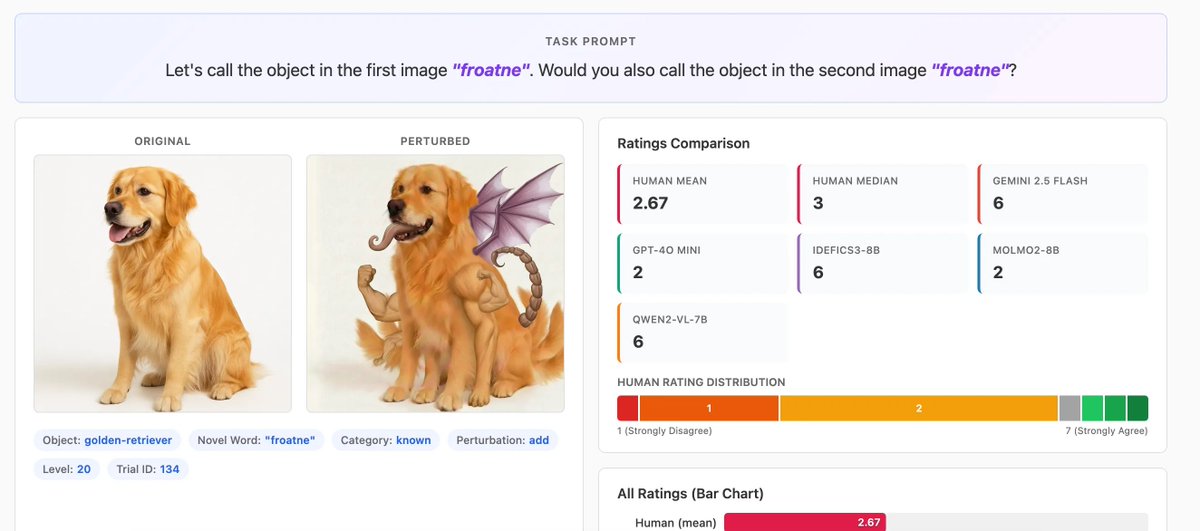
We studied how VLMs adopt new visual concepts (such as the funny dog example below) and map them to language compared to humans, and found that…
If you're at CVPR, don't miss our work on WMRewad, see all details in Jianhao's thread, but in short WMReward is an inference-time framework that steers video generators toward physically plausible outputs:
Excited to share our new paper!
“Forecasting Downstream Performance of LLMs With Proxy Metrics”
w/ my amazing advisors @sivareddyg, @mariusmosbach, @DBahdanau
Cross-entropy loss is a poor predictor of how models perform on downstream tasks (esp. reasoning). We propose something better: proxy metrics computed over expert reasoning traces.
🧵 Thread below 👇
Vaibhav Adlakha (@vaibhav_adlakha) is now Dr. Adlakha, congratulations 👨🎓💐! My first PhD student to graduate from McGill. Vaibhav's work had a deep impact on retrieval and RAG systems, LLM2Vec for one! @McGill_NLP@Mila_Quebec
Talking today at ICLR Lifelong Agent Workshop at 2:30 pm Rio https://t.co/E5HgH51Kir #ICLR2026
Lifelong Agents from Small Language Models
Frontier API agents are too expensive to deploy per user, per task, per interaction; the deployable unit for lifelong agents is a small language model. Committing to small agents raises three questions. First, how does a small agent acquire frontier-level competence? Second, how does a fixed small agent adapt to each user? Third, how does a small agent retrieve from its memory and communicate with other agents?
(Couldn't go to ICLR in person, so it's remote.)
Don’t miss @dohmatobelvis presenting our latest work, “Why less is more (sometimes): A theory of data curation” at #ICLR2026!
Swing by our poster at the main conference to chat:
📅 Saturday, April 25
🕒 3:15pm–5:45pm
📍 Pavilion 3, P3-#1816
Frontier LLMs can navigate complex websites, but are expensive and can't run locally. At the same time, small open models can't match the capabilities of commercial APIs. Can we close this gap with synthetic data?
To answer this, we built Agent-as-Annotators (A3): a framework for agentic capability distillation, which is inspired by the human annotation process. Our new A3-Qwen3.5-9B model trained on just 2.3K trajectories matches the 3x larger Qwen3.5-27B on WebArena (41.5%) and nearly doubles the previous best open-weight SFT result (21.5%), despite never seeing WebArena tasks in during training.
Paper: https://t.co/nLOQDUbt7x
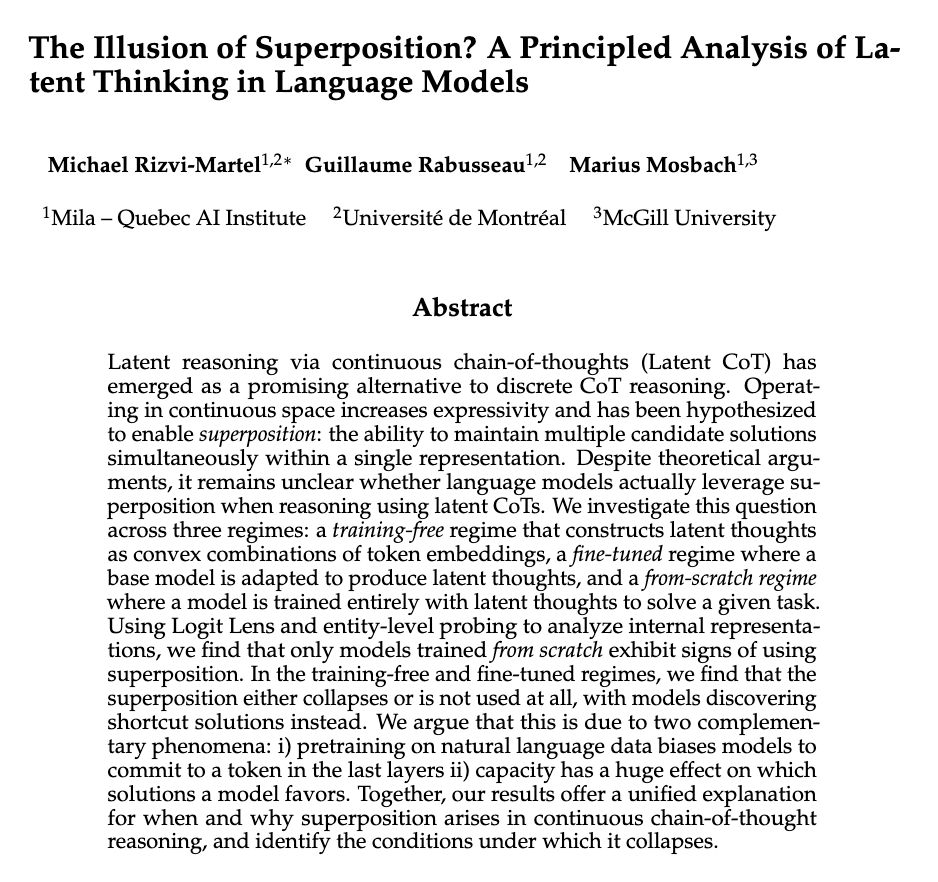
Latent CoT is an alternative LLM reasoning scheme hypothesized to enable “superposition” allowing models to hold uncertainty over multiple concepts during reasoning 💭
We revisit superposition in 3 latent CoT approaches and find that it is largely an illusion 🔮!
More in 🧵
SAEs fail at OOD tasks. Why?
Features in superposition are linearly representable but not linearly accessible. Instead of discarding sparse coding, we embrace the geometry of superposition and use methods equipped to handle the nonlinearity it induces.
Mechanistic interpretability aims to understand models — and the more superhuman or incoherent they become, the more we need that understanding to be reliable. We propose a framework for this, drawing on established tools from causal reasoning and statistical identifiability:
🧵
🚨LLM2Vec-Gen encodes the potential response of an LLM rather than the input!
✨So what? It better transfers safety🛡️and reasoning 🧠 abilities to embedding space!
💬What else? Embeddings are decodable! Give the intermediate embeddings back to the LLM, and decode the content!
Your LLM already knows the answer. Why is your embedding model still encoding the question?
🚨Introducing LLM2Vec-Gen: your frozen LLM generates the answer's embedding in a single forward pass — without ever generating the answer. Not only that, the frozen LLM can decode the embedding back into text.
🏆 SOTA self-supervised embeddings
🛡️ Free transfer of instruction-following, safety, and reasoning
first paper of the phd 🥳
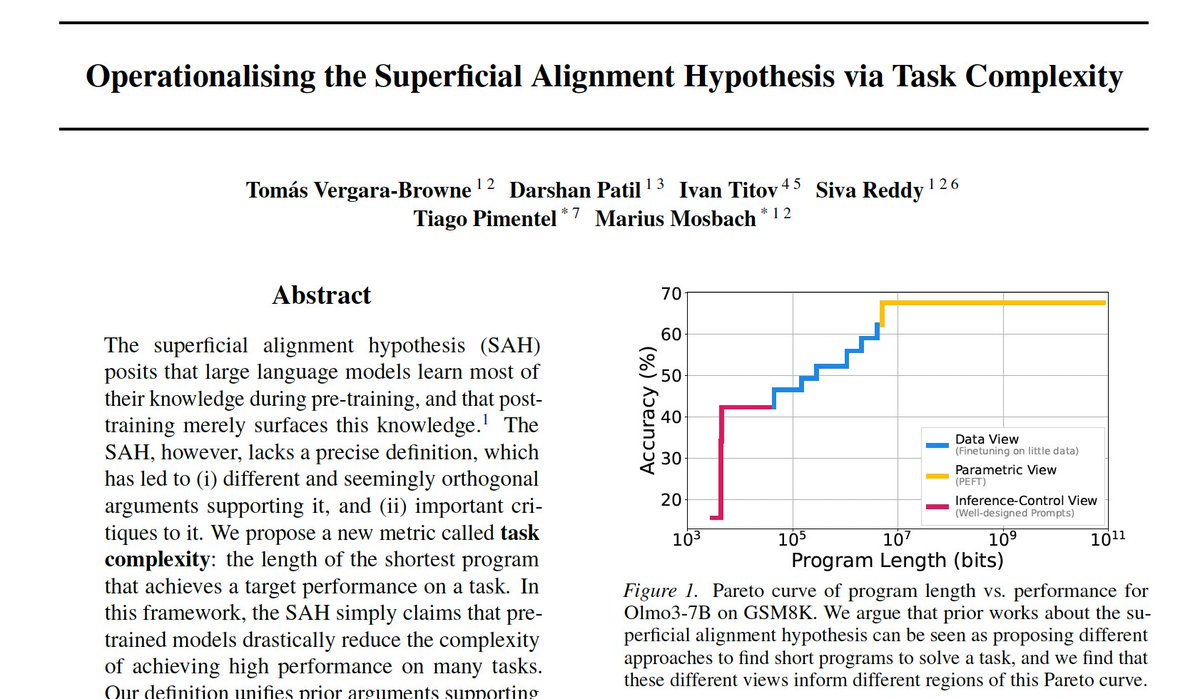
the Superficial Alignment Hypothesis (SAH) argues that pre-training adds most of the knowledge to a model, and post-training merely surfaces it.
however, this hypothesis has lacked a precise definition. we fix this.
🚀 New paper: BRIDGE — Predicting Human Task Completion Time from Model Performance
Benchmarks report accuracy.
Humans think in time.
BRIDGE connects the two.
How long would a task take a human, just from model performance logs?
Details 🧵