@GenFlynn@RandPaul Military must follow Potus. Why not just say who potus reports to? It's easy to say he reports to the american people. Something else is going on.
@Real_RobN Why does it seem so odd to me that so many of us have known all this for years already? Is it drugs, mind control or something? So many still cant or won't believe it. And the very people they support and vote for already know all this stuff is true.
Did Trump even read the declassified documents that the Susie Wiles Admin just released?
Because if he did, then a bunch of pre-dawn raids to arrest former intelligence officials for treason would have been reported by CNN this morning.
Did anything happen this morning?
SHOCKING SECRET RECORDING: NYC doctors REFUSED to save dying COVID patients — even when begged to try treatments saving lives worldwide.
Nurse Erin worked at Elmhurst Hospital — ground zero, the hardest-hit COVID hospital in America. She watched horrific, *needless* deaths pile up under the official protocols (many with ~90% fatality rates once patients were intubated).
In this recording, she confronts a doctor about proven off-patent options like high-dose IV Vitamin C (used successfully in Asia). The doctor’s response?
“Come on, there is no cure. There’s no antiviral therapy… People keep coming up with silly stuff. There’s no basis for Vitamin C to be working here.”
Even as patients were actively dying, the doctor dismissed any deviation from the deadly standard protocols.
This is the perverse incentive system laid bare:
✅ Follow the (often lethal) protocols → get paid well, protected from liability, never questioned.
❌ Fight to actually save lives with cheap, available therapies → risk your career, license, and reputation.
The media sensationalized the body count at Elmhurst to terrify the world into lockdowns… while the real story was medical mismanagement and financial incentives that rewarded death over recovery.
This wasn’t “following the science.” This was following the money — and it killed people.
Never forget what was done to patients (and their families) in the name of “protocol.”
The truth is out. Hold them accountable.
Colonialism is bad, right?
Wrong.
The Aztec Empire ran sacrifice at industrial scale. Excavations of the Huey Tzompantli, the skull rack next to the Templo Mayor, have uncovered hundreds of skulls of men, women, and children. Spanish eyewitnesses described tens of thousands. The Aztecs fought "Flower Wars" whose purpose was capturing live victims for the altar. Hearts were cut out of living people. Subject peoples hated Aztec rule so much that Tlaxcalans made up most of Cortes's army. The conquest was largely an indigenous uprising against an indigenous empire. The sacrifices ended under Spanish rule.
India: burning a widow alive on her husband's funeral pyre. British records from Bengal alone documented thousands of cases between 1815 and 1828. The British, with Indian reformers like Raja Ram Mohan Roy, banned it in 1829. When priests told General Napier it was sacred custom, he answered: my nation also has a custom, we hang men who burn women alive. You follow yours, we will follow ours.
India: Thuggee cults murdered travelers by the tens of thousands over centuries as offerings to Kali. It was a hereditary profession. William Sleeman's campaign in the 1830s wiped it out.
Slavery was a universal indigenous institution. Dahomey and Ashanti were built on slave raiding and sold captives for a thousand years to Arab traders before any European ship arrived. Pacific Northwest tribes held up to a quarter of some village populations as slaves and killed them ceremonially at potlatches. The Comanche ran a captive-raiding economy across the Southwest. What colonizers introduced after 1807 was the first attempt in history to abolish slavery globally. The Royal Navy's West Africa Squadron spent fifty years hunting slave ships and freed about 150,000 Africans. African kings protested. The King of Bonny complained that abolition was destroying a trade ordained by his gods and priests.
The Dahomey kingdom's "Annual Customs" beheaded hundreds of captives and slaves every year to honor dead kings. Documented by European visitors for two centuries. It ended when France conquered Dahomey in 1894.
Sailors called Fiji the Cannibal Isles. Chief Ratu Udre Udre kept a stone for every victim he ate. His pile holds nearly 900. Shipwrecked sailors were killed and eaten. Within a generation of missionaries and British administration after 1874, the practice was gone.
Nigeria: In parts of Igboland, newborn twins were left in the bush to die and their mothers ostracized or killed. Missionary Mary Slessor spent decades in Calabar rescuing abandoned infants until the practice collapsed.
Indigenous genocide of indigenous people. In 1835, two Maori tribes invaded the Chatham Islands and slaughtered the Moriori, whose own law forbade them to fight back. They killed, enslaved, and ate them. The Moriori population fell from about 2,000 to barely 100. No European did this. British colonial law ended it.
Add headhunting in Borneo, the Philippines, and Nagaland. Female infanticide in India and Polynesia. Foot binding in China, dismantled partly by missionary campaigns. Every one of these ended under pressure from the colonial powers we are taught to treat as history's unique villains.
Colonialism was not charity. The Belgian Congo was a horror, conquest was for profit, and rule was without consent. But the ledger has two sides and one has been erased. Pre-colonial societies practiced slavery, human sacrifice, widow burning, infanticide, and genocide, because cruelty is not a European invention. The first civilization that tried to abolish these practices worldwide is the one you were taught to be ashamed of.
If "indigenous" means innocent and "colonizer" means guilty by definition, that is not history.
Well THIS seems like important information I wish I had known earlier. And the tweet is beautifully written, explaining the science with clarity.
If you have two minutes to spare, read this.
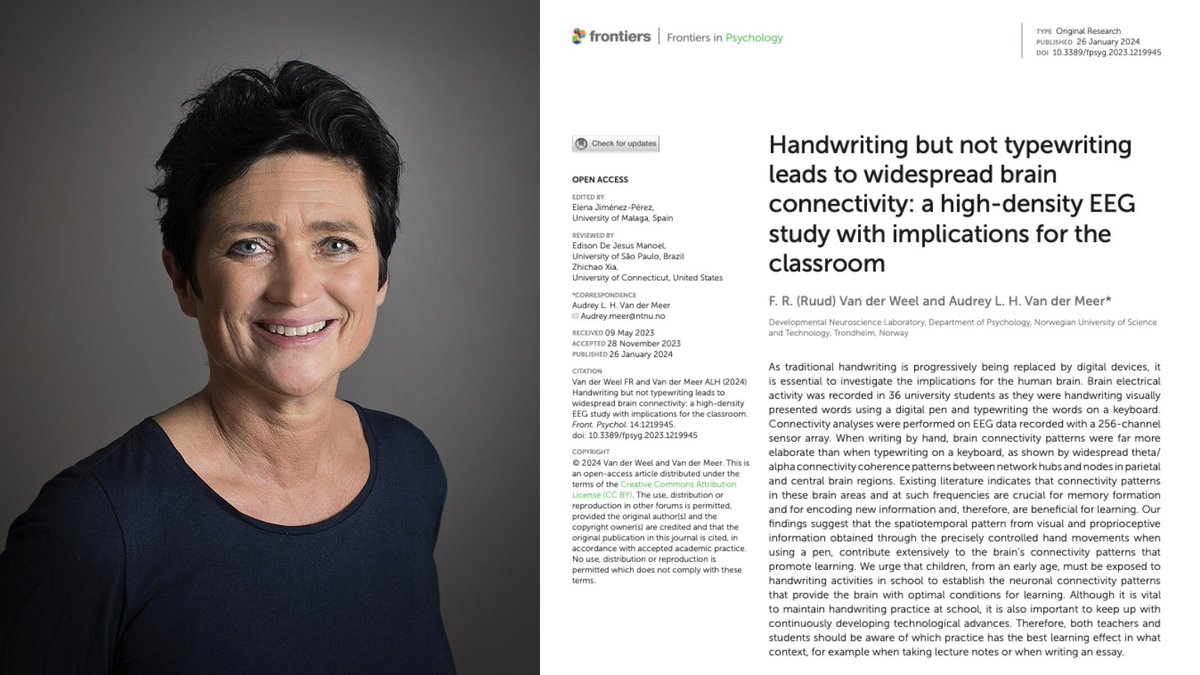
A Norwegian neuroscientist spent 20 years proving that the act of writing by hand changes the human brain in ways typing physically cannot, and almost nobody outside her field has read the paper.
Her name is Audrey van der Meer.
She runs a brain research lab in Trondheim, and the paper that closed the argument was published in 2024 in a journal called Frontiers in Psychology. The finding is brutal enough that it should have changed every classroom on Earth.
The experiment was simple. She recruited 36 university students and put each one in a cap with 256 sensors pressed against their scalp to record brain activity. Words flashed on a screen one at a time.
Sometimes the students wrote the word by hand on a touchscreen using a digital pen, and sometimes they typed the same word on a keyboard. Every neural response was recorded for the full five seconds the word stayed on screen.
Then her team looked at the part of the data most researchers had ignored for years, which is how different parts of the brain were communicating with each other during the task.
When the students wrote by hand, the brain lit up everywhere at once.
The regions responsible for memory, sensory integration, and the encoding of new information were all firing together in a coordinated pattern that spread across the entire cortex. The whole network was awake and connected.
When the same students typed the same word, that pattern collapsed almost completely.
Most of the brain went quiet, and the connections between regions that had been alive seconds earlier were nowhere to be found on the EEG.
Same word, same brain, same person, and two completely different neurological events.
The reason turned out to be something nobody had really paid attention to before her work. Writing by hand is not one motion but a sequence of thousands of tiny micro-movements coordinated with your eyes in real time, where each letter is a different shape that requires the brain to solve a slightly different spatial problem.
Your fingers, wrist, vision, and the parts of your brain that track position in space are all working together to produce one letter, then the next, then the next.
Typing throws all of that away. Every key on a keyboard requires the exact same finger motion regardless of which letter you are pressing, which means the brain has almost nothing to integrate and almost no problem to solve.
Van der Meer said it plainly in her interviews.
Pressing the same key with the same finger over and over does not stimulate the brain in any meaningful way, and she pointed out something that should scare every parent who handed their kid an iPad.
Children who learn to read and write on tablets often cannot tell letters like b and d apart, because they have never physically felt with their bodies what it takes to actually produce those letters on a page.
A decade before her, two researchers at Princeton ran the same fight using a completely different method and ended up at the same answer. Pam Mueller and Daniel Oppenheimer tested 327 students across three experiments, where half took notes on laptops with the internet disabled and half took notes by hand, before testing everyone on what they actually understood from the lectures they had watched.
The handwriting group won by a wide margin on every question that required real understanding rather than surface recall.
The reason was hiding in the transcripts of what the two groups had actually written down.
The laptop students typed almost word for word, capturing more total content but processing almost none of it as they went, while the handwriting students physically could not write fast enough to transcribe a lecture in real time, which forced them to listen carefully, decide what actually mattered, and put it in their own words on the page.
That single act of choosing what to keep was the learning itself, and the keyboard had quietly skipped the choosing and skipped the learning along with it.
Two studies. Two countries. Same answer.
Handwriting makes the brain work. Typing lets it coast.
Every note you have ever typed instead of written went into your brain through a thinner pipe. Every meeting, every book highlight, every idea you captured on your phone instead of on paper was processed at half depth.
You did not forget those things because your memory is bad. You forgot them because typing never woke the part of the brain that would have made them stick.
The fix is the thing your grandmother already knew.
Pick up a pen. Write the thing down. The slower road is the faster one.