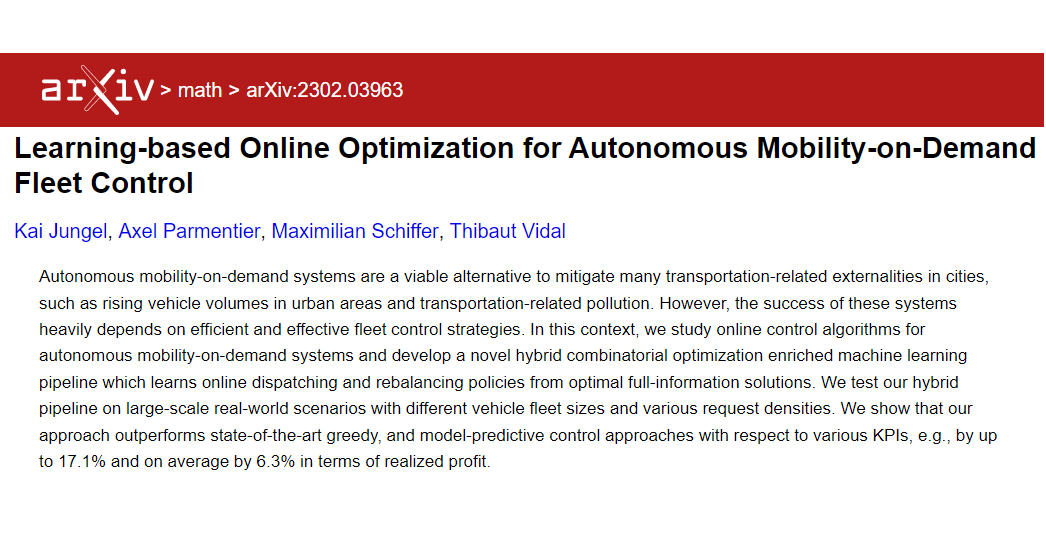
Check our latest work regarding online fleet control for mobility-on-demand applications at https://t.co/Ui1klU7oo6. It introduces a hybrid ML + CO pipeline that learns to solve the dispatching problem as a parametrized k-disjoint shortest path (polynomial) on a tailored graph.
Decision-support systems need user confidence 🧐 to go into production. This is especially critical for hybrid #MachineLearning + #ORMS pipelines. So, how to explain data-driven decisions based on contextual information? We introduce new methodologies: https://t.co/YQriZmEsra
@vidalthi@TU_Muenchen @EcoledesPonts @VUamsterdam@univgroningen@unibielefeld Congratulations Kai, Patrick and Leo for this great algorithm. And thank you Maximilan Schiffer for this super collaboration of our PhD students.
Yet another nice application of https://t.co/wk1XYvjiSo
@JFPuget @giomdal There are applications in Operations Research where we want to use NP-hard problems as layer. In a follow-up to https://t.co/EHbdUqXn1u, we use a deterministic aircraft routing (AR) problem (NP-hard) as layer in a pipeline to solve a data-driven version of the AR problem.
It comes with a generalization of the column generation algorithm to MILPs with lexicographic objectives: (1) algorithms to leverage solvers to find a lexicographic optimal basis and integer solutions, and (2) algorithms to solve lexicographic resource constrained shortest paths
Félicitations à Louis Bouvier, étudiant de l'@ENS_ParisSaclay, pour son mémoire intitulé 'Large Neighborhood Search and Structured Prediction for the Inventory Routing Problem' réalisé au sein du laboratoire CERMICS.
New MSc, Ph.D., and postdoc positions are opening at the SCALE-AI Chair on Data-Driven Supply Chains at @polymtl. Research topics on #ORMS, #optimization and interpretable #MachineLearning. Can you relay this announcement to your network?
https://t.co/u3f3A0k3CA
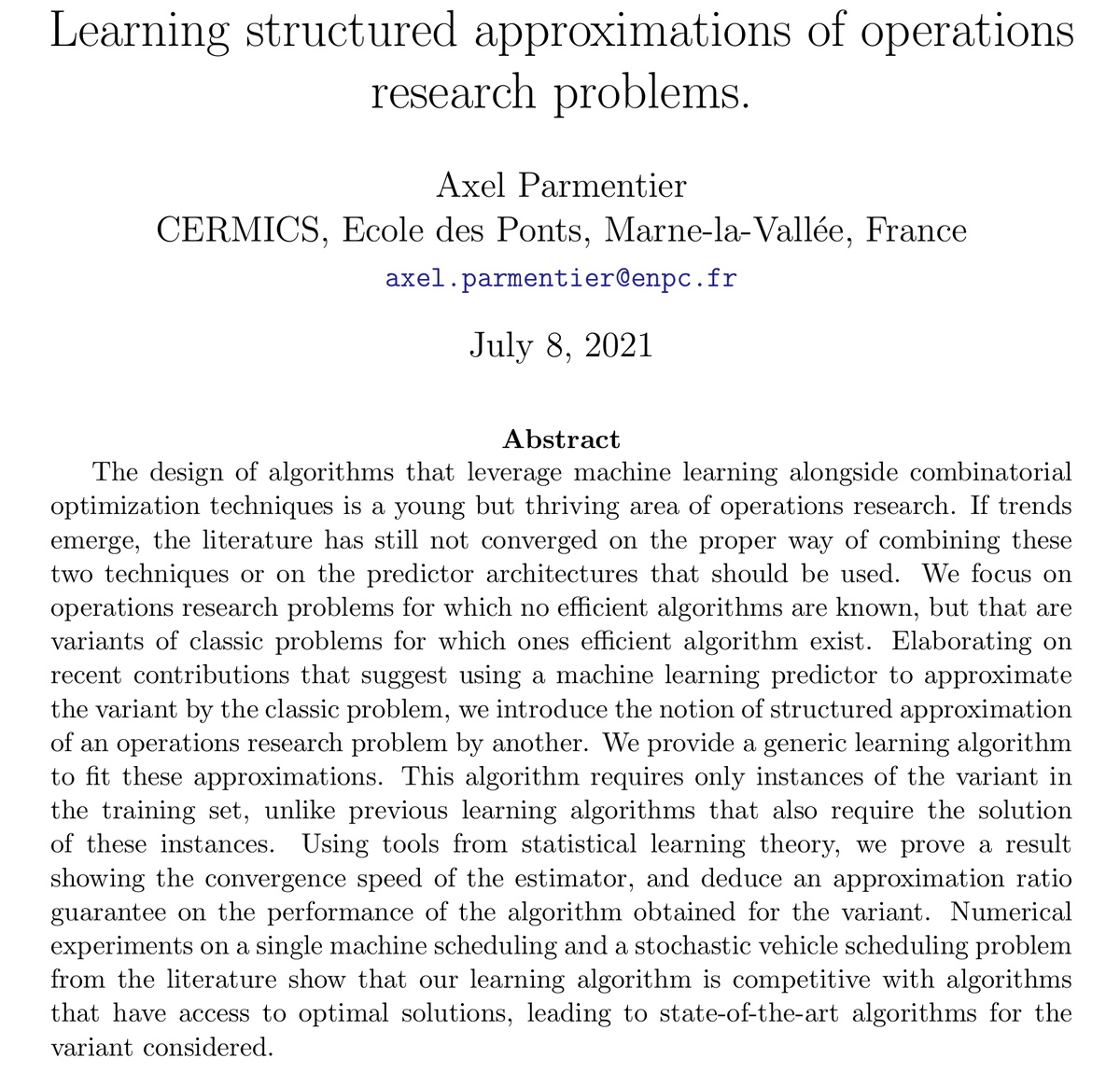
Detailed numerical experiments show the practical efficiency of the algorithm on the stochastic vehicle scheduling problem and a single machine scheduling problem. The code will be made accessible at the end of the review process. Comments welcome. (5/5)
And they come with theoretical guarantees. We prove an approximation ratio guarantee, making a link between our "ML for OR" algorithm and approximation algorithms. The proof relies on statistical learning theory. (4/5)
The DAAO (Data, Machine Learning, and Optimization) group of the GDR RO is pleased to announce the online tutorial of Thibaut Vidal on combinatorial optimization and interpretable machine learning on June 21, 2021 from 2 pm to 5 pm (CET). https://t.co/5tfNfdRzzK
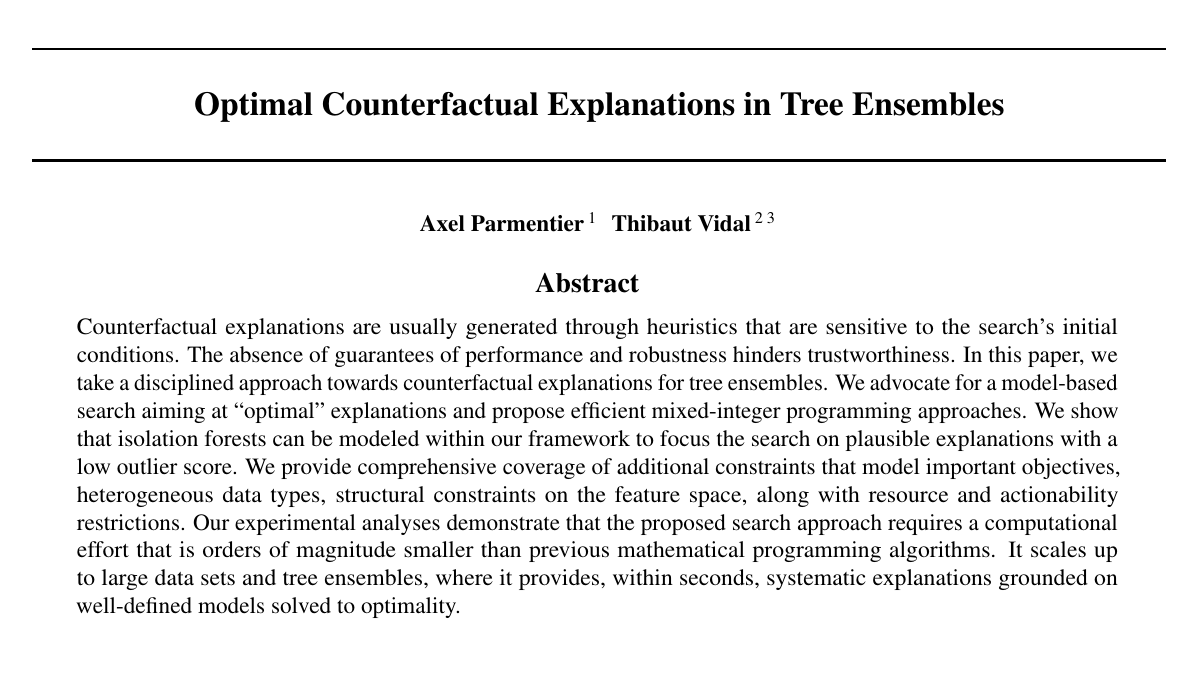
Check our recent #ICML2021 paper titled "Optimal counterfactual explanations in tree ensembles" at https://t.co/6ZFxhSmR32
We argue that *optimal* counterfactual explanations are fundamental for transparency and trustworthiness in #MachineLearning... (1/6)