It’s with great pleasure that @DreherAxel, @matzatecon, @LanglotzSarah and I announce the publication of two new datasets detailing the universe of U.S. refugee resettlements between 1975 and 2018 (see: https://t.co/dUYe6XDOtu)
What happens when a city relaxes its zoning rules? A new e61 working paper released earlier this week answers this question using a natural experiment in the Adelaide council of Campbelltown. In this week’s plus61, authors Matthew Maltman (@1finaleffort) and Theo Gibbons (@geothibbons) explain why the reforms had such a large effect and what that means for housing policy.
https://t.co/tUidoihDzS
Annual migration flows for 230 countries from 1990 to today.
This new dataset is the first consistent year-by-year map of how humanity moves.
In 2005, Germany counted 160,000 people arriving from Poland. Poland counted 12,300 leaving for Germany. Same people, same year, the same stretch of border, and a thirteen-fold gap between two official tallies.
That gap is the everyday reality of migration data, and it explains why we know so little about how people actually move. Countries count arrivals and departures differently, or don't count them at all. The numbers we do have come mostly from Western nations and arrive as five or ten-year snapshots from the UN, long after the fact. When a war or a climate shock sends people moving in a single year, the data simply can't see it.
A new study in Nature rebuilds the whole picture. Thomas Gaskin and Guy Abel have produced annual migration flows between 230 countries and regions, every year from 1990 to today, with confidence bounds on every figure. It's the first time anyone has had a consistent year-by-year account of global movement at this coverage.
The trick is to stop trusting any single source and let a model weigh them against each other. They trained a set of neural networks with a memory of past years, the kind that learn how last year's conditions shape this year's decisions, and fed them everything available: UN migrant stocks, harmonised European flow records, national statistics from countries that count well, and Facebook's own data on where its users moved between 2019 and 2022. On top of that sit more than forty background factors (e.g. GDP per capita, life expectancy, conflict deaths, refugee numbers, shared language and religion, trade, even colonial history). The model learns which sources to believe where, and reconciles contradictions like that German-Polish one instead of picking a side.
The result reproduces 94% of the patterns in its training data and 73% on flows it was never shown, beating the existing five-year estimates on held-out tests while running at annual resolution. More importantly, it surfaces movements the old snapshots blurred away. Global migration roughly tripled, from about 13 million people a year in 2000 to around 35 million by 2023, with per-capita movement climbing from 0.2% to 0.45% of the world's population. The single biggest corridor is Bangladesh to Saudi Arabia, near 300,000 people a year since 2010, part of 19 million who have moved from South Asia to the Gulf states in that time. Run the model across the past and it catches the spikes too, like the roughly 950,000 people who fled Rwanda for the Democratic Republic of Congo in 1994.
What makes this more than a better spreadsheet is the honesty about doubt. Every flow comes with a margin, so the map shows both where people moved and where we're only guessing, and the widest margins fall exactly on the poorest and least-counted regions.
link to full article: https://t.co/zqScLVMXPH
We (me, @Jeff_Weaver_, @anahitark) are looking to hire a Gujarati-speaking field intern (paid) and RA to help with lab-in-the-field work on barriers to trade in rural Gujarat. Full details in the link, and feel free to help us by RTing! https://t.co/57U4lTIXV9
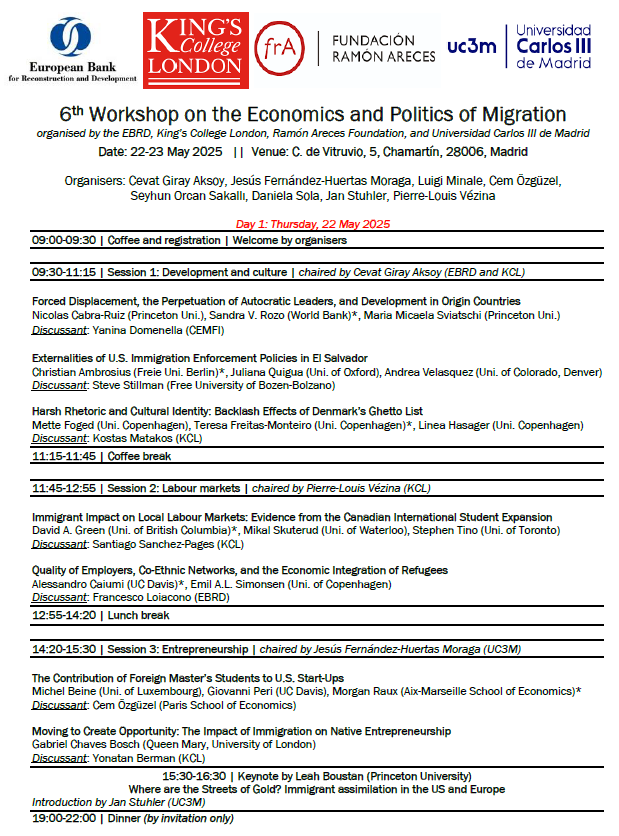
We’re excited to share the program for the 6th Workshop on the Economics & Politics of Migration, taking place on 22–23 May 2025 in Madrid.
From 162 submissions, 13 papers were selected —alongside keynotes by Leah Boustan and Dean Yang.
Many thanks for the incredible interest!
I'm organizing a two-day summer school on networks (10-11 September) at Monash University where Matt Jackson (@JacksonmMatt ), Sanjeev Goyal, and myself will teach a 12 hours course. It is free and anybody interested can apply here: https://t.co/n1Mn23GWZX
📣Now hiring: Predoc in Economics and Data Science
@ellliottt Ash and I are hiring a predoc -- work @ETH_en Zurich on exciting projects in applied econ (education, political econ etc.), using AI, NLP, and causal inference. Apply here: https://t.co/8A4Dum4uIw
@econ_ra
Do you like (thinking about) TARIFFS? 🙋🏽♀️
Do you really love working with DATA? 💻
Are CHARTS something near and dear to your heart? 📈
@PIIE is HIRING a new Research Analyst for International Trade. Come and work for/with me.
APPLY now. Here's how 👉🏻
https://t.co/xbtjpJUgCI
📣Call for papers📣
Join us for the 6th Workshop on the Economics and Politics of Migration, co-organized by @EBRD@KingsCollegeLon@FundacionAreces@uc3m, happening 22-23 May 2025 in Madrid 🙌
Keynote speakers @leah_boustan and @deanyang 👏
We look forward to your submissions!
Call for Papers
ADEA-QUT Development Economics Conference
10-11 February 2025, Queensland University of Technology, Brisbane, Australia
For details, visit: https://t.co/OOhVE2LwTQ
Submissions close Friday, 15 November 2024.
APPLY NOW FOR POSTDOC: We invite applications for the 4th postdoc cohort of the Stephan Klasen Fellowship that honors Stephan's commitment to support young researchers from the Global South. More at https://t.co/y7oprz1uOe @wiwiunigoe @uniGoettingen@glad_1723#KlasenFellowship
As part of a key expansion to enhance its vibrant research, education, and knowledge exchange, the University of Southampton's Department of Economics is advertising up to 10 positions at the Lecturer, Associate Professor, and Professor levels. @UoS_Economics@unisouthampton
@libdemdaisy Amazing Daisy, fantastic, you've been an absolute star throughout the campaign. Stupendous, massive congratulations and the very best for the coming weeks and months. Just sorry I haven't been able to get in contact with you before now to send on my best wishes.
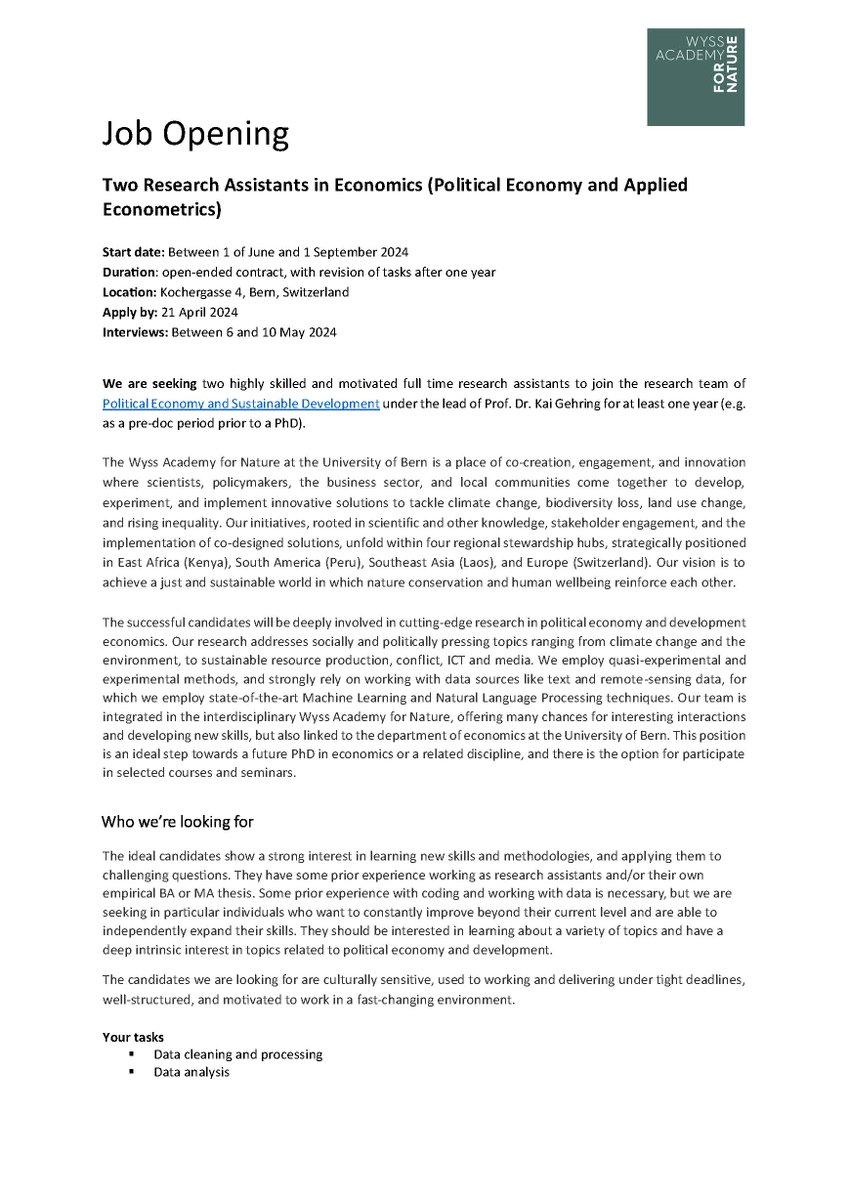
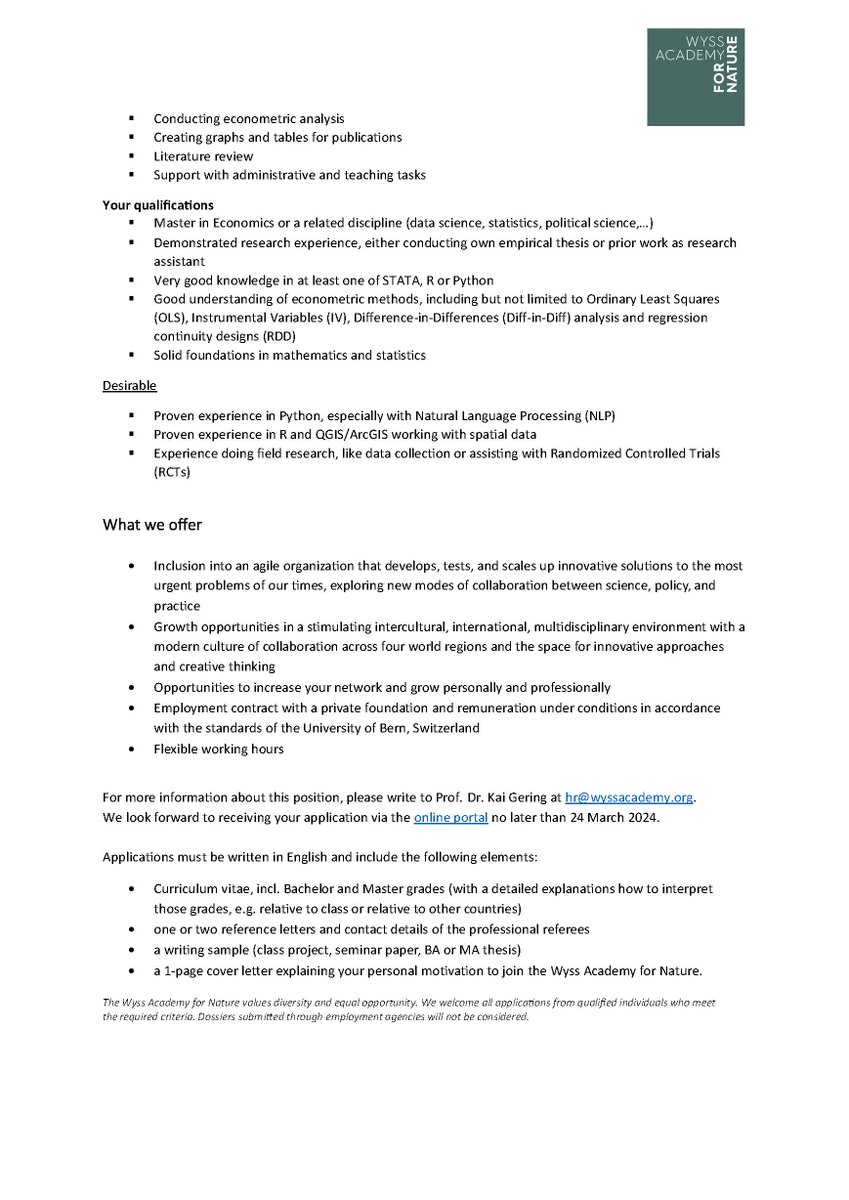
We are hiring two full time research assistants (e.g. as a Predoc before a Phd) to work with us on exciting projects at the intersection of political economy and development economics.
Short thread with more details and tipps to apply 1/n
https://t.co/xhMbhAlqbr
Call for papers: CEMIR Junior Economist Workshop on Migration Research, 22 – 23 October 2024 in Munich.
For advanced Ph.D. students, postdocs and assistant
professors in economics.
Deadline 14 June.
https://t.co/8Ehpa4jdOV
JOB ALERT
Additional Lecturer/Assistant Professor Position in Economics at the @UofGAsbs More info here:
https://t.co/PACzrRzOyK Deadline 28 April 2024. Please share widely, thank you very much!
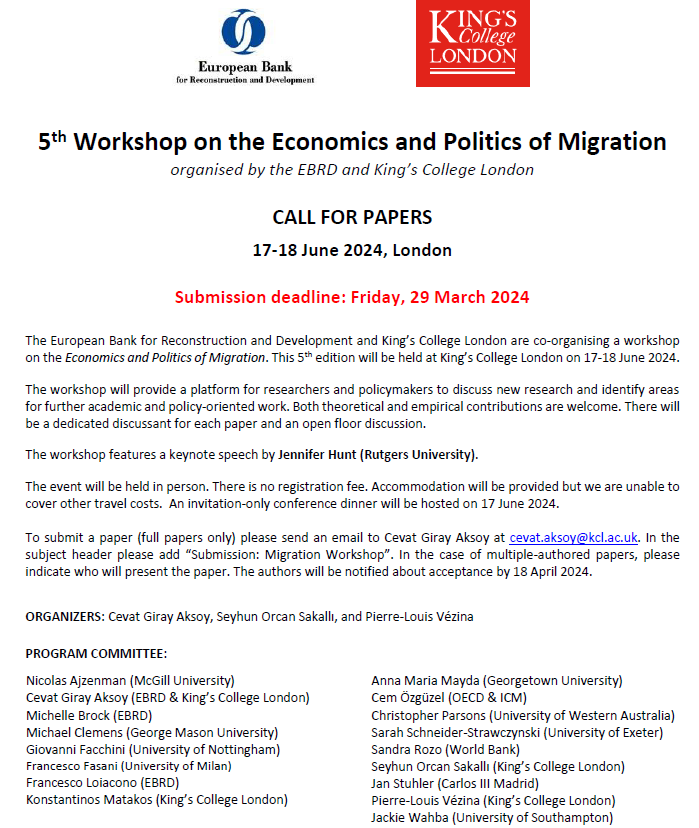
📢Call for papers!
We are organising the 5th 𝗪𝗼𝗿𝗸𝘀𝗵𝗼𝗽 𝗼𝗻 𝘁𝗵𝗲 𝗘𝗰𝗼𝗻𝗼𝗺𝗶𝗰𝘀 𝗮𝗻𝗱 𝗣𝗼𝗹𝗶𝘁𝗶𝗰𝘀 𝗼𝗳 𝗠𝗶𝗴𝗿𝗮𝘁𝗶𝗼𝗻 on 17-18 June 2024, London | https://t.co/ucZvZ0wewC
Submit your papers before Friday, 29 March 2024