@JesusFerna7026@JesusFerna7026 thank you for all your efforts and given the dataset have you been able to isolate the role of any specific factors (micro plastics, water, feminism, two income households, social media etc). Keep up the great work!
Some may feel I’m dwelling on this, but I am concerned for the health of the UK economy.
The yield on the 10-year gilt has climbed 12 basis points today (see the CNBC chart below), decoupling from both oil prices and yields in other advanced economies—both of which are currently lower.
Meanwhile, the 30-year yield has just hit a 28-year high.
#economy #markets #gilts #uk
Look at what the bond market just said about Britain.
30-year: 5.73%.
20-year: 5.67%.
10-year: 5.06%.
Every single one screaming.
The bond market does not bluff. It does not vote. It does not protest.
It prices the truth.
And it has just told you Britain is uninvestable at the rates you are being offered.
Higher yields are not a reward. They are danger pay.
At noon today Andrew Bailey will speak. He will tell you everything is fine.
The bond market has already called him a liar.
You are watching the slow motion bankruptcy of Britain.
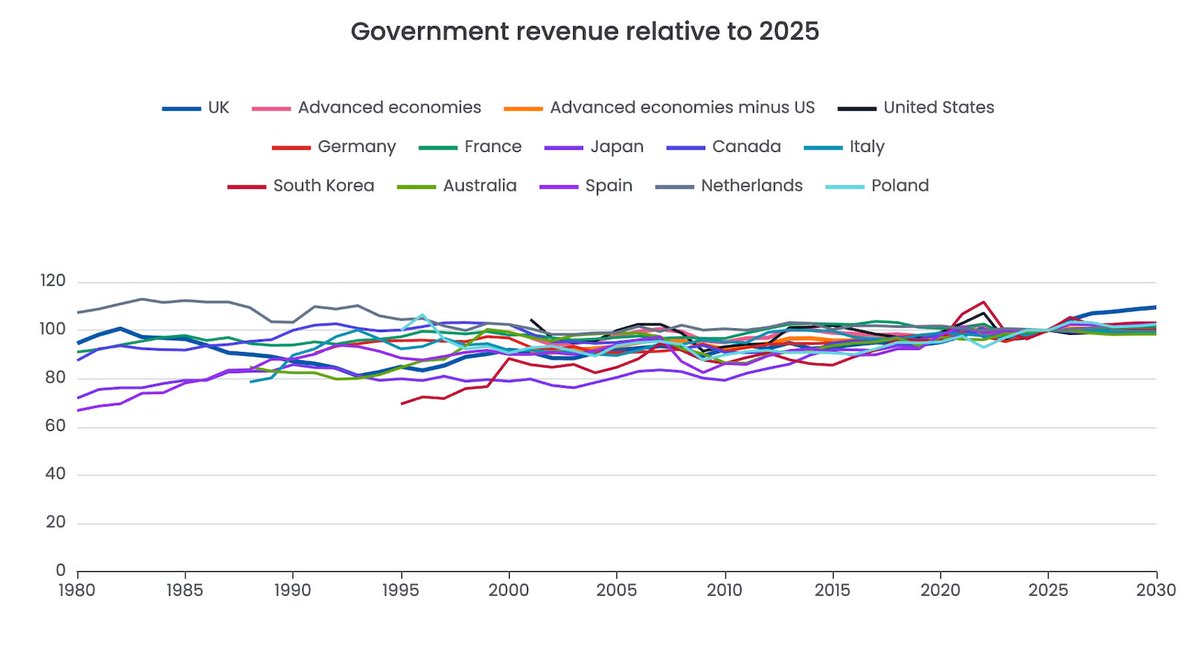
UK tax is going to be the highest since 1945. But public spending won't increase; in fact most of us will experience a decline in public services.
Here's why - in a thread that I'd love to be completely wrong.
Here is my new paper for the Great British Business Council on the importance of oil, gas and coal to the UK economy.
The UK’s industrial decline is not inevitable, but the result of decades of deliberate policy choices that have undermined domestic energy production and driven manufacturing offshore. Lowering UK employment and tax revenues, while increasing the UK trade deficit.
The paper also includes a plan to reverse this.
https://t.co/18R7heb7d7
🏴🇬🇧 Before 1830, nobody had a lawn.
The rich had their grass cut by scythemen. Ordinary people had no garden worth speaking of.
Edwin Budding was an engineer in Stroud, Gloucestershire. Working in a textile mill, he noticed a machine using a cutting cylinder to trim the surface of cloth.
He looked at it.
And thought about grass.
He built a machine with a cutting cylinder mounted on a wheeled frame. Then pushed it across his garden at midnight. At midnight. So the neighbours wouldn't see.
It worked.
He patented it in August 1830.
Within twenty years the Victorian suburb was born. The striped lawn. The neat garden. The Sunday morning ritual.
Every suburban garden in America. Every cricket ground. Every football pitch. Every golf course on earth.
Traces back to one man. In Stroud. With a cloth machine. At midnight.
Right now, somewhere in the world, someone is cutting their grass. And they have no idea who Edwin Budding was.
Help us share more of our history:
https://t.co/rih7iKwnvf
Be Part Of Us.
Be Proud Of Us. 🇬🇧
India ran the most important cardiovascular study of the 20th century by accident, and then immediately forgot about it.
In 1967, Dr. S.L. Malhotra published a study in the British Heart Journal examining heart disease rates among 1.5 million Indian railway employees. The population was extraordinarily useful for research purposes: same employer, same healthcare access, comparable income and working conditions, spread across the entire country.
The only meaningful variable was geography. Which meant diet.
North Indian railway workers: Punjab, Rajasthan, UP, ate a diet built around ghee and dairy fat. They consumed up to 19 times more fat than their southern counterparts. The fat was primarily saturated: clarified butter, milk fat, the short-chain saturated fatty acids that Ancel Keys had recently been telling the Western world were arterial death.
South Indian railway workers ate a diet based on rice, sambar, and seed oils: groundnut oil and sesame oil, primarily. They ate considerably less fat overall. By the standards of dietary advice being formulated in the 1960s, they should have been the healthy ones.
Heart disease mortality in South India: 135 per 100,000.
Heart disease mortality in North India: 20 per 100,000.
Seven times higher in the population eating seed oils.
Among railway sweepers specifically, the lowest-paid, most physically active workers, the gap was even wider. Heart disease was fifteen times more common in the South Indian sweeper population than in the North Indian sweeper population.
Malhotra controlled for everything he could reach: smoking, where Northerners actually smoked more. Activity levels, where the relationship was inconsistent. Socioeconomic status, where executives died more often than sweepers regardless of region. He found no variable that explained the gap except the type of fat in the diet.
He published the data. In a peer-reviewed journal. In 1967.
The study was cited periodically, acknowledged as methodologically interesting, and then set aside.
The decade in which Malhotra published was the decade in which Ancel Keys's fat hypothesis was being converted into policy. The American Heart Association was issuing guidance recommending polyunsaturated vegetable oils as replacements for saturated animal fats. The food industry was producing seed oils at industrial scale. The infrastructure of seed oil promotion was being built, expensively and with great institutional momentum.
A study showing that populations eating animal fat had a fraction of the heart disease of populations eating seed oils was not, in that context, a study that anyone particularly wanted to follow up.
Nobody followed up.
Almost sixty years later, the finding stands unrefuted in the literature.
It is not in the dietary guidelines.
🏴🇬🇧 In the second half of the eighteenth century, something happened in Scotland.
A country of one and a half million people.
Produced ideas that changed the entire world.
In one generation.
Adam Smith. He wrote The Wealth of Nations in 1776. He invented economics.
David Hume. He asked the question nobody had dared ask. How do we actually know anything? His answer changed philosophy forever.
James Watt. Walking across Glasgow Green, the idea came to him. A separate condenser. It made the steam engine practical. And started the Industrial Revolution.
Joseph Black. He discovered latent heat. The principle that made refrigeration, steam power and thermodynamics possible.
James Hutton. He looked at the rocks at Siccar Point. And understood the earth was unimaginably old. He invented geology.
These men knew each other. They argued in the same taverns. Walked the same streets.
In one generation, one small country invented economics, philosophy, geology, thermodynamics and the steam engine.
The modern world runs on what they built. 🇬🇧
This is your history.
Help us keep it alive. 👇
Be Part Of Us 👉 https://t.co/rih7iKwnvf 🙏
Be Proud Of Us. 🇬🇧
@MerrynSW I remember being invited on a certain podcast/panel by @MerrynSW and saying in real terms property may drop 70-80% from peak to trough, but much would be disguised by inflation (money illusion)
@John_Stepek Average long term real interest rate is circa 2.96%, rates have been far too low for far too long leading to mispricing of risk and inefficient allocation. We actually need rates to slowly rise to their true rate and for Government to simplify taxes and cut spending (unlikely)!
"The 6th biggest economy in the world is run by infantile fantasists with no understanding of financial markets.... There's nothing progressive about driving the economy of a cliff"📉⛰️
@LiamHalligan @ #BattleFest 2025 "From steel to railways: can the state revitalise British industry?"👨🏭🚆
👇
@danielmgmoylan@RoryStewartUK Have the peers appointed according to proportional representation achieved at the General Election and half the house as independent experts according to census of occupations (200 of each)
BREAKING: The Great American Debt Trap Has Snapped Shut
Total U.S. consumer credit just hit $5.08 TRILLION.
That is not a typo.
In October alone, Americans borrowed another $9.2 billion. Exposed. Desperate. Drowning.
Here is the number that should terrify every central banker on Earth:
Credit card debt stands at $1.32 trillion, with average interest rates at 22.8%.
The Federal Reserve has slashed rates by 150 basis points since September 2024.
Credit card rates have not moved.
Read that again.
The transmission mechanism is broken. The Fed is cutting. Banks are not passing it through. American households are trapped paying depression era rates on recession era wages to finance inflation era prices.
Since 2020, consumer credit has exploded by nearly $1 trillion. Not for luxuries. For survival. For groceries. For gas. For the gap between what wages pay and what life costs.
This is not consumer confidence. This is consumer capitulation.
The mathematics are merciless: At 22.8% APR, debt doubles in 38 months. The average American carrying a balance is not building wealth. They are feeding a compounding machine designed to extract every dollar they will ever earn.
What comes next:
When credit tightens, and it will, there is no buffer. No savings. No slack. Just $5 trillion in obligations meeting a workforce one missed paycheck from default.
What to watch:
Q4 delinquency data. If serious delinquencies breach 3%, the unraveling begins.
How to survive:
Pay down revolving debt before anything else. 22.8% guaranteed loss beats any guaranteed gain.
The Fed cannot save you from this.
Only arithmetic can.
And the arithmetic says: America is borrowing from tomorrow to pay for yesterday.
Tomorrow always arrives.
The stock market may only represent a small element of London's global financial centre status, but having slipped below Oman in terms of IPO activity we might want to have a think about actually doing something to arrest the decline. https://t.co/jKEyGXWu2B
Every second a Labour MP spends campaigning for a wealth tax is a second that could be spent campaigning for real tax reform that could make the tax system fairer, boost economic growth and (unlike the wealth tax) actually happen.
A thread:
My monologue on the risk of a sovereign debt crisis from The Times at One with Andrew Neil today on @TimesRadio. More tomorrow!
The French government fell yesterday because the National Assembly rejected its plan to shave £38bn off next year’s government budget. Chicken feed in annual French state spending of £1.5 trillion — an incredible 57% of GDP.
Spending would still have risen, tho by less than in recent years. But that was enough to produce a massive majority against it.
France could now stagger through this year and into next without a budget and with annual fiscal deficits stuck at 6% of GDP and national debt at 115% of GDP and rising. The bond markets, where governments go to borrow, look on askance and will certainly demand a bigger risk premium to lend given a fiscal crisis has now become a political crisis.
Britain’s fiscal position is not quite as dire — but only just. The bond markets have their eye on us too. Which is why the government is planning a second Budget of substantial tax rises to give the impression it is on top of debt and deficit. But we’re already paying more to borrow than we did even during the infamous ClusterTruss interregnum three years ago.
In both France and Britain the politicians have decided it’s just too difficult to rein in public spending. And since borrowing is becoming more expensive that only leaves tax rises to balance the books. Or, more accurately, stay within even the mildest of fiscal constraints.
Almost every major developed economy has a debt and deficit problem, nowhere more so than America, which this year will run another $2tn deficit — 6% of GDP — taking its accumulated gross national debt to over $37tn — 10 times the size of the UK economy and 123% of US GDP.
Only America’s ability to borrow in dollars — most global investors need dollar assets in their portfolios — staves off a fiscal crisis across the pond.
But Washington, on the left and right, has given up the ghost when it comes to fiscal prudence. So even the dollar might not protect America forever, especially since 6% annual deficits are projected for as far as the eye can see.
Italy and Greece, proportionately, leave America in the dust. Italy’s national debt is now 138% of GDP, Greece’s 146%. Only the might of the ECB — and behind it the strength of the German Bundesbank — make such eye-watering figures manageable.
But when it comes to national debt, Japan is in a league of its own — 235% of GDP, it’s only saving grace is that it’s financed largely by thrifty Japanese savers rather than here-today-gone-tomorrow foreign investors, unlike, say the UK or France or America.
So the world is awash in sovereign debt, the accumulation of massive borrowings made during the Great Financial Crash, the pandemic and in the aftermath of Russia’s invasion of Ukraine — and stubbornly resistant to reduction because of politicians who lack the guts or acumen to cut it and who still come up with madcap schemes to spend even more.
For the moment there is no sign of the bond markets going on strike. But they are charging more and sovereign debt has become a nice little earner, producing returns of 5% or more.
The rest of us, as taxpayers, are picking up the tab in interest charges. This year the Labour government will borrow another £150bn. But £110bn of that will go on paying the interest on previous borrowings — far more than we will spend on schools, defence or police.
Politicians have long talked about borrowing to invest. Now they borrow to service the interest on money they’ve previously borrowed.
Of course this cannot go on indefinitely. But exactly how and when it ends remains unclear. My sense is that it will be as a character in an F Scott Fitzgerald novel described going bankrupt — at first slowly and then suddenly.
Don’t say you haven’t been warned.
One of the biggest causes of error and mistake in the public sector is the firmly rooted belief that the process is more important than the results.
Case in point: