On June 6, 1944, the Western Allies launched Operation Overlord, the long-awaited invasion of Nazi-occupied France. The assault began with Operation Neptune, the amphibious phase of D-Day, and remains the largest seaborne invasion in history. Nearly 160,000 American, British, Canadian, and Allied troops crossed the English Channel under the protection of thousands of ships and aircraft.
The invasion force included about 5,000 landing and assault craft, supported by 289 escort vessels and 277 minesweepers clearing safe routes through German defenses. Before dawn, airborne troops parachuted behind enemy lines to secure key bridges, roads, and strategic positions. At first light, soldiers stormed five designated beaches: Utah, Omaha, Gold, Juno, and Sword.
The fighting was especially fierce at Omaha Beach, where American troops faced heavy German resistance and suffered significant casualties. Despite obstacles, strong defenses, and rough conditions, Allied forces established beachheads along the Normandy coast. By the end of D-Day, all five beaches were secured, and troops were pushing inland. The success of June 6, 1944, marked a turning point in World War II and opened the path to the liberation of Western Europe from Nazi control.
On June 5, 1989, one day after the Chinese government violently suppressed pro-democracy demonstrations in Beijing, an unidentified man stepped into the path of a column of tanks near Tiananmen Square. Carrying shopping bags and dressed in ordinary clothes, he stood alone as the tanks attempted to continue their advance.
The lead tank tried to maneuver around him, but the man repeatedly moved to block its path. For more than half an hour, he brought the armored column to a standstill, creating one of the most powerful images of peaceful resistance in modern history. At one point, he even climbed onto the lead tank and appeared to speak with the crew inside before returning to the street.
The man's identity and fate remain unknown, earning him the nickname "Tank Man." Photographs and video of the confrontation were captured by international journalists and quickly spread around the world. More than three decades later, Tank Man remains a lasting symbol of courage, defiance, and the power of an individual standing against overwhelming force.
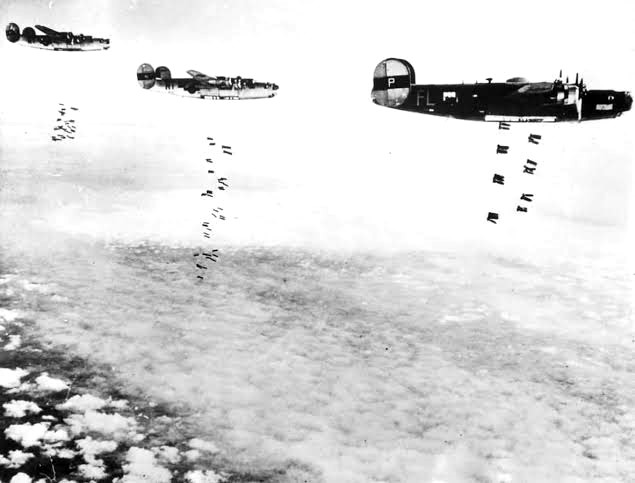
On the night of June 5–6, 1944, as the Allied invasion of Normandy drew near, the British Royal Air Force launched one of the largest bombing operations of World War II. More than 1,000 British bombers crossed the English Channel and dropped approximately 5,000 tons of bombs on German coastal defenses, artillery positions, and gun batteries along the Normandy coast.
The massive air raid was designed to weaken German strongpoints before Allied troops stormed the beaches on D-Day. The bombardment targeted defenses overlooking key landing zones, hoping to destroy artillery that could devastate the invasion fleet and landing forces. The operation involved hundreds of aircraft flying through darkness, navigating carefully to avoid Allied ships and troops gathering below.
While not all targets were destroyed, the bombing disrupted German communications, damaged fortifications, and added to the confusion among defenders. Combined with naval bombardment and airborne assaults, it helped pave the way for the largest amphibious invasion in history.
On June 4, 1942, one of the most important battles of World War II began in the Pacific Ocean: the Battle of Midway. Just six months after the attack on Pearl Harbor, Japanese forces under Admiral Chūichi Nagumo launched a major air strike against Midway Atoll, hoping to lure the U.S. Navy into a decisive battle and eliminate America's remaining aircraft carriers.
What Japan didn't know was that U.S. codebreakers had successfully deciphered key Japanese naval communications. This gave American commanders advance warning of the attack and allowed them to position their carriers for an ambush.
As Japanese aircraft struck Midway Island, American planes launched counterattacks against the Japanese fleet. In a dramatic turning point, U.S. dive bombers caught several Japanese carriers while their decks were crowded with fueled and armed aircraft. Within minutes, three carriers were set ablaze, and a fourth was destroyed later that day.
The Battle of Midway lasted four days and ended in a decisive American victory. Japan lost four aircraft carriers, hundreds of planes, and many experienced pilots. The defeat halted Japanese expansion in the Pacific and shifted the momentum of the war to the United States. Historians often regard Midway as the turning point of the Pacific War, proving how intelligence, timing, and courage could change the course of history.
On June 3, 1864, during the American Civil War, Union forces led by Ulysses S. Grant launched a massive assault against Confederate defenses commanded by Robert E. Lee at the Battle of Cold Harbor in Virginia. The Confederate troops had spent days building strong trenches and fortifications, giving them a major advantage. When Union soldiers advanced across open ground, they were met with devastating rifle and artillery fire.
In less than an hour, thousands of Union soldiers were killed, wounded, or missing, making it one of the war's bloodiest and most one-sided battles. Many soldiers reportedly pinned their names to their uniforms before the attack, fearing they would not survive. Grant later admitted that ordering the assault was one of the greatest regrets of his military career.
Although Lee won a tactical victory at Cold Harbor, Grant refused to retreat. Instead, he continued his campaign against Richmond and eventually moved south toward Petersburg, keeping pressure on the Confederate Army. The battle remains a powerful example of the deadly consequences of attacking well-entrenched defenses during the Civil War.