Silicon Valley's real origin story isn't garage geniuses. It's Cold War money, a $538 loan, a scribbled sketch of the first microchip, and the women history left out.
Buy FROM SEED TO SILICON VALLEY on @Gumroad https://t.co/MipaSW1MlJ
This book Creating Compelling Content helps creators understand what actually makes content worth someone’s attention.
If you create content—or want to—this book is for you.
Buy CREATING COMPELLING CONTENT on @Gumroad https://t.co/IQ1Mq11VYn
Silicon Valley was once famous for fruit—not technology.
Long before Apple, Google, Intel, Facebook and Tesla, the place we now associate with some of the most powerful technology companies on Earth looked remarkably ordinary.
It was an agricultural valley.
Orchards stretched across the landscape. Farmers cultivated fruit. Canneries processed the harvest. The economy was built around agriculture, and there was little reason to imagine that this quiet corner of California would one day become the centre of the digital revolution.
So what happened?
How did an agricultural valley become home to an extraordinary concentration of engineers, scientists, entrepreneurs, investors and technology companies?
The answer did not begin with a garage.
It began with a university, a visionary professor, government research, ambitious engineers, a transistor, a culture willing to take risks—and a series of decisions that gradually changed what the Valley could become.
Then came the breakthroughs. The companies. The money. The immigrants. The failures. The garage stories. The extraordinary successes.
And eventually, a place that once grew fruit began producing something that would change the world.
The author tells the full story in From Seed to Silicon Valley: The Untold Human History Behind the Digital Revolution.
"Read the book on Selar" (https://t.co/49oVY0MxKU)
THE HUMANS BEHIND ARTIFICIAL INTELLIGENCE
Artificial intelligence can look almost entirely automated. You enter a prompt, a system processes it, and an answer appears within seconds. But behind many of these systems is a layer of human work that users rarely see.
AI models depend on enormous quantities of data. Before that data can be used effectively, people may need to collect, organise, classify, label, review, and assess it. Human feedback is also used to evaluate model responses and identify errors, helping developers improve how AI systems perform.
Some of this work is distributed across global labour markets. Workers can perform tasks such as data labelling, content moderation, transcription, and evaluation, often as part of supply chains that remain largely invisible to the people using the finished technology.
The conditions surrounding this work have also attracted scrutiny. Research and investigations have documented cases involving low pay, limited worker protections, and exposure to disturbing material among some workers involved in AI-related tasks. These cases do not describe every AI worker or every company, but they reveal an important part of the infrastructure behind modern AI.
This changes how we should think about artificial intelligence. The systems may be automated, but the process that makes them useful still depends heavily on human judgement, labour, and oversight.
As AI becomes more capable, the question is therefore not only how intelligent machines can become.
It is also how much human work remains behind the machines—and who performs it.
Understanding the World. This is MUNDIVO.
SOURCES:
International Labour Organization — The hidden human labour behind AI
OECD — OECD Framework for the Classification of AI Systems
https://t.co/iPobdmYJWq — AI incidents and documented labour concerns
UNESCO — Recommendation on the Ethics of Artificial Intelligence
"If he now wants to debate, inviting me as a presidential candidate, he has to go and become a presidential candidate first."
- Peter Obi replied to Minister of Works, Dave Umahi's debate challenge.
This is the moment that made many people laugh and shed tears during Mr Peter Obi’s interview with Chude. I never knew Peter Obi is this comic. Let’s be honest here on X, did you really laugh when you watched the video? Type your answer at the comment section
Video📹; Peter Obi is just too calm….For once I must agree with that statement!
To think he never mentioned the airport….
To think he doesn’t even have a police driver in this same abuja …
To think this is not an isolated case….lol
The anger In me right now💔
Omor if we’re allowed to say all what we see and experience while traveling with his excellency peter obi media might just scatter but he’ll never allow…!
These people are bent on seeing him break!
@fkeyamo and Co keep pushing please you just might see that thing you’re eagerly looking for.
As a member of the team that accompanied His Excellency @PeterObi to the Abuja airport on Saturday, July 4, I can state categorically that he does not have a police officer as his driver in Abuja. Therefore, if airport CCTV captured a police officer entering the driver’s seat of a vehicle, that vehicle could not have been Mr. Obi’s.
It is also important to note that Mr. Obi travels through as many as ten Nigerian airports every week. Over time, there have been several acts of hostility directed at him and members of his team by airport personnel across different locations.
Based on the account shared by the Honorable Minister, it is clear that the incident Mr. Obi referenced during his interview with @Chude did not occur on the date or at the airport cited by the Minister. They are plainly two different incidents.
"Some men change their party for the sake of their principles; others change their principles for the sake of their party." Winston Churchill
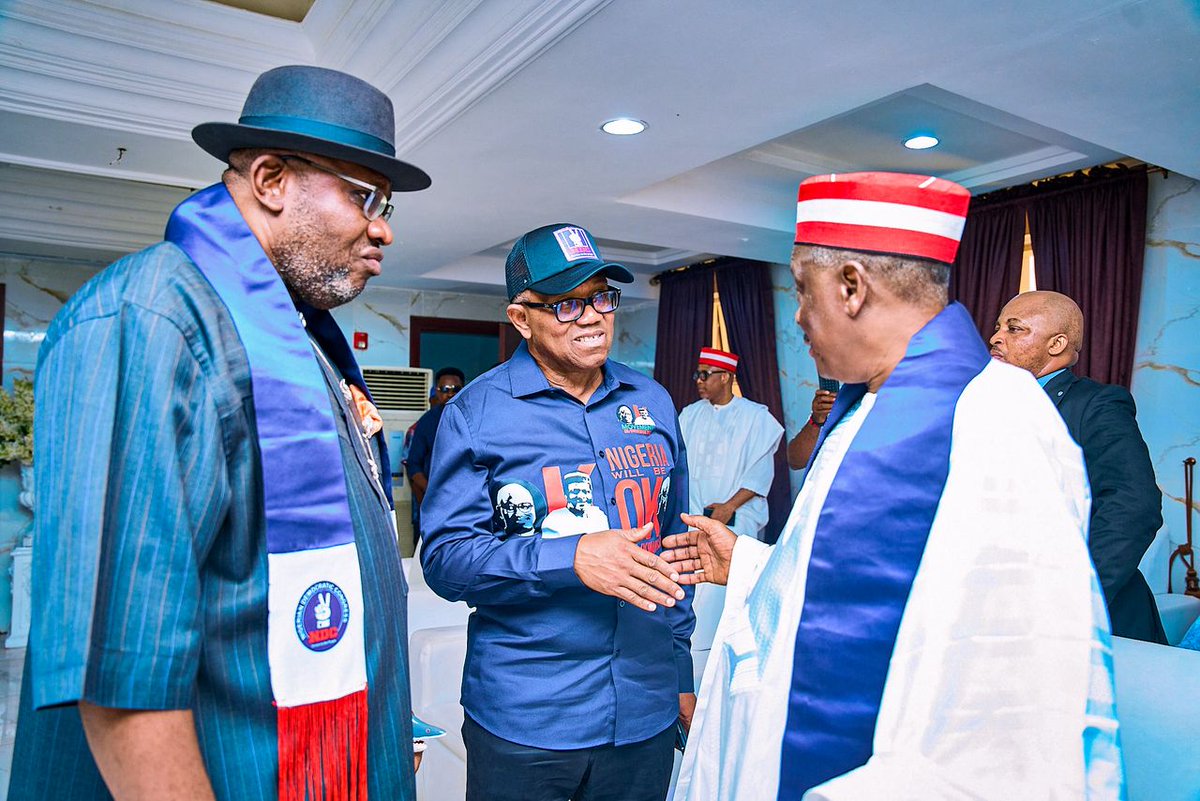
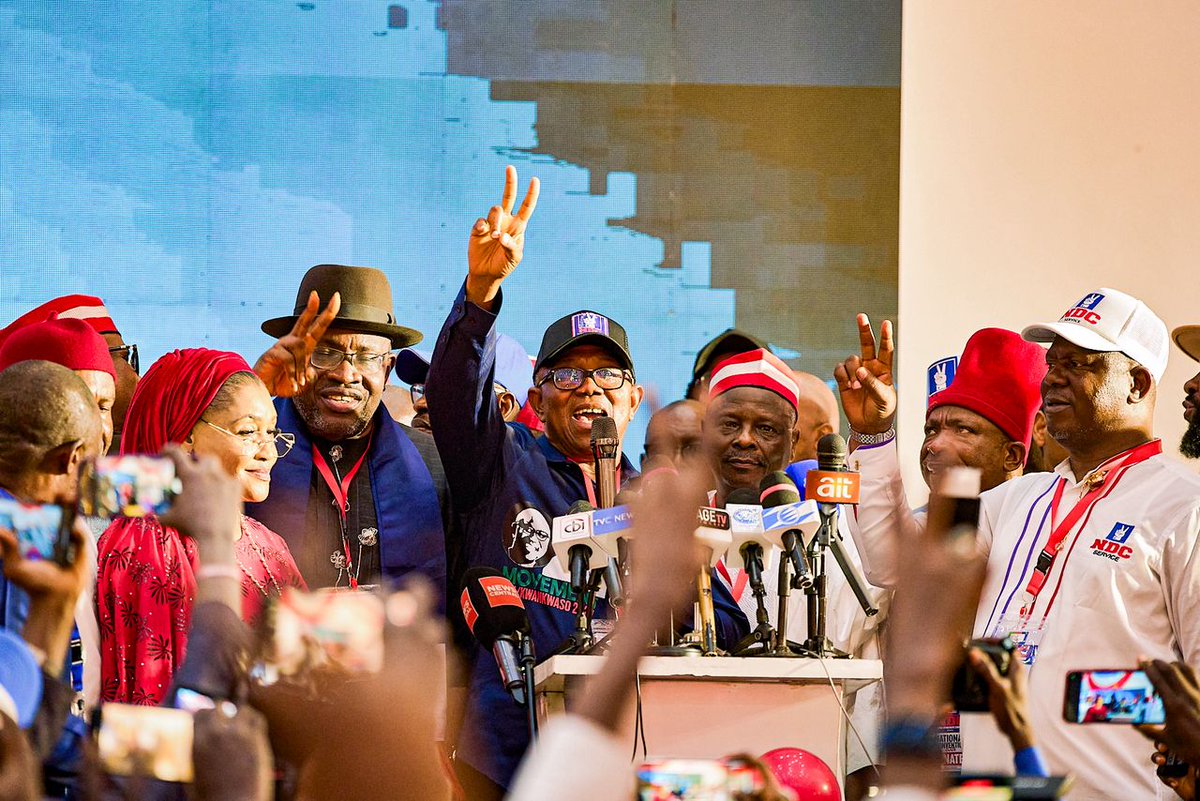
Today, May 9th, I attended the 1st convention of my latest party, the Nigeria Democratic Congress (NDC) in Abuja, Nigeria. The convention was successful and continued to show the resilience of Nigerians to change
I express my sincere appreciation and gratitude to the NDC family, led by the distinguished Senator Henry Seriake Dickson, for inviting us and for the generosity of spirit with which they have accommodated us at this critical moment in our national journey.
I also wish to express profound gratitude to the African Democratic Congress(ADC), particularly Distinguished Senator David Mark, for providing a democratic platform and showing uncommon understanding when the ongoing litigation forced us out of the Labour Party and the New Nigeria People's Party, NNPP respectively. That spirit of solidarity must remain the foundation upon which a better Nigeria will be built.
Today, the most painful aspect of our political existence is that many who once benefited from democratic governance have now become willing accessories to the destruction of democracy itself. Those who once fought for justice now openly celebrate electoral injustice. Those who once spoke against impunity now defend coercion, manipulation, intimidation, and outright political gangsterism, especially against opposition voices. What we are witnessing is not politics; it is a systematic assault on democracy and the will of the people.
Nigeria today stands at a dangerous crossroads. Our democracy is under severe threat. Our nation is drifting without direction, and our people are passing through immense suffering. Across the world, Nigeria is increasingly described as a failing and disgraced nation. This is not the destiny God ordained for our great country. It was not always so, and it must never be allowed to remain so.
Across virtually every recognised indicator of good governance - accountability, political stability, rule of law, control of corruption, government effectiveness, regulatory quality, and the separation of powers - Nigeria continues to record alarming failures. The institutions that should protect the people are weakening daily, while the burden on ordinary citizens grows heavier with each passing moment.
Today, over 140 million Nigerians live in multidimensional poverty. Tens of millions of young people remain unemployed or underemployed. Inflation continues to crush families. Businesses are shutting down. Farmers can no longer safely access their farms. Communities live in fear. In this month alone, hundreds of innocent Nigerians have lost their lives to insecurity, while many others have been kidnapped, displaced, or thrown deeper into poverty.
The most heartbreaking question confronting us is this: Who consoles the grieving mother whose child was abducted on the way to school? Who speaks for the father who can no longer feed his family despite working every day? Who defends the young Nigerian whose dreams have been destroyed by a nation that rewards connections over competence and corruption over character?
Our present tragedy is not accidental. It is the direct consequence of years of deliberate sabotage by a political class that prospers by dividing the people and weakening the nation. Nigeria is not a poor country; rather, we are being looted into poverty. We have abundant human and natural resources, yet we remain trapped in deprivation because leadership has failed to place the common good above personal interest.
Our choice as a people is therefore clear: whether to surrender to despair and national decline, or to summon the courage to rescue our country and rebuild it on the foundations of unity, equity, justice, competence, and productivity.
@PeterObi Dear @PeterObi , I feel the weight of your emotion in this speech. I only pray for strength for you at this time. Though you're not desperate to be president, you're the president Nigeria and Nigerians desperately need.
My advice: Return to Labour Party. Peace is restored there.
Many of us are busy, but not really moving forward. One of the enemy’s subtle strategies is this: He loads your life with problems, just to keep your focus on yourself. Before you know it, all your energy is spent fighting for survival, instead of advancing purpose.
@carpetmanxyx@officialABAT But during the election, the military were seen watching and overlooking the Area Boys hijacking the ballots. Now, the wickedness of this government is touching everyone, including the same military. Now, nobody is safe.