Comment peut-on souhaiter réduire au silence quelqu'un qui fait des vidéos aussi extraordinaires ? La contribution d'Étienne Klein à la diffusion des sciences est remarquable et sa qualité de passeur est très probablement inégalée dans ce pays.
Certes, il y a incontestablement cette histoire de plagiat, mais cela ne mérite pas l'opprobre dont il est l'objet, d'autant plus que celle-ci semble nourrie par des sentiments qui ne sont pas toujours des plus nobles.
Dear Christopher Nolan,
My name is Herod Priovolos and I want to tell you what #TheOdyssey truly means to me and to generations of Greeks who grew up with Homer’s story.
Homer did not sing of Odysseus simply to entertain us with ships, storms, gods and monsters. He told the story because he understood what war, time, distance and loss can do to the human soul.
Odysseus leaves Ithaca as a king, a husband and a father. He returns twenty years later alone, exhausted and disguised as a beggar, carrying the memory of every companion who never made it home.
The monsters are not merely creatures created for spectacle.
The Cyclops is power without justice. The Sirens are the beautiful voices that tempt a person to abandon their purpose. Circe represents the danger of losing our humanity. Calypso offers Odysseus immortality, but even eternal life becomes a prison when the price is forgetting his wife, his son, his homeland and his own identity.
And Ithaca is not merely an island.
Ithaca is the place that remembers you when the world no longer recognizes your face. It is the home that remains alive inside you after everything else has been taken away. It is Penelope growing older while she waits. It is Telemachus becoming a man without his father. It is Argos surviving long enough to recognize his master one final time.
Odysseus is not great simply because he defeats monsters. He is great because he is proud, frightened, wounded, clever, imperfect and deeply human. He loses his companions, his youth, his name and twenty years of his life, yet he refuses to forget who he is.
When he finally returns, Penelope does not recognize him through strength, glory or appearance. She tests him. Odysseus proves his identity by remembering the bed they built together around the roots of a living olive tree.
That is the heart of The Odyssey.
Not the battles. Not the ships. Not the monsters.
Two people standing before each other after twenty years, asking whether love, memory and identity can survive everything time has done to them.
That is why this poem has survived for almost 3,000 years. Every human being is trying to return to something: a home, a person, a lost part of themselves, or the life they had before the world changed them.
So use Homer’s seas, gods, heroes and monsters. But please understand what you are touching.
The Odyssey was never truly about how far a man could travel.
It was about how much the world could take from him before he stopped being himself, and whether, after losing almost everything, he could still find his way home.
Les types qui shortent SpaceX en ce moment ont fait Harvard, Wharton et Stanford. Un demi-million de dollars de scolarité, des CV parfaits, des modèles Excel à 40 onglets. Et une capacité de projection strictement égale à zéro.
Aujourd'hui, Elon leur a répondu en une phrase :
"I said SpaceX will be worth more than Earth if we achieve our goals."
Toute la Ivy League a ricané. Personne n'a posé le calcul. Normal : quinze ans d'études pour apprendre à donner la réponse attendue, pas à imaginer celle qui n'existe pas encore. Je vais donc le faire à leur place. Gratuitement.
Le contexte d'abord. Cinq semaines après la plus grosse IPO de l'histoire, le titre est repassé sous son prix d'introduction. -30% depuis le pic à 2 600 milliards qui avait brièvement dépassé Microsoft et Amazon. Les vendeurs à découvert ont empoché 8,7 milliards et se congratulent sur Bloomberg : les diplômés fêtent leur victoire de six semaines sur un pari de vingt ans. Moi, je rachète vos bags à chaque chute.
Plus que la Terre, donc. Plus que les 600 trillions de dollars de richesse matérielle accumulée par l'humanité depuis Sumer. Point de départ du calcul, toujours le même : Starship divise le coût du kilo en orbite par 100. Et chaque fois dans l'histoire qu'un coût d'infrastructure est divisé par 100, ce n'est pas le marché existant qui grossit, ce sont des industries entières qui naissent. Le calcul divisé par 100 a donné Internet, le smartphone, l'IA. Voici ce que donne l'orbite divisée par 100.
Les 20 boîtes iconiques de 2045. Aucune n'existe encore. Vos enfants les trouveront aussi évidentes qu'Apple ou Amazon.
Dyson Energy, solaire spatial beamé vers la Terre, premier maillon de l'essaim de Dyson : 20 trillions.
Psyche Metals, minage des astéroïdes de classe M — plus de métaux dans un seul caillou que tout ce que l'humanité a extrait depuis le néolithique : 15 trillions.
Ares Terraforming, l'entreprise qui épaissit l'atmosphère de Mars : 10 trillions.
Helios Compute, data centers orbitaux — énergie solaire continue, refroidissement gratuit, zéro permis de construire : 8 trillions.
Selene Fusion, hélium-3 lunaire pour les réacteurs terrestres : 7 trillions.
Atlas Robotics, la main-d'œuvre robotique qui construit tout le reste : 6 trillions.
Crystalline, semi-conducteurs et fibre optique parfaits, impossibles à produire sous gravité : 6 trillions.
Vulcan Shipyards, chantiers navals orbitaux — des vaisseaux assemblés en apesanteur qui ne toucheront jamais un sol : 5 trillions.
New Olympus, immobilier, énergie et infrastructures martiennes : 5 trillions.
SolNet, le réseau laser interplanétaire, l'internet du système solaire : 4 trillions.
Orbital Organs, impression d'organes humains en microgravité — la fin des listes d'attente de greffe : 4 trillions.
Starline, transport point à point, Paris-Tokyo en 40 minutes : 3 trillions.
Ceres Water, extraction de glace et stations-service orbitales : 3 trillions.
Von Braun Resorts, hôtels orbitaux puis lunaires — la croisière de luxe du 21ème siècle : 2 trillions.
Prometheus Shielding, habitats, radioprotection, support de vie : 2 trillions.
Orbital Express, la logistique inter-orbites, le FedEx du vide : 2 trillions.
Kessler Solutions, contrôle du trafic spatial et nettoyage des débris : 1 trillion.
Eden Systems, agriculture en environnement clos, de l'orbite à Mars : 1 trillion.
Astral Assurance, la Lloyd's de l'espace : 1 trillion.
Studio Zéro-G, le premier Hollywood orbital — cinéma et sport en apesanteur : 1 trillion.
Total : 106 trillions de dollars de capitalisation. Le marché paie historiquement 4 à 5 fois le chiffre d'affaires pour de la croissance, donc ces valorisations impliquent un PIB spatial de l'ordre de 20 à 25 trillions par an. L'équivalent d'ajouter les États-Unis à l'économie mondiale. Pas en remplaçant quoi que ce soit : en plus, sur une frontière sans limite physique. Et j'ai certainement raté les trois plus grosses, comme un analyste de 1995 aurait raté Google, Amazon et Netflix. Lui aussi avait fait la Ivy League.
Maintenant la partie que Wall Street refuse de comprendre. SpaceX ne sera en concurrence avec aucune de ces 20 boîtes. SpaceX est leur propriétaire foncier. Chaque kilo lancé, chaque équipage, chaque bit de données passe par son péage. AWS prélève quelques pourcents de l'économie numérique et ça a suffi à pousser Amazon au-dessus des 2 trillions. Prélevez 10% d'un PIB spatial de 25 trillions : 2,5 trillions de revenus annuels de monopole d'infrastructure en hypercroissance. Voilà mes 30 à 50 trillions d'ici 5 ans. Une règle de trois, pas une prophétie.
Prolongez ensuite la courbe de deux décennies, le temps que Dyson Energy passe du white paper au chantier. Les 600 trillions de la Terre sont un stock, accumulé en 10 000 ans. Le Soleil, lui, rayonne en continu 20 000 milliards de fois la puissance que consomme l'humanité. Celui qui tient la porte d'accès à ce réservoir vaut mécaniquement, à terme, plus que tout ce qui se trouve du côté départ de la porte. "Worth more than Earth" n'est pas un délire. C'est une multiplication.
Ce qui nous ramène à la vraie question : pourquoi un type qui a fait Wharton est-il incapable de suivre un raisonnement qui tient sur une serviette de restaurant ? Parce que la projection est un muscle, et que tout son parcours a consisté à le sectionner. Un test de pensée divergente conçu pour la NASA a suivi 1 600 enfants : à 5 ans, 98% se classent au niveau "génie créatif". À 10 ans, 30%. À 15 ans, 12%. À l'âge adulte, 2%. Ce n'est pas le vieillissement qui fait ça. C'est l'école, machine conçue par la gauche pour fabriquer des agents dociles de la norme, qui force la pensée convergente : une question, une réponse, un barème. Et le diplôme prestigieux n'est pas l'antidote, c'est le stade terminal de la maladie. Un demi-million de dollars pour devenir le meilleur du monde à donner la réponse attendue. Ces gens peuvent modéliser n'importe quel passé. Ils sont structurellement incapables d'imaginer un futur plus grand que le présent. Et ils appellent ça de la lucidité.
Résultat : Wall Street price SpaceX comme une boîte de lancement plus Starlink, exactement comme on pricait Internet en 1995 sur le marché du fax. Les 2% de survivants du broyeur scolaire achètent la baisse. Les 98 autres ricanent, comme ils ont ricané sur l'atterrissage des boosters, sur Tesla, sur Starlink, et sur cette IPO il y a cinq semaines.
Vers 2031, un humain marchera sur Mars en livestream devant 5 milliards de personnes. Ce jour-là, le seul diplôme qui comptera sera d'avoir eu raison avant tout le monde. D'ici là, je continue de racheter vos bags.
L'optimisme est toujours sous-valorisé. La pensée divergente aussi. J'accumule les deux.
STEVE JOBS GOT FIRED FROM APPLE.
Then he walked straight into MIT and dropped the most raw, unfiltered 60-minute business masterclass ever recorded.
Zero PR bullshit. Zero image to protect.
Just pure, brutal honesty from the man who built Apple once and was about to rebuild it even bigger.
Stop scrolling.
Watch this tonight instead of Netflix.
Bookmark it. Come back to it.
🚨 SPACEX IS REPEATING PALANTIR IN 2020
And it could cost them a fortune.
In 2020, Palantir IPO'd at $10 and exploded to $35.
The media loved it.
Retail couldn't stop buying it.
Everyone was convinced they had found the next trillion-dollar company.
Then Palantir crashed almost 80%.
$35 → $7
That's where most people quit.
That's also where smart money started buying.
What happened next?
$7 → $44+
A life-changing move.
Now look at SpaceX.
IPO near $150.
Pump above $215.
The same hype.
The same headlines.
The same crowd screaming that it's too late.
Now $SPCX has dropped to $165.
And for the first time, weak hands are starting to panic.
Sound familiar?
Because this is exactly how the biggest winners shake people out before the real move begins.
Retail buys excitement.
Institutions buy fear.
Palantir did it.
Amazon did it.
Tesla did it.
And now SpaceX is building the same setup.
My accumulation zone remains:
$145 → $165
My target remains:
$230+
Most people won't buy there.
They'll buy after the headlines return and the easy money is gone.
That's how markets work.
I've spent more than a decade studying market cycles and calling major tops and bottoms before the crowd sees them.
This setup is one of the clearest I've seen all year.
Follow and turn notifications on.
I'll post the exact level where I start buying $SPCX.
I'm a cardiologist. After 40, stop guessing about your health. These numbers tell you whether you're building a long, vibrant life — or quietly declining without knowing it.
I run these on myself. I run them on every patient I care about. Most are cheap bloodwork. All are available now. And together, they paint a picture no standard annual physical will ever give you. Print this. Bring it to your next appointment. Your 60-year-old self will thank you.
ꟷꟷꟷ
𝗙𝗮𝘀𝘁𝗶𝗻𝗴 𝗜𝗻𝘀𝘂𝗹𝗶𝗻
Target: below 5 μIU/mL. Ideal: 3-4.
This is the 10-year warning bell your standard panel completely misses. Your glucose and A1c can look "normal" for a decade while your pancreas is working overtime to keep them there. Fasting insulin catches insulin resistance 5-10 years before your A1c moves. By the time A1c rises, the damage is already extensive.
𝗛𝗢𝗠𝗔-𝗜𝗥
Target: below 1.0.
Calculated from fasting insulin and fasting glucose. The single best measure of insulin sensitivity. Above 1.0 and your metabolism is already under strain. Above 2.5 and you're insulin resistant — even if every other number looks fine.
𝗛𝗯𝗔𝟭𝗰
Target: below 5.4%.
Not below 5.7% — that's the threshold where medicine calls you "prediabetic." By then you've been metabolically compromised for years. Optimal is below 5.4%. Blood sugar mastery is longevity mastery.
𝗧𝗿𝗶𝗴𝗹𝘆𝗰𝗲𝗿𝗶𝗱𝗲 : 𝗛𝗗𝗟 𝗥𝗮𝘁𝗶𝗼
Target: below 2. Ideal: below 1.
Your metabolic health crystal ball. This ratio predicts insulin resistance, cardiovascular risk, and metabolic syndrome better than any single lipid number alone. A ratio above 3.5 is a red flag regardless of what your total cholesterol says.
𝗔𝗽𝗼𝗕
Target: below 80 mg/dL for moderate risk. Below 60 for high risk.
I've written about this extensively. ApoB counts every atherogenic particle hitting your artery walls. A 2024 analysis found 54% of patients had dangerous levels that standard LDL testing completely missed. If you only know your LDL, you're driving with one eye closed.
𝗟𝗽(𝗮)
Test once in your lifetime.
100% genetic. 1 in 5 Americans are elevated. Triples heart attack risk independently of everything else on this list. Diet and exercise cannot lower it. The 2026 ACC/AHA guidelines now recommend everyone be tested. Most never have been.
𝗵𝘀-𝗖𝗥𝗣
Target: below 1.0 mg/L.
You can have perfect cholesterol and inflamed arteries silently preparing to rupture. hs-CRP measures the fire behind the plaque. The JUPITER trial proved that finding and treating inflammation saves lives — even when lipids look fine. If this number is elevated, your mouth, your gut, your metabolic health, and your visceral fat are the first places to investigate.
𝗩𝗶𝘁𝗮𝗺𝗶𝗻 𝗗
Target: 50-80 ng/mL.
Not the bare minimum of 30 your doctor accepts. Suboptimal vitamin D is linked to higher inflammation, weaker immunity, increased cardiovascular events, worse mood, and poorer outcomes across nearly every disease I treat. Supplement D3 with K2 — without K2, calcium deposits in your arteries instead of your bones.
𝗧𝗲𝘀𝘁𝗼𝘀𝘁𝗲𝗿𝗼𝗻𝗲 (𝗧𝗼𝘁𝗮𝗹 + 𝗙𝗿𝗲𝗲)
Men: optimal range 600-1000+ ng/dL total.
Declining testosterone is an independent predictor of cardiovascular death in men. It's tied to insulin resistance, arterial stiffness, visceral fat accumulation, and systemic inflammation. DHEA-S drops 10-20% every decade after 30. Tracking these isn't about vanity — it's evaluating your body's systemic resilience.
𝗕𝗹𝗼𝗼𝗱 𝗣𝗿𝗲𝘀𝘀𝘂𝗿𝗲
Target: below 120/80. Aim closer to 110/70.
Every point above optimal is cumulative arterial damage. Buy a home cuff. Measure morning and evening, seated quietly for five minutes, arm at heart level. White-coat readings in the office miss what's really happening. The smartest $40 investment in cardiac self-care.
𝗩𝗢𝟮 𝗠𝗮𝘅
Men over 40: above 40 mL/kg/min. Women over 40: above 35.
Cardiorespiratory fitness is the single strongest predictor of all-cause mortality — stronger than smoking, diabetes, or heart disease as individual risk factors. A landmark study in JAMA found that extreme fitness was associated with the lowest mortality with no upper limit of benefit. You can estimate VO2 max with a timed mile, a rower test, or a wearable. Get faster every year.
𝗡𝘂𝗺𝗯𝗲𝗿 𝗼𝗳 𝗠𝗲𝗱𝗶𝗰𝗮𝘁𝗶𝗼𝗻𝘀
Target: as few as possible.
Every medication you're on should be earning its place. I just wrote about five commonly prescribed drugs that do more harm than good with long-term use. Bring your full medication list to every appointment. Ask: "Do I still need this?" Deprescribing is one of the most powerful and underused tools in medicine.
ꟷꟷꟷ
Thirteen numbers. Most available through cheap bloodwork and simple tests. Get them once or twice a year. Here's what I want you to understand: these numbers don't just tell you where you are. They tell you where you're heading. A fasting insulin of 8 today becomes diabetes in five years. An ApoB of 120 today becomes a heart attack in ten. An hs-CRP of 3 today means your arteries are inflamed right now — regardless of how healthy you feel. The standard annual physical checks a fraction of these. It was designed to find disease that's already there. This panel finds the disease that's coming — years before it arrives.
What gets measured gets improved. Optimize with the foundation I write about every week on this platform:
Zone 2 cardio plus resistance training 3-4 times per week. High-protein whole-food nutrition. Sleep 7-9 hours — non-negotiable. Morning sunlight. Stress management. And the targeted supplements I've covered in detail — creatine, magnesium, CoQ10, D3+K2, glycine, omega-3, psyllium husk.
The breakthroughs coming in the next decade — gene editing for cholesterol, cellular reprogramming, senolytics that clear senescent "zombie" cells driving inflammation and aging, GLP-1 drugs rewriting metabolic medicine — will be most powerful for people who've already built the metabolic foundation to receive them.
The future of medicine is personalized. But it starts with knowing your numbers today. Print this list. Book the bloodwork. Own the data. Prevention isn't passive. It's the most aggressive thing you can do for the decades ahead.
A Japanese immunologist spent 20 years proving that the chemicals trees release into the air walk into your bloodstream, hunt down your stress hormones, and arm your immune system in ways no therapist or pharmaceutical has ever matched, and most of the data has been sitting in Japanese medical journals for two decades waiting to be translated.
His name is Qing Li.
He is a clinical professor at Nippon Medical School in Tokyo and the president of the Japanese Society of Forest Medicine. The Japanese government has been funding his research since 2004, and the body of work he has produced is the reason forest bathing is now an officially prescribed clinical therapy in Japan and Korea.
The story actually starts in 1982, when the Japanese Ministry of Agriculture, Forestry and Fisheries coined the term shinrin-yoku to describe the practice of slow, mindful walking in a forest. They did it for a practical reason.
Japan was urbanizing fast, stress-related illness was climbing, and the country had thousands of square kilometers of forest sitting unused. The idea was to give people a reason to walk into the trees... They had no idea what was actually happening to the human body during those walks until Qing Li ran the first proper experiment in 2005.
He took twelve healthy adult men on a three-day, two-night trip to a forest park. They walked for a few hours each day. Nothing strenuous. No prescribed routes or breathing exercises. They simply walked slowly through the trees, breathing the air, looking at the forest.
Li drew blood and urine samples before the trip, on the second day, on the third day, on day seven after returning home, and again on day thirty.
The numbers that came back from the lab were not what anyone expected.
The activity of a specific type of immune cell called the natural killer cell, which is the cell your body uses to hunt down cancer cells and virus-infected cells before they can spread, had jumped by roughly 50 percent during the forest trip. The actual number of natural killer cells circulating in the bloodstream had increased significantly.
Three different anti-cancer proteins that those cells produce, called perforin, granzymes, and granulysin, had all risen sharply. And the effect did not disappear when the men went home. The immune boost was still measurable on day seven and was still partially present on day thirty.
Two hours a day in a forest had upgraded the immune system for a full month.
Li ran the same experiment with women a year later and found nearly identical results. Then he ran it with a control group who took a three-day trip through an urban area with the same amount of walking, the same hotel quality, and the same diet.
The urban group showed no measurable change in natural killer cell activity at all. The forest was doing the work, not the vacation.
The mechanism turned out to be a class of airborne molecules called phytoncides. Trees produce these compounds to defend themselves against insects, bacteria, and fungi. Pine, cedar, oak, and cypress trees release them in particularly large amounts, especially in warmer weather and after rainfall.
When you walk through a forest, you are inhaling those molecules into your lungs and absorbing them through your skin, and once inside your body they appear to directly stimulate the production and activity of the very immune cells Li was measuring in his lab.
Roughly 50 percent of the health benefit of a forest walk, according to Li's data, comes from the chemistry of the air itself. The other half comes from what the forest is doing to your nervous system.
This is where it stops being only about the immune system and starts being about stress.
A separate Japanese research team measured cortisol, the body's main stress hormone, in 84 participants across 35 different forest sites. They drew samples before and after a 30-minute walk in each forest and compared them to control walks in matched urban environments. The cortisol levels of the people who walked in the forest were lower than the cortisol levels of the people who walked in the city by a significant margin. Their heart rates were lower. Their blood pressure was lower.
The activity of their parasympathetic nervous system, which is the part responsible for rest and recovery, had gone up. The activity of their sympathetic nervous system, which is the part that drives fight or flight, had gone down.
Then a researcher at the University of Michigan named MaryCarol Hunter ran the cleanest version of this experiment ever done. She recruited participants from a city and told them to take a nature pill three times a week for eight weeks.
They were free to choose the time, the place, and the duration of the nature experience, as long as it was outside, in daylight, and free of phones, conversations, and aerobic exercise. They sent her saliva samples before and after each session so she could measure cortisol changes accurately and rule out the normal daily drop in stress hormones that happens to everyone.
The result was that participants experienced a 21.3 percent drop in cortisol per hour spent in nature, with the biggest payoff happening between minutes 20 and 30 of the walk.
After that, the cortisol kept dropping, but more slowly. The threshold dose for measurable stress relief was just 20 minutes outside in something that looked and felt like nature.
What none of this means is that nature is a substitute for therapy or for medication when someone genuinely needs them. Therapy treats different things than a walk does, and Li himself has been careful in interviews to call forest bathing a complementary intervention rather than a replacement for clinical care.
But what the research has settled is that the human body has a physiological response to being among trees that operates on the same biological systems modern medicine is trying to reach with drugs and clinical protocols, and that response is fast, measurable, and free.
The strangest part of Li's work is the implication he keeps repeating in interviews. The average person now spends more than 90 percent of their life indoors. Their cortisol stays elevated. Their natural killer cells stay sluggish.
Their parasympathetic nervous system rarely gets a chance to take over. The system that was tuned by millions of years of life under a canopy of trees is being asked to run permanently inside a box made of drywall and screens.
Your body has not forgotten what it is supposed to do in a forest. It is waiting for you to walk into one.
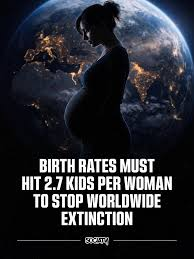
Humanity isn't disappearing because people don't want babies.
Humanity is disappearing because having a baby costs $300,000 and 18 years of your life when you're already 30+ and anxious about retirement.
Fix the economics. Birth rates fix themselves.
Every country that made parenting affordable France, Germany, Denmark stabilized their fertility rates.
Every country that didn't US, Japan, South Korea is collapsing demographically.
It's not a biology problem. It's a policy problem.
Yes, concerns about declining fertility are valid. But humanity isn't disappearing because people suddenly stopped wanting children. The real fertility crisis isn't biological, it's economic. People still want families; fewer can afford to build one. When housing, healthcare, education, and financial stability feel out of reach, having children becomes a luxury rather than a life choice.
🚨 BREAKING: Google Gemini can now analyze any stock like a Wall Street analyst (for free).
Here are 14 insane Gemini prompts that replace $4,000/month Bloomberg terminals:
(Save this 🔖 you’ll need it later)
🚨 Breaking Alert
NVIDIA ($NVDA) CEO Jensen Huang just said on CNBC live:
“Investing in SpaceX, Anthropic, and OpenAI is like buying
$AMZN, $GOOGL, or $MU in their early days.”
As the leader of the world’s most valuable company — now valued at $5.43 trillion —
his perspective carries substantial industry insight and credibility.
I believe these three opportunities in the second half of this year could potentially double your capital and accelerate your path to becoming a millionaire.
Here are the beginner‑essential rules I’ve distilled through years of trial and error. (Save these.)
If you can’t follow them, don’t buy stocks.
Down 6% → Sell everything immediately (stop‑loss)
Up more than 20% → Take profit on half (let the rest run)
IPO day or hype‑driven news surge → Don’t chase
Only deploy a small, pre‑planned amount and stay patient.
Emotional FOMO → Absolutely forbidden
Ignore any impulse that pushes you outside your rules.
If you can’t stick to discipline, don’t enter the market.
Hot stocks can skyrocket in seconds — and crash just as fast.
Save these rules. Stay sharp. Stay disciplined.
I’m 60 years old and retired from JPMorgan. My monthly income is $105,000.
My June advice:
$SNDK (SanDisk) — Don’t buy
$CRWV (CoreWeave) — Don’t buy
$FUTU (Futu Holdings) — Don’t buy
$INTC (Intel) — Buy at $99–$105
$NVDA (NVIDIA) — Buy at $210–$216
$MU (Micron Technology) — Buy at $990–$999
$MRVL (Marvell Technology) — Buy at $210–$218
People ask, Why don’t you charge?
I’ve made enough. Sharing is my passion ,that’s why I post for fre.
REMEMBER WHAT THE BITCOIN ETF DID. THIS IS BIGGER.
The SEC is preparing an "innovation exemption" for tokenized stocks. Per Bloomberg.
January 2024: spot Bitcoin ETF approved. $130,000,000,000 in inflows. 18 months.
2026: tokenized NVDA, AAPL, TSLA. Decentralized rails. 24/7.
Addressable market: $60,000,000,000,000.
460x larger than what the ETF unlocked.
The infrastructure layer prints first.
Ouvrir un PEA et balancer sur un ETF, c'est devenu de la simple survie de base face à l'incompétence publique. L'étape suivante, c'est Bercy qui viendra confisquer nos plus-values quand leur pyramide de Ponzi s'effondrera. 🤡
C'est un secret de polichinelle. Quasiment tous les jeunes à qui je parle autour de la trentaine (CSP+) ont commencé à investir en bourse et ne croient pas 1 seconde pouvoir toucher une retraite.
THIS IS INSANE.
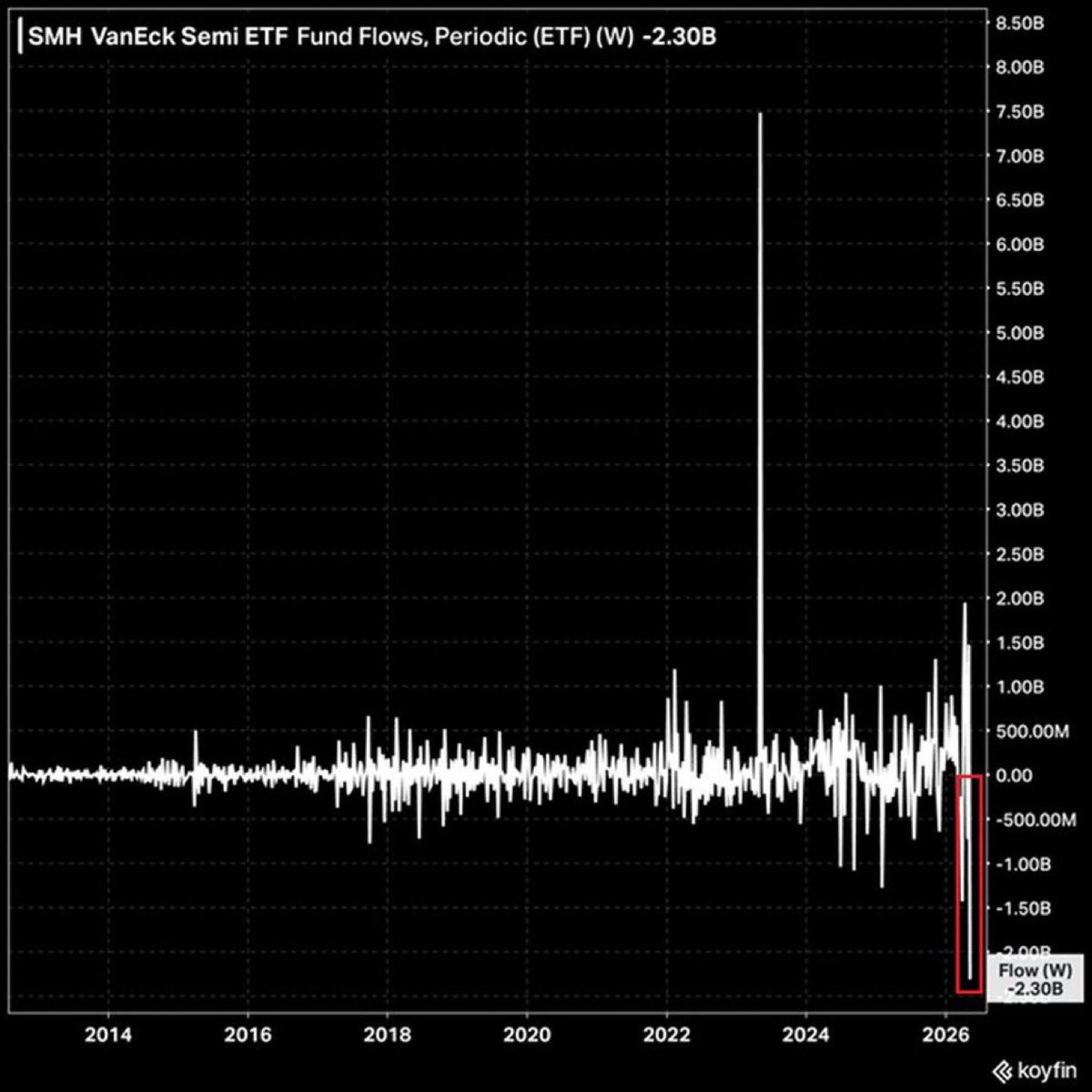
The smart money is running for the exits in semiconductors and nobody is paying attention.
Last week the SMH ETF saw its largest single-week outflow in its entire 14 year history.
$2.3 billion pulled out in 5 trading days.
What makes this even more interesting:
The week before, SMH had its 3rd largest weekly inflow on record at $1.5 billion.
So in 2 weeks, money rushed in and immediately RUSHED BACK OUT.
That’s not how investors behave when they are confident.
That is panic and profit taking happening at the same time.
Zoom out:
In April, semiconductor ETFs collected a record $4.7 billion in combined inflows across SMH and SOXX.
That was the most, EVER.
Now in just a few weeks, $8.9 billion has been pulled back out.
The leveraged 3x semi ETF SOXL has posted 5 consecutive weeks of withdrawals.
Retail traders are clearly locking in profits after the parabolic run.
This is the part most people miss:
Money flow is one of the most reliable leading indicators in markets.
It moved aggressively into semis at the top, now it is moving aggressively out.
If you want to know which stocks we’re buying next, turn on notifications this is VERY important.
Many people will wish they followed us sooner.