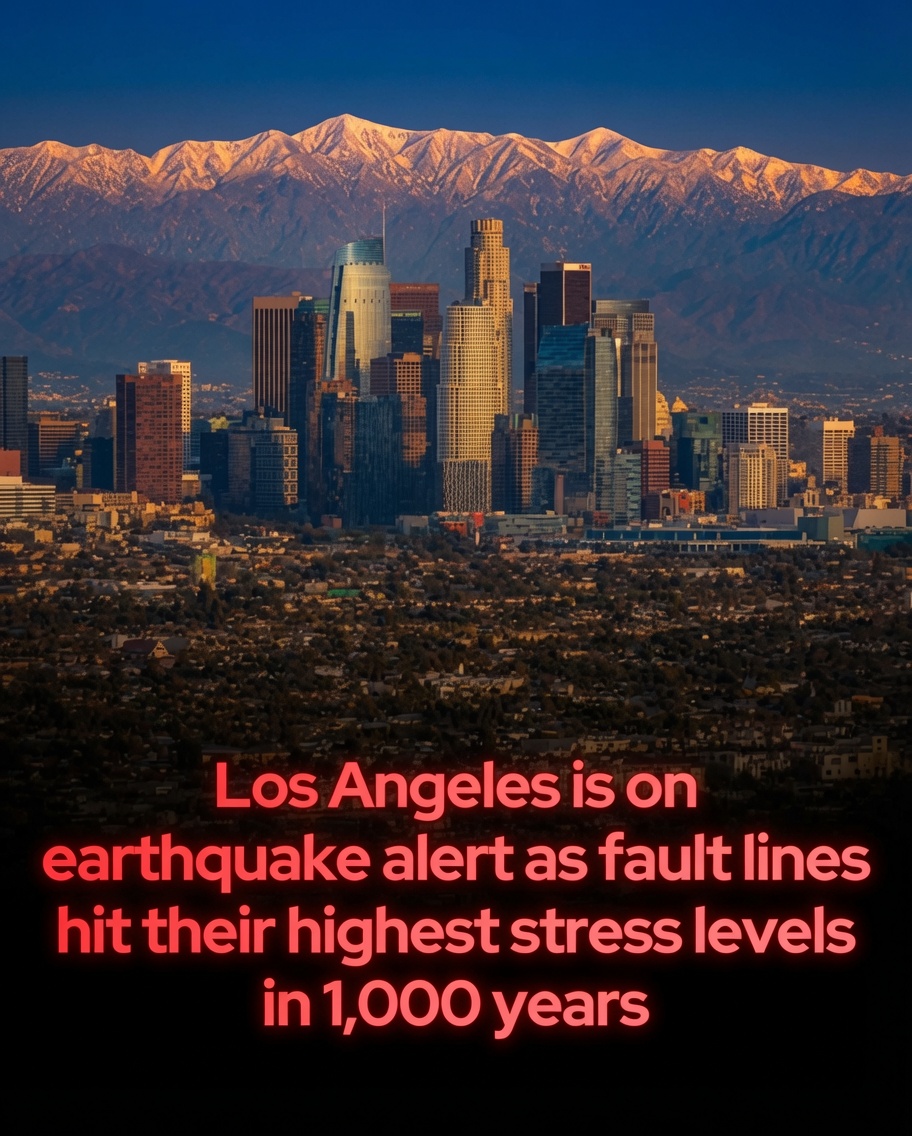
Southern California is currently on high alert as major fault lines have reached their greatest stress levels in the past 1,000 years.
A recent study reconstructed a thousand year history of earthquakes along sections of the San Andreas and San Jacinto fault systems. Researchers combined tree ring analysis radiocarbon dating historical documents and computer modeling to examine seismic activity.
Their results show that two of the three fault segments analyzed have accumulated stress equal to or greater than the maximum observed over the last millennium.
This does not indicate that a large earthquake is imminent. Earthquake prediction remains impossible and the accumulated stress could release at any time ranging from days to decades in the future.
Nevertheless the study highlights ongoing risks in the region which is long overdue for a magnitude 7 or stronger event.
The research paid particular attention to the Cajon Pass area near San Bernardino where the San Andreas and San Jacinto faults converge. Experts describe this zone as an earthquake gate because a rupture here could propagate across multiple segments potentially subjecting millions of residents to intense ground shaking.
A magnitude 7 quake would release more than 125 times the energy of the recent magnitude 5.6 event in Northern California. Such a tremor could impact nearly 24 million people in Southern California while severely damaging highways railways and essential energy systems.
The authors note that modern California building standards are engineered to resist strong seismic forces which helps limit the potential for catastrophic structural failures.
Acabo de escuchar la expresión más castiza, rencorosa y elegante a la vez que he oído en mi vida: ya quisieras saber tú todo lo que a mí se me ha olvidado.
In 2019, a Nigerian man called Gerald “Sunny” Okafor died in a Japanese detention center after a 4-week hunger strike. Detained for immigration issues, he begged to be sent home, but the Japanese authorities refused.
The Japanese are extremely hostile to Africans.