@svaradarajan@bismil_prasad If a tweet is enough to trigger hours of questioning, bigger issue is accountability not political optics.
BJP should apply the same standard everywhere: criticize claim, not criminalize dissent.
Madarsa ho ya government office rules must be equal for everyone.
See below 👇
Should the religion of the school decide the minimum education a child gets?
I am a Hindu.
I still don’t want a Hindu child in a Vedic pathshala or a Muslim child in a madrasa getting a weaker academic education than a child in a regular school.
If the institution’s religion changes the standard, that is not equal education.
1/5👇
@MeghUpdates Cabinet comeback or not, the real question is:
Why should political loyalty get rewarded while basic accountability in education whether in madrasas or regular schools gets debated?
Same standards for everyone. Same accountability for everyone.
Should the religion of the school decide the minimum education a child gets?
I am a Hindu.
I still don’t want a Hindu child in a Vedic pathshala or a Muslim child in a madrasa getting a weaker academic education than a child in a regular school.
If the institution’s religion changes the standard, that is not equal education.
1/5👇
Should the religion of the school decide the minimum education a child gets?
I am a Hindu.
I still don’t want a Hindu child in a Vedic pathshala or a Muslim child in a madrasa getting a weaker academic education than a child in a regular school.
If the institution’s religion changes the standard, that is not equal education.
1/5👇
@HelleLyngSvends Questioning narratives is healthy including when the narrative is about education.
If we can question government statistics, we should also question why minimum academic standards can differ between a regular school, madrasa and Vedic pathshala.
Should the religion of the school decide the minimum education a child gets?
I am a Hindu.
I still don’t want a Hindu child in a Vedic pathshala or a Muslim child in a madrasa getting a weaker academic education than a child in a regular school.
If the institution’s religion changes the standard, that is not equal education.
1/5👇
4/5
Two rights are colliding.
A child’s right to education. The autonomy of religious institutions.
Both matter.
The child did not choose the institution’s religion. That institution can still decide how little academic education they receive and therefore shape their future.
Religious teaching can stay. A weaker academic floor should not.
Should the religion of the school decide the minimum education a child gets?
I am a Hindu.
I still don’t want a Hindu child in a Vedic pathshala or a Muslim child in a madrasa getting a weaker academic education than a child in a regular school.
If the institution’s religion changes the standard, that is not equal education.
1/5👇
5/5
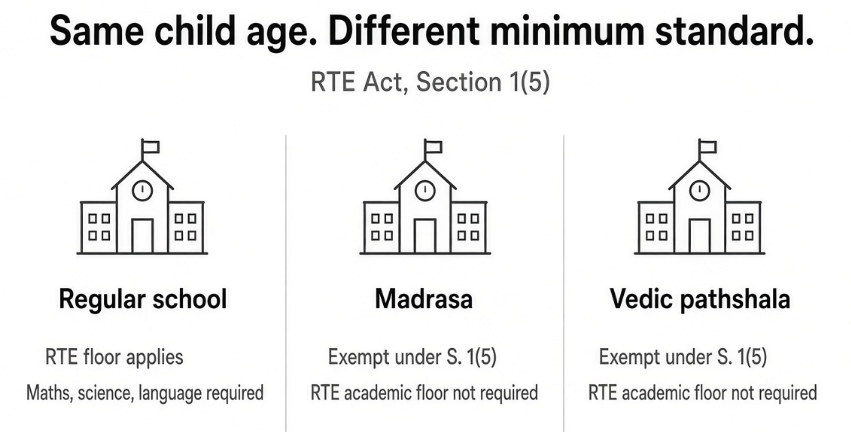
Imagine three classrooms:
- Regular school
- Vedic pathshala
- Madrasa
Should all three have to ensure a minimum level of maths, science, language, and basic skills?
Same floor. Every child. Every institution.
If you want an exemption, argue for it for both.
If you want a standard, demand it from both.
Which one are you actually defending?
4/5
Two rights are colliding.
A child’s right to education. The autonomy of religious institutions.
Both matter.
The child did not choose the institution’s religion. That institution can still decide how little academic education they receive and therefore shape their future.
Religious teaching can stay. A weaker academic floor should not.
3/5
If a madrasa can be exempt, a Vedic pathshala can be exempt. If a pathshala must meet a standard, a madrasa must meet it.
I do not want a special Hindu exemption. I do not want a special Muslim exemption.
The rule should not change with the religion of the institution.
2/5
The RTE Act promised every child aged 6–14 free and compulsory education.
Section 1(5), inserted in 2012, then said the Act does not apply to madrasas, Vedic pathshalas, and institutions primarily imparting religious instruction.
Same age. Same country. Different floor, depending on the institution.
The Supreme Court is examining whether that exemption can stand.
Should the religion of the school decide the minimum education a child gets?
I am a Hindu.
I still don’t want a Hindu child in a Vedic pathshala or a Muslim child in a madrasa getting a weaker academic education than a child in a regular school.
If the institution’s religion changes the standard, that is not equal education.
1/5👇
@ShashiTharoor@authoramish@ShashiTharoor sir, DUSU elections are a perfect reminder: students don’t just need debates about generations they need politics that actually addresses fees, jobs, hostels and opportunities.
If the next generation is future, campus politics should start treating them like it.
CJP + DUSU: Can a Gen-Z movement finally break the ABVP–NSUI duopoly?
For decades, Delhi University student politics has been dominated by BJP-backed ABVP and Congress-backed NSUI.
Now a new Gen-Z movement is trying to enter that space.
Can CJP turn viral anger into actual votes on 18th September?
See my take👇
@timesofindia DUSU elections again proving one thing:
Student issues fees, jobs, hostels can wait.
Religion and polarization can’t.
If campus politics is reduced to Hindu vs Muslim, who is actually fighting for students?
See below report
CJP + DUSU: Can a Gen-Z movement finally break the ABVP–NSUI duopoly?
For decades, Delhi University student politics has been dominated by BJP-backed ABVP and Congress-backed NSUI.
Now a new Gen-Z movement is trying to enter that space.
Can CJP turn viral anger into actual votes on 18th September?
See my take👇
GDP 📈 | Jobs ❓ | Real wages ❓ | Household expenses 📈
7.8% GDP Growth — or just another number the BJP wants India to celebrate without asking questions ?
The headline is impressive.
But the real story begins when you look beyond the headline.
If these GDP numbers are completely transparent and beyond question, why shouldn’t independent economists, institutions and citizens be encouraged to scrutinise them?
- The IMF’s projections are more cautious.
- Unemployment remains a concern. - Young Indians are struggling for stable, well-paying jobs, while household purchasing power and real wages determine whether growth actually reaches ordinary families.
A country can post spectacular GDP growth while millions still feel financially squeezed.
So the question isn’t simply:
“Did GDP grow 7.8%?”
The question is:
“WHO is benefiting from that growth and can the public independently verify what the headline number really represents?”
CJP’s demand for greater transparency should not be dismissed as “anti-national” or “anti-development.”
If the numbers are rock-solid, scrutiny should strengthen them not threaten them.
Because GDP growth on a spreadsheet means little if the Indian household isn’t feeling the growth in its wallet.
@Cockroachisback@AamAadmiParty@INCIndia@yadavakhilesh
@PMOIndia@narendramodi@NikolPashinyan ABVP and NSUI still dominated the presidential race. Attention ≠ votes.
Similarly, diplomatic meetings ≠ outcomes.
The real test is what India gains from these partnerships on the ground.
See below post
Look at the 2025 numbers.
Turnout: ~39%
President:
ABVP — 28,841
NSUI — 12,645
NOTA — 3,175
The Left alliance was far behind the two major players.
Attention ≠ votes.
That is the gap any new force has to close.
4/8
@PMOIndia@narendramodi Global outreach matters, but so does listening to India’s own youth.
My latest post asks a similar question at DUSU: Can a new Gen-Z political force challenge the ABVP–NSUI duopoly?
The future of politics will be shaped by how well we understand the next generation.
CJP + DUSU: Can a Gen-Z movement finally break the ABVP–NSUI duopoly?
For decades, Delhi University student politics has been dominated by BJP-backed ABVP and Congress-backed NSUI.
Now a new Gen-Z movement is trying to enter that space.
Can CJP turn viral anger into actual votes on 18th September?
See my take👇