Outpost is a platform for PathAI teams to build and deploy custom AI model development and deployment agents within our cloud infrastructure with governed access to approved internal systems and tools. Read more in the article. https://t.co/ygT2INWzoI
What’s next? Language unlocks potential capabilities beyond accuracy:
🔓 Open-vocabulary prediction: extend to new diagnoses with minimal tuning.
🔍 Natural language slide search: e.g. "slides showing interface dermatitis with basal vacuolization"
🩺 Further enrichment with case-specific clinical context
Full blog post: https://t.co/0WShasbRsj
#DigitalPathology #ComputationalPathology #HealthcareAI #PLUTO4 #MultimodalAI
🔬 Moving Beyond Pixels: Advancing Multimodal Pathology
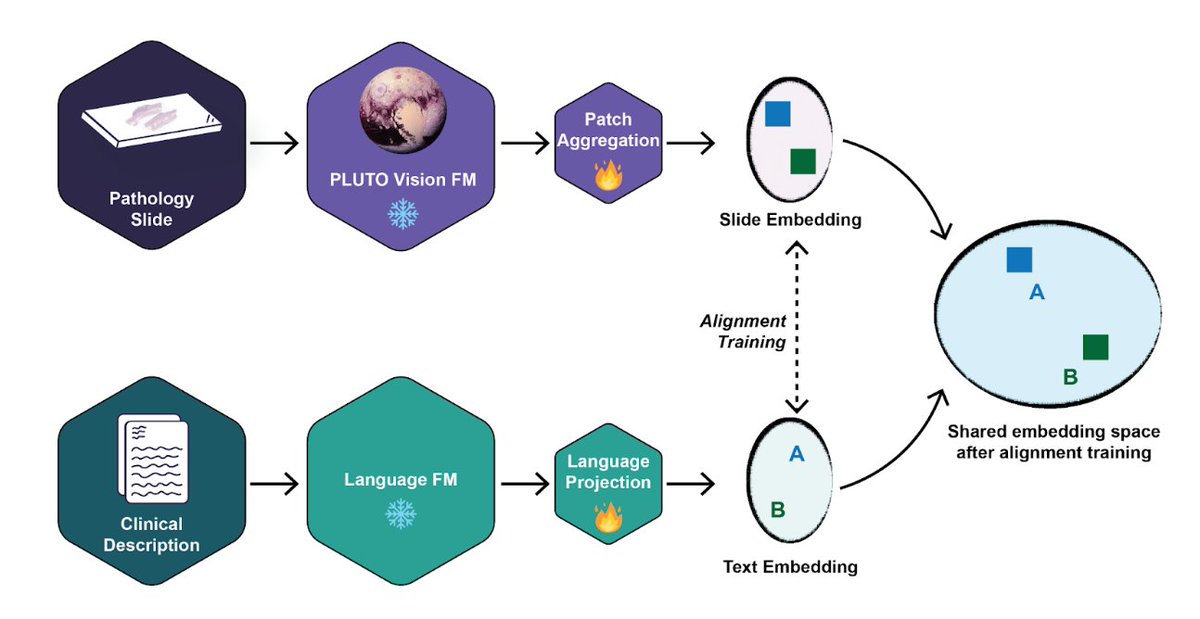
Pathology AI has long relied on images alone. What happens when you add language?
We combined PLUTO-4 vision embeddings with rich histological descriptions to build a joint vision-language space for disease classification, and the results are promising.
🧵 #AI #MachineLearning #Pathology #MultimodalAI #FoundationModels
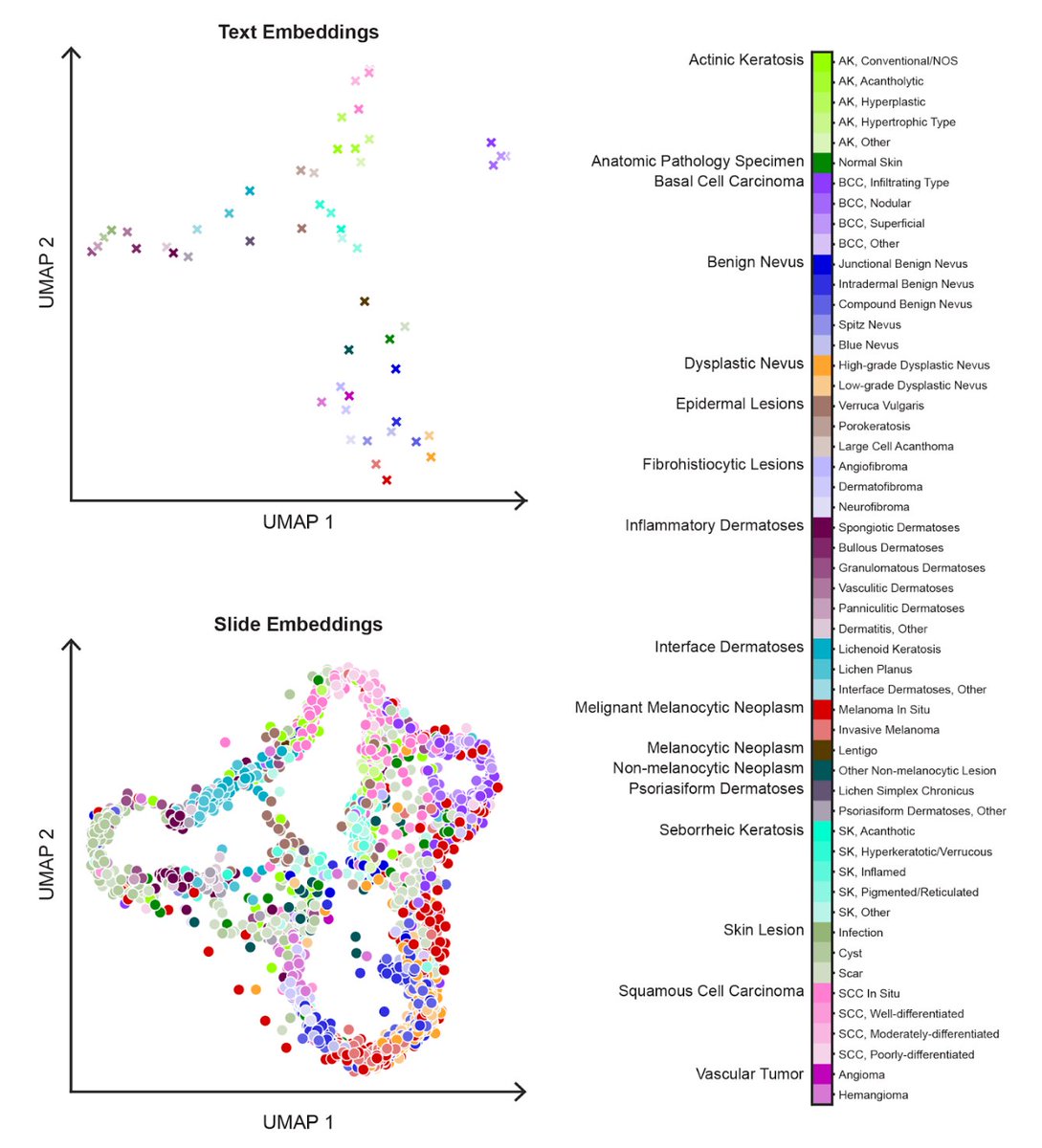
Looking deeper into the the shared embedding space, it has clinically meaningful structure:
🟢 Subtypes cluster together
🟤 Inflammatory dermatoses separate cleanly from melanocytic lesions
Slide embeddings mirror text embedding organization, showing alignment across modalities, not just within them.
These results highlight how our PLUTO-4 foundation models enhance PathAI’s AI-pathology products across digital diagnostics and translational research.
We’re excited for the new capabilities PLUTO-4 will unlock for our partners and the community!
📄 Learn more in our technical report:
👉 https://t.co/530ByAxNly
#AI #Pathology #HealthcareAI #FoundationModels #PLUTO4
🚀 Excited to share PLUTO-4, our new state-of-the-art foundation models for pathology! 🔬
We’re seeing SoTA performance across multiple public benchmarks (EVA and HEST) — surpassing other leading pathology foundation models. (1/6)
#AI#MachineLearning#Pathology #FoundationModels #HealthcareAI
Beyond public benchmarks, PLUTO-4 shows real-world impact —
🩺 ~10 % improvement across multiple PathAI products, with strong gains in dermatopathology specimen classification.
These advances bring us closer to robust, generalizable FMs for pathology applications.
#Dermatology #HealthcareAI
The opportunity to standardize the way we construct data sets is important...If we try to build a data set for every use case, we can set ourselves up to fail. We don't want to build a large reference data set that doesn't get used - @balasubramaniac from @Path_AI#FriendDx
🔍 Interpretable concepts found using SAE
- SAE trained on PLUTO embeddings disentangled polysemantic features. Single dimensions captured distinct concepts:
✅ Cell types (e.g., cancer cells, red blood cells)
✅Geometric features (e.g. edge of tissue)
✅ Artifacts (surgical ink)
PathAI #MachineLearning engineers have
recently published new #AI findings for mechanistic interpretability of PLUTO, a pathology #foundationmodel. Using sparse autoencoders (SAEs), we uncovered biologically meaningful and interpretable features. 🧵
https://t.co/4T8GWU7y9p
Monosemantic representations
- Single SAE dimensions correlate with counts of single cell types. For example, SAE-1736 represents plasma cell abundance exclusively
- The findings generalized to:
✅ Out-of-domain datasets (CPTAC)
✅ Different stains (H&E, IHC)
✅ Various scanners
🔬 Impact
This study shows the promise & potantial of SAEs in explaining foundation model behavior for medical imaging. Interpretable features unlock:
- Potential for clinical AI 🏥
- New biological insights 🧪
🔗 Read the full work: https://t.co/2R6c7ck4wH
#AI#Pathology